Blink (2024) ☆☆☆(3/4): Before their kids become blind

Documentary film “Blink”, which is currently available on Disney+ in South Korea, is the story of one loving family who decide to have a very special trip around the world. As the parents sincerely try to help their four children have more experience to remember, the documentary closely observes how this family come to stick together more thanks to this precious journey, and we come to have more understanding and empathy on its personal importance to all of them.  

At the beginning, we are introduced to a middle-class French-Canadian couple and their four young kids. Édith Lemay and Sébastien Pelletier talk a bit about how it has frequently been demanding for both of them to raise their four kids together in their cozy suburban house, and we see how lively their four kids are in each own way. While their eldest kid Mia is your average big sister for her three younger brothers, Léo, Colin, and Laurent are often brimming with their boundless spirit and energy, and it is apparent that they have all happily grown up under the loving care and attention of their parents.

However, there is one big medical problem for three of these kids. Because of a rare genetic disorder called retinitis pigmentosa, Mia, Colin, and Laurent will inevitably become blind, and we notice that they are already on the way of losing their eyesight. It goes without saying that their parents were quite devastated to learn about their serious medical condition, but Édith and Sébastien have tried to help them as much as possible, and that is why they came to decide to have a global travel along with their four kids for showing a lot more of the world around them than before. 

It goes without saying that they were going to spend a lot of money for this special family trip, but then Édith and Sébastien happened to get some enough money to finance their global travel with their kids. After some careful planning on how to spend the money day by day, they and their kids made a sort of bucket list on what they wanted to experience together during their global travel, and their kids eagerly filled the list with some humor and creativity.

And they did travel around here and there around the world as shown from the documentary. First, they went to Namibia for watching many different animals living in its animal preservation region, and they were not disappointed at all as beholding those various animals out there. After that, they went to a number of different countries including Egypt, Turkey, Thailand and Mongolia, and you will be amused and touched to see one of the kids trying something so trivial but also quite meaningful to him when he and his family came to a desert area for riding camels together.

They also even go to Nepal just for watching one of those big snowy mountains of the Himalayas. Although their hiking course around the Himalayas turns out to be a bit more demanding for them, the kids do not lose their spirit at all, and Édith and Sébastien are certainly happy to see their kids enjoying not only all those beautiful landscapes surrounding them but also befriending a few local animals (I particularly like that grumpy cat, by the way).

However, Édith and Sébastien are also often reminded of how their three kids are still losing their eyesight day by day. For example, their three kids cannot easily see during nighttime, and this problem of theirs will surely get worse and worse as time goes by. They and Léo, who is incidentally not afflicted with retinitis pigmentosa unlike his three siblings, hang around with each other pretty well on the whole, but we cannot help but observe that there will soon be more distance between him and his three siblings due to the worsening eye condition of his three siblings.

Nevertheless, the emotional bond among the family members remains strong as before, and that is quite evident to us when they suddenly find themselves trapped within a rather small place in the middle of their trip in Ecuador. As they get stuck there much longer than expected, the kids become afraid and nervous, but they still stick together under their parents, and that is certainly another moment to remember for all of them.

Yes, it should be noted that these kids are pretty lucky to live under the affluent parents who can actually afford to provide a lot of things to them besides their exemplary homeschooling, but it is difficult for us not to be moved by their sincerity and enthusiasm as well as the considerable dedication shown from their parents. Although there are several occasional moments where they are quite conscious of the camera observing them, Édith and Sébastien come to us as very decent people who really care a lot about the future of their kids, and their kids are always direct and frank in showing their thoughts and feelings in front of the camera.        

 On the whole, “Blink”, which is directed by Edmund and Daniel Roher, handles its interesting human subjects with enough respect and sensitivity, and the result is often moving while never losing its sight on the personal dimensions of their precious journey at all. As shown from the end of the documentary, the kids are all right while also quite ready to go further with their life, and their family trip will always occupy a special place in their minds even after they cannot see anymore in the end.

Posted in Movies | Tagged , , , , | Leave a comment

It’s Not Me (2024) ☆☆☆(3/4): Carax on a Godard mode

Leo Carax’s new short film “It’s Not Me”, which happens to be released in South Korean theaters along with Alice Rohrwacher’s new short film “An Urban Allegory” (2024), is elusive but undeniably intriguing in many aspects. Clearly influenced by those baffling later works of Jean-Luc Godard, the film often made scratch my head more than once, but it also engaged me with a real sense of wit and creativity beneath its seemingly random stream of images, and the overall result is actually a lot more enjoyable than whatever Godard’s later films attempted to do.

At first, Carax seems willing to show more of himself to us, but then his mind cannot help but follow his irrepressible creative spirit, and that is the beginning of his little visual joyride. He is really prepared to baffle or fascinate us in his own way here in this film, and I assure you that you will gladly go along with that especially if you have admired his idiosyncratic directing career like I have.

Like Godard’s later films such as “Goodbye to Language” (2014), the film frequently utilizes title cards for accentuating its ideas and themes. To be frank with you, I was rather annoyed by this at first, but then I was gradually amused by how Carax humorously handles this, and that certainly distinguishes his film a lot from Godard’s later works, which are nothing but hollow and ponderous cinematic doodles to me (Call me a philistine if you want, folks).

What is presented between these title cards are a deliberately jumbled mix of various video clips ranging from some rough home movie to a certain famous short film by the Lumière brothers. While this surely is another thing Godard tried again and again in his later movies, Carax easily surpasses Godard as actually generating a sort of narrative flow among these seemingly random video clips. You can clearly sense him trying one thing after another with no apparent direction, but you can also feel his wit, confidence, and energy nonetheless, and you may actually find yourselves often intrigued by whatever he is going to try next.

This free-wheeling attitude of the film will surely take you back to “Holy Motors” (2012), which is incidentally one of Carax’s better works. In that boundlessly fascinating film, Denis Lavant, who has been one of Carax’s main collaborators since Carax’s first feature film “Boys Meets Girls” (1984), plays many different roles as moving here and there by a big white limousine, and he even plays again that weird character he previously played in Carax’s segment in “Tokyo!” (2008). As a matter of fact, that weird character briefly appears in the middle of “It’s Not Me”, and Lavant has a little juicy fun as going all the way with his character’s amusingly unpleasant aspects.

Another interesting moment in the film is when Carax shows a bit of his sincere concern about how our world has been threatened more and more by the ongoing rise of fascism during last several years. At one point, we see a mother reading a rather twisted tale to her children, and we later see an archival footage clip showing a big American Nazi rally held in the middle of New York City. Yes, as shown in Marshall Curry’s Oscar-nominated short documentary film “A Night at the Garen” (2017), such a deplorable thing really occurred there in 1939, and the chilling images from that archival footage clip are strikingly juxtaposed with the current political status of our world.

Nonetheless, the mood remains casual and lightweight while Carax continues to explore the range of his artistic creativity as much as possible within the 41-minute running time of his short film, and that is why you should not leave the screening room before it is completely over. Right after its end credits, Carax presents a little surprise for you, and that reminded me again that I must re-evaluate his previous film “Annette” (2021) as soon as possible. I wrote a 3-star review after watching it for the first time in 2021, but its memorable moments have stayed in my mind since that, and I must admit that this unconventional musical film is much more interesting and creative than many other recent musical flicks such as, yes, “Wicked” (2024).

On the whole, “It’s Not Me” is a small but undeniably intriguing piece of work, and Carax demonstrates here again that he is still a talented director willing to take a chance at any time. After “Boys Meets Girl”, he became a rising new director to watch, but then his filmmaking career took a big downturn after the problematic (and very expensive) production of “The Lovers on the Bridge” (1991), and he seemed to crash down toward the bottom when his next film “Pola X” (1999) came out. Nevertheless, he eventually made a triumphant comeback with “Holy Motors”, and “Annette”, which garnered him the Best Director Award when it was premiered at the 2021 Cannes Film Festival, solidified the second prime of his compelling filmmaking career.

Probably because I was charmed a lot by Rohrwacher’s “An Urban Allegory” right before watching it, I put “It’s Not Me” one or two steps below “An Urban Allegory” at present. but I am willing to revisit both of them sooner or later. Despite being quite different from each other in terms of style and theme, they somehow make a superlative double feature show, and it is really lucky for me and other South Korean audiences to have such a nice little cinematic gift around the end of this year.

Posted in Movies | Tagged , | Leave a comment

An Urban Allegory (2024) ☆☆☆1/2(3.5/4): Rohrwacher, JR, a bit of Carax

It took some time for me to understand and appreciate the works of Alice Rohrwacher, who has been one of the most interesting filmmakers of our time since she made a feature film debut with “Heavenly Body” (2011). While I admired “Happy as Lazzaro” (2018) as much as many others, I actually struggled a bit to discern what and how it is about, but then I got more accustomed to her own distinctive style and touches after watching “La chimera” (2023) and “The Wonders” (2014) later, and I also enjoyed a lot her Oscar-nominated short film “Le pupille” (2022), which is incidentally available on Disney+ right now.

In case of her latest short film “An Urban Allegory”, Rohrwacher worked along with JR, an acclaimed French artist who previously made an Oscar-nominated documentary film “Faces Places” (2017) along with Agnès Varda. Inspired by “Allegory of the Cave” by Plato, the film explores the importance of art in our urban life via its seemingly simple story, and the result is another fascinating work to be added to Rohrwacher’s advancing career.

At first, we meet a little young boy named Jay (Naïm El Kaldaoui) and his dancer mother. Although he is rather ill, there is not anyone else to take care of him besides his mother right now, so she has no choice but to go to her latest audition along with her son. Alas, she only ends up arriving a little too late at a building where the audition is going to be held, and now she must persuade the supervisor of the audition to let her participate in the audition while her son is waiting for her alone in the corner.

While his mother is occupied with the audition, Jay happens to encounter a guy who is clearly the director to preside over the audition along with his staff. Because this dude is played by none other than Leo Carax (He also serves as one of the producers of the film, by the way), our level of interest is instantly increased, and Carax has some little fun with his brief but crucial part – especially when his character whispers something to Jay.

The film does not specify much what exactly Carax’s character says to Jay, but we come to have a pretty good idea as Jay later wanders around streets and alleys and then begins sort of a steam-of-consciousness monologue clearly influenced by the aforementioned work of Plato. As he looks more around people and places, we become more aware of how we often let ourselves get entrapped in our urban daily life in one way or another, and I assure you that you will not feel like checking up your smartphone at all while watching this small satiric moment.

However, the film also finds some hope and optimism as our little hero comes to discover how things around him and others can really look and feel quite different, and that is where JR’s own distinctive artistic style makes a leap from what has been established so well by Rohrwacher. I will not go into details here for not spoiling any of your entertainment, but I can tell you instead that you will be quite delighted if you were entertained a lot by those memorable pieces of installation art by JR in “Faces Places”.

Around that narrative point, the film smoothly enters a realm of fantasy, so you cannot entirely be sure about what is exactly happening on the screen, but then there comes a sublime moment associated with the collaborative art project “Chiroptera”. With the score by Thomas Bangalter and the choreography by Damien Jalet, this ambitious art project powerfully resonates with the main theme of the film, and we come to reflect more on how art can actually make us regard our reality differently and then become more liberated than before.

In the end, the film returns to focusing on the relationship between Jay and his mother, who is certainly quite upset as looking for her son. Young performer Naïm El Kaldaoui is engaging in his effortless natural performance, and his expressive face sometimes speaks volume even when his character does not tell or signify much on the surface. He and his co-star Lyna Khoudri are convincing in their interactions early in the film, and that is the main reason why the last scene of the film is quietly touching.

Although its running time is only around 20 minutes, the film is efficient in its gentle handling of its story, mood, and character, and it is really fortunate for me and other South Korean audiences that the film is released in South Korean theaters along with Carax’s recent short film “It’s Not Me” (2024). The total running time of these two very different short films is just a bit more than 60 minutes, but I felt satisfied enough with both of these two interesting works, and I am already quite willing to revisit them again someday.

By the way, if you ask me which one I actually like more, I will say that “An Urban Allegory” won my heart while “It’s Not Me” intrigued my mind in many different directions, and I will also add that I usually follow my heart’s judgment in case of evaluating movies. While it is pretty amusing to see Carax emulating whatever Jean-Luc Godard struggled to do in those decidedly (and snobbishly) cerebral works during his later years, what Rohrwacher attempts to do along with JR somehow touched my heart a lot more than expected, though I must confess that my mind was initially baffled a little during its first few minutes. In short, this is one of more interesting short films I saw during this year, and it surely makes a wonderful double feature show along with “It’s Not Me”.

Posted in Movies | Tagged , | 1 Comment

Merry Christmas, Mr. Lawrence (1983) ☆☆☆(3/4): A clash of styles

Nagisa Ōshima’s 1983 film “Merry Christmas, Mr. Lawrence”, whose 4k restoration version was recently released in South Korean theaters several weeks ago, is a fascinatingly odd war film which attempts to present two very different human relationships at the center of the story but somehow feels rather unbalanced on the whole. While it remains adamantly distant about one of these two human relationships, it is also often reluctant to delve into the other one which is actually more poignant and interesting in my inconsequential opinion, and I came to have some reservation even though I observed its story and characters with enough interest.

At the beginning, the movie, which is based on Sir Laurens van der Post’s 1963 autobiographical novel “The Seed and The Sower”, feels like your typical prisoner-of-war movie. Its main background is a Japanese prisoner camp located somewhere in the Java Island of Indonesia, and the story, which is set around late 1942, opens with the latest matter to be handled by John Lawrence (Tom Conti), a Lieutenant Colonel of the British Army who has functioned as a liaison officer between his fellow British soldiers and those Japanese soldiers led by Captain Yonoi (Ryuichi Sakamoto) mainly because he is the only one who can speak Japanese in his group. His job is certainly quite thankless to say the least, but Lawrence tries to do his best for his fellow British soldiers despite that, and he has mostly been on good terms with Sergeant Hara (Takeshi Kitano) even though there is always a considerable distance between them.

Meanwhile, a new prisoner is sent to the camp. He is Major Jack “Strafer” Celliers (David Bowie), and he recently surrendered himself to the Japanese Army after his latest military operation was failed, but he remains defiant as unflappably sticking to his pride and dignity. This stubborn attitude of his comes to attract the attention of Yonoi, who becomes gradually obsessed with this dashing British dude for a reason which is probably elusive even to himself.

The homosexual undertone between Celliers and Yonoi is unmistakable to say the least, but the screenplay by Ōshima and his co-writer Paul Mayersberg only comes to tantalize us with suggestions and possibilities without much resolution. Is Celliers actually aware of whatever is going on between him and Yonoi? And is Yonoi really conflicted a lot about whatever he feels and thinks behind his stiffly tense appearance? Although there eventually comes an emotional highlight between them, these two vastly contrasting characters still do not click well with each other, and we are only left with rather hollow impressions even after the movie goes a bit into what makes Celliers tick.

This baffling problem is probably due to how Ōshima deliberately generated the clash of acting style between his Western and Eastern cast members. While he encouraged his Japanese performers toward more acting details, he simply let his Wester performers act as casually as possible in contrast, and the result is particularly evident from the vast difference between David Bowie and Ryuichi Sakamoto. While Sakamoto frequently tries for more acting across the screen, Bowie sticks to his usual cool appearance, and this contrast in style is often fascinating to watch at least for a while.

However, the movie never gets deeper into the strained relationship between Celliers and Yonoi, and, most of all, it also fails to generate enough chemistry between Bowie and Sakamoto. Often reminiscent of Peter O’Toole in “Lawrence of Arabia” (1961) throughout the film, Bowie simply coasts along his own uncanny presence, but he is not supported that well by Sakamoto, who unfortunately gives us a prime example of Overacting 101 here in this film. As later shown again in “The Last Emperor” (1987), Sakamoto is not a very good actor at all, but his rather weak performance can be forgiven to some degree thanks to his memorable score which incidentally won a BAFTA award (It was also his first movie score, by the way).

On the other hand, another main narrative in the story, which is associated with the equally strained relationship between Lawrence and Hara, is more effective in comparison. Although they are not exactly friendly to each other, Lawrence and Hara somehow come to recognize and respect each other more as they push and pull each other throughout the film, and that is why the last moment between them is more touching than expected.

Again, the clash in acting style is evident in this case, but Tom Conti and Takeshi Kitano are more successful compared to Bowie and Sakamoto. Although he had to memorize his Japanese lines phonetically, Conti, who recently appeared briefly in Christopher Nolan’s Oscar-winning film “Oppenheimer” (2023), clicks well with Kitano during several key scenes of theirs, and Kitano, who looks relatively more expressive here compared to that usual static screen persona shown in his subsequent movies, manages to bring some personality and humanity to his bluntly callous character.

In conclusion, “Merry Christmas, Mr. Lawrence” is a flawed but engaging result from Ōshima, who has been mainly known from his highly controversial film “In the Realm of the Senses” (1976). Compared to that shocking work, the movie feels rather mild in addition to being hampered by some glaring weak elements, but it is still a curious mixed bag to admire and remember, and I recommend you to give it a chance someday.

Posted in Movies | Tagged , | Leave a comment

The Fall (2006) ☆☆☆1/2(3.5/4): A glorious folly of striking images

Tarsem’s 2006 film “The Fall”, whose 4K remastered version will be released in South Korean theaters on Christmas, is a glorious folly of striking images to behold. Loosely based on the screenplay of the 1981 Bulgarian film “Yo Ho Ho”, the film bets almost everything on impressing us more and more with its sheer visual power, and that is definitely something you should watch it on big screen, regardless of whether you like it or not in the end.

The narrative ground of the movie is fairly simple. After the striking opening sequence shown in black and white film, we are introduced to a young Romanian immigrant girl named Alexandria (Catinca Untaru), who has been recovering from her serious arm injury at a hospital located somewhere in California around the 1920s. Just like any curious kid, she moves around here and there in the hospital, and that is how she encounters Roy Walker (Lee Pace), a Hollywood stuntman who has also been recovering from some serious accident. As befriending Alexandria during next several days, he tells her a rather rudimentary fairy tale concocted by himself, and she eagerly listens to his story with growing enthusiasm.

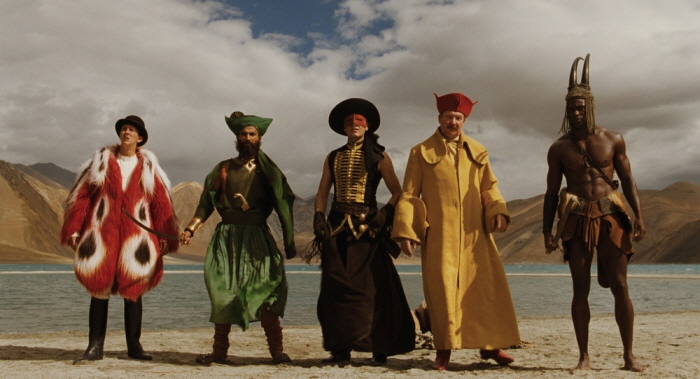
The movie shows us whatever Alexandria imagines in her mind while listening to Roy’s story, and we often get amused by how her innocent mind processes those colorful elements of Roy’s story. When he introduces an “Indian” character into his story early in the film, Roy actually means an American Native character, but Alexandria imagines this figure as a literally Indian guy just because, as shown later in the film, she knows an Indian immigrant guy hired at a local orange orchard where she and her family work. Likewise, many of other figures in Roy’s story are imagined as a number of various people Alexandria previously encountered, and it is particularly funny to observe how a bunch of armored soldiers in Roy’s story are imagined in Alexandria’s mind at one point.

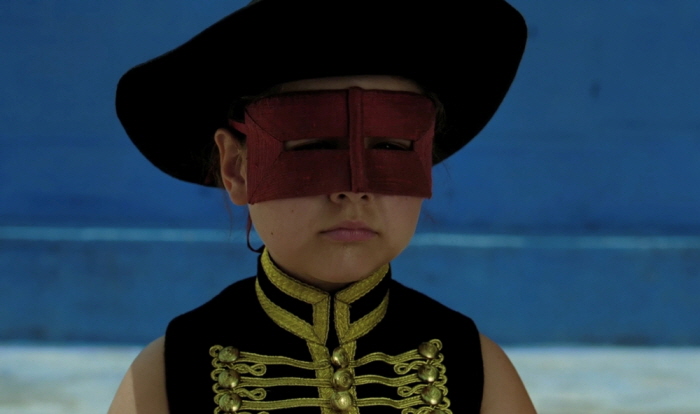
Anyway, Roy’s story is quite familiar to the core. Around one valiant masked hero, who naturally looks identical to Roy, several different figures including that Indian figure are gathered, and all of them are quite willing to have their revenge on their common enemy who is incidentally quite rich and powerful to say the least. For example, this bad guy entrapped the wife of that Indian figure in a maze full of stairs and corridors once after coming to discern that he could not have her at any chance, and her husband still does not get over the devastation caused by her eventual death.

This huge maze scene looks quite real on the screen just like many other scenes in the film, because, well, Tarsem and his crew members including cinematographer Colin Watkinson actually shot the film bit by bit around the numerous real locations around the world for no less than 4 years instead of using CGI. As a matter of fact, Tarsem financed the production of the film for himself, though he subsequently struggled more for its theatrical distribution before it eventually got released in US in 2008.

Sadly, Tarsem’s admirable efforts here in the film were not praised that much at first. The following box office result was pretty unsuccessful (It only earned 3.7 million dollar while its total production budget was no less than 30 million dollar), and many of critics and audiences were not particularly enthusiastic about the film at that time. At least, it was admired a lot by a few notable critics including my late friend/mentor Roger Ebert, who not only gave it a 4-star review but also willingly introduced it at the 2009 Ebertfest.

Impressed by the mesmerizing visual power of “The Fall” as much as Ebert was at that time, I gladly wrote my 3.5-star Korean review around the end of 2008, and I still stand by my initial feelings and thoughts on the film. Yes, the story itself feels quite contrived and superficial especially in case of its numerous fantasy scenes, but these fantasy scenes remain grounded well by the human poignancy observed from the budding friendship between Roy and Alexandria. Still very heartbroken by a painful personal matter of his, Roy attempts to manipulate Alexandria via his fairy tale for attaining a certain hidden goal, but he comes to care about her a lot more than expected, and, what do you know, she eventually functions as an unexpected savior in not only his fairy tale but also his real life.

Everything depends a lot on the effortless chemistry between the two lead performers of the movie, who are certainly the heart and soul of the story. Besides looking as dashing as required during the fantasy scenes of the film, Lee Pace did a good job of embodying his character’s despair and anguish, and he is also complemented well by the genuine sincerity of young performer Catinca Untaru, who is instantly engaging from the very beginning with her unadorned natural performance.

On the whole, “The Fall” still has the power to astound and impress us thanks to its many striking visual moments, while remaining to be the best work in Tarsem’s rather uneven filmography. After making a promising feature film debut with “The Cell” (2000), he seemed to advance further with this precious personal project of his, but, alas, his subsequent works including “Immortals” (2011) were not so successful in many aspects compared to his first two feature films. Nevertheless, he gave us “The Fall” at least, and we will continue to remember it as one of the most daring and interesting cinematic gambles during last several decades.

S

Posted in Movies | Tagged , , | Leave a comment

Time to Be Strong (2024) ☆☆☆1/2(3.5/4): Their aimless little trip in Jeju Island

South Korean independent film “Time to Be Strong”, which is incidentally the 15th movie project of the National Human Rights Commission in South Korea, is a somber but haunting character drama about three young people feeling lost and desperate in one way or another. While a considerable part of their youth has already been gone, there is only a lot of uncertainty about their future, and the movie observes their loss and confusion with deep understanding and empathy.

At the beginning, we meet the three main characters of the story: Soo-min (Choi Sung-eun), Sa-rang (Ha Seo-yoon), and Tae-hee (Kang Chae-yun). We gather that they were once pretty popular as adolescent K-pop stars but they are all retired now, and the main purpose of their trip to Jeju Island is pretty simple: they want to have a private trip which may compensate for their lost high school days.

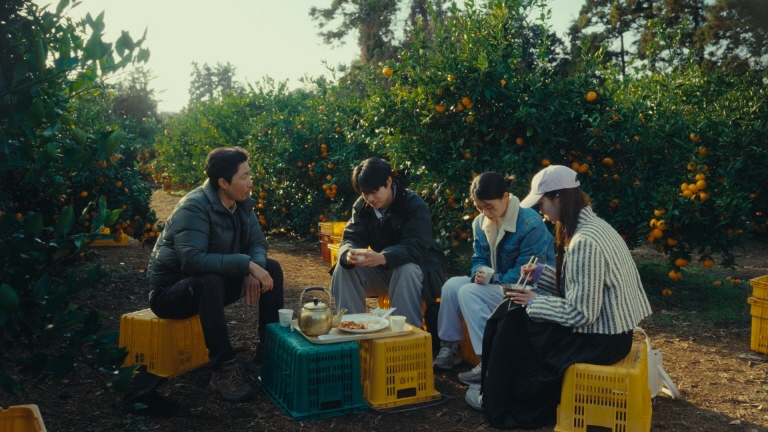
However, things do not go that well for them from the beginning. Sa-rang happens to get her suitcase lost before arriving at the place where they will stay during next several days, and she also inadvertently causes a serious trouble which costs all the money they have. As a consequence, they have to move to a little camping car, and they also must do some part-time job at a nearby tangerine orchard.

And we get to know more about how things have been quite bad for them. While Sa-rang has clearly been struggling with some mental problem, Soo-min has been suffering anorexia, and we are not so surprised when it is later revealed that their former K-Pop group was disassembled after some infamous incident which happened to one of their colleagues. In case of Tae-hee, he is still officially bound by his contract in addition to having the debt of less than 30 million won, and, as shown from a brief amusing scene early in the film, he still misses when he was quite famous.

Steadily building up its main characters along the story, the screenplay by director/writer Namkoong Sun, who previously made a commendable feature film debut with “Ten Months” (2020), subtly conveys to us how much its main characters have been exploited and damaged by their entertainment industry. Now becoming way over 20, they are not that youthful enough anymore, and, after spending so much time on doing whatever they were demanded to do, they are all at loss now while wondering about any possible way to deal with their loss and confusion.

However, the situation is not entirely bad for them as they come to receive the kindness of the strangers they happen to encounter. The owner of that tangerine orchard turns out to be more generous than expected, and there is a little touching moment when he provides some medical help to Soo-min at one point in the story. In case of a young woman who comes to befriend Soo-min and her friends by coincidence, she is eager to get to know them more, and she surely brightens up the mood a bit for all them during one evening.

However, there is still the harsh reality to deal with for Soo-min and her friends. While both Sa-rang and Soo-min remain haunted by that horrible incident, Tae-hee still does not know how to handle his serious financial problem, and all of them must recognize more that most of their youth is gone forever. Even at the end of the story, nothing much is certain, and they are all reminded more that they only have each other for now.

Nevertheless, the movie also ably pulls out some little moments of hope and optimism among its main characters in the end, and it also shows a bit of humor and warmth at times. In case of an unexpected dramatic moment during the last act, this becomes quite poignant as one of the main characters says something meaningful for all of them, and we also chuckle a bit as observing the absurd aspect of their circumstance.

Like any good character drama films, the movie benefits a lot from its solid cast members, who are all believable in their respective roles. Choi Sung-eun, who previously collaborated with Namkoong in “Ten Months”, gives another strong performance to remember, and she is also supported well by her two co-stars. Although her character often feels rather elusive, Ha Seo-yoon makes her character more understandable than expected, and Hyeon Woo-seok holds his own place well between Ha and Choi. As two crucial supporting characters in the story, Hong Sang-pyo and Kang Chae-yoon have each own moment to shine, and Kang steals the show a bit when her character sincerely tries to cheer up Soo-min and her two friends later in the story.

Overall, “Time to Be Strong” is the impressive second work from Namkoong, who surely confirms to us here that she is indeed a talented filmmaker who may impress us more during next several years. To be frank with you, I am not interested much in K-Pop, and I do not even know a lot about whatever has been happening inside the K-Pop industry, but the movie successfully delivers its important message on human rights via the story and characters to remember for a long time. In short, this is a first-rate public service in addition to being one of the best South Korean films of this year, and you should check it out as soon as possible.

Posted in Movies | Tagged , , , | 1 Comment

Carry-On (2024) ☆☆☆(3/4): An efficient genre variation inside the airport

Netflix film “Carry-On”, which was released in last week, is a familiar but efficient genre variation to enjoy. Yes, this is surely influenced by many other thriller films ranging from “Die Hard 2” (1990) to “Nick of Time” (1995), but the story and characters are skillfully handled with enough thrill and suspense, and you will gladly go along with that even while occasionally noticing its plot holes and contrivances during your viewing.

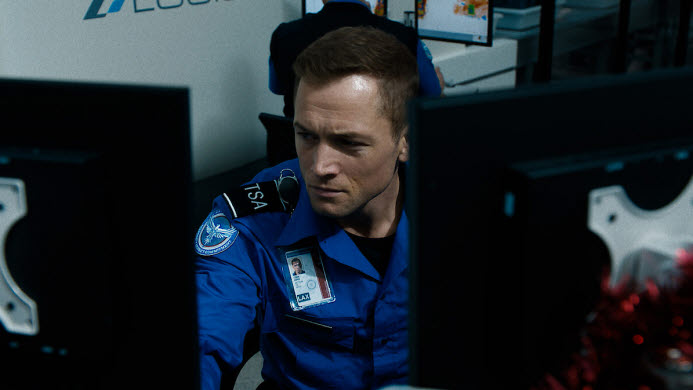
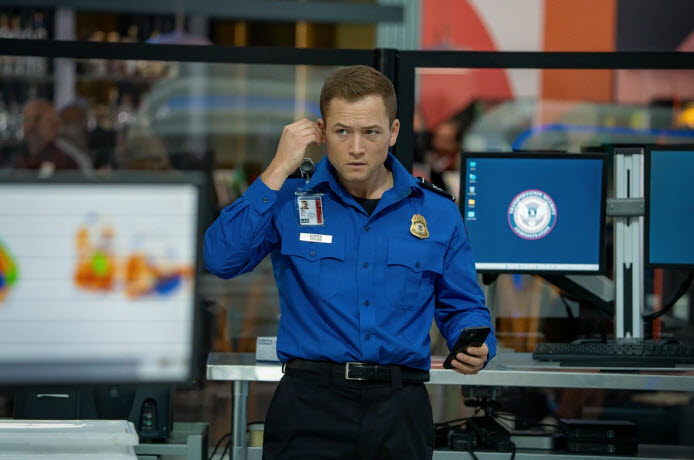
After the opening scene which effectively sets the tone, we are introduced to a lad named Ethan Kopek (Taron Egerton), who has worked as a Transportation Security Administration (TSA) officer at LA International Airport. Because it is Christmas Eve, Kopek and his girlfriend, who also works at the airport, will soon go through one of the busiest days at their big workplace, and the movie succinctly establishes their close relationship as they are going together to the airport early in the morning.

Because his girlfriend recently turned out to be pregnant, Kopek comes to feel the need to be more responsible about where his life and career are going, so he decides to be more active about getting promoted. After managing to persuade his direct supervisor, he comes to replace a colleague who is incidentally also his best friend, and we see him scanning the luggage of the incoming passengers instead of that colleague.

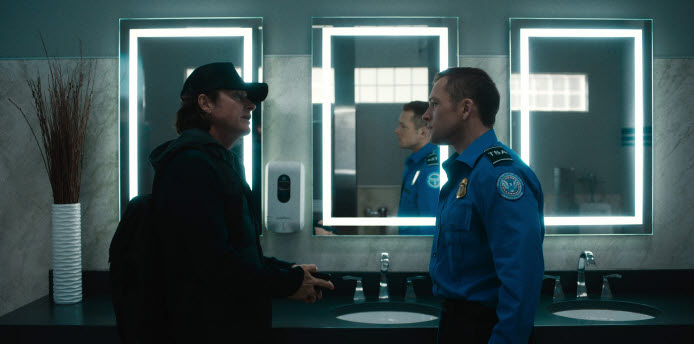
However, there soon comes a big problem not long after Kopek begins scanning those incoming suitcases one by one. It turns out that there is someone very dangerous inside the airport, and this guy, who approaches Kopek via a remote earphone sent to him, demands Kopek to do one supposedly insignificant thing. All Kopek will have to do is ignoring the scanning result on the baggage of a certain passenger, and this guy threatens to kill Kopek’s girlfriend if Kopek refuses to follow his instruction.

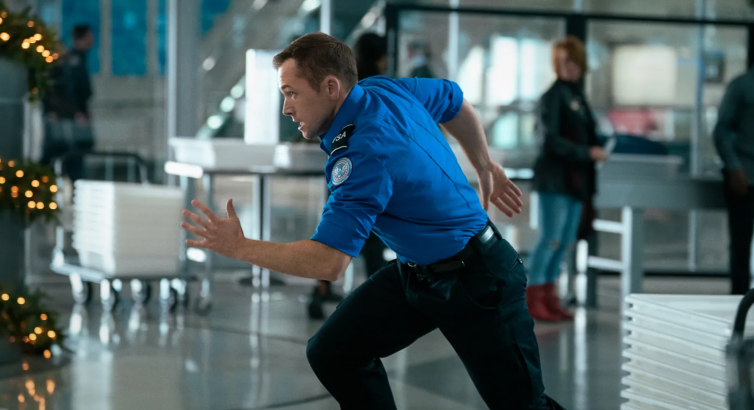
Naturally, Kopek becomes quite nervous to say the least. He attempts to find any possible way to alert this serious threat to anyone around him, but, not so surprisingly, his opponent keeps cornering him in one way or another, and he chillingly demonstrates at one point that he is definitely not someone Kopek can easily mess with at any chance.

Steadily rolling the story and characters with more tension, the screenplay by T.J. Fixman also brings some more character details to the plot. As Kopek and his opponent push or pull each other throughout the story, we get to know more about why Kopek has been reluctant to do more for his life and career, and it is rather ironic to see how he becomes all the more active than before as trying to save himself as well as many others including her girlfriend. Although he is still one or two steps behind his opponent, he comes to show much more grit and cleverness than he has ever possibly imagined, and we surely come to root for him more as constantly reminded of what is being at stake for him and others.

Under the competent direction of director Jaume Collet-Serra, who made a number of enjoyable genre flicks such as “Orphan” (2009), “Run All Night” (2015), and “The Shallows” (2016), the movie provides a series of solid suspenseful moments to keep us on the edge to the end. There is an unnerving scene where our hero finally encounters what he is supposed to ignore, and that is just the beginning of how things become a bit more complicated for him and several other characters including his opponent. At one point, he must stay calm and careful in handling the content of that certain baggage in question, and you may also be a bit amused by the presence of a time-honored genre cliché which was incidentally disliked a lot by my late mentor/friend Roger Ebert. 

The movie certainly depends much on the talent and presence of its lead performer for vividly conveying us to the amounting tension and pressure on its hero, and Taron Egerton, a promising British actor who has been moving onto better things since “Kingsman: The Secret Service” (2014), dutifully holds the film together as required. Even when his character does not seem to signify much on the surface, Egerton ably illustrates his character’s growing panic and desperation along the story, and his strong performance keeps driving the film even when it stumbles a bit more than once later in the story.

The movie also assembles a bunch of good supporting performers around Egerton. Despite her rather thankless role, Sofia Carson brings some warmth to her scene with Egerton early in the film, and Tonatiuh, Theo Rossi, Logan Marshall-Green, Sinqua Walls, Curtiss Cook, Joe Williamson, and Dean Norris are also well-cast in their respective parts. Although her supporting character is more or less than a plot device, Danielle Deadwyler provides a bit of extra intensity to the story, and Jason Bateman is alternatively smarmy and menacing in his villainous role.

 Overall, “Carry-On” works fairly well while doing exactly what it is expected to, and the result is one of more enjoyable offerings from Netflix during this year. It is surely a by-the-book thriller flick from the beginning to the end, but it is certainly better than Collet-Serra’s recent films “Jungle Cruise” (2021) and “Black Adam” (2022), and that is enough for recommendation in my trivial opinion.

Posted in Movies | Tagged , , , | Leave a comment

Mufasa: The Lion King (2024) ☆☆1/2(2.5/4): Before he became the king

Barry Jenkins’ new film “Mufasa: The Lion King” is something bound to happen sooner or later. After winning two Oscars via “Nomadland” (2020), Chloé Zhao moved on to making a Marvel Cinematic Universe flick called “Eternals” (2021). After getting a Best Director Oscar nomination thanks to “Minari” (2020), Lee Isaac Chung moves on to giving us a Hollywood blockbuster film named “Twisters” (2022) several months ago. Most of all were rather surprised (or dismayed) to hear that Jenkins was going to direct the prequel to “The Lion King” (2019), but that looks now sort of inevitable considering that interesting current trend observed from many of rising American independent filmmakers.

The 2019 film is a competent but unnecessary live action version of the 1994 animation film, which incidentally remains on the top of the bunch. As I have said many times before, live action film usually cannot surpass animation film in many aspects, and that was quite evident to me when I eventually watched the 2019 film a few days ago as sort of a homework to do before watching “Mufasa: The Lion King”. While it is not that bad, it inarguably feels inferior to the 1994 film despite some strong points, and, above all, many of animal characters in the film look rather bland or shabby (I felt the constant urge to send all of the lion characters in the film to a local laundry, by the way).

In case of “Mufasa: The Lion King”, everything in the film is visually improved to considerable degree, and I was glad to see it at the Dolby Cinema screening room of a local theater. While its animal characters look more expressive in addition to feeling realistic as much as possible, several different backgrounds in the film are often filled with enough details to engage our eyes, and the overall result is surely an improvement over its predecessor.

The movie begins with showing how things have been pretty good since what happened at the end of the 2019 film. While her parents Simba (voiced by Donald Glover) and Nala (voiced by Beyoncé Knowles-Carter) are absent due to some personal business, a young female lion cub named Kiara (voiced by Blue Ivy Carter, who is Knowles-Carter’s daughter) happens to be under the care of a wise-cranking meerkat named Timon (voiced by Billy Eichner) and a jolly warthog named Pumbaa (voiced by Seth Rogen), and you may get amused (or annoyed) as Timon and Pumbaa attempt to cheer up Kiara with an exaggerated tale on their adventure in the previous film.

Anyway, there soon comes an old but wise mandrill named Rafiki (voiced by John Kani), who willingly tells a story about Kiara’s legendary grandfather. When he was just a lion cub, young Mufasa (voiced by Braelyn and Brielle Rankin) and his parents were going through a long and arduous journey to a certain place which might be a haven for not only them but also many other animals, but then he happened to get separated from his parents when he got himself swept away by the big current of water caused by a sudden downpour. Not long after he finds himself in some distant region, young Mufasa is rescued by a lion cub named Taka (voiced by Theo Somolu), who happens to be the son of Eshe (voiced by Thandiwe Newton) and Obasi (voiced by Lennie James). As the current leader of his clan, Obasi does not welcome young Mufasa much, but Eshe willingly takes care of young Mufasa, and young Mufasa and Taka soon become more like brothers as time goes by.

Several years later, Mufasa, who is now voiced by Aaron Pierre, and Taka, who is now voiced by Kelvin Harris Jr., find themselves facing a serious problem due to Kiros (voiced by Mads Mikkelsen), an evil and ruthless white lion who has led a bunch of vicious lions willing to kill anyone standing on his way to more power. Mikkelsen, who has been mainly known for his chilling performance in American TV drama series “Hannibal”, surely knows how to exude menace and malice, and he even has a diabolical musical moment which may take you back to how Jeremy Irons delighted us in the 1994 animation film (This and several songs in the film are written by Lin-Manuel Miranda, though I do not think any of them will be as popular as his notable songs in “Moana” (2016) or “Encanto” (2021)).

Eventually becoming totally left alone by themselves due to Kiros and his merciless clan, Mufasa and Taka must look for a new place to live besides evading their enemies, and they are soon joined by young Rafiki (voiced by Kagiso Lediga during this part) and a young lioness named Sarabi (voiced by Tiffany Boone). As these four main characters go together through a long journey to what Mufasa’s parents were searching for at that time, the movie expectedly provides a series of lovely landscape shots as required, and Jenkins and his cinematographer James Laxton, who was Oscar-nominated for Jenkins’ great film “Moonlight” (2016), make sure that we can behold and appreciate numerous background details, whenever the movie is not driven by busy actions unfolded across the screen.

Around the narrative point where Mufasa must come forward for not only himself and his companions but also many other animals, the story naturally becomes more predictable, and we often cannot help but reflect more on some inherent contradiction inside the story. Mufasa surely proves himself as a noble and righteous leader for every animal around him, but you may also observe that he and his clan will kill and then eat some of other animals for their survival in the end just like any other predator on the top of the food chain. No, I do not expect at all the movie to be realistic as your average nature documentary, and but that harsh fact of nature kept remaining in my mind during my viewing.

In conclusion, “Mufasa: The Lion King” is not entirely without good elements to enjoy mainly thanks to Jenkins’ sensitive touches and the game efforts from his voice cast members, but it is relatively passable compared to what Jenkins has achieved during last 16 years since his remarkable first feature film “Medicine for Melancholy” (2008). Now I remember what film critic Justin Chang said about “Eternals”: “You walk out in the depressing realization that you’ve just seen one of the more interesting movies Marvel will ever make, and hopefully the least interesting one Chloé Zhao will ever make.”. In my humble opinion, a similar thing can be said about Jenkins and “Mufasa: The Lion King”, and I am sure that he will move onto better things to come just like Zhao.

Posted in Movies | Tagged , | Leave a comment

The Lion King (2019) ☆☆1/2(2.5/4): An unnecessary live action version

2019 film “The Lion King” is a product not so necessary in many aspects just like many of other live action versions of Disney animation films during last several years. When I watched its trailer in 2019, I was not so willing to watch it as clearly observing its limits, and it turns out that I made a right choice, when I finally watched it via Disney+ yesterday.

As many of you know, the 1994 animation film version has been one of the more well-known Disney animation films. Although this is not exactly one of my favorite Disney films (This is probably because I knew too well about the African wildlife even when I was very young), I enjoyed it nonetheless when I watched it along with my younger brother at a local movie theater in 1994, and, yes, its soundtrack, which incidentally won two Oscars, is one of the better ones from Disney animation films.

The 2019 film surely tries to emulate a lot of things which were successful in the 1994 animation films, but, alas, the result is not even as interesting as director/co-producer Jon Favreau’s previous film “The Jungle Book” (2016), which is also the live action version of a classic Disney animation film. While “The Jungle Book” has enough fun and wonder to justify its existence as well as winning its Special Effects Oscar, the 2019 version of “The Lion King” is less impressive in terms of visual qualities even compared to “The Jungle Book”, and it certainly looks and feels underwhelming compared to whatever we saw from the 1994 animation film version.

Oh, the animal characters of the 2019 film surely look quite realistic thanks to the competent efforts of Favreau and the crew members including Oscar-nominated cinematographer Caleb Deschanel, but their fairly good efforts here in this film only remind us again and again that live action film usually cannot surpass animation film. Many of the animal characters in the 2019 version look far less colorful than their respective counterparts in the 1994 version, and their world also feels less impressive in comparison.

Furthermore, the lion characters in the 2019 film looks as shabby as you can expect from African wildlife animals without much personality. Sure, Mufasa, the charismatic father of the young lion hero in the story, sounds as authoritative as required because it is voiced by James Earl Jones as it was in the 1994 animation film version, but he does not look that charismatic in my inconsequential opinion, and I must confess that I felt the constant urge to send him and many other lion characters to a local laundry.

And there is Scar, Mufasa’s nasty brother who is voiced by Chiwetel Ejiofor here in the 2019 film. In the 1994 animation film version, this villainous character was memorably performed by Jeremy Irons, and his sardonic voice performance was one of the key factors in the success of the 1994 animation film. Although he cannot sing that well as many people pointed out at that time, Irons delivers his own musical moment (“Be Prepared”) with delicious malice and gusto, and that is certainly one of the highlights in the 1994 animation film.

However, compared to Irons’ juicy villain performance, Ejiofor is too subdued in his mostly passable voice performance, and that only emphasizes what a weak villain Scar is in the 2019 film. Rather than looking evil and cunning, Scar in the 2019 version looks so sour and pitiful that the movie feels ponderous whenever he appears on the screen, though those giggling hyenas lighten up the mood to some degree.

If you are willing to overlook all those glaring flaws in the 2019 film, you will likely get satisfied as getting exactly what you expect to get. There are several good action scenes, and they are boosted well by the effective score by Hans Zimmer, who won his first Oscar for the 1994 animation film. I must point out that several new songs in the film are not so memorable compared to the old ones from the 1994 version including Oscar-winning song “Can You Feel the Love Tonight” and two fellow Oscar nominee songs “Circle of Life” and “Hakuna Matata”, but they are not that bad either at least.

The voice cast members of the film did as much as possible on the whole. Donald Glover, who voiced Simba, is rather colorless compared to JD McCrary’s perky voice acting early in the film, but his voice performance still functions as a sort of blank background for the relatively more colorful ones from a bunch of notable performers including Alfre Woodard, John Oliver, John Kani, Seth Rogan, Billy Eichner, Eric André, Florence Kasumba, Keegan Michael Key, and Beyoncé Knowles Carter. While Woodard manages to bring some pride and dignity to her thankless supporting role, Oliver, Rogan, and Eichner have a number of funny moments as expected, and Kani, whom you may remember for his supporting role in “Black Panther” (2018), provides some extra gravitas to the story.

In conclusion, “The Lion King” is not so horrible as I feared, but it is pretty forgettable besides being quite redundant. To be frank with you, I only watched it as a sort of homework before watching Barry Jenkins’ upcoming film “Mufasa: The Lion King” (2024), and I can only hope that that movie will be more enjoyable, even though it looks like a rather low point compared to many of Jenkins’ acclaimed works including, yes, “Moonlight” (2016). I am keeping my expectation low, but who knows?

Posted in Movies | Tagged , , | Leave a comment

Small Things Like These (2024) ☆☆☆1/2(3.5/4): He can’t possibly ignore what he saw…

“Small Things Like These” presents a somber but intense drama about one ordinary person who happens to face a very difficult moment of choice. He can simply look away from an ongoing injustice in his little town, but he also cannot possibly ignore what he saw, and the movie did a commendable job of engaging us more in his growing personal conflict along the story.

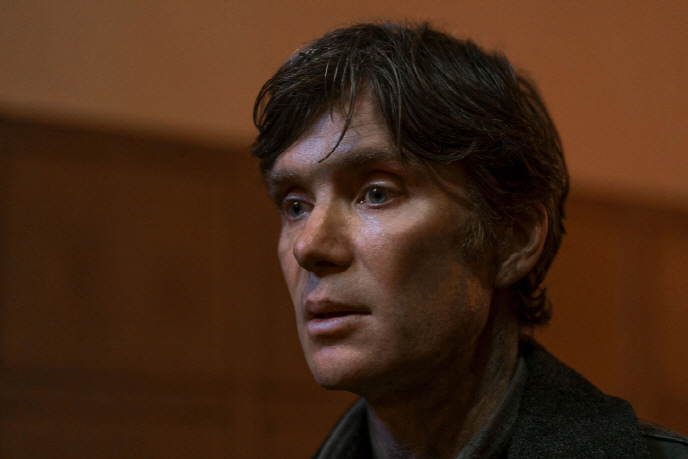
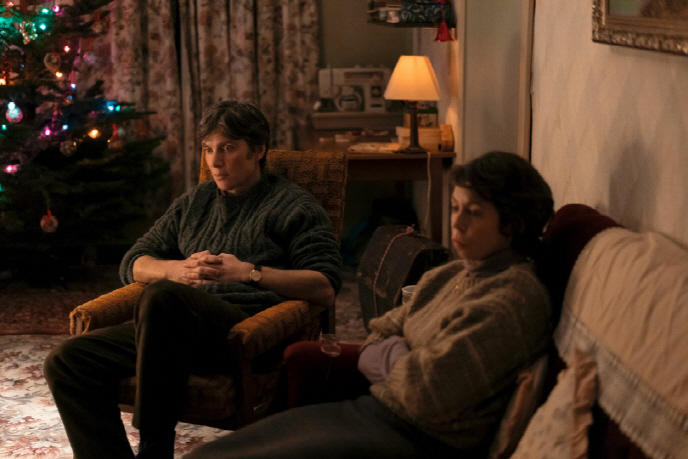
Cillian Murphy, who also participated in the production of the film, plays Bill Furlong, a coal merchant living with his dear family in a small rural town of Ireland in the middle of the 1980s. As Christmas week is coming, Bill certainly becomes busier than before, and the early part of the film shows us how diligently he works day by day around the town.

On one day, Bill happens to see something rather disturbing. When he does some delivery at a local Catholic convent early in the morning, he witnesses a young woman taken into the convent against her will, and this happening continues to haunt his mind even after he returns to his cozy residence. As shown from a series of following flashback scenes, his mother was unmarried when he was born, and she also could have been taken to the convent if it had not been for the generosity of her wealthy female employer.

If you have ever seen Peter Mullan’s “The Magdalene Sisters” (2002) or Stephen Frears’ “Philomena” (2013), you surely know what is going on inside the convent. As mentioned at the end of the film, thousands of unmarried pregnant women were confined in those “Magdalene asylums” in Ireland from the 18th to the late 20th centuries, and these “fallen” women had to endure a lot of abuse and labor exploitation in addition to being separated from their babies forever.

The movie quietly illustrates how many people around Bill are willing to look away from this ongoing injustice in their town. Bill later tells his wife about what he witnessed, but she does not care that much because she does not want her husband to disrupt their fairy comfortable daily life at all. As subtly implied to us in one way or another throughout the film, the church has exerted considerable influence over the town and its residents just like many other places in Ireland during that time, and Bill and his family can be stigmatized and then ostracized by many of their neighbors if he ever steps outside the line to which everyone else in the town faithfully sticks under the church.

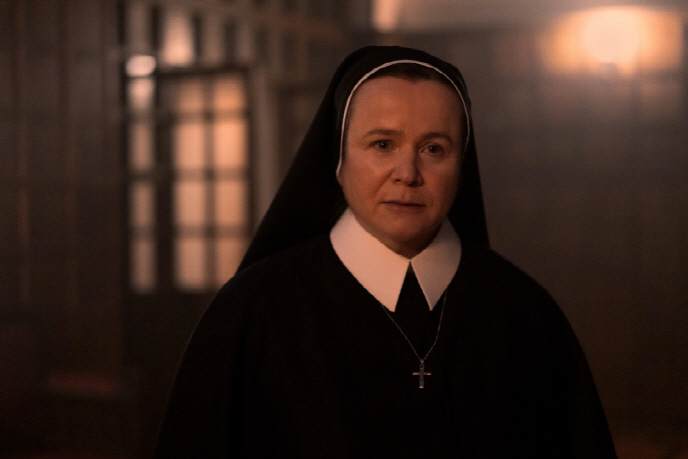
Nevertheless, Bill cannot help but care more, especially after he witnesses a bit more of what is going on inside the church. Reminded more of how his mother would have been without her kind employer, he certainly becomes all the more conflicted, but the oppressive power of the church, which is sternly represented by the Mother Superior of the convent, always hovers around him even when he is alone.

The screenplay by Enda Walsh, which is adapted from the novel of the same name by Claire Keegan (Her other novel “The Quiet Girl” was recently adapted into an Oscar-nominated movie, by the way), takes its time building the tension surrounding its plain hero, and it eventually leads us to a particularly intense scene where Bill comes to have a little private meeting with the Mother Superior of the convent. Their conversation sounds seemingly plain at first, but we come to sense more of what is being exactly exchanged between them below the surface, and this surely unnerves us more.

Murphy, whose career was recently boosted further thanks to his Oscar-winning performance in Christopher Nolan’s “Oppenheimer” (2023), gives us a masterclass of restraint and subtlety. He initially does not seem to be signifying that much on the outside, but his mostly taciturn appearance in the film ably suggests whatever is churning inside his character’s increasingly conflicted mind, and we come to have more empathy and understanding on what is being at stake for his character. When his character eventually makes a small but important decision around the end of the story, Murphy is utterly captivating to watch, and the movie presents this with considerable dramatic effect even though it firmly sticks to its restrained mood as before.

Around Murphy, several other cast members hold each own place well. Young performer Louis Kirwan is poignant as young Bill during several flashback scenes, and he is supported well by Michelle Fairley and Agnes O’Casey, who play Bill’s mother and her generous employer, respectively. While Eileen Walsh is effective as Bill’s concerned wife, Helen Behan and Zara Devlin are also solid in their small but crucial supporting roles, and Emily Watson is often chilling as deftly conveying to us the heartless sides of her character.

On the whole, “Small Things Like These”, which is directed by Tim Mielants, is a modest but undeniably powerful movie to be appreciated for its palpably realistic presentation of the story and characters, and it will remind you of how difficult it is sometime for many of us to do the right thing. As nervously implied during the end credits of the movie, what finally happens at the end of the story may not amount to that much, and the church will surely continue to dominate over the town and its people as usual. Nevertheless, there is also some small light at the end of the dark emotional journey in the movie, and that will make you reflect more on the importance of individual conscience and compassion.

Posted in Movies | Tagged , | Leave a comment