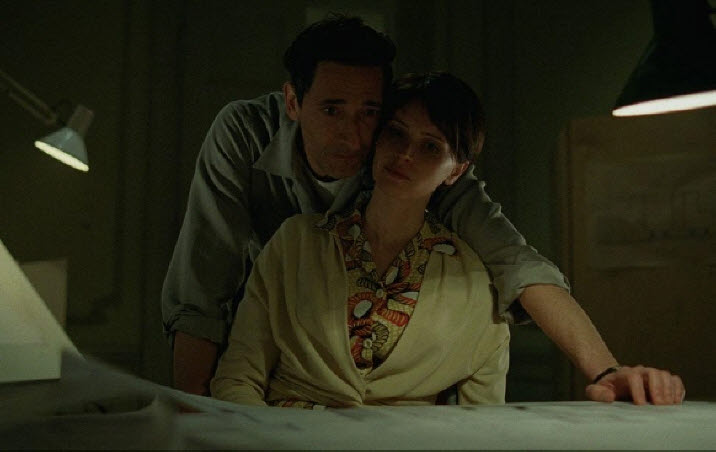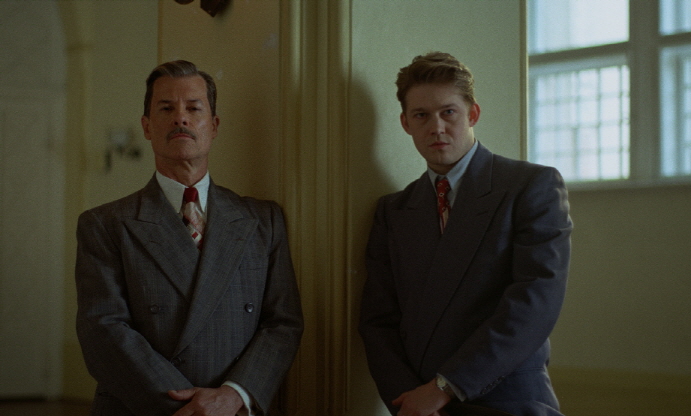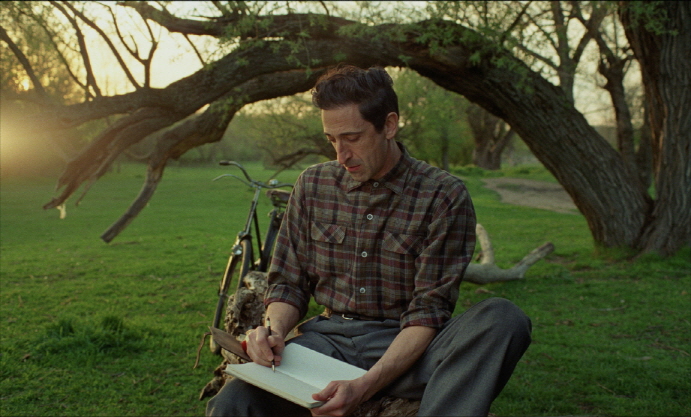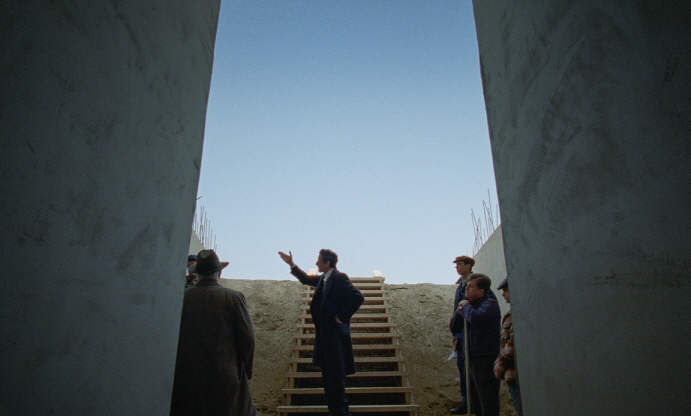
Red Rooms (2023) ☆☆☆1/2(3.5/4): The woman delving into a dark web crime

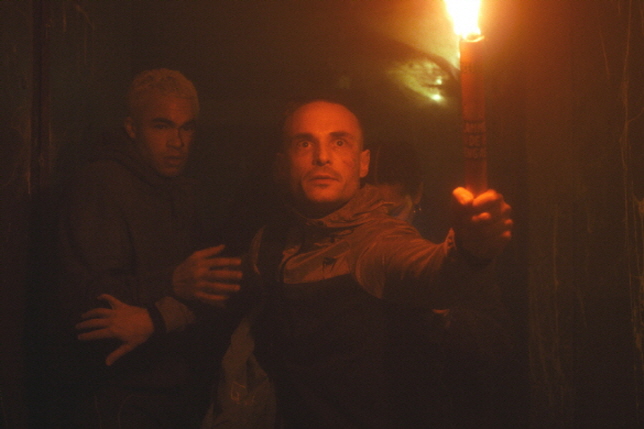
“Red Rooms” is a disturbing but compelling mix of psychological thriller and character study. Closely following the obsessive behaviors of its rather enigmatic heroine, the movie makes us all the more curious about what really makes her tick, and we also come to brace ourselves as she goes deeper and deeper into one unspeakable crime while not looking away at all.

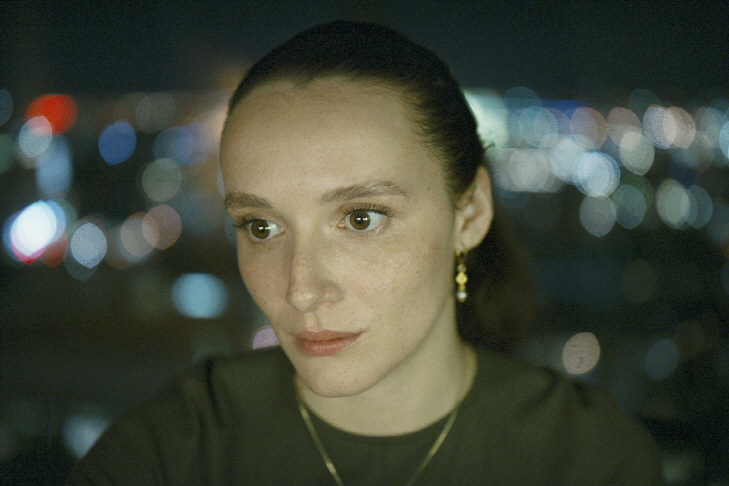
The opening part of the movie succinctly and effectively establishes what Kelly-Anne (Juliette Gariépy) has been obsessed with. When she is not working as a model to be photographed, she spends most of her spare time onto a notorious dark web crime involved with serial killings, which was recently solved with the arrest of the culprit. Right from the first day of the following trial, she patiently waits near the courthouse building early in the morning for getting into the courtroom first, and then we soon see the beginning of the trial, which is impressively presented in one continuous take during next several minutes.

The crime in question is pretty heinous to say the least. The culprit is accused of murdering three adolescent girls not only for his twisted pleasure but also selling the video clips of his atrocious killings in the dark corners of the Internet. It is really fortunate that the culprit was eventually arrested after several months of investigation, but there is not any definite evidence to incriminate him besides several indirect pieces of evidence against him, and his lawyer is already quite determined to emphasize on the reasonable doubt on whether he is really the one who committed all those horrible crimes.

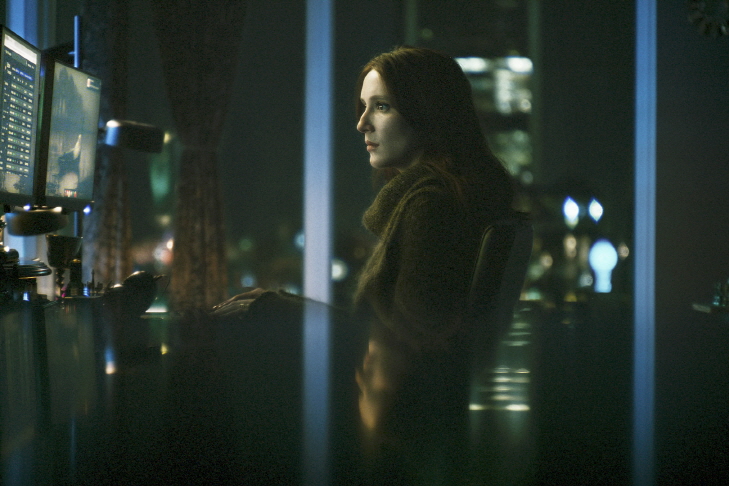
Kelly-Anne simply watches the ongoing trial day by day without signifying much on the surface, and we see more of how much she is obsessed with the case. Because she happens to have a particular set of skills involved with online search and hacking, she can go deeper into where the culprit was supposed to be operating before his eventual arrest, and we slowly come to gather that she has been searching for something important for a while.

However, neither she nor the movie specifies what she exactly wants, and that is the main source of suspense in the film. Does she simply wish for bringing the justice for those unfortunate young girls? Or, does she actually want to jeopardize the trial via whatever she is looking for? Regardless of whatever we think or feel about Kelly-Anne, she remains coldly focused on her little personal mission – even when she happens to befriend a young woman obsessed with the case as much as her.

That young woman’s name is Clémentine (Laurie Babin), and she is a lot more expressive than Kelly-Anne in comparison. As your average groupie, she is apparently quite smitten with the culprit, and she does not hesitate to insist in front of those reporters out there that he is wrongfully accused. It goes without saying that she is troubled as much as Kelly-Anne, but Kelly-Anne later lets Clémentine into her little apartment for an unspecified reason which may be elusive even for herself.

With Clémentine functioning as sort of counterpart for Kelly-Anne, the movie delves further into how willingly Kelly-Anne throws herself more into the case. Around the point where the video clips showing how two of the victims were murdered are presented in the story, the movie thankfully handles this alarming moment with considerable restraint and care, but we are still horrified and chilled even though we simply observe the emotional reactions caused by those reprehensible video clips.
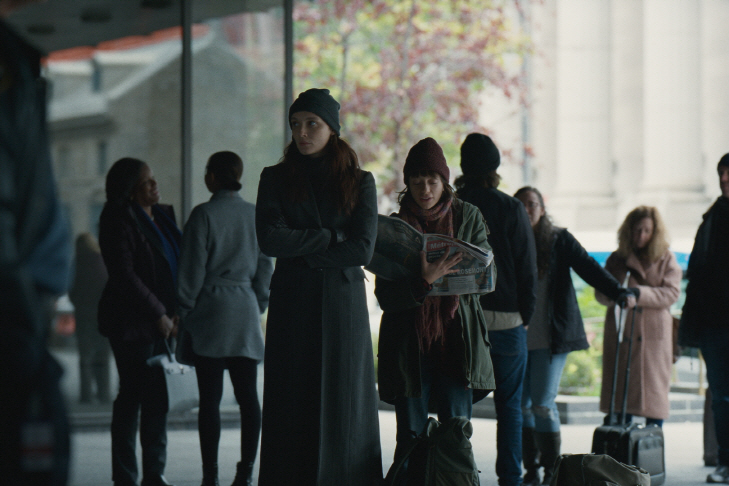
And we come to sense more of how emotionally damaged Kelly-Anne is. Was she really a troubled person from the beginning? Or, was she actually traumatized by whatever she came across during her increasingly risky online investigation? We only keep guessing on her true motive even when she finally gets a golden opportunity to obtain what she has been looking for so long, and what consequently follows next is another powerful moment to remember.

Everything in the movie depends on the detached but undeniably electrifying performance of Juliette Gariépy. Although we do not get to know that much about her character even at the end of the story, there are several key moments where her poker face crumbles a bit to give us some glimpses into whatever is churning inside her character’s mind, and Gariépy did a terrific job of bringing considerable emotional intensity to the screen without any exaggeration at all.

In case of several other supporting performers around Gariépy, they are all effective in their respective roles. While Laurie Babin somehow makes her pathetic character a bit more sympathetic than expected, Elisabeth Locas is often harrowing as the grieving mother of one of the victims, Maxwell McCabe-Lokos is mostly silent but looks suitably creepy as the culprit.

On the whole, “Red Rooms”, directed and written by Pascal Plante, is worthwhile to watch for how it deftly and thoughtfully handles its very sensitive main subject while also working as a first-rate psychological thriller, though this is not definitely something you can watch casually on Sunday afternoon, As Friedrich W. Nietzsche once said, the abyss gazes also onto you when you gaze long into the abyss, but, this time, the abyss not only gazes onto her but also remains inside her, and that surely leaves some thoughts for us.
Posted in Movies | Tagged , , , , | Leave a comment

Infested (2023) ☆☆☆(3/4): Stuck wtih lots of spiders

French horror film “Infested” will definitely make one of my close friends wince and jump more than once. He really dislikes spiders to say the least, and he may think twice about watching “Infested” even though he actually enjoyed “Arachnophobia” (1990), which is also full of small and big venomous spiders but is relatively more cheerful in comparison.

After the disturbing opening scene set in the middle of some Arab desert area, the movie introduces us to Kaleb (Théo Christine), a young colored man who has tried to earn his meager living via selling sneakers to his multicultural neighbors in some big suburban apartment building. He has lived with his sister Manon (Lisa Nyarko) in their family apartment, but they have conflicted a lot with each other over whether they should sell their apartment after their dear mother’s recent death. While he does not want to leave for the memories of their mother, his sister is already preparing to renovate their apartment for selling it someday, and this certainly annoys him a lot.

Meanwhile, we get to know a bit about Kaleb’s little private hobby. He loves collecting and raising various rare animals and insects, and his latest purchase is a small exotic spider he recently bought from a local convenient store owner. Needless to say, that spider is one of those dangerous spiders shown in the opening scene, and the mood naturally becomes unnerving as Kaleb casually handles that spider in his room later while having no idea about the potential danger in front of him.

Of course, the spider soon escapes from his room, and we soon come to see how dangerous it really is. Besides being quite lethal, it can grow and reproduce a lot within a very short time, and how it reproduces is not a pretty sight to say the least. Exponentially growing in number and size hour by hour, the spiders eventually infest here and there in the apartment building, which is swiftly quarantined by the local police not long after the first victim is reported. Shortly after they belatedly come to realize what is really going on around them, Kaleb and several others around him including his sister find themselves hopelessly trapped inside the apartment building, and it looks like there is no possible way out for them.

Naturally thrown into more fear and panic, Kaleb and several others desperately try to find any chance for survival and escape while also attempting to warn many of neighbors in the building. However, not so surprisingly, things continue to get worse and worse while they remain trapped inside the building as before. Although they come to learn a bit about how to stop or chase away their deadly enemies at least for a while, the building is already filled with thousands of spiders and their silky webs, which surely add more creepiness to the screen.

As Kaleb and several other main characters come to stick together for their escape and survival, director/co-writer Sébastien Vaniček, who incidentally made a feature film debut here after making several short films, doles out a number of effective moments to accumulate more tension and dread on the screen. While there are some nasty moments as many people in the building get killed by the spiders in one way or another, there is also a suspenseful scene where Kaleb and several others must carefully and quickly go through a tunnel of web strewn with spiders, and this scene will surely keep you on the edge especially if you have any aversion to spider.

Although the mood surely becomes more frantic around the last act, the movie keeps focusing on the main characters and their desperate struggle along the story. While he feels like your average petty lad at times, Kaleb comes to show more depth later in the story, and there is a brief reflective moment when Kaleb comes to have a little personal conversation with one of the main characters. The movie also makes some points on how Kaleb and many other colored neighbors of his are often discriminated and ignored by the local police, and this certainly contributes to the cathartic aspects of the finale.

During the climatic sequence predictably filled with plenty of action and a lot of CGI spiders, the movie willingly goes for some overkill, though the result is a bit too long in my humble opinion. Fortunately, it still makes us care about whatever will happen to its main characters in the end, and it also allows a bit more character development around the end of the story.

The main cast members of the film are convincing in the increasing panic and fear felt by their characters. While Théo Christine dutifully holds the center as required, Sofia Lesaffre, Jérôme Niel, Lisa Nyarko, and Finnegan Oldfield have each own moment along the story, and Niel has several good moments as his character comes to show a lot more grit for helping not only Kaleb and several others than expected.

On the whole, “Infested” is a well-made genre piece which will scare or entertain you enough, though you may still hesitate to watch after reading my 3-star review. I must confess that some spiders such as, say, tarantula are sort of cute to me, but the movie makes me swear that I should never, never, never meddle with any kind of unknown exotic spider in any case, and that says a lot about its effectiveness.

Posted in Movies | Tagged , , | Leave a comment

Captain America: Brave New World (2025) ☆☆(2/4): Nothing new or brave here

I felt old as watching “Captain America: Brave New World”, another Marvel Cinematic Universe (MCU) product naturally connected with several previous MCU flicks in one way or another. One of those products in question is “The Incredible Hulk” (2008), and that reminded me that I was old enough to remember when superhero movies were going through a big breakthrough thanks to the considerable critical/box office success of “Dark Knight” (2008) and “Iron Man” (2008) many years ago.

After the enormous box office success of “Avengers: Endgame” (2019), MCU has attempted to recharge our interest in superhero movies during last several years, but the result was not that impressive in my humble opinion. While there were some interesting stuffs such as “Shang-Chi and the Legend of the Ten Rings” (2021) or “Black Panther: Wakanda Forever” (2022), there were also several disappointing products as shown from “Eternals” (2021) and “Ant-Man and the Wasp: Quantumania” (2023), and we only felt more exhausted about superhero movies.

In case of “Captain America: Brave New World”, it seems to try some new things on the surface, but it only ends up being quite bland and predictable instead, and that is a big letdown to say the least. While it seriously lacks substance and personality in terms of story and characters, the movie also feels deficient in technical aspects, and it only makes us more bored and tired in the end.

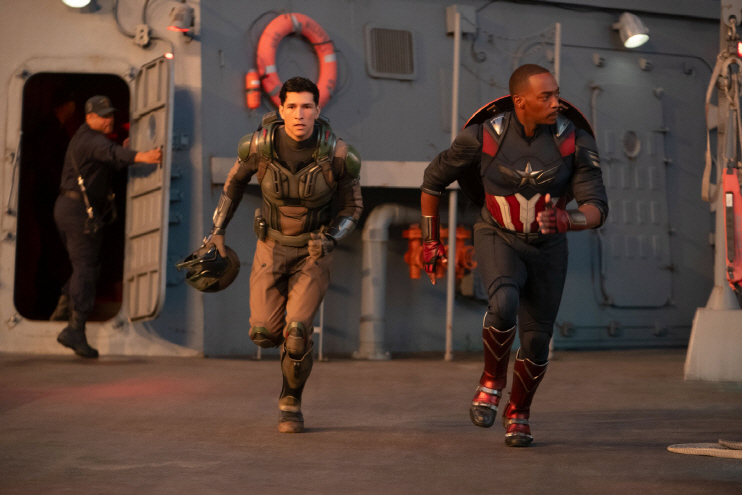
At first, the movie seems a bit promising as we watch how Sam Wilson (Anthony Mackie) is trying his best as the new Captain America along with his new partner who is now the new Falcon. After accomplishing his latest mission, Wilson and his partner are invited to the White House, where he meets President Thaddeus “Thunderbolt” Ross (Harrison Ford). Even though he and several other Avengers members were once quite defiant against Ross when Ross was a US Army general in “Captain America: Civil War” (2016), Wilson is willing to serve under Ross and his government, and Ross also seems ready to support Wilson despite their old conflict in the past.

However, of course, there soon comes a big trouble. When Ross is about to announce the international accord on a new big island which was created due to what happened in “Eternals” (2021), several figures suddenly try to assassinate him, and one of them is Isaiah Bradley (Carl Lumbly), who is incidentally a close friend of Wilson. As Bradley and several other assassins are subsequently arrested and then incarcerated, Wilson senses something fishy about the incident, and it becomes quite possible that Ross did not tell everything to him.

It is not much of a spoiler to tell that Ross is really hiding something behind him. Even if you have not seen the trailer yet, you can easily guess that right from his very first scene in the film, and that is the main reason why Wilson’s following investigation is not particularly compelling to watch. We are supposed to be surprised at the certain point where the main villain of the movie is eventually revealed, but that only reminds us more of how much the movie is limited by the ongoing narrative frame of its franchise. 

Furthermore, there is not much character development in Wilson or several other main characters to interest us, and this makes the narrative all the more tepid. Yes, there is some interesting character potential in Wilson for being a Black Captain America in addition to being a lot more physically vulnerable than his predecessor, but the movie does not delve much into that aspect, and the same thing can be said about Bradley, who seems an interesting figure for being a Black super soldier who fought in the Korean War but only ends up functioning as a mere plot element.

 Maybe you can just go for action scenes instead, but, alas, the action sequences in the film are not that exciting or interesting. There are surely lots of bangs and crashes during these action scenes, but they are devoid of style and personality despite being mostly competent on the whole, and we only become more aware of the heaps of CGI added onto the screen.

The main cast members try their best in filling their respective spots, though most of them are under-utilized at best and wasted at worst. Anthony Mackie, whom I will never forget when he played the lead role of Spike Lee’s amusingly flawed “She Hate Me” (2004) 21 years ago, has no problem with playing his familiar role again, but there is not much to do for him besides throwing himself into those perfunctory action scenes in the film. While Harrison Ford, who is replacing late William Hurt here, acquits himself well without embarrassing himself at all, Danny Ramirez, Shira Haas, Giancarlo Esposito, Tim Blake Nelson, and Carl Lumbly manage to leave some impression at least, and Haas has some fun with the unflappable attitude of her supporting character.

In conclusion, “Captain America: Brave New World”, directed by Julius Onah, is a middling product which has nothing new or fresh to provide while tepidly sticking to its increasingly stale narrative formula. After its ongoing Phase 5, MCU will soon move onto Phase 6, but its genre seems to be going down more these days, and I am afraid that I will be more depressed about enduring and then reviewing whatever may be produced next during several more years.

Posted in Movies | Tagged , | Leave a comment

Elton John: Never Too Late (2024) ☆☆1/2(2.5/4): Entering the last chapter of his career

Documentary film “Elton John: Never Too Late”, which was released on Disney+ a few months ago, works whenever it focuses on what may be the last chapter of Elton John’s life and career. After all, considering that he is about to have his 78th birthday at this point, he is surely thoughtful about how to spend the rest of his life as well as how fortunate he has been during last several decades, and that makes the documentary a bit touching at times.

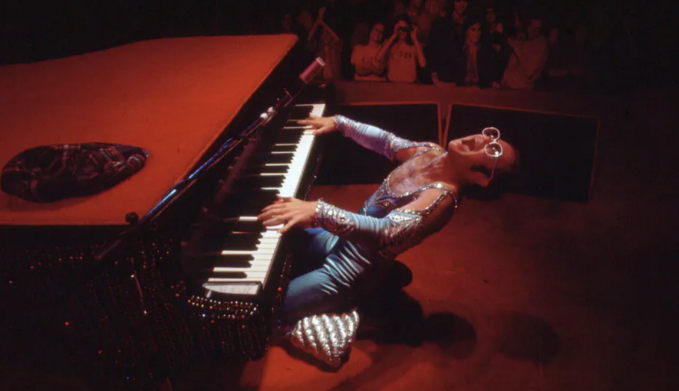
Closely looking into how he went through what would be his farewell concert tour in 2022, the documentary looks over John’s overall career and life. As some of you know, he was born to a rather unhappy and miserable couple in 1947, and he still remembers how he was often abused by his parents during his childhood years. That is why he came to focus more on music while showing considerable interest and talent in music, and he soon began to earn some money as playing piano in local bars.

Around the late 1960s, John was ready to go further as an aspiring musician, but he needed someone who could write better lyrics than him. By coincidence, he happened to be connected with a lad named Bernie Taupin, who eventually became a longtime professional partner and wrote many of John’s songs including that Oscar-winning song for “Rocketman” (2019). Once they clicked well with each other, John and Taupin became quite a productive team, and it did not take much time for them to get their first big success in UK.

After he became a rising new British singer to notice, John naturally went to US. Although his first performance in LA was rather modest, he quickly drew more public attention while doing more concerts here and there in US, and this surely boosted his career a lot. Around the beginning of the 1970s, he was regarded as the next big British superstar after the Beatles and David Bowie, and he became all the busier as relentlessly churning out a series of successful songs and albums during next several years.

Shuffling among a bunch of archival photographs and footage clips, the documentary tries to convey to us how exciting it was for him to be suddenly on the top of his field. He was really happy to perform his music in front of hundreds of audiences, and it is evident that he still enjoys that even during his farewell concert. Yes, he is not young anymore now, and he surely looks less active compared to those wild times in his past, but he is still ready for his performance nonetheless.

As approaching to 80, John becomes more aware of how precious the remaining life for him is, and that is the main reason why he decided to retire from doing concert tours. He wants to spend more time with his husband David Furnish, who incidentally directed the documentary with R.J. Cutler, and their two young kids, but you may sense some bittersweet feeling when he frankly admits that he may not live that long enough to see his dear two sons going to college and then having each own adult life.       

John is also quite open about some of his bad times. As being more aware of his homosexuality, he became more conflicted, and then he found himself experiencing his first romantic relationship, though his first boyfriend turned out to be alternatively helpful and toxic. While coming to work as his manager, John Reid helped John’s career in one way or another, but he was also frequently abusive to John, who had to endure his toxic boyfriend quite a lot during next several years before eventually breaking up with him.

Meanwhile, John also found himself going down into drug addiction after trying cocaine for the first time. To our disappointment, the documentary does not go into much detail on how he came to reach to the bottom of addiction and then started to get clean and sober around the 1990s, but we get a rather amusing episode on when he and John Lennon was surprised by the sudden visit of a certain famous figure while they were pretty high on drug and alcohol.   

John’s friendship with Lennon is certainly another interesting story in John’s life and career, though, again, the documentary does not delve much into this rich material. John was certainly excited when he and Lennon met each other for the first time, and he even helped Lennon to a considerable degree in more than one way. After making a surprise appearance in John’s concert in New York City, Lennon became more active and serious about his life and career than before, though, as many of you know, what could have been another interesting chapter of his was cut short by his tragic death in 1980. 

Overall, “Elton John: Never Too Late”, which recently garnered a Best Song Oscar nomination for John and his several collaborators including Taupin, is rather tame and unfocused while looking like scratching the surface of John’s remarkable life and career, and that is understandable to some degree considering its production background. After all, besides being co-directed by his husband, the documentary is co-produced by his production company Rocket Entertainment, so I was not so surprised to see that it takes a rather mild and conventional approach to its main human subject. Sure, I was not that bored during my viewing, but his life and career deserve more than this, don’t they?

Posted in Movies | Tagged , , , | 1 Comment

The Six Triple Eight (2024) ☆☆(2/4): These ladies deserve better than this…

The most interesting moment in Tyler Perry’s new film “The Six Triple Eight”, which was released on Netflix a few months ago, is its epilogue part, which briefly shows a series of interviews and archival records. Yes, there were really many African women who joined the US Army during the World War II, and these ladies actually did something important for the American soldiers during that time.

It is too bad that the rest of the movie is not so interesting compared to that. We all know that Perry, who also wrote the screenplay based on Kevin M. Hymel’s nonfiction book “Fighting a Two-Front War”, is not a very good storyteller, but the story is riddled with broad clichés and stereotypes in addition to being quite uneven in terms of tone and mood, and this frequently distracts us from the fairly good efforts from the main cast members.

The main subject of the movie is the 6888th Central Postal Directory Battalion, an all-African American female battalion during the World War II. The story begins with how a young African American woman named Lena Derriecott (Ebony Obsidian) becomes a member of the 6888th Battalion in 1944. She had a young Jewish lover in her hometown in Pennsylvania, but, alas, he died not long after joining the US Air Force, and, after grieving on his death for a while, she eventually decides to join the US Army.

As going to the army training camp in Georgia, Lena comes to befriend a number of young African American women also going to the same destination. Many of them know too well that the US Army will probably keep them and other African American female soldiers from going to Europe due to racism and racial segregation, but they come to join the US Army for various reasons anyway, and they are willing to do their best for becoming good soldiers.

Of course, right from their first day, they come to see how difficult and demanding it will be for all of them. Their battalion leader, Major Charity Adams (Kerry Washington), firmly emphasizes on how they must be always exemplary in front of those many white officers and generals out there, and Lena and her fellow recruits soon find themselves struggling a lot under Major Adams’ strict supervision.

Nevertheless, Lena does not lose her will and determination at all despite that, because, what do you know, the spirit of her dead lover keeps her going from time to time. This is just one of many blatant dramatic devices used by Perry’s screenplay, and he does not even seem to know how to use this utterly clichéd method more effectively.

In addition, Perry’s screenplay tries to juggle a bit too many stuffs within the 2-hour running time. Besides Lena’s main plot, there is a subplot involved with how Major Adams must deal with the racism from her superiors day by day, and then there is a possible romantic subplot between Lena and one African American male soldier who quickly finds himself smitten with her. Furthermore, there is also a subplot involved with how a concerned old mother comes to persuade President Franklin D. Roosevelt (Sam Waterston) to handle the literally accumulating issue with all those letters and packages sent from thousands of American soldiers or their family members in US.

When Major Adams and her African female soldiers are eventually sent to a city in Scottland in early 1945 for handling this serious mail delivery problem, the movie seems more focused than before, but Perry only throws more clichés and plot contrivances along the story without generating enough human interest for us. While Lena and many of her fellow African American soldiers are not fleshed out enough to engage us, Major Adams is mainly defined by her defiantly unflappable attitude, though she comes to show a bit of her humanity during a few obligatory dramatic moments including the one where she boldly defies her racist superior later in the story.
As getting more distracted and disinterested during my viewing, I only came to observe how much the main cast members are struggling to enhance whatever they are required to handle. Kerry Washington has some juicy moments as your average no-nonsense leader, but she also often finds herself limited by her rather flat character. Ebony Obsidian and several other actresses including Milauna Jackson, Kylie Jefferson, Shanice Shantay, and Sarah Jeffery try their best, but they are usually required to fill their respective spots without much else to do. In case of the more notable cast members in the film, Dean Norris, Sam Waterson, Susan Sarandon, and Oprah Winfrey just come and go in their brief appearance, and Norris is unfortunately saddled with a thankless task of delivering all those unpleasant racist insults whenever he appears on the screen.

On the whole, “The Six Triple Eight”, which recently received a Best Song Oscar nomination (This is incidentally Diane Warren’s 16th Oscar nomination – and she has not won yet while she received the Honorary Oscar in 2022), is well-intentioned but ultimately disappointing in many aspects. In my humble opinion, these exceptional ladies deserve better than this, and I can only hope that their extraordinary story will be presented more effectively by any better storyteller out there.

Posted in Movies | Tagged , , , , , , | 1 Comment

A Complete Unknown (2024) ☆☆☆(3/4): Still Unknown

As a human being, Bob Dylan is probably one of the most distant figures among the greatest American songwriters during the late 20th century. Sure, many of his songs have been remembered and admired for their timeless artistic qualities, but Dylan himself has been adamantly enigmatic to many of us during last 60 years, even though there have been many films and documentaries associated with him in the meantime.

James Mangold’s latest film “A Complete Unknown”, which received 8 Oscar nominations including the one for Best Picture, does not delve much into who the hell Dylan is as a human being, but it instead focuses on presenting one of the highlights in his career with enough mood and details to enjoy. Although I still do not get to know anything particularly new in the end despite being not so familiar with Dylan’s life and career from the beginning, the movie mostly succeeds in what it intends to do at least, and I was entertained enough despite some reservation.

The movie begins with how Dylan, played by Timothée Chalamet, gets associated with several prominent musicians who come to help him in one way or another during the early 1960s. In 1960, Dylan is just a young anonymous folk singer coming to New York City, but then he comes across an unexpected opportunity when he visits a hospital in New Jersey for meeting legendary folk singer Woody Guthrie (Scoot McNairy) there. Guthrie’s equally famous folk singer Peter Seeger (Edward Norton) is also visiting Guthrie right at that moment, and Seeger gladly takes Dylan under his wing once he sees Dylan’s little impromptu performance along with Guthrie.

Thanks to Seeger’s support, Dylan quickly rises as a new talent in the town while encountering a number of notable figures in American folk music besides Seeger. When he sees the performance of Joan Baez (Monica Barbaro), something clicks between them as they recognize each other’s considerable talent, and that is the beginning of their rather rocky personal/professional relationship during next several years. When Johnny Cash (Boyd Holbrook), whose life and career is incidentally the main subject of Mangold’s previous film “Walk the Line” (2005), shows a lot of enthusiastic admiration on Dylan’s songs, Dylan is certainly delighted to say the least, and he and Cash instantly hit off with each other when they finally meet later. 

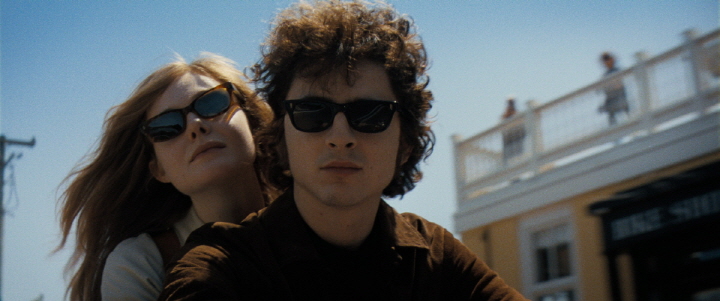
Meanwhile, Dylan’s popularity goes up and up, but his romantic relationship with a young woman named Sylvie Rosso (Elle Fanning) gets more strained due to his increasingly aloof attitude. No matter how much she tries to understand and accept him, Rosso only becomes more frustrated with him, and there eventually comes a point where she notices something going on between him and Baez (Rosso is actually the barely fictional version of one of Dylan’s real-life girlfriends, by the way).    

 When the movie eventually moves onto 1965 later, the screenplay by Mangold and his co-writer Jay Cocks, which is based on Elijah Wald’s 2015 book “Dylan Goes Electric!”, sticks to its detached attitude just like its hero. As getting more pressured by many others just for being regarded as the new young leader of the American folk music, Dylan becomes more distant to others including Baez and Seeger, and then he fully demonstrates his determination to go his way in front of many audiences at the 1965 Newport Folk Festival.

Needless to say, Mangold and his crew members including cinematographer Phedon Papamichael and editors Andrew Buckland and Scott Morris pull all the stops during this climactic part, which gives a vivid look into how intense that controversial moment was. Yes, what Dylan did at that time certainly angered many audiences out there, but it also induced a lot of enthusiasm and excitement at the same time, and the movie did a commendable job of presenting this famous (or infamous) moment with enough thrill and energy.  

Although Dylan remains a very distant figure to the end, Chalamet, who was Oscar-nominated for this film, flawlessly embodies his character’s distinctive qualities instead of resorting to mere mimicry. While never flinching from how Dylan sometimes looks like your average stubborn artist prick, Chalamet ably suggests the insecurity and vulnerability behind his character’s aloof façade, and he is also excellent in a number of obligatory musical performances in the movie.

Several principal cast members in the film simply come and go around Chalamet, but they leave some impression on us despite that. Edward Norton is effective in his gentle supporting performance, and he is especially wonderful when his character comes to recognize and then accept that Dylan will never be the successor to Guthrie as expected by many others including Seeger. Monica Barbaro, who was Oscar-nominated along with Chalamet and Norton, and Elle Fanning are well-cast in their respective supporting roles, and the same thing can be said about a bunch of notable performers including Boyd Holbrook, Dan Fogler, Norbert Leo Butz, P.J. Byrne, Michael Chernus, and Scoot McNairy, who speaks volumes in his mostly silent performance.  

To be frank with you, I am still scratching my head on Dylan as a human being, but I must also admit that “A Complete Unknown” is a well-made biographical musical drama film. Sure, this is a conventional stuff relatively less ambitious and interesting than how Todd Haynes creatively and fascinatingly presented Dylan’s life and career in “I’m Not There” (2007), but there are some entertaining elements including the good efforts from Chalamet and several other cast members at least, and I will not grumble for now.

Posted in Movies | Tagged , , | 1 Comment

The Brutalist (2024) ☆☆☆1/2(3.5/4): An ambitious piece to behold and admire

Brady Corbet’s latest film “The Brutalist” is an ambitious piece to behold and admire. While often boldly trying to emulate the style and form of those Hollywood classic epic drama films of the 1950-60s, it also brings a considerable amount of modern touch and sensibility to its story and characters, and the result is utterly spellbinding, regardless of how you feel about this adamantly monumental film.

The story of the movie feels like a typical American immigrant tale at first. Its hero is László Tóth (Adrien Brody), a Hungarian-Jewish Holocaust survivor who emigrates to America in 1947. Before the World War II, he worked as an architect, but now he is virtually a nobody just like many other emigrants, and he can only hope that his cousin living in Philadelphia, who has run a little furniture shop, will provide him a job and a place to stay.

Anyway, once he arrives in Philadelphia, László is gladly greeted by his cousin, and we observe how he tries to bring some architecture sensibility of his to those handmade furniture pieces to be sold. On one day, he and his cousin are requested to renovate the library in a big house belonging to a wealthy businessman named Harrison Lee Van Buren (Guy Pierce) for a surprise birthday gift for him, and the movie patiently follows how László and his crew make the library look quite different than before.

However, Van Buren is not so amused when he arrives at his house earlier than expected. Consequently, the situation becomes very difficult for László during next few years, but, what do you know, Van Buren changes his mind when his new modern library comes to draw a lot of attention later, and he is ready to help László in more than one way. Besides hiring László as the architect of a grand new big building to bear the name of his family, Van Buren also helps László’s wife and niece, who also managed to survive the Holocaust just like László, coming from Hungary to US at last.

It is not much of a spoiler to tell you that László eventually becomes conflicted about the issues of principle and integrity as coming to clash with his rich sponsor more and more along the story. While he seems ready to support László all the way at first, Van Buren gradually shows more of his heartless sides as things do not seem to be going well from his viewpoint, and László’s wife Erzsébet (Felicity Jones) begins to notice how her husband becomes more distant from her as he struggles to stick to his artistic integrity in front of Van Buren and others.

As the screenplay by Corbet and his co-writer Mona Fastvold steadily builds up the story and characters with more details, the movie constantly impresses us with a number of stunning visual moments to be appreciated. Cinematographer Lol Crawley did a superlative job of filling the screen with vivid and realistic period atmosphere (The movie was actually shot via the VistaVison process and cameras for accentuating that, by the way), and the result is seamlessly mixed with the occasional archival footage clips from the 1950-60s. The editing by Dávid Jancsó is precise and efficient in maintaining the narrative pacing throughout the film, which is incidentally more than 3.5 hours including the 15-minute intermission part. The score by Daniel Blumberg feels a little too simple and restrained, but it still plays a crucial part in setting the tone of several key scenes in the movie.

Above all, the movie depends a lot on the hauntingly soulful acting of Adrien Brody, who was deservedly Oscar-nominated for his best performance since his Oscar-winning turn in Roman Polanski’s “The Pianist” (2002). While never making any excuse on his character’s many human flaws, Brody deftly illustrates his three-dimensional character’s inner conflicts along the story, and he is compelling to watch whenever he subtly suggests whatever is churning behind his character’s seemingly passive appearance.

Around Brody, Corbet assembles several good performers, who have each own moment to shine in one way or another. While Guy Pearce is suitably obnoxious as a rich man who turns out to be more brutal and controlling than he seems at first, Felicity Jone, who was Oscar-nominated along with Brody and Pearce, manages to overcome her rather thankless role, and Joe Alwyn, Raffey Cassidy, Stacy Martin, Alessandro Nivola, Jonathan Hyde, and Isaach de Bankolé are also solid in their substantial supporting parts.

On the whole, “The Brutalist”, which received 10 Oscar nominations including the one for Best Picture (It also won the Silver Lion for Best Director when it was premiered at the Venice International Film Festival in last year, by the way), is quite impressive for its masterful technical qualities as well as its confident handling of story and character. Although I am a bit less enthusiastic about it than many others because it is not wholly perfect due to several notable flaws including a few abrupt narrative turns during its second half, this is surely not something we can see everyday, and its mesmerizing moments still linger around my mind even at this point.

Now I am reminded of what my late friend/mentor Roger Ebert wrote about Paul Thomas Anderson’s “There Will Be Blood” (2007): “…“There Will Be Blood” is not perfect, and in its imperfection we may see its reach exceeding its grasp. Which is not a dishonorable thing.” In my trivial opinion, his words can also be applied to “The Brutalist”, and I wonder whether it will look greater than before when I revisit it someday.

Posted in Movies | Tagged , , , | 2 Comments

September 5 (2024) ☆☆☆(3/4): The Munich Massacre of 1972 via live TV 

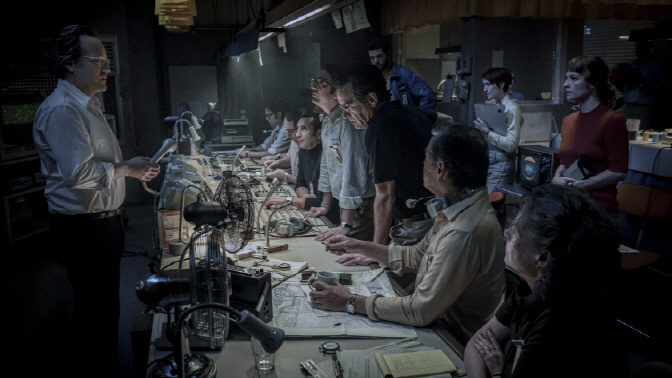
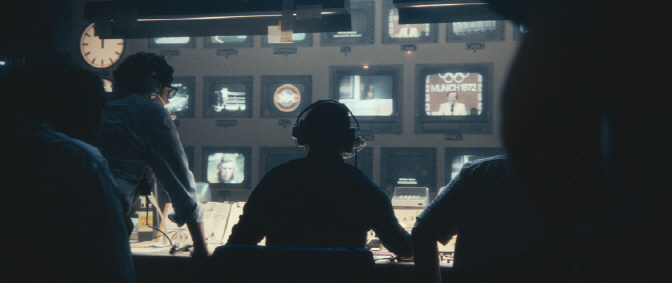
It is always interesting to watch professionals doing their best, and “September 5” is one of such prime examples. Here are a bunch of professionals simply trying to do their job well under one extraordinary circumstance which drew the attention of the whole global world during that time, and the movie is often riveting while also indirectly provoking some thoughts and reflection from us.

 At the beginning, we see how things were quite exciting in Munich, West Germany during the first week of September 1972. The 1972 Summer Olympics was being held, and the West German government was eager to promote the new era of the country after World War II. The American Broadcasting Company (ABC) was in the middle of its first live coverage of the Summer Olympics, and the opening part of the film shows how the ABC sports crew are going through another busy day in Munich.

However, a shocking incident happened in the middle of the early morning of the next day. A bunch of Palestinian terrorists broke into one of the buildings for the Olympic athletes where the Israeli athletes and coaches were staying at that time, and then these terrorists held 11 hostages as demanding the release of 200 Palestinian political prisoners held by the Israeli government. While the Israeli government did not bend to this demand at all, the West Germany government tried to resolve the situation as soon as possible, but, as many of you know, that eventually led to a disastrous outcome.

The movie closely follows how the ABC sports crew instantly embarked on reporting this horrible incident. Once they get confirmed on what is really going on, they all busily prepare for the live TV coverage of that incident, and the movie ably immerses us into the increasingly tense atmosphere surrounding them. While they surely have considerable advantages as the only American broadcasting company which can broadcast the hostage situation on live TV, they can still be beaten at any point by many other competitors out there who are also quite determined to be the first in line, and the movie shows a bit of humor from how they try to get closer to the ongoing hostage situation by any means necessary. At one point, one of them disguises himself as an American athlete for freely going back and forth between the crew and a certain famous TV reporter without any interference from the local police, and that leads to a brief but hilarious moment later in the story.       

Under the permission from Roone Arledge (Peter Sarsgaard), who is the President of ABC Sports, Marvin Bader (Ben Chaplin), who is the head of operation at ABC Sports, allows Geoffrey Mason (John Magaro) to handle their ongoing live TV coverage, and Mason is certainly ready to prove his worth to others around him. With some invaluable help from a female German employee who often serves as a translator, Mason and his crew members keep catching on the latest development of the hostage situation and then reporting it on live TV, and it seems that this will be the finest moment of their career.   

However, as the situation becomes more and more serious, the ABC sports crew members become more aware of the ethical aspects of their live TV coverage. They are certainly concerned about how things can get quite worse at any minute, and they are also quite worried about whether they can actually show that on live TV. Furthermore, they belatedly come to realize that those terrorists are also probably watching their live TV coverage, and that makes Mason very conflicted about whether their live TV coverage actually jeopardizes the whole circumstance.

Firmly maintaining its dryly objective viewpoint, the screenplay by director Tim Fehlbaum and his co-writers Moritz Binder and Alex David, which was incidentally Oscar-nominated a few weeks ago, keeps rolling the story and characters with considerable efficiency. While simply observing how they work together, the movie lets us get to know its main characters bit by bit, and it also steadily accumulates its narrative momentum thanks to the taut and efficient editing by Markus Förderer. As a result, we never feel lost amid many different characters working inside the limited background, and you will also be marveled to see how the movie did a seamless job of incorporating archival footage clips into the story. 

The main cast members of the film are all convincing in their respective parts. Peter Sarsgaard and Ben Chaplin are dependable as usual, John Magaro, who has become one of the most reliable performers working in Hollywood during last several years, fills the center with another fine performance, and he is also supported well by a bunch of other good performers including Zinedine Soualem, Benjamin Walker, and Leonie Benesch, who was memorable in Oscar-nominated German film “The Teachers’ Lounge” (2023) and holds her own place well as the sole substantial female character in the story.

Overall, “September 5” is an engaging historical drama to be admired for its focused handling of its main subject, and I was often entertained by its authentic period mood and details while appreciating its thoughtful sides. Although it does not spell out any particular message on the surface, the movie makes us muse more on some ethical issues of journalism observed from the story, and it goes without saying that these issues are still relevant even at this point. Yes, you may think it could show and tell more about its main subject, but it did its job fairly well within its rather short running time (95 minutes), so I will not complain for now.

Posted in Movies | Tagged , , , , , | 1 Comment

I.S.S. (2023) ☆☆1/2(2.5/4): A thriller inside the International Space Station

“I.S.S.”, which is currently available on Netflix in South Korea, is a modest space thriller film about several astronauts suddenly finding themselves under a rather tricky circumstance. While it is often hampered by plot contrivance and superficial characterization, the movie has some entertaining moments to enjoy at least, and it certainly reminds me again of why I am still not so willing to go to the space. 

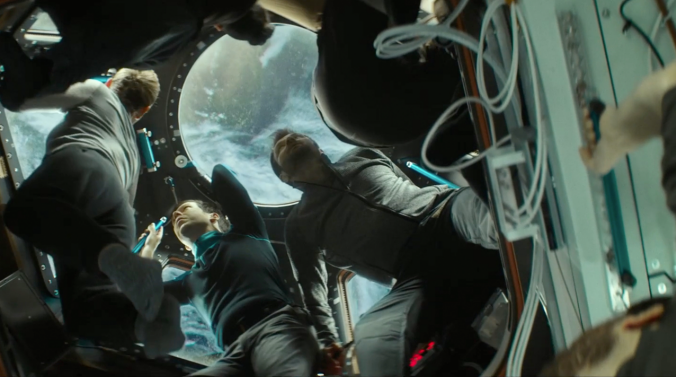
The movie opens with the arrival of two American astronauts at the International Space Stain (ISS). They are Dr. Kira Foster (Ariana DeBose) and Christian Campbell (John Gallagher Jr.), and we soon see them gladly welcomed by the four astronauts who have already been staying inside the ISS for a while. Besides Gordon Barrett (Chris Messina), who is also an American, the other three astronauts are from Russia, and they and the American astronauts are supposed to work together harmoniously inside the space station, regardless of whatever is going on between their countries at present. Because she happens to have her first day inside the ISS, Dr. Foster is naturally a bit nervous, but she gradually gets accustomed to the zero-gravity environment of the space station while starting to work on her science project and befriending her fellow astronauts more.

However, something serious occurs on one day. The continents of the Earth are suddenly covered with what looks like nuclear bomb explosions, and it soon becomes apparent that a war is started between US and Russia. Via his emergency communication line, Barrett is instructed that he and his fellow American astronauts should take over the space station by any means necessary, and they naturally begin to regard the Russian astronauts with growing suspicion, because the Russian astronauts probably also received the same order from their country.

During its first half, the movie steadily accumulates the sense of uneasiness around its few main characters, and there are several effective scenes including a suspenseful one where one of the American astronauts must go outside the space station for fixing an antenna alone by himself. With only Dr. Foster assisting him via their radio communication, he must be careful with each of his physical movements, because, as many of you know, even a very small movement can be quite perilous in the zero-gravity environment.

Around its middle point, the screenplay by Nick Shafir unfortunately eliminates all the ambiguity surrounding the main characters, and that is where the movie becomes less engaging. Without providing enough ground for character development from the beginning, the main characters remain to be more or less than flat archetypes, and we do not get to know that much about any of them along the story. For example, there is a brief moment when the movie delves a bit into Dr. Foster’s personal life, but this feels rather perfunctory instead of making her a bit more interesting at least. In case of several other characters in the story, they are mostly defined by their appearance and attitude, and you will not be so surprised by how they will come to function as mere plot elements later in the story.  

During the last act, the movie naturally attempts to generate more suspense to accompany its eventual climax, and the overall result is mildly entertaining despite more distracting plot contrivance along the story. While a certain plot turn at one point later in the film is quite artificial to say the least, that leads to one intense physical fight scene, and I also like a key scene where the three main characters must be very tactful to each other with one sharp object to be used in one way or another.     

Director Gabriela Cowperthwaite, who has been mainly known for her acclaimed documentary film “Blackfish” (2013), and her crew members including cinematographer Nick Remy Matthews did a credible job of establishing the zero-gravity environment on the screen. Yes, this has not been a novelty anymore because of Alfonso Cuarón’s “Gravity” (2013) and a number of other recent space films following that ground-breaking masterpiece, but “I.S.S.” looks fairly realistic in its limited background as far as I can see.

The main cast members of the film fill their respective roles as much as possible. While Ariana DeBose, who has become more notable thanks to her Oscar-winning breakthrough turn in Steven Spielberg’s “West Side Story” (2021), manages to bring some personality to her rather underwritten role, Chris Messina and John Gallegher Jr. do a bit more than required by their rather thankless parts. In case of Masha Mashkova, Costa Ronin, and Pilou Asbæk, they acquit themselves well even though they are usually demanded to look like hiding something behind their back, and Asbæk, a Danish actor who was terrific in Oscar-nominated Danish film “A War” (2015), is especially good as his character goes through a series of conflicts along the story.

In conclusion, “I.S.S.” does not bring anything particularly new to its familiar genre territory, and it has already been fading in my mind even though I watched it early in this morning. Yes, that high standard set by “Gravity” is surely something which cannot be surpassed during next 10 years at least, but “I.S.S.” feels subpar even compared to many other space films out there, and I am already ready to move onto whatever I am going to watch next.

Posted in Movies | Tagged , , , | Leave a comment

Inside (2023) ☆☆(2/4): A man who gets trapped

I guess any good performer is bound to go for the challenging task of carrying a movie alone by his or her sheer talent and presence. While Ryan Reynolds pushed his acting ability as much as possible while being the whole show of “Buried” (2010), Robert Redford demonstrated alone that he still could be very engaging just with his own presence in “All Is Lost” (2013), and Mélanie Laurent also went all the way alone by herself in recent Netflix film “Oxygen” (2021).

In case of “Inside”, which is currently available on Netflix in South Korea, Willem Dafoe, who is going to have the 70th birthday in this year, willingly throws himself into a similar challenge, but I do not think the movie provides enough materials for him to play during its 105-minute running time. Sure, he has been one of the most compelling character actors working in Hollywood, but even he cannot overcome the thin and tedious narrative of the film, and that is a shame to say the least.

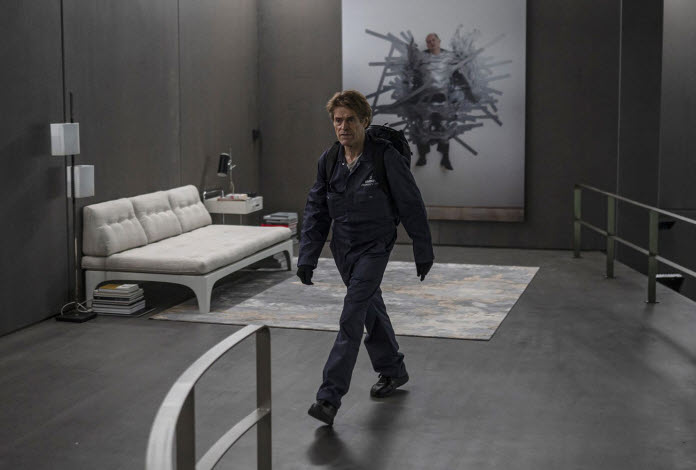
At first, the movie, which is directed by Vasilis Katsoupis, looks promising as Dafoe’s criminal character breaks into the penthouse apartment of a big building located somewhere in the middle of New York City. This apartment belongs to some rich guy who happens to be an avid art collector, and it surely looks more like an exhibition site rather than a residence to live, as being decorated with many different artworks here and there.

What Dafoe’s character, whose name in the end credits is probably a winking nod to a certain Pixar animation film where Dafoe voiced one of the supporting characters, tries to steal the three valuable paintings of Egon Schiele. While he easily finds two of these paintings within a few minutes, the last one seems to be hidden somewhere beyond his reach, so he decides to give up on that before it is too late for him.

And then there soon comes another big problem. For some unknown reason, the security system of the apartment happens to have an error at the last minute, and he consequently gets trapped inside the apartment while also getting disconnected from an accomplice of his, who is supposed to handle any problem with the security system. No matter how much he tries again and again, it looks like there is no possible way out for him, and the situation becomes all the worse as the temperature control system of the apartment also goes haywire.

Now this looks like a classic setup for thriller, but the screenplay by Ben Hopkins, which is developed from the story idea by Katsoupis, only comes to meander instead without much narrative development. While the mood becomes a bit suspenseful as its criminal hero struggles to deal with the temperature problem inside the apartment, the movie mostly feels static and languid as failing to generate enough narrative momentum, and its sole main character’s desperate struggle becomes all the more monotonous for us as a result, though you may be amused a bit by several darkly amusing moments showing how he handles his biological needs. As the water line is somehow cut off, he soon needs to search for any possible way to get water, and he also must find and then secure anything to eat for himself.   

I think the movie is intended to be a sort of existential thriller rather than a conventional one, but it often falters in terms of characterization. Although we get to know a bit about its criminal hero at the beginning of the film, the movie does not flesh him out a lot on the whole, and we simply observe his plight from the distance without much care. Around the narrative point where he is thrown into more despair and madness, the movie seems to be going nowhere just like him, and it even attempts a couple of hallucinatory moments which do not work at all in my humble opinion.

While getting bored more and more along the story, my mind often went astray as reflecting more on what a versatile actor Dafoe really is. Since he made quite an impression on us via a number of striking performances during the 1980s, this legendary actor has steadily entertained us as appearing in a number of notable films such as “Shadow of the Vampire” (2000) and “The Florida Project” (2017), and he is still one of the most diligent performers in Hollywood as shown from his recent supporting turns in “Poor Things” (2023) and “Nosferatu” (2024).      

Although he does not have much to do here except looking despaired or frustrated throughout the whole film, Dafoe manages to find a way to fill his rather superficial character with some human details, and he succeeds in preventing the movie from becoming a total bore. Besides looking quite fit despite his old age, he is utterly committed on the screen at every second, and his solid efforts here in this film surely deserve to be served by a better one somewhere inside it.

In conclusion, “Inside” is not entirely a waste of time mainly thanks to its charismatic lead actor, but I remain quite dissatisfied without remembering much of anything else in the film besides his solo performance. It is certainly a good challenge for not only him but also the director and his crew members, but the overall result is not so interesting besides being quite inferior to those several movies mentioned at the beginning of my review. As a matter of fact, you will have a much productive time with any of them, so I sincerely recommend them instead.

Posted in Movies | Tagged , | Leave a comment