Young Woman and the Sea (2024) ☆☆1/2(2.5/4): A passable biopic about one remarkable woman

“Young Woman and the Sea”, which is currently available on Disney+, is a biographic film about one remarkable woman who showed that women can do anything as much as men. While her extraordinary achievement certainly deserves to be known more to us, the movie is unfortunately rather plain and clichéd in comparison, and that is a shame considering the commendable efforts from its lead actress.

Daisy Ridley, who seems ready to go further than the recent Star Wars trilogy, plays Gertrude “Trudy” Ederle, an American competition swimmer who became the first woman to swim across the English Channel in 1926. The early part of the film focuses on her childhood years in New York City during the 1910s, and we see how young Ederle became interested in swimming just because her older sister was allowed to learn swimming under their no-nonsense mother’s insistence. Although she has to be careful about losing hearing after suffering a severe case of measles, young Ederle enjoys swimming more and more, and she and her older sister eventually join a local Woman’s Swimming Association later.

Under their trainer who comes to recognize Ederle’s potential and passion, Ederle keeps going further during next several years. In the end, she comes to participate in the 1924 Paris Olympics, but her older sister, who has been content with her younger sister swimming better than her in many competitions, cannot go just because there is only one spot available.

Anyway, Ederle and several other members of the US women’s team are supervised by a German trainer named Jabez Wolffe (Christopher Eccleston) during their trip to the 1924 Paris Olympics, and we see how much they are disregarded and discriminated by their mean trainer. While those American male athletes are allowed to do routine training on the ship everyday, Ederle and the other American female athletes are not allowed to do that in contrast, and Wolffe does not pay much attention to their training or welfare while more concerned about his seasickness.

As a result, Ederle shows a worse result than expected at the 1924 Paris Olympics, and she feels all the more daunted when her older sister subsequently chooses to follow their conservative parents’ wish and then marry some German immigrant guy to help their father’s butchery business. However, after seeing that she has been a role model for many young girls out there, she becomes determined to find any possible way for swimming more and then getting recognized more, and she soon sets herself against a very demanding challenge: swimming across the English Channel.

From that narrative point, the screenplay by Jeff Nathanson, which is based on Glenn Stout’s nonfiction book of the same name, takes a more predictable course. After succeeding in getting full sponsorship, Ederle begins to prepare along with Wolffe just because he happens to be assigned to her as a guy who attempted to swim the channel more than once, and, not so surprisingly, they do not get along that well with each other from the beginning. The movie even suggests that Wolffe deliberately sabotaged Ederle’s first attempt to swim across the channel, but I must tell you that this is entirely fictional as far as I learned from Wikipedia later.

The last act of the movie focuses on Ederle’s second attempt, which is assisted by Bill Burgess (Stephen Graham), who was the second guy who successfully swam across the channel. Despite looking crude and coarse on the surface, Burgess turns out to be a much better trainer for her than Wolffe, and her family show full support as usual.
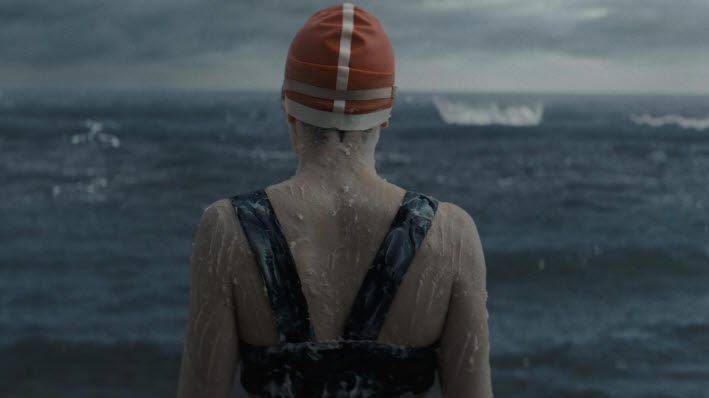
What follows next is a series of grueling obstacles Ederle has to face as trying to swim across the channel for the second time. Besides her accumulating physical exhaustion, she must endure the cold water temperature and unpredictable current changes of the channel, and she also has to be careful about those jellyfish in the sea.

Now some of you are probably reminded of recent Oscar-nominated Netflix film “Nyad” (2023), which is about a real-life competitive swimmer swimming against a similar challenge. Although the climatic part of “Young Woman and the Sea” looks fairly realistic under the competent direction of director Joachim Rønning, this still looks less palpable and impressive compared to “Nyad”, and the movie also is deficient in terms of story and characters. While Ederle is presented as your average clean-cut heroine, many supporting characters around her are more or less than stereotypes, and this often makes the film less engaging in my humble opinion.

At least, Ridley and the other main cast members in the movie try as much as they can. While her earnest performance carries the film to the end, Christopher Eccleston Tilda Cobham-Hervey, Kim Bodnia, Jeanette Hain, Glenn Fleshler, and Sian Clifford dutifully fill their respective spots around her, and the special mention goes to Stephen Graham, who brings some spirit and personality to the story as well as his character.

On the whole, “Young Woman and the Sea” does not impress me enough for recommendation, but it made me want to know about its admirable real-life heroine at least. As shown at the end of the story, Ederle continued to live the life of a trailblazer during the rest of her life, and her life and achievements certainly deserve something better than this passable biography film.

Posted in Movies | Tagged , , , | 1 Comment

28 Years Later (2025) ☆☆☆(3/4): Danny Boyle back in Zombieland

Danny Boyle’s latest film “28 Years Later” reminds me again that he is a filmmaker who has rarely repeated himself. Yes, he is back in that post-apocalyptic world explored in “28 Days Later” (2002), and we are surely served with a number of gory and bloody moments involved with those raging zombies, but, to my little surprise, the movie turns out to be more thoughtful and meditative than expected.

At the beginning, the movie quickly establishes how things have been grim and hopeless in Britain and Ireland since what happened at the beginning of “28 Days Later”. After a highly infectious virus nicknamed the “Rage virus” was spread from a medical research center in London, Britain and Ireland were eventually quarantined, and the remaining survivors have been stuck there during next 28 years while nearly isolated from the outside world.

The early part of the film is mainly set in an island where a bunch of survivors have peacefully lived together for many years. Except for a tidal causeway to the mainland, the island has been totally and safely separated from the mainland filled with lots of infected people, and the movie observes a bit of how the survivors in the island go through another day of their shabby life as doing their respective tasks.

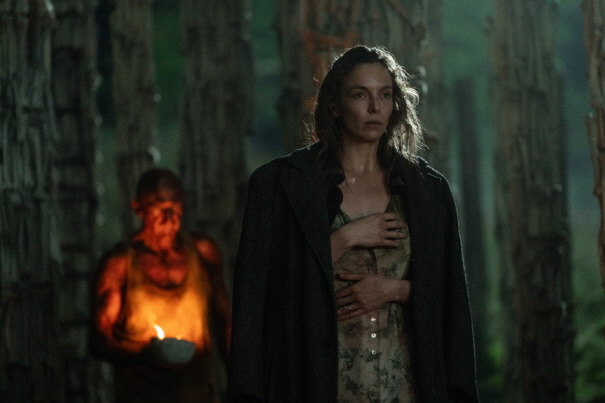
One of them is a guy named Jamie (Aaron Taylor-Johnson), a scavenger who has lived with his ailing wife Isla (Jodie Comer) and their 12-year-old son Spike (Alfie Williams). He is going to supervise a coming-of-age initiation to be done by his son in the mainland, and Spike seems to be ready for that, though he is more concerned about how his mother has become sicker day by day for some unspecified medical problem.

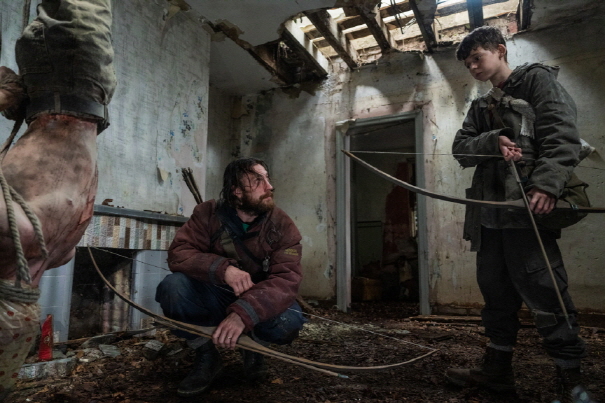
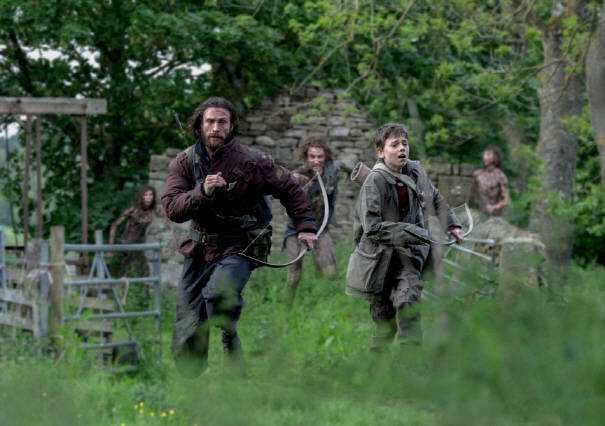
Once Spike and his father enter the mainland with their bows and arrows, we get to know more about how dangerous the mainland is despite looking quiet and peaceful on the surface. There are still a lot of infected people here and there in the mainland, and some of them are more dangerous due to having more strength due to that virus. Not long after Spike manages to kill one infected person as required, he and his father find themselves chased by one of those more dangerous infected people, and that leads to one of the most intense moments in the film.

After learning about a certain mysterious survivor who may be a doctor, Spike naturally becomes interested in bringing his mother to that figure who lives somewhere in the mainland, and the second half of the film follows his following impulsive journey along with his mother. Again, Spike is reminded of how he is not totally prepared for dealing with those infected people out there, but he tries as much as possible nonetheless, and his mother turns out to be more helpful than expected even though her medical condition keeps getting worse as before.  

 As their perilous journey is continued, the screenplay by co-producer Alex Garland, who also wrote the screenplay for “28 Days Later” and then impressed us more as directing several feature films including “Ex Machina” (2014) and “Civil War” (2024), takes some time for more character development. While we certainly get several scary scenes involved with those infected people, the movie stays focused on the relationship between Spike and his mother, and we come to sense more of the strong emotional bond between them.

In addition, the movie constantly emphasizes how everything looks alien and unsettling to its main characters in one way or another. The cinematography by Anthony Dod Mantle, who won an Oscar for Boyle’s previous film “Slumdog Millionaire” (2008), often conveys to us the anxious mood surrounding the main characters, and that is why a few brief but surprisingly tender moments later in the film are quite effective. The editing by Jon Harris feels rather distracting at first due to frequent jump cuts throughout the film, but this jumpy editing style somehow works along with the increasing dread and anxiety along the story, and that is accentuated further by the intentionally jarring score by Young Fathers.

The main cast members of the film are terrific on the whole. While Jodie Comer and Aaron Taylor-Johnson dutifully hold the ground, young performer Alfie Williams is convincing in his character’s gradual growth and maturation along the story, and Jack O’Connell and Edvin Ryding are well-cast in their substantial crucial supporting parts. In case of Ralph Fiennes, he has some juicy fun with that mysterious character who will surely remind you a bit of Colonel Kurts in “Apocalypse Now” (1979), and he is particularly wonderful when his character gently handles an important moment between Spike and his mother later in the story.   

Overall, “28 Years Later” is relatively more somber compared to the sheer intensity of “28 Days Later”, and that may let you down a little, but it will engage you with its good mood, storytelling, and performance instead. As reflected by its final scene, there will be the following sequel in the next year, and, considering how “28 Years Later” demonstrates more potential and interest in its familiar genre territory, I think we can have some expectation on whatever may come next after this solid installment.

Posted in Movies | Tagged , , , , , | 1 Comment

Elio (2025) ☆☆☆(3/4): A boy’s little cosmic adventure

“Elio”, the latest animation feature film from Pixar Animation Studios, is a modest but sweet SF fantasy tale which often amused me for good reasons. While it will be fairly enjoyable to young audiences thanks to its bright and colorful visual elements, the film will touch you especially if you were ever eager to learn more about whatever is beyond our home planet, and you may also appreciate how much it is influenced by a number of notable American SF films in the 1980s.

 The early part of the film focuses on the aching loneliness of its little hero. After suddenly losing his dear parents due to some unspecified incident, Elio Solis (voiced by Yonas Kibreab) has felt quite alone and unwanted, and even his aunt Olga (voiced by Zoe Saldaña), an army officer working in a big military facility monitoring those dangerous space debris outside the Earth, does not provide him much comfort, even though she really tries her best for raising her nephew alone by herself. 

Anyway, Elio has been quite interested in the universe and the possible existence of aliens thanks to his chance encounter with an exhibition associated with Carl Sagan and Voyager I, and he has aspired to be taken to anywhere but the Earth just because he has not often felt like being at home on the Earth. As soon as summer starts, he goes to a nearby beach, and then he tries to receive any message from the space beyond the Earth via his amateur radio, while a certain famous song from Talking Heads is humorously played on the soundtrack.

And then there comes an unlikely opportunity for Elio. When he later happens to be with his aunt at that military facility, he comes upon a chance to respond to what may be a reply from whoever met Voyager I somewhere in the universe, and he instantly grabs that chance without any hesitation. This eventually causes a big trouble for both him and his aunt, but, what do you know, it turns out that his response was actually received by a group of alien creatures out there, who subsequently transport him to their headquarters in a way reminiscent of the climax of Robert Zemeckis’ “Contact” (1997).  

These aliens are the members of an interplanetary organization called “Communiverse”, and, not knowing that he is actually a young kid, they mistake Elio for the leader of the Earth. Just because he can live there once he gets accepted into Communiverse, Elio lies to the aliens, but, of course, his deception soon gets threatened due to an aggressive alien warlord who is not so pleased about not getting accepted by Communiverse. In exchange for getting accepted into Communiverse, Elio agrees to deal with that alien warlord for himself, and his task seems rather easy up to a certain point.

Around that point, Elio come to befriend a little alien who is also a kid just like him, and that makes the film look like a cross between Nick Castle’s “The Last Starfighter” (1984) and Joe Dante’s “Explorers” (1985). As a matter of fact, the movie borrows a certain story idea from the former (Hint: It involves with cloning), and you may be more amused by how the film also adds a bit of John Carpenter’s “The Thing” (1982) and “Starman” (1984) to this borrowed story idea later.

Needless to say, Elio and Glordon (voiced by Remy Edgerly), who incidentally looks like a cuter version of those aliens in Bong Joon-ho’s “Mickey 17” (2025), become each other’s best friend along the story. At one point in the middle of the story, they have to crawl inside a labyrinthic network of narrow tunnels, and you may be a bit tickled by how Glordon can actually talk in more than one way, which somehow reminds me of that bizarre talking bug in David Cronenberg’s “Naked Lunch” (1991).

The film feels a bit too hurried as shifting to action mode during the last act, and I think the screenplay by Julia Cho, Mark Hammer, and Mike Jones could provide more depth and personality to its story and characters before eventually arriving at the expected ending, Nevertheless, the film has enough humor and sensitivity to engage us, and, as a guy who once memorized all the planets in the solar system and many of their numerous satellites during his childhood years, I could not help but feel a little sentimental as watching Voyager I and then listening to a piece of audio recording from Carl Sagan (I still had an old translated copy of that famous book written by him, by the way). 

The voice cast members of the film are mostly solid on the whole. Young performer Yonas Kibreab did a fine job of imbuing his character with vibrant spirit and likability, and he and his fellow young performer Remy Edgerly are convincing in the relationship development between their characters. In case of several notable adult voice cast members including Zoe Saldaña, Brad Garrett, Jameela Jamil, Shirley Henderson, and Matthias Schweighöfer, they simply fill their respective supporting roles, and that is another weak aspect of the film.
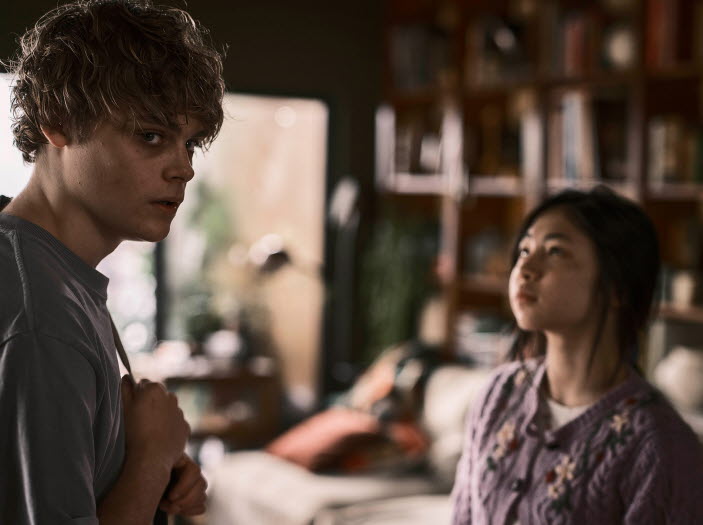
In conclusion, “Elio”, directed by Madeline Sharafian, Domee Shi, and Adrian Molina, is one or two steps down from the recent better offering from Pixar Animation Studios such as “Coco” (2017) or “Turning Red” (2022), but it is still entertaining enough to compensate for its flawed aspects. Sure, Pixar Animation Studios can do much better than this, but, folks, after not so impressed by the live action adaptations of “Lilo & Stitch” (2002) and “How to Train Your Dragon” (2010), I felt an urgent need for any good new animation film out there, and I am glad that “Elio” satisfies me a bit more than expected.

Posted in Movies | Tagged , , , , , | 2 Comments

Predator: Killer of Killers (2025) ☆☆☆(3/4): Three Predator tales

Animation feature film “Predator: Killer of Killers”, which was released on Disney+ early in this month, tries an interesting variation on what we have seen from “Predator” (1987) and several films from its franchise. This time, we get three different Predator tales presented in animation, and the overall package is fairly enjoyable enough to make you have some expectation on whatever may come next.

The first story, which is set in Scandinavia, 841, is about a female Viking chieftain named Ursa (voiced by Lindsay LaVanchy). For many years, she has been quite determined to avenge for her dead father, and now her moment of revenge seems almost close to her as she and several others including her young son are about to corner a figure responsible for her father’s death.

However, as you have already expected, something is silently pursuing Ursa and her men, and that is one of those Predators. Not long after Ursa and her men eventually accomplish her personal mission, this Predator finally reveals itself for killing them all, and we are accordingly served with lots of bloody and violent actions which are definitely not for young audiences.

The second story, which is set in Japan in the early 17th century, begins with a conflict between two brothers of some powerful lord. When they were just little young boys, they were inseparable from each other, but then they were forced to have a duel by their stern father just for determining who will succeed him later. Kenji (voiced by Louis Ozawa) refused to fight, but he only found himself betrayed and then defeated by his brother, who subsequently succeeds their father after he died several years later.

Kenji, who has been in exile after that humiliating defeat, returns to settle his old score with his brother at one night, but, unbeknownst to him, a Predator is quietly following after him. What follows next is basically not so far from what is presented during the first story, but different atmosphere and details bring some personality at least, and the second story also provides a fair share of brutal violence for more thrill and excitement for us.

Around this point, the film feels a bit repetitive, but the screenplay by Micho Robert Rutare, which is developed from the story written by him and director/co-producer Dan Trachtenberg, thankfully changes the setting a lot in case of the third story, which is mainly set in the early 1940s. The hero of this story is a young Latino American pilot named John J. Torres (Rick Gonzalez), and the early part of the story succinctly establishes how much this lad is eager to fly a fighter plane someday.

And then there comes an unexpected chance for Torres not long after he got drafted into the US Navy. In the middle of the North African campaign, his squadron happens to encounter an unidentified aircraft, and, after coming to learn that this unidentified aircraft is something beyond their skill and knowledge, Torres quickly gets into a rather shabby fighter plane for warning his fellow squadron members as soon as possible.

It is not much of a spoiler to tell you that Torres eventually finds himself confronting that unidentified aircraft alone, which turns out to be one of those Predator spaceships. Although he seems quite disadvantaged at first, Torres eventually discovers how he can outwit his deadly opponent, and that leads to a thrilling action sequence to watch.

As already implied to us in advance, all these individual stories converge on the last act of the film, and that is where the film becomes less interesting. We get to know a bit about Predators, and we later get a brief moment linked with “Prey” (2022), the previous Predator movie which is incidentally directed by Trachtenberg. In addition, the cliffhanger ending makes the film itself more like a teaser for the next film to follow, and we become more aware of how it is rather thin in terms of story and character.

Nonetheless, the film is pretty competent on the whole while packed with enough style and energy to distinguish itself to a considerable degree. I like how its digital animation often emulates a rough cell animation style, and the action scenes in the film are slick, fast, and efficient without ever confusing us at all. In case of the voice cast members, Lindsay LaVanchy, Louis Ozawa, who incidentally appeared in “Predators” (2010), and Rich Gonzalez did a commendable job of imbuing their respective characters with enough intensity and personality, and Michael Biehn brings some little extra fun as Torres’ no-nonsense squadron leader.

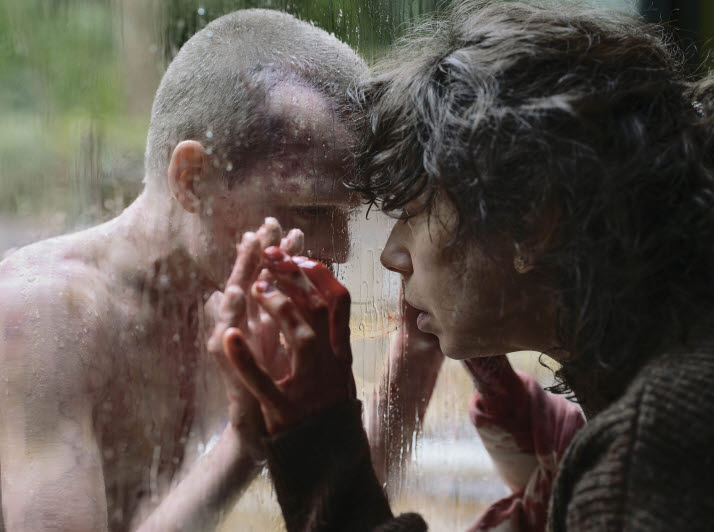
Overall, “Predator: Killer of Killers” is another entertaining film from its franchise after “Prey”. Like that movie, the film demonstrates that there is still some potential for more intrigue and entertainment in the franchise, and I come to have more admiration on the skills and talent of Trachtenberg, who made a solid feature film debut with “10 Cloverfield Lane” (2016) and will soon give us another Predator flick around the end of this year. In my humble opinion, the franchise is finally in the right direction thanks to him, and I am already ready to be entertained by his next Predator film.
Posted in Movies | Tagged , , , | Leave a comment

Deep Cover (2025) ☆☆☆(3/4): Improv squad

“Deep Cover”, which was released on Amazon Prime in last week, generates laughs from its outrageous story premise as much as possible, and I enjoyed that. While this is another typical “fish-out-of-water” comedy film, the movie shows more wit and humor than expected, and it will certainly make you giggle or chuckle more than once (Full Disclosure: I did).

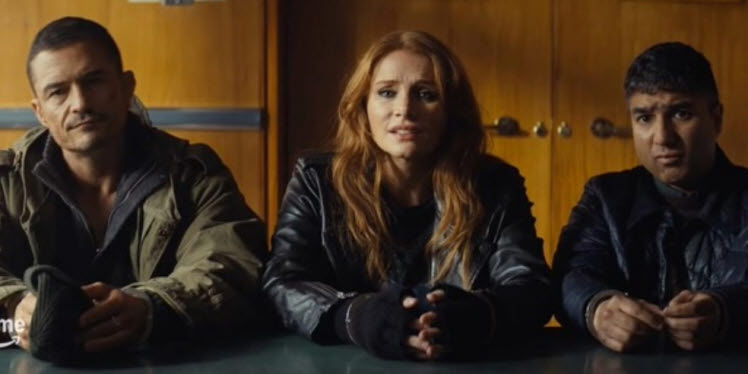
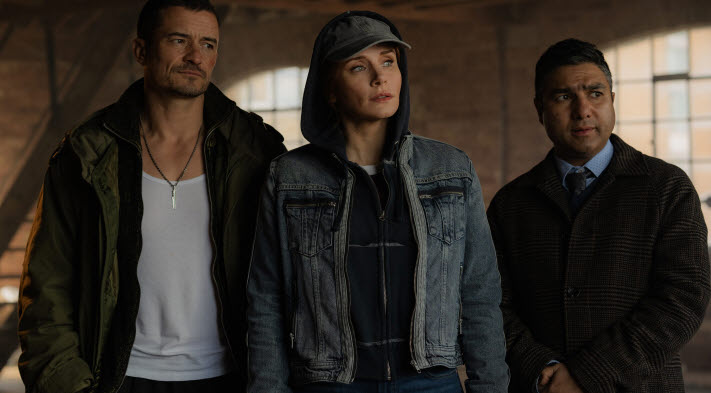
At first, we are introduced to its three different main characters: Kat (Bryce Dallas Howard), Marlon (Orlando Bloom), and Hugh (Nick Mohammed). While Kat is a struggling stand-up American comedian who works as an improvisation theater teacher in London, Marlon is an unemployed method actor who often takes his acting a bit too seriously, and Hugh is a meek IT worker who desperately wants to be, well, funny.

Not long after Marlon and Hugh join Kat’s improvisation theater, Kat is approached by a cop who gives an offer she cannot refuse. The cop wants Kat and two other performers to help his little sting operations, and Kat accepts the offer because 1) she and her fellow performers will be paid enough for each operation and 2) she surely needs some challenge at present. Although Marlon and Hugh are not exactly ideal acting partners for her, she persuades them to join her in this risky but interesting acting challenge, and they soon embark on their first sting operation.

Of course, Kat and her acting partners do not click that well with each other at first, but then they find some chemistry among them, and then they deliver a much bigger success than their handler expected. They subsequently find themselves involved with a number of important criminal figures, and that is where their handler pushes them into more challenge. Now they have to be undercover agents for him, and Kat and her acting partners must take much more risk than before as approaching to their main target.

Steadily maintaining the enough level of tension along the story, the screenplay by Colin Trevorrow, Derek Connolly, Ben Ashenden, and Alexander Owen has a lot of fun with how Kat and her acting partners manage to survive via their improvisation skill. While Kat is usually the one who sets the ground for their acting, Marlon holds the ground with his total professional commitment, and Hugh surprises himself as well as his acting partners as demonstrating that he is actually a good actor. In fact, he is so good in his improvisation that he somehow makes himself look really like a dangerous criminal, and that leads him to an unlikely chance of romance, though he can be killed at any moment if he is not careful.

Meanwhile, the movie gradually raises the stake for its three main characters as they eventually meet their main target, who is incidentally one of the most powerful and dangerous criminal figures in the town. This figure in question shows them that he is definitely not someone to mess with, and Kat and her acting partners become all the more nervous as their situation becomes a lot more complicated and perilous than expected.

Nonetheless, the movie does not lose any sense of humor while continuing to generate more laugh and amusement for us. At one point, Kat and her acting partners are tasked with handling the aftermath of a killing just because they are supposed to be hardcore criminals, and we are amused by how much they struggle to hide their frantic desperation from their criminal associates. I was also tickled by Kat’s very awkward (and risky) encounter with her friends at one point in the story, and that leads to one of the most hilarious moments later in the film,

Like any good comedy film, the movie depends a lot on the good comic timing among its main performers, who are funny and engaging in each own way as deftly generating the comic momentum among them. While Bryce Dallas Howard imbues her character with enough pluck and charm, Orlando Bloom, who seems to become more interesting as he is aging away from his famous role in Peter Jackson’s the Lord of the Rings trilogy, demonstrates the unexpected side of his acting talent, and Nick Mohammed, who has been more notable thanks to his Emmy-nominated supporting turn in Apple TV+ comedy series “Ted Lasso”, holds his own place well between his two co-stars.

In addition, the movie places a bunch of recognizable performers here and there in the story. As a criminal who turns to have some soft heart, Paddy Considine has his own small comic moments, and so is Sonoya Mizuno, who was memorable in her small but crucial supporting performance in Alex Garland’s “Ex Machina” (2014). In case of Sean Bean and Ian McShane, they surely know well how to play their seedy archetype roles as veteran performers, and McShane gladly chews every moment of his in addition to exuding enough menace as required.

In conclusion, “Deep Cover”, which should not be confused with Bill Duke’s 1992 film “Deep Cover”, is a solid comedy movie packed with enough wit and humor, and director Tom Kingsley, who previously made “Black Fond” (2011) and “The Darkest Universe” (2016), did a commendable job on the whole. In short, this is one of the better products from the major streaming services during this year, and you will not be disappointed if you just want to have some big laughs.

Posted in Movies | Tagged , , | Leave a comment

One of Them Days (2025) ☆☆☆(3/4): One eventful day of theirs

“One of Them Days” is a colorful comedy film about one bumpy adventure of two African American ladies. Right from the beginning, you will have a pretty good idea about how the movie will roll its story and characters to its expected finale, but it is constantly buoyed by a series of effective comic moments, and, most of all, it is held together well by the talent and presence of its two good lead actresses.

At the beginning, we see how things look promising for Dreux (Keke Palmer) on one day, a young black woman who has diligently worked as a waitress at some local diner of one neighborhood in LA. Thanks to her diligence as well as resourcefulness, Dreux finally gets a chance for promotion, and all she will have to do now is making some good impression during the upcoming interview to be held at PM 4:00.

However, alas, she soon faces a big problem due to her best friend/roommate Alyssa (RZA), a struggling artist who has not sold any of her paintings yet. Alyssa is supposed to hand their rent to their rather strict landlord, but, unfortunately, her useless current boyfriend took it for financing another idiotic business plan of his, and now she and Dreux will be evicted out of their shabby apartment building if they fail to pay the rent, which is no less than $ 1500, within 8 hours.

As Dreux and Alyssa try to find any possible option for them, we get to know more about their friendship as well as their contrasting personalities. While Dreux is relatively more serious and thoughtful, Alyssa is often impulsive and thoughtless, and they frequently cannot help but bicker with each other – even while trying to stick together for handling their impending matter as soon as possible. Some of the most humorous moments in the film come from their rocky relationship dynamics, and Keke Palmer, who has been more prominent thanks to her wonderful recent supporting turn in Jordan Peele’s “Nope” (2019), and SZA, a musician whose real name is incidentally Solána Imani Rowe, did a good job of conveying to us how much their characters are accustomed to each other.

Once its two main characters and their faulty relationship are established, the screenplay by Syreeta Singleton doles out one episodic comic moment after another for our amusement. There is a silly but undeniably hilarious scene involved with a certain feisty black woman who gets involved with Alyssa’s crummy boyfriend, and then there is an equally funny scene where Dreux and Alyssa try on a local loan company which promises a quick money with a very, very, very high interest (My personal advice from some real experience: Be careful with any kind of loan even if you are quite desperate, because loan is bound to get increased in one way or another unless you are really careful and frugal). My personal favorite scene is the one where Janelle James, who has been mainly known for her Emmy-nominated supporting turn in American TV sitcom series “Abbott Elementary”, makes a brief appearance, and its eventual payoff moment will certainly tickle you for a bloody good reason.

Although it extends its deadline a bit later in the story, the movie keeps bouncing with spirit and humor – even when Alyssa and Dreux inadvertently find themselves threatened by a notorious local gangster boss. It is not much of a spoiler to tell you that our two ladies will eventually find a way to get enough money to solve their impending trouble, but you will be surprised a bit by how they eventually come upon that solution, and you will certainly root for them more than before.

While their characters go up and down together as expected, Palmer and SZA deftly complement each other with good comic chemistry from the beginning to the end, and they also provide some gravitas as fleshing out their respective characters with more human details. As observing more of how serious she is about that precious chance of promotion, we come to understand and care more about Dreux and her sincere aspiration, and then we also come to sense more of how much she has been supported by her imperfect best friend. Although she is your average walking trouble to her best friend’s annoyance and frustration, Alyssa remains loyal and true to Dreux, and, what do you know, she actually turns out to be much more helpful than expected later in the story.

Palmer and SZA are also supported well by a number of various supporting performers who have each own moment to shine around them. Katt Williams effortlessly steals the show as a homeless dude who gives Dreux and Alyssa a bit of wise warning before they go to that loan company, and Lil Rel Howery does not disappoint us at all with his skillful comic timing even though he only appears in one single scene. While Aziza Scott brings some comic tension as a crucial supporting character in the story, Patrick Cage is well-cast as an unlikely love interest for Dreux, and Maude Apatow, who is the elder daughter of Judd Apatow and Leslie Mann, is also effective as a new neighbor in Dreux and Alyssa’s apartment building.

On the whole, “One of Them Days” is pretty predictable at times, but it delivers some good laughs thanks to not only its two wonderful lead actresses but also the competent direction of director Lawrence Lamont, who incidentally makes a feature film debut here after making several music videos. Although it does not exceed my expectation, the movie amused and then entertained me enough at least, so I will not grumble for now.

Posted in Movies | Tagged , , | Leave a comment

Life Is Beautiful (1997) ☆☆☆1/2(3.5/4): As a clown as well as a father

I cannot help but marvel at what is so cheerfully, masterfully, and touchingly done in Roberto Benigni’s 1997 Oscar-winning film “Life Is Beautiful”, which was re-released in South Korean theaters early in this month. This is a very special film which dares to attempt one inherently tricky stunt between drama and comedy, and the result still beautifully works as a comic fable of luck, defiance, and love.

The first half of the film is quite lightweight to say the least, but it is actually very crucial in establishing the ground for its comic hero, who can be regarded as a sort of holy clown for good reasons. Although he may look a bit too silly and annoying at first, Guido Orefice, who is played by Benigni himself, is always good at charming others around him thanks to his good nature as well as his rather incredible luck and clever acts of improvisation, and the first half of the movie presents a series of comic situations where he somehow gets away with one thing after another for our smile and amusement.

At the beginning of the story, which is set in 1939, Guido and his friend have just arrived at a little town for working along with Guido’s aging uncle at a local hotel, and that is how he comes across a pretty young female schoolteacher named Dora (Nicoletta Braschi). Although their first encounter is not exactly romantic, Guido soon finds himself quite attracted to Dora, and, what do you know, he comes to appear in front of Dora again and again thanks to not only several wily moves from him but also some good luck for him.

Yes, his active romantic pursuit may look a bit creepy to us these days, but Benigni’s ebullient spirit, which incidentally contributed to one of the most memorable moments at the 1999 Academy Awards when he won a Best Actor Oscar (The movie also won in Best Foreign Language Film and Best Original Dramatic Score in addition being nominated for Best Picture, Best Director, and Best Screenplay, by the way), is simply infectious on the screen. Just watch how effortlessly he bounces from one comic moment after another, you can easily see why Dora comes to like and then fall in love with his character even though he is a total stranger to her from the very beginning.

Playing her character as straight as possible, Nicoletta Braschi ably complements her co-star who is also her husband, and her earnest performance comes to function as the solid counterpart for her husband’s irrepressible comic energy. Besides his sincere presentation of love, Guido always surprises Dora as managing to bring a little but precious bit of magic and romance to those private moments between them, and this eventually prompts her to walk away from her lousy fascist fiancé for marrying Guido instead.

The second half of the movie begins with how happy Guido and Dora are with their little son several years later, but we observe more of how things have become gloomier for Guido and many other Jewish people in the city. Nonetheless, Guido remains optimistic and spirited as usual while constantly covering the harsh reality from his son – even when he and his son and uncle are inevitably taken along with other Jewish people to a concentration camp located somewhere in Italy.

Around this narrative point, the screenplay written by Benigni and his co-writer Vincezo Cerami enters a very, very, very risky territory. Quite determined to protect his son as long as possible, Guido lies to his son right from their first day at the concentration camp that they and others around them are playing a long-term hide and seek game for winning the first prize, and his innocent son does not have any problem with going along with that.

This is not very realistic to say the least, but, as I said earlier in this review, the movie is intended as a fable instead of a realistic Holocaust drama film. As he did in the first half of the film, Guido simply continues his daring comic dance between sheer luck and smart improvisation, and the concentration camp is just another test on how far he can go with that. Like those artist characters of Ernst Lubitsch’s “To Be or Not to Be” (1942) or the master of ceremony in Bob Fosse’s “Cabaret” (1972), he simply makes a defiant stance against fascism in his own humorous but courageous way, and there is undeniable poignancy in that – especially when he keeps his usual attitude despite finally being at his wits’ end.

More than 25 years have passed since the movie came out, but it is still remarkable to observe how the movie somehow succeeds in striking the right balance with its very sensitive story materials. Around the time of its initial theatrical release, the movie was understandably criticized a lot for trivializing the grim history of the Holocaust, but I must point out that 1) it wisely avoids being too dark and gloomy for its comedy and 2) it also indirectly recognizes the horror and despair of the Holocaust from time to time. Just look at a brief but clearly tragic moment involved with Guido’s uncle, and you will see that the movie is indeed serious about its historical subject even while doing its tricky genre stunt along with its comic hero.

In conclusion, “Life Is Beautiful” is a sublime mix of comedy and drama which has endured the test of time fairly well after going through all the hoopla surrounding it at that time. Unfortunately, Benigni’s career got crashed down to a considerable degree because of the critical failure of his very next film “Pinocchio” (2002), but “Life Is Beautiful” remains as his crowning achievement nonetheless, and, considering its current IMDB ranking, I believe it will be continued to be loved and cherished by audiences as before.

Posted in Movies | Tagged , , , , , , | Leave a comment

Pierrot le Fou (1965) ☆☆1/2(2.5/4): Two abstract figures on the run

In my inconsequential opinion, any serious young movie enthusiast is bound to be fascinated with the works of Jean-Luc Godard at first. After all, he is one of the greatest filmmakers in the cinema history besides being one of the most prominent members of the French New Wave during the 1950-60s, and some of his notable works including “Breathless” (1959) and “Vivre sa vie” (1962) have been quite influential for many years.

However, as getting older and more experienced besides having each own taste, some of those young movie enthusiasts may eventually feel more distant to many of Godard’s works just like I often did during last 20 years. Oh, yes, I once did enjoy some of his stylish experiments including “Contempt” (1963) and “Weekend” (1967), but then my reliable bullsh*t detector was turned on as I was subsequently quite baffled and frustrated with his several later works including “Goodbye to Language” (2014), and I came to observe many of his films with more skepticism and reservation while still admiring his undeniable contribution to the art of cinema.

In case of his 1965 film “Pierrot le Fou”, whose recently remastered edition happened to be released in South Korean theaters early in this month, it is an admirable exercise in style which unfortunately did not engage me as much as it did when I watched it for the first around 20 years ago. While it is certainly as distinctive as you can expect from your average Godard film, you can clearly sense that there is not enough substance to support its stylish genre game, and it also sadly reflects more of how Godard began to regard himself too seriously around that time in contrast to many of his fellow French New Wave filmmakers including François Truffaut (Full Disclosure: I like him much more than Godard).  

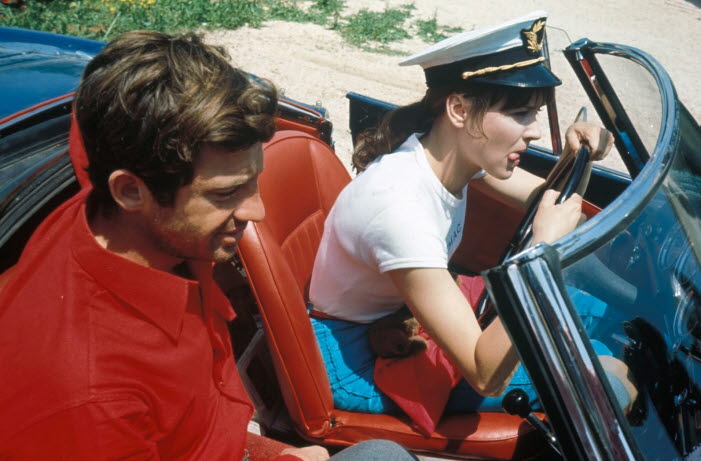
The movie, which is based on Lionel White’s rather obscure novel “Obsession”, is about two contrasting figures who somehow get involved with each other despite having nothing common between them. At first, we are introduced to a middle-class writer named Ferdinand Griffon (Jean-Paul Belmondo, who feels less cocky compared to his breakout turn in “Breathless”), and the early part of the film quickly establishes how much he has been discontented and frustrated with his current status. While he has lived quite comfortably thanks to his rich wife, he was recently fired from his job at some broadcasting company without much prospect at present, and he has been wondering whether he should seriously try on a writing career someday.

Ferdinand’s hollow state of existence is mainly reflected by one evening party which he reluctantly attends along with his wife. A lot of talks and discussions are exchanged among him and many others at the party, but our eyes are drawn more to how Godard presents this sequence with a lot of visual touches, which, at least to me, do not seem to serve any particular purpose on the whole just like the rather gratuitous exposure of female breasts or the brief appearance of a certain legendary American filmmaker.

Anyway, Ferdinand eventually decides to commit a bit of transgression along with his ex-lover Marianne (Anna Karina), who happens to be associated with some unspecified criminal scheme when Ferdinand returns to her. When he enters her apartment, there is the body of a murdered man, but he does not seem that alarmed at all by that or several guns in her apartment, and he eventually runs away along with Marianne even though there is not much love or attraction between them from the start. 

When they are not running away, he and Marianne often talk about whether they really love each other or not, but their rather disjointed conversations make them look more like puppets to be manipulated by Godard in one way or another. For instance, they frequently mention a lot of American culture stuffs ranging from Laurel and Hardy movies to William Faulkner and Raymond Chandler, and there are even several supposedly comic scenes where they attempt to embody some of these stuffs for no apparent reason.

In addition, Marianne often calls Ferdinand “Pierrot” without explaining anything to him or us. As far as I can see, she simply enjoys his annoyance and bafflement from that, and Anna Karina, who incidentally divorced Godard around the time when the movie came out, did a good job of imbuing her character with some mischievous spirit.   

As the movie aimlessly bounces from one point to another along with its two main characters without much narrative momentum to hold our attention, Godard peppers the story here and there with a series of superficial political statements which do not stick that much to us on the whole. At one point later in the story, he has his two lead performers do a silly comic sketch supposedly satirizing the geopolitical situation in Vietnam during the 1960s, but I think this can be a bit too crude and insensitive for Asian audiences now. In short, this is probably another example showing the increasingly glaring artistic limits of a European white male filmmaker during that period.

In conclusion, “Pierrot le Fou” is fascinating to some degree at times, but I do not think it is as great as “Breathless” or “Vivre sa vie”. Nevertheless, you need to check it out if you are a serious movie enthusiast willing to watch and learn more, and, regardless of whether you will like it or not, it will show you more of Godard’s filmmaking style in addition to helping you shape your own opinion on his works. Like there are dog persons and cat persons, there are also Godard persons and Truffaut persons, and please let me know which kind of person you are.

Posted in Movies | Tagged , , | Leave a comment

How to Train Your Dragon (2025) ☆☆1/2(2.5/4): Is this really necessary?

“How to Train Your Dragon”, the live action movie version of the 2010 animation film of the same name, is fairly enjoyable but also quite unnecessary in my humble opinion. Although this is a competent product which will probably satisfy most of its target audiences, it sadly does not bring anything particularly new or fresh to the story and characters, while only reminding us again of how live action film cannot usually surpass animation films in terms of mood, style, and detail.

Above all, my mind remembers too much of how much I was entertained and electrified when I watched the 2010 animation film for the first time. Shortly after returning from my little trip to Chicago and the 2010 Ebertfest in April, I was quite exhausted and depressed after the inevitable end of all those fun and excitement during that glorious time (I met and talked a lot with Roger Ebert and my fellow Far-flung foreign correspondents, for example), but then there came two special films which rejuvenated me to a considerable degree. First, I watched the restored version of Fritz Lang’s great silent film “Metropolis” (1927) at the 2010 Jeonju International Film Festival, and then I watched the 2010 animation film, which was incidentally released in South Korean theaters not long after that.

I must confess that I gave the 2010 animation film only three stars out of four as regarding it as another usual Hollywood blockbuster animation film, but, what do you know, it has grown on me along with its two subsequent sequels which are equally entertaining. Besides its colorful characters to remember, it is also packed with a lot of style and personality to be savored, and its dragon flying sequences are as spirited and exciting as the ones in James Cameron’s ambitious SF blockbuster film “Avatar” (2009). Not so surprisingly, I watched it no less than three times during its first several weeks in South Korean theaters, and I always enjoyed every minute of it without getting bored at all.

However, the live action film version does not engage or amaze me that much even though having all the same elements to be mixed in the pretty much same way. While there are some additions and variations here and there in the film, its overall result still does not distinguish itself a lot from its animation film version, and that made me want to revisit the 2010 animation film version more than before.        

In addition, there are a number of main elements in the live action film version which are unfortunately deficient in comparison. For instant, its meek but resourceful young hero Hiccup (Mason Thames) feels plainer and more colorless, and this will probably make you appreciate more of how Jay Baruchel’s nerdy but likable voice performance imbues a considerable amount of spirit and personality to Hiccup in the 2010 animation film version.

And look at all those broad supporting characters surrounding Hiccup in the live action film version, who often just look like a group of performers doing their job in front of the camera instead of feeling like real characters to observe. Yes, their counterparts in the 2010 animation film look quite cartoonish at times, they are much more memorable as bringing some extra humor and personality to the story.

As a matter of fact, only Gerard Butler, who reprises his role from the 2010 animation film, seems to understand the task given to him and his fellow cast members in the live action film version. As Hiccup’s macho father who is also the chieftain of their Viking clan living in one remote island, he gleefully chews every scene of his in the film with Scottish accent (Don’t ask me whether this is ethnically or culturally accurate or not), and he also brings some inner sensitivity to his character as he did wonderfully in the 2010 animation film.

In case of all those dragon characters in the film, they certainly look as realistic as possible thanks to good special effects, but, not so surprisingly, they do not have enough sense of awe and wonder compared to their animation counterparts. Director/writer Dean DeBlois, who co-directed and co-wrote the 2010 animation film, and his crew members including cinematographer Bill Pope try their best here, but I must point out that Hiccup’s accidental pet dragon Toothless and many other dragon figures look a lot more colorful and interesting in the 2010 animation film. In the live action film version, they are just a bunch of well-made CGI figures, and Toothless somehow looks a bit less charming here to my little disappointment.

The live action film version will not probably let you down in case of its several dragon flying sequences, but they are almost exactly identical to what we already experienced from the 2010 animation film version, and the score by John Powell, who was deservedly Oscar-nominated for the 2010 animation film (His score should have won instead of Trent Reznor and Atticus Ross’ tacky hipster electronic linoleum score for David Fincher’s “The Social Network” (2010), by the way), is pretty much same except some necessary orchestral modification. Even though he is simply demanded to repeat one of his greatest career achievements here, Powell admirably sticks to what made his 2010 score so special, and his another solid effort ironically drew me back more to the 2010 animation film.    

In conclusion, “How to Train Your Dragon” may entertain you as much as you pay for your ticket, but I am still asking myself whether this is really necessary from the start. At this point, it is quite possible that those two sequels of the 2010 animation film will also be adapted into live action film, and, folks, that prospect makes me depressed more instead of being actually excited or interested.

Posted in Movies | Tagged , , , | Leave a comment

Bring Her Back (2025) ☆☆☆(3/4): Their insidious foster mother

Danny and Michael Philippou’s latest horror film “Bring Her Back” is an intense and compelling experience which actually made me cringe more than once during my viewing. Just like their previous film “Talk to Me” (2023), the movie is quite willing to explore that dark territory of personal trauma and grief, and it admirably held my attention to the end even though it disturbed and horrified me more and more along the story.

The story mainly revolves around Andy (Billy Barratt) and Piper (Sora Wong), two underage half-siblings who suddenly become orphaned after the unexpected death of their widower father. Because there is not any close family member around them, Andy and Piper soon find themselves under the supervision of a local social worker, and their social worker promptly decides that Andy and Piper should be under foster care before Andy becomes old enough to apply for the guardianship on his younger half-sister.

The selected foster mother for Andy and Piper is a single woman named Laura (Sally Hawkins), who looks ideal for both Andy and Piper on the surface. When Andy and Piper arrive at her house incidentally located in the middle of some remote forest area, Laura cheerfully welcomes Andy and Piper, but Andy cannot help but feel awkward for good reasons. Laura seems to care a lot about Piper because Piper is visually impaired just like Laura’s dead daughter, but she pays relatively less attention to Andy, and Andy is also often disturbed by the presence of Oliver (Jonah Wren Phillips), another foster kid in Laura’ house who, according to Laura, has been mute due to some unspecified trauma.

Because he knows well that he can be separated from his younger half-sister at any chance, Andy chooses to try to adjust himself to the new environment of theirs as much as possible, even while becoming more aware of their foster mother’s insidious sides. At one point, Andy and Piper attend their father’s funeral along with Laura, and Laura pushes Andy into showing a bit more respect and affection to his dead father’s body, even though that turns out to be the last thing he wants to do right now.

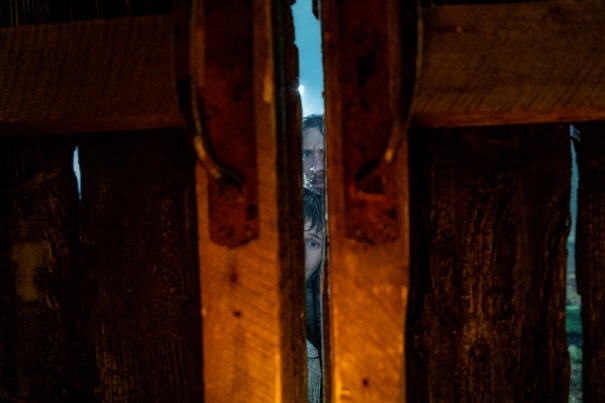
 And we observe a number of suspicious signs from Laura and her house. There is a shabby warehouse not so far from an empty swimming pool in front of the house, and it is apparent that she does not want Andy or Piper to go inside that small building. There is a mysterious white line circling around the house and its little surrounding space, and we come to see later that this is not a mere perimeter at all. Above all, there is also a certain disturbing video tape clip shown to us a bit at the beginning of the movie.

Along with their cinematographer Aaron McLisky, the Philippou brothers steadily dial up the level of creepy tension on the screen. Laura and her house are frequently shrouded in gloomy ambience, and this often makes a chillingly ironic contrast to how Laura makes everything sound fine and good in front of Piper, who is often oblivious to what is happening around her and her older half-brother.

Needless to say, Andy becomes more desperate as coming to sense more of how Laura manipulates both him and Piper for putting more distance between them. Besides touching more on Andy’s traumatic relationship with his dead father, Laura does not hesitate to commit some truly nasty things to him, and Andy consequently finds himself pushed toward more anxiety, dread, and desperation.

 Around the narrative point where we get to know more about what Laura has been planning behind her back, the movie doles out a series of grim moments of shock and horror. It will definitely jolt you a lot with a considerable amount of extreme violence and gore during these moments, but these moments are also fueled by recognizable human motives and emotions, and that is the main reason why we remain engaged in what is being at stake for the main characters around the end of the story.

The main cast members of the film are all effective in their respective parts. While Billy Barratt holds the center with his earnest performance, young newcomer Sora Wong is solid even though she did not have any previous movie acting experience, and they are also believable in the relationship dynamics between their characters along the story. On the opposite, young performer Jonah Wren Phillips looks so convincing in several key scenes of his that you may need to be assured that he was not physically or mentally harmed at all during the shooting, and Sally Hawkins totally surprises us as demonstrating another side of her immense talent via her against-the-type casing. At first, Hawkins looks as cheery and comforting as she did in “Paddington” (2014) and its 2017 sequel, but she soon effortlessly dives into the darker sides of her character without any hesitation, and the result is another stellar performance to added to her impressive career.

On the whole, “Bring Her Back” is another good genre piece from the Philippou brothers, and I appreciate how they skillfully handle the story, mood, and characters to generate enough intrigue and horror for us. With “Talk to Me” and “Bring Her Back”, they show us that they are another interesting filmmaker to watch, and I will certainly look forward to watching whatever may come next from them.

Posted in Movies | Tagged , , | Leave a comment