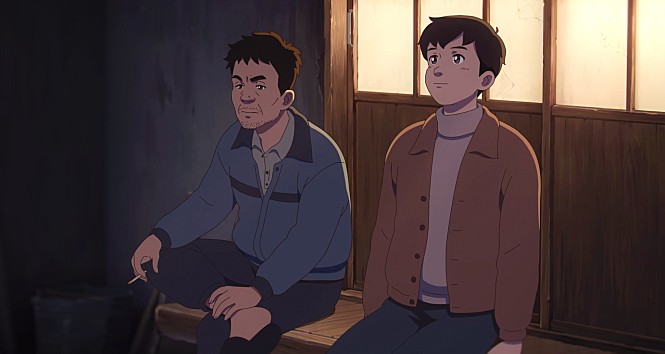
The Summits of Gods (2021) ☆☆☆(3/4): Following after a mountaineer

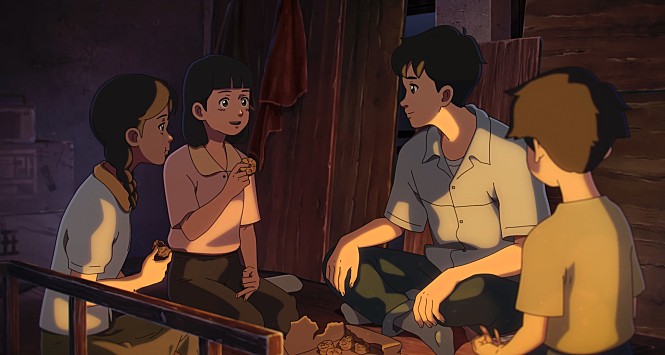
At first, Netflix animation film “The Summits of Gods”, which was released a few days ago, draws our attention for its odd combination. Although it is based on a Japanese manga series of the same name written and illustrated by Jiro Taniguchi (It was developed from Baku Yumemakura’s 1998 novel, by the way), the film is actually made in France, and you may find it rather awkward to see those Japanese characters in the film speaking in French, even while admiring those gorgeous visual moments rendered in cell animation.

The story begins with a photographer named Makoto Fukamachi (voiced by Damien Boisseau), who is doing his latest assignment for a mountaineering magazine around Everest of the Himalayas during the opening scene. Although he does his best for capturing a bunch of Japanese mountaineers trying to climb on Everest, but these mountaineers’ attempt is soon aborted due to an unexpected bad weather, and everyone returns to Kathmandu in the end.

When he is drinking along with others at a local bar, Fukamachi was approached by someone trying to sell a certain old camera to him. According to that person, this camera once belonged to George Mallory, who attempted to climb Everest in 1924 but was unfortunately gone missing while presumed to be dead somewhere in Everest. Fukamachi naturally does not believe that at all, but then he comes across a mountaineer named Habu Joji (voiced by Eric Herson-Macarel), and, after witnessing Joji taking away the camera from that person, Fukamachi becomes convinced that that camera really belonged to Mallory.

And we hear from Fukamachi about why Mallory’s camera is so important. As many of you know, Sir Edmund Hillary and Tenzing Norgay are officially the first ones to succeed in reaching to the top of Everest, but it was also speculated that Mallory actually succeeded first. If he did photograph his moment of success as he promised before trying to climb on Everest, that camera will surely give a big news to surprise the world.

However, as he embarks on searching for Joji, Fukamachi is reminded again and again of how elusive and anti-social Joji has been throughout his whole life. Since he was young, Joji has been quite passionate about climbing mountains, but he did not get along that much with his fellow mountaineers, and he often let himself ostracized by many of others around him. Always looking more serious in comparison, he even did not hesitate to say that he will definitely save himself first instead of letting himself and his partner die together under a certain impossible circumstance, and that certainly killed the mood among him and others.

Of course, such a situation like that soon happened to him as expected when Joji subsequently tried to climb on a big rock wall along with a young man who had worshiped him from the beginning. What eventually happened after a long and grueling period between both of them is pretty devastating to watch to say the least, and that consequently pushed Joji into more solidarity as he kept driving himself into more risk and peril. At one point, we see Joji attempting on one of the most dangerous climbing routes in the Alps, and that is followed by a literally chilling scene where he must not only deal with the extreme weather condition but also confront his growing guilt about that unfortunate incident.

Around the point where Fukamachi is approaching closer to Joji than before, the film gives us a bunch of impressive visual moments to behold. Director/co-writer Patrick Imbert and his crew did a fairly good job of evoking the texture and details of Japanese animation on the screen, and they certainly did their best in case of the scenes depicting those snowy landscapes of the Alps and the Himalayas. These scenes look quite striking on the screen, and I particularly like one involved with a big and wide crevice which looks pretty daunting for its unfathomable depth.

Meanwhile, the story brings some human depth to both of its two main characters. While that camera eventually turns out to be more or less than a MacGuffin (Is this a spoiler?), we get to know more about Joji’s constant attraction toward climbing onto those high mountains, and we also come to sense more of why Fukamachi was drawn to that camera as well as Joji. As one slowly follows the other later in the story, the film gradually becomes a sort of meditation on human nature, and those gorgeous depiction of cold and snowy summits in the film come to feel more haunting than before.

On the whole, “The Summits of Gods” is a fairly solid piece of work reminiscent of several notable mountaineering documentaries ranging from “Touching the Void” (2003) to “14 Summits: Nothing Is Impossible” (2021), which also is incidentally available on Netflix at present. Although the story and characters are rather simple and broad in my humble opinion, the film compensates for this weak aspect enough via its excellent visual depiction of the risks and challenges of climbing on those high rocky places, and that reminds me again of why cell animation is sometimes better than digital animation in terms of style, mood, and drama. Yes, as I said you before more than once, I am your average indoor guy who never dreams of climbing onto such risky spots like Everest, and I surely winced more than once while watching “The Summits of Gods” at last night, but I am willing to savor its several good moments again someday.

Posted in Movies | Tagged , , | 2 Comments

Benedetta (2021) ☆☆☆(3/4): Verhoeven strikes again

Paul Verhoeven’s new film “Benedetta” is a decidedly salacious period drama peppered with some nudity, violence, and cynicism. Although it is relatively less wild, violent, and sensational compared to many of Verhoeven’s notable works, the movie is still another provocative work of his, and, although observing its main characters from the distance during my viewing, I actually enjoyed several blatantly vulgar moments wrapped inside its amusingly sanctimonious attitude.

At the beginning, the movie, which is set in the 17th century Italy, shows us the early life of a nun named Benedetta Carlini (Virginie Efira). When she was very young, her rich merchant father sent her to the abbey of a content in a small town of Tuscany, and we get a moment of sardonic black humor as her father and the Abbess, played by Charlotte Rampling, come to have some conflict on how much he has to pay for her daughter being accepted into the abbey. No matter how much he tries to persuade her, the Abbess remains unflappably no-nonsense as before, and Benedetta’s father eventually agrees to accept her conditions.

Although the rest of her life will be stuck in the abbey forever, young Benedetta is quite eager to devote herself to her God, and, as reflected by the opening scene, she also seems to have some genuine spiritual connection with her God. During her first night in the abbey, a strange incident happens, and the Abbess and many other nuns in the abbey are naturally baffled even though they just put aside their bafflement in the end.

When Benedetta grows up to be a young woman 18 years later, there comes an unexpected change into the abbey. While she is spending her time with the Abbess and her visiting parents, a shabby peasant girl suddenly comes in the abbey for getting anyone to help her free from her abusive father. Because she instantly takes a pity on her, Benedetta persuades her parents to get this poor peasant girl to be allowed into the abbey, and Bartolomea (Daphne Patakia) soon becomes the new member of the convent.

Things go well during next several days, but it turns out that Bartolomea cannot repress her wild free spirit well. She and Benedetta initially get along well with each other, and we get another naughty moment to tickle you due to its scatological humor, but then Benedetta experiences something quite thrilling when Bartolomea approaches to her a bit too closely while nobody is watching around them.

As already shown from a series of dream scenes which feel as sacrilegious as you can expect from Verhoeven, Benedetta has developed a sort of religious mania inside her, and that becomes quite more serious after that incident of hers with Bartolomea. At first, she becomes quite vicious to Bartolomea during one certain scene which will make you wince for a good reason, and then she is subsequently thrown into a bout of inexplicable hysteria at one night.

And that is the point where the story becomes more deranged than before. Besides her increasingly serious fits, Benedetta also often shows something which suggests that she is actually a saint chosen by God, and nearly everyone around her begins to believe her words without hesitation. After all, things have been pretty gloomy for everyone inside and outside the abbey due to a spreading plague epidemic, and Benedetta soon comes to get considerable influence over the abbey to the displeasure of the Abbess.

While Benedetta and the Abbess eventually clash more with each other after one devastating incident happens during one rather ominous night, the screenplay by Verhoeven and his co-writer David Birke, which is based on Judith C. Brown’s nonfiction book “Immodest Acts: The Life of a Lesbian Nun in Renaissance Italy”, also focuses on the growing romantic relationship between Benedetta and Bartolomea. Once Benedetta gets the full control over the abbey later in the story, she and Bartolomea heedlessly throw themselves into their love and passion, and Verhoeven does not disappoint us at all in case of their expected sex scene. In addition, the movie also pays some attention to a little special present from Bartolomea, and that is certainly another big laugh for us.

Of course, the situation inevitably becomes quite serious with the entrance of the character played by Lambert Wilson, who has a nasty little fun as a haughty dude quite willing to punish our two lesbian lovers by any means necessary. As a result, we are served with a torture scene which is thankfully presented with some admirable restraint, and then there inevitably comes a big dramatic moment of good old burning-at-the-stake.

Even around that point, we still maintain some distance from all of the main characters in the story, but the movie continues to hold our attention thanks to Verhoeven’s competent handling of story and characters, and his main cast members are fearless as willingly going along with his sardonic approach. Although her character is often a bit too elusive to sympathize with, Virginie Efira is still compelling while complemented well by Daphne Patakia’s unadorned forthright acting, and Wilson and Rampling have each own moment to shine as the other crucial parts of the story.

Overall, “Benedetta” is one or two steps down from Verhoeven’s better works including “Black Book” (2006) and “Elle” (2016), but it is still a fairly interesting work thanks to the commendable efforts from Verhoeven and his main cast members. I must confess that I was a bit sleepy during its first 30 minutes, but I soon became less sleepy as gleefully following its story and characters, and I am glad to report that Verhoeven is still a dirty (and talented, of course) old filmmaker even at present.

Posted in Movies | Tagged , , , , , | 1 Comment

14 Peaks: Nothing is Impossible (2021) ☆☆☆(3/4): Project Possible

Netflix documentary “14 Peaks: Nothing Is Impossible”, which was released on this Monday, is about one extraordinary achievement which certainly deserves to be known more to us. As reflected by the very title of the documentary, the hero of the documentary and his team succeeded in climbing all 14 eight-thousander peaks of the Himalayas within less than a year, and the documentary gives us a close look into their ambitious project which was surely quite risky and demanding from the beginning.

At first, we are introduced to a Nepalese dude named Nirmal Purja, and the documentary alternates between his life story and the gradual progress of his project. As the youngest son of a poor family in Kathmandu, Nepal, Purja has always been drawn to challenging tasks to prove himself more since he was young, and that was one of the main reasons why he decided to climb all those 14 summits of the Himalayas within several months in 2019 even though nobody had ever tried to do that within such a short period before. Since renowned Italian Mountaineer Reinhold Messner succeeded in climbing all the 14 summits during 1970-1986, a number of other mountaineers also accomplished the same thing, but it took more than 5 years even in the case of the shortest record time in the bunch.

Nevertheless, Purja was not daunted at all as he has been quite accustomed to physically arduous tasks throughout his whole life. After all, before he decided to pursue a mountaineering career, he was in the Brigade of Gurkhas of the British Army and then subsequently joined the Special Boat Service (SBS), the special forces unit of the Royal Navy. Once he successfully went through all those difficult military trainings, he was later put into real combats, and he tells us about one scary incident where he avoided death thanks to sheer luck.

Although his old parents had depended a lot on the money from his military career, Purja decided to quit the army in 2018 because of his growing passion toward mountaineering, and he promptly embarked on gathering enough fund for his project, but, understandably, nobody was interested in funding “Project Possible” because it felt too impossible to say the least. Nevertheless, Purja did not give up at all, and, with the agreement from his ever-understanding wife, he eventually got the fund via re-mortgaging their house.

Besides testing on whether he was physically fit enough to accomplish the aim of Project Possible, Purja also assembled the team. His team members were all his fellow Nepalese mountaineers, and that meant a lot to all of them because their success would bring more attention to not only their country but also many overlooked Nepalese mountaineers who were substantial in those numerous Himalayan climbings since Edmund Hilary climbed on Everest with Tenzing Norgay in 1953.

Purja’s plan consisted of three phases. First, he and his colleagues were going to climb on the six summits in Nepal including Everest, and then they would move onto the five other summits in Pakistan, and then they would go for the last three summits in Tibet, China. Their first summit to climb was Annapurna, and they were reminded again of how risky it is to climb this infamous summit. When they climbed down shortly after reaching to the summit at last, they came across a mountaineer who was in a very serious medical condition, and the mood becomes tense as we see them and others subsequently trying to bring back this unfortunate mountaineer to the base camp and then send this person to a big hospital in Kathmandu as soon as possible.

As they accomplished the task of the phase one and then moved onto the phase two, Purja and his colleagues became more confident than before, though there were still unexpected obstacles here and there around them. In case of K2, another notorious summit in the Himalayas, they took much more risk for climbing that summit than expected, but they eventually succeeded, and that incidentally also happened to help other teams a lot. Around the time when they embarked on the phase three, the Chinese government happened to stand on their way, but they kept trying to persuade the Chinese government in one way or another, and the Chinese government finally allowed them to climb all of the three summits in Tibet.

And there was also a serious personal matter involved with Purja’s mother, who was not that well even before her son embarked on Project Possible. At one point, it seemed quite possible that Purja should abort his project for spending more time with her, but, despite her increasingly fragile physical condition, she told him to keep going as usual, and she did live long enough to see the eventual end of her son’s project.

The documentary comes to lose some of its narrative momentum as reaching to its expected arrival point, but it keeps holding our attention nonetheless under the competent direction of director/co-writer/co-producer Torquil Jones. Besides those obligatory shots showing us how huge and challenging those 14 summits look under the bright and clear blue sky, there are also lots of vivid and frightening moments captured during the climbings of Purja and his colleagues, and I must say I was often marveled by how they managed to record all these moments even though they also had to focus a lot on other things besides their safety during that time.

On the whole, “14 Peaks: Nothing Is Possible” is an engaging documentary which is often awe-inspiring and thrilling for a number of impressive moments to remember, and it also reminds me again of my longtime aversion to high places. Sure, I want to watch those summits of the Himalayas for myself someday, but, folks, please don’t ever force me to climb on them.

Posted in Movies | Tagged , , , , | Leave a comment

The Hand of God (2021) ☆☆1/2(2.5/4): Naples, Family, Maradona…. and Movie

I often felt impatient during my viewing of Paolo Sorrentino’s new film “The Hand of God”, which was released in South Korean yesterday before being available on Netflix two weeks later. While it is Sorrentino’s another distinctive work which also has some personal elements to notice and appreciate, the movie did not engage me that much due to its tediously laid-back narrative and superficial characterization, and there was not enough emotional resonance for me around the end of its supposedly poignant coming-of-age drama.

The movie, which was incidentally shot in Sorrentino’s hometown Naples, Italy in the 1980s, begins with the stunning opening shot which will grab your attention right from its first few seconds. After initially sweeping above the sea of the Mediterranean for a while, the camera slowly looks up to show us the wide and lovely view of Naples, and then it focuses on one classic car moving along a beach road before eventually looking at the buildings of Naples again.

This car later stops at a bus station where a bunch of women waiting for their bus to arrive. The man in the backseat of the car calls for one of these women, and, though she does not trust this stranger that much, she soon gets on the car and goes somewhere along with him. He promises her that he will make her get what she has wanted so much, and she follows his instruction although what she comes to experience is rather baffling in addition to being not very pleasant.

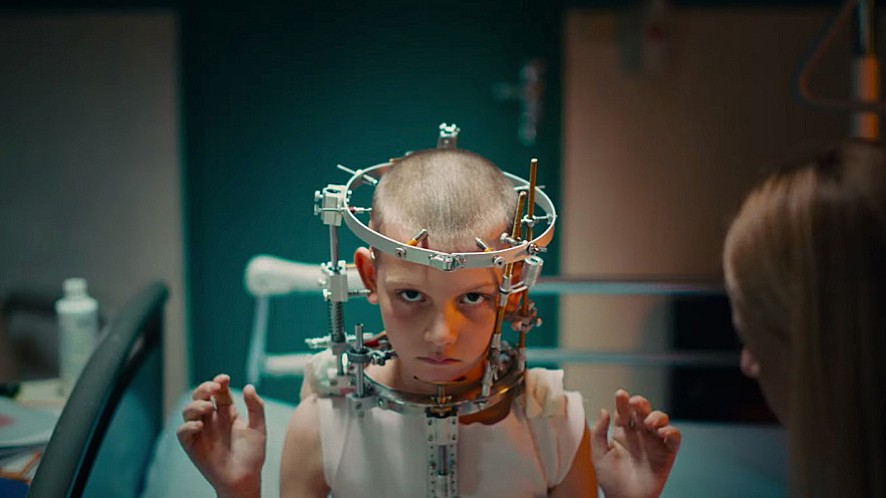
Anyway, when she subsequently returns to her home where her husband is waiting, they soon come to have a fight, but the movie is not mainly about this problematic couple. After getting her call, her older sister Maria (Teresa Saponangelo) and Maria’s husband Saverio (Toni Servillo) come along with their adolescent son Fabietto (Filippo Scotti), and Fabietto comes to experience something he will never forget because of his aunt’s apparently unstable psychological status.

After this eventful night, the movie lets us get to know more about Fabietto and his family. While he is often proud of being a communist, Saverio has actually worked in a big bank of the city, and he and Maria have maintained a fairly stable relationship even though it later turns out that there is a big problem behind their back. Fabietto’s older brother has recently been trying on the extra audition for Federico Fellini’s new film, but it looks like he will not get any part no matter how much he tries. In case of Fabietto’s older sister…. well, we seldom see her because she is usually in the bathroom whenever the movie shows her interaction with the other family members.

We also get to know a number of people surrounding this fairly ordinary middle-class family. An old baroness and her adult son live right above their apartment, and the baroness and Maria sometimes exchange some gossips whenever she comes down to their apartment. In case of one certain female neighbor living on the same floor, Maria hates her guts for some reason, and there is a little amusing moment when she gives that neighbor a prank call just for her little naughty amusement.

And there are a bunch of colorful relatives who often gather around Fabietto and his family whenever they have a chance. Watching how they enjoy their summer afternoon outside the city at one point, I could not help but think of how my mother and many of her family members often enjoyed summer together on the east coast of the Korean Peninsula during my childhood years, though that is not possible anymore at present because they all became estranged from each other later due to a trivial money problem.

Besides all these numerous figures surrounding Fabietto and his family, the movie also has Diego Maradona, a famous real-life Argentine soccer player about whom many of citizens of Naples have been quite excited. Just like everyone around him, Fabietto has been very enthusiastic about Maradona, and he is even willing to watch Maradona’s another game at a local stadium instead of spending a brief winter vacation along with his parents outside the city.

Now all these and other elements in the film including Fabietto’s growing fascination with filmmaking will surely take you back to Fellini’s several classic films ranging from “I vitelloni” (1953) to “Amacord” (1973), but Sorrentino’s screenplay somehow often struggles to make them gel together without generating enough narrative centripetal force – even after one devastating incident in the middle of the story. Despite Filippo Scotti’s earnest acting, Fabietto remains to be a blank background for other characters even around the ending, and many of substantial supporting characters surrounding Fabietto are more or less than broad caricatures without much depth, though Toni Servillo, who has been one of Sorrentino’s frequent collaborators since Sorrentino’s debut feature film “One Man Up” (2001), and Teresa Saponangelo acquit themselves well as a couple who has stuck together for many years despite their flawed but enduring marital relationship.

While notably subdued and restrained compared to many of his stylish works such as Oscar-winning film “The Great Beauty” (2013), “The Hand of God”, which received the Grand Jury Prize when it had a premiere at the Venice International Film Festival in this September and then was selected as the Italy’s entry for Best International Film Oscar, did not click well with me on the whole, and I think this is another misfire in Sorrentino’s career after “Loro” (2018). I do understand that the movie is quite personal to Sorrentino, but, alas, I still do not feel much of that aspect for now.
Posted in Movies | Tagged , , | 1 Comment

Ghostbusters: Afterlife (2021) ☆☆1/2 (2.5/4): A hollow piece of nostalgia

“Ghostbusters: Afterlife” exists only for the nostalgia for its target audiences, and, unfortunately, that is all. Although it does try to recharge its franchise with a number of new characters at the beginning, the movie ultimately regurgitates old familiar elements from its predecessors while not generating anything new or surprising for us, and I only came to observe its story and characters without much care or attention.

After the opening scene which involves with one of the four Ghostbusters in the previous two films, we are introduced to a young nerdy girl named Phoebe (Mckenna Grace), her mother Callie (Carrie Coon), and her older brother Trevor (Finn Wolfhard). Due to their current difficult financial status, Callie and her two kids have to leave their small apartment in New York City, and then they go to a rural town in Oklahoma where Callie’s estranged father lived before his recent death. Callie hopes to get some money from selling her father’s house and the surrounding land, but her hope is soon dashed as she later sees how shabby the house really is, and she and her kids have no choice but to live in the house for a while.

As they gradually get accustomed to their new home, Phoebe becomes more interested in who her grandfather really was, and then she comes to sense something invisible inside the house after one incident involved with a chess board. Eventually, she discovers not only a certain device familiar to many of us but also a secret laboratory hidden below the barn next to the house, and she naturally becomes all the more curious about what her grandfather was trying to do before his death.

Fortunately for her, someone in the town knows a lot about the Ghostbusters, and that person in question is Gary Grooberson (Paul Rudd), a local middle-school science teacher who turns out to be a bit too smart to be stuck in his current position even though he often shows his students old horror films such as “Child’s Play” (1988). Besides showing Phoebe more about what happened in “The Ghostbusters” (1984), Gary talks with her a bit about a series of inexplicable earthquakes happening around the town, and it does not take much time for Phoebe to discern the connection between this mysterious happening and her grandfather’s secret project.

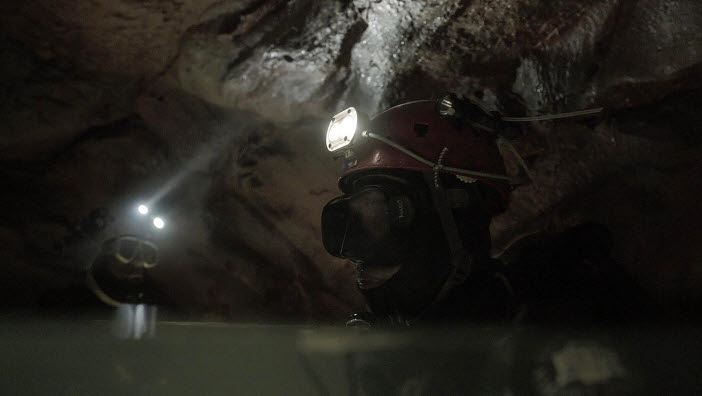
Around that time, you will get a pretty good idea of what you are going to get, if you ever saw “The Ghostbusters”. Yes, there is an evil supernatural force to be unleashed sooner or later at some old abandoned spot not so from the town. Yes, Phoebe and Trevor come to have an adventure once they acquire all those equipments from the 1984 film besides that iconic vehicle. Yes, they and their two new friends, Podcast (Logan Kim) and Lucky (Celeste O’Connor), must stick together for stopping that evil supernatural force from causing, of course, the end of the world we know.
In the meantime, the movie throws one familiar thing after another along the story, and you will certainly get nostalgic if you enjoyed the 1984 film just like I did, but, sadly, the screenplay director Jason Reitman and his co-writer Gil Kenan does not go beyond that at all. While I was amused a bit by the appearance of several notable creatures from the 1984 film, there is not much fun and surprise from that, and I am disappointed to report to you that the climax of the movie is more or less than a lazy variation of that memorable climactic part of the 1984 film. In case of what is supposed to be a big emotional moment around the end of the movie, it feels merely obligatory without adding much to what has been so predictably and perfunctorily accumulated on the screen, and I come to miss more the 2016 reboot version than before, which was surely flawed but actually tried some new things with its all-female Ghostbusters.

At least, the movie is not a total waste of time mainly thanks to the good efforts from its several young main performers. McKenna Grace, a young promising actress who drew my attention for the first time via her likable performance in “Gifted” (2017), anchors the film well with her plucky performance, and Finn Wolfhard, who has been mainly known for Netflix series “Stranger Things”, Logan Kim, and Celeste O’Connor are also well-cast as Phoebe’s three fellow Ghostbusters, though their supporting characters are rather thankless in comparison.

In contrast, a number of notable adult cast members in the film are seriously wasted due to their flat supporting characters. While Carrie Coon, who has been one of the most dependable actresses working in Hollywood, does not have many things to do from the beginning, Paul Rudd only utilizes a bit of his considerable comic talent, and the other adult cast members including Bokeem Woodbine, Tracy Letts, and J. K. Simmons simply come and go as required by the screenplay. In case of several main cast members from the 1984 film, their expected cameo appearance will surely delight the fans of the 1984 film, but the movie does not do anything much besides bringing their characters back to the screen, and that is another disappointment in the movie.

Overall, “Ghostbusters: Afterlife” did not entertain me enough, and whatever I saw from it was quickly evaporated as I came out of the screening room. I do not hate it, but I still wish it would do much more than serving us with heaps of nostalgic stuffs, and I can only hope that I will be more entertained by whatever will come next after this hollow entry.

Posted in Movies | Tagged , , , | Leave a comment

Last Night in Soho (2021) ☆☆1/2(2.5/4): From Dream to Nightmare

Edgar Wright’s latest film is “Last Night in Soho” is a stylish horror thriller which somehow did not engage me much despite considerable technical efforts shown from the screen. While I initially enjoyed its first half which deftly swings back and forth between two very different worlds, the movie unfortunately stumbles at times during its second half which becomes darker and very unpleasant, and the overall result consequently becomes uneven and artificial in my humble opinion.

Thomasin McKenzie, a promising New Zealander actress who has been more prominent since “Leave No Trace” (2018) and “Jojo Rabbit” (2019), plays Eloise, a young woman who has been living with her grandmother in their rural home near Redruth, Cornwall of England since her mother died many years ago. As shown from the opening scene, Eloise has been aspiring to be a fashion designer someday just like her mother, and she is certainly delighted when she is notified of her enrollment at the London College of Fashion.

With her grandmother’s blessing coupled with some understandable concern, Eloise soon leaves for London. As an innocent girl who has never been there, she cannot help but excited to see new things here and there in the city, but then she is reminded again that there is always considerable possibility of danger for her in the city. At point, she feels like being stalked by a rather suspicious cab driver after he takes her to where the dormitory for her and other students is located, and the mood accordingly becomes a bit unnerving as she tries to evade this creepy dude.

When she eventually arrives in the dormitory, the situation does not get better for her at all. Most of her fellow students including her sassy female roommate are not particularly nice to her at all, and Eloise comes to feel more isolated as a result, but then she comes across a notice on some other place where she can stay instead of her dormitory. It is an old house in Soho which belongs to some old lady, and, once she looks around the room to be rented to her, she instantly decides to move into this room.

However, it soon turns out that there is the other problem in this room besides its shabby interior and those neon lights from a bistro on the first floor. Probably because of her ability to see her mother’s ghost, Eloise finds herself transferred to a young woman living in the same place in 1965 whenever she sleeps in the room at night. Although she is quite baffled at first, she cannot help but attracted more to this inexplicable supernatural experience because she is a big fan of the music and fashion of London during the Swinging Sixties.

However, we instantly sense a certain danger when that young woman, named Sandie (Anya Taylor-Joy), gets herself associated with some charming guy to whom she actively approaches. Sandie has aspired to get a big break for her future entertainer career, and it seems that Jack (Matt Smith) may give her what she has wanted so much. Of course, he turns out to have the other plan for Sandie, and Eloise consequently comes to behold some unpleasant sides of London during that time.

And this increasingly alarming nocturnal experience of hers does not simply remain as bad dreams at all. In addition to being more disturbed night by night, Eloise also comes to see disturbing things even during daytime, and she naturally becomes more terrorized as there is no one to believe what she is going through. Furthermore, it looks like what happened to Sandie during that time is still casting a long shadow over the present, and we come to wonder more about how a certain ominous supporting figure is associated with Sandie.

In the meantime, the movie constantly soaks the screen in lots of mood and style as required, and Wright and his crew members including cinematographer Chung-hoon Chung, who has often worked outside South Korea since “Stoker” (2013), did a competent job on the whole. The scenes set in 1965 are filled with authentic period atmosphere and details to be savored, and, as a director who knows well how to use songs effectively and refreshingly for story and characters as shown from his previous film “Baby Driver” (2017), Wright utilizes well a number of notable old pop songs from the 1960s.

However, the screenplay by Wright and his co-writer Krysty Wilson-Cairns is hampered by thin narrative and superficial characterization, and that weak aspect is more exacerbated during its second half. Mainly because it feels relatively flat and bland compared to the colorful spirit of the 1965 part, the present part does not work well enough as the ground to support the 1965 part except being the perfunctory counterpoint, and the 1965 part only becomes another case of being all style but no substance in the end.

Anyway, the main cast members of the film try to fill their respective roles with each own presence as much as they can. While Thomasin McKenzie and Anya Taylor-Joy have some juicy fun as their characters intertwine with each other along the story, Matt Smith looks insidious and untrustworthy as required, and Terence Stamp and Diana Riggs, who sadly died in last year, acquit themselves well despite being stuck in their thankless supporting parts.

In conclusion, “Last Night in Soho” is not entirely without fun and entertainment, but it is a less enjoyable genre exercise than “Baby Driver” and Wright’s other previous works such as “The Shaun of the Dead” (2004) and “Scott Pilgrim vs. the World” (2010). Yes, I do understand that Wright tries to have a fun as before, but, sadly, the movie does not convey much of his excitement and enthusiasm to me, and that is a disappointment to say the least.

Posted in Movies | Tagged , , | Leave a comment

King Richard (2021) ☆☆☆(3/4): A father behind two daughters

“King Richard” is your average feel-good drama film which mostly plays safe from the beginning to the end. Right from when I went through its first few minutes, I could clearly discern what I was going to get, and the movie did not exceed my expectation that much as often being a bit too mild and sanitized for understandable reasons, but I must admit that it still held my attention enough mainly thanks to its several good performances.

The movie is based on the incredible real-life story of Venus and Serena Williams and their father Richard Williams. As many of you know, Venus and Serena have been two of the most distinguished tennis players in the world, and the early part of the movie shows us how much they were supported by their father even during their early years in the African American ghetto neighborhood of Compton, California. While both he and his wife Oracene (Aunjanue Ellis) are often busy with earning their living everyday, Richard (Will Smith) is not daunted at all as nurturing his two daughters’ considerable athletic skills day by day, and he also tries to look for any good sponsor or coach who may give a chance to his two daughters.

Because of their racial/social background, Richard and his two daughters did not draw much attention despite his constant attempts, but then there eventually comes a breakthrough for them. After checking out how good both Venus (Saniyya Sidney) and Serena (Demi Singleton) really are as promising young tennis players, a coach named Paul Cohen (Tony Goldwyn) agrees to teach and train them more, and what do you know, both Venus and Serena soon distinguish themselves more as playing at one competition for junior players after another.

It seems that all Richard will have to do now is stepping aside for his two daughters to advance more toward their respective adult professional careers, but he does not stop at all as he already has a plan for his two daughters’ future. He does not hesitate when he comes to believe that the girls need a better coach for getting much more improved, so he later takes them to Rick Macci (Jon Bernthal), who has more influence and connections compared to Cohen. In addition, he decides to be an independent agent for the girls because he feels the need to get things under his control as usual.

The main conflict in the story comes from when Richard later puts the moratorium on the girls’ burgeoning career just in case after becoming quite concerned about their welfare and education due to one tragic real-life case. Venus and Serena are certainly not so pleased about that, and neither is Oracene, but they all go along with that because they know and understand how much he has been dedicated to supporting not only Venus and Serena but also their three older sisters, who also grow up pretty well even though they are relatively less impressive than their younger sisters.

While it usually sides with its hero, the screenplay by Zach Baylin also recognizes how Richard is sometimes blinded by his pride and ego even when he is sincerely dedicating himself to his two daughters’ careers, and that aspect is sharply pointed out during one crucial private scene between Richard and Oracene. As they pull and push each other during their conversation, we come to sense more of how much Oracene has tolerated her husband for many years, and it is a bit shame that the movie does not delve deeper into their problematic but fairly functional relationship (Richard and Oracene Williams eventually divorced in 2002, by the way).

Anyway, the movie keeps things rolling under director Reinaldo Marcus Green’s competent direction. I must point out that many of tennis match scenes in the film feel perfunctory at best, but the movie still engages us as smoothly moving from one expected moment to another, and we are certainly rewarded with the obligatory dramatic finale which somehow pulls out a genuinely uplifting moment for the ending.

Most of all, the main cast members of the film did a commendable job of bringing considerable life and personality to their respective parts. Will Smith, who has been regarded as one of the main contenders in the ongoing Best Actor Oscar race, shows here more serious side of his talent as he previously did in “Ali” (2001) and “The Pursuit of Happyness” (2006), and he utilizes well his likable screen persona in addition to being willing to go into his character’s edgier aspects. While Aunjanue Ellis is equally good during her several key scenes with Smith, Saniyya Sidney and Demi Singleton hold each own place well between Smith and Ellis besides looking very convincing during those tennis match scenes in the film, and Tony Goldwin and Jon Bernthal are also solid as two very different coaches in the story.

Overall, “King Richard” is a fairly safe product compared to Green’s debut feature film “Monsters and Men” (2018), but I recommend it anyway despite some reservation mainly due to the enjoyable efforts from Smith and several other main cast members. After all, considering that how much Venus and Serena Williams were involved in the production of the film (They are two of its several executive producers), it is probably not possible for us to expect the movie to take a warts-and-all approach to the story and characters from the beginning, so I will not grumble about its inherent flaws for now, and I will just remember those good elements in the film.

Posted in Movies | Tagged , , , , , | 1 Comment

Spencer (2021) ☆☆☆(3/4): It’s Christmas in Hell for her…

Pablo Larraín’s latest film “Spencer” is presented as “A fable from a true tragedy”, and it is clear from the beginning that the movie goes for something deeper than those well-known facts about its famous human subject. Although the overall result often feels clinical and distant with some distracting missteps to notice, the movie still works as an interesting character study at least, and, above all, it is held together well by its strong lead performance which is incidentally one of the best ones of this year.

The heroine of the movie is Diana, Princess of Wales (Kristen Stewart), and the movie focuses on her three days of late December in 1991. As her British royal family members including her husband Charles, Prince of Wales (Jack Farthing) will gather together for Christmas at the Queen’s Sandringham Estate in Norfolk, Diana also has go there as expected, but she does not feel that well from the beginning. She is expecting to have some good private time with her two sons, but, as gradually shown to us along the story, her marriage with her husband has been seriously deteriorated during last several years, and she has not even received much support or help from the other Royal family members including her mother-in-law.

Probably because of becoming quite nervous and distracted, Diana, who happens to decide to drive to Sandringham alone by herself, finds herself getting lost somewhere in the surrounding area, but she fortunately comes across the Royal Head Chef on the road when he is doing some errand outside. Because a house where she grew up in the past happens to be not so far from the spot, Diana cannot help but feel a bit nostalgic, and that prompts her to do something rather odd to the chef’s bafflement.

After finally arriving in Sandringham, Diana is reminded again of how suffocating it has been for her to live as a member of the British royal family. Right from when she enters the estate, she has to submit herself under the stern supervision of Equerry Major Alistair Gregory (Timothy Spall) as required, and then she also has to deal with the cold indifference from many of the British royal family members during their dinnertime. She has no choice but to try to look fine as much as possible on the surface, but she soon becomes more agitated and suffocated, and then we are served with a cringe-inducing moment involved with a certain psychological disorder of hers.

Feeling more trapped and isolated hour by hour, Diana becomes more conscious of how things have been falling apart in her martial relationship, and she comes to think more of Anne Boleyn after finding a book about Boleyn in her bedroom. Although her situation is relatively less gloomy compared to Boleyn’s in comparison, she discerns a parallel between Boleyn and herself, and she even frequently sees the apparition of Boleyn later in the story, which initially looks amusing but then comes to feel rather heavy-handed in my inconsequential opinion.

At least, she gets some little comfort from a few people who show genuine care and attention to her. As having always been someone to lean on for Diana, Diana’s Royal Dresser willingly gives Diana some pep talk, and the Royal Head Chef also shows support and encouragement when Diana comes down to the kitchen for talking with him over a certain trivial matter. Her two sons sincerely worry about her as shown from their little private night time with their mother, and her husband shows a bit of understanding and compassion on her ongoing personal struggle inside and outside the family, though they remain estranged with each other as before.

Steadily maintaining its detached but sobering mood, the movie presents all these and other moments in the story one after another, and the screenplay by Steven Knight gradually builds up its heroine’s inner conflict and turmoil beneath the surface. Although I have no idea on how close the movie is to her real-life story, Knight’s story simply focuses on its heroine’s increasingly nervous state of mind, and Larraín and his crew members including cinematographer Claire Mathon and composer Jonny Greenwood did a commendable job of presenting that on the screen with palpable emotional effect.

Most of all, the movie is firmly anchored by Kristen Stewart, who will receive an Oscar nomination for giving another stellar performance to be added to her impressive acting career. Although we still often remember her for appearing in those Twilight flicks, we have also been quite impressed by a series of admirable performances from her during last several years, and Stewart surprises us again here in this film. Instead of attempting to imitate her real-life counterpart, she ably embodies her character’s life and personality via details and nuances to be observed and appreciated, and it is constantly compelling to see her deftly going up and down along with her character throughout the movie.

In case of several other notable cast members in the film, they simply fill each own spot around Stewart. Without overshadowing Stewart at all, Jack Farthing, Timothy Spall, Sally Hawkins, and Sam Harris are all solid in their substantial supporting roles, and Hawkins brings some warmth to a brief intimate scene between her and Stewart later in the story.

On the whole, “Spencer” is another engaging biographical drama film from Larraín, who previously gave us “Jackie” (2016) and “Neruda” (2016). Like these two films, “Spencer” is something to be admired by my brain rather than being embraced by my heart, and I am not totally enthusiastic about it unlike some other critics and reviewers, but I recommend it anyway for its several strong elements including Stewart’s memorable acting. It may require some patience from you as your typical arthouse flick, but I assure you that you will not be disappointed once you accept how it is about as well as what it is about.

Posted in Movies | Tagged , , , | 2 Comments

The Humans (2021) ☆☆☆(3/4): A chilly chamber family drama

“The Humans” is a chilly chamber drama about one increasingly stark situation among several miserable family members who happen to gather together for their little Thanksgiving dinner. This is certainly not something you cannot casually watch on Sunday afternoon, but the movie did a fairly good job of presenting its story and characters with enough mood and insight, and it steadily holds our attention even as it gets more bitter and depressing later in the story.

The story is mainly unfolded inside one modest apartment located somewhere in the Chinatown area of New York City. Although it looks rather barren and stuffy on the whole, Brigid (Beanie Feldstein) and her boyfriend Richard (Steve Yeun) hope that this apartment will be a nice new place for both of them, and we see her several family members looking here and there inside the apartment for a while. Although her parents Erik (Richard Jenkins) and Deirdre (Jayne Houdyshell) do not like this place much, they do not say that to their daughter, and neither does Brigid’s older sister Aimee (Amy Schumer).

Anyway, Brigid’s parents and older sister come to the apartment for having the Thanksgiving dinner with her and Richard, and they also bring Brigid’s grandmother Momo (June Squibb). Having recently become quite fragile in addition to suffering Alzheimer’s disease which deteriorates her speaking ability a lot, Momo is mostly bound to her wheelchair, and there is not much interaction between her and others because she often seems to be lost in her fading mind.

As Brigid and her family spend some time together before having the Thanksgiving dinner, we also come to observe the considerable emotional gaps among Brigid and her family. Her parents, who are still living in their hometown in Pennsylvania, are devoted Catholics, and they unintentionally annoy their daughters as asking and talking a bit too much about how their daughters have been in their respective personal lives. While Brigid is a struggling musician without much prospect at present, Aimee recently happened to lose her job due to a certain chronic illness, so they do not want to talk about their current statuses, but, to their annoyance, the conversation among them and their parents often sways to that inconvenient subject.

Brigid and Richard try their best for giving the fairly nice Thanksgiving dinner to their guests, but the mood is still not lightened up much despite their sincere efforts. Furthermore. there are also a series of small but disturbing incidents due to the shabby aspects of their apartment, and the mood accordingly becomes chillier and spookier with more darkness here and there in the apartment.

And it gradually turns out that there are a few secrets to be revealed sooner or later. While Aimee frequently checks her smartphone alone for some unknown reason, Erik and his wife seem to be having some problem between them even while they behave as if nothing serious had happened at all, and we later get a sudden moment of emotional outburst from Deirdre.

These secrets will not surprise us much when they are eventually fully revealed during the second half of the film, but we come to pay more attention to how much the characters are isolated from each other. They all cannot help but become strained and uncomfortable whenever they have a conversation among them, and they simply prefer to walk away and then be alone for a while. If you have ever been quite unhappy to be among your family members during those holiday season meeting, you will surely understand well their misery and unhappiness.

Although everything in the story remains calm and static to the end, the movie thoughtfully observes and depicts its characters nonetheless, and director/writer/co-producer Stephen Karam, who adapted his Tony-winning play of the same name for himself, ably conveys to us the stark sense of isolation and disconnection surrounding the characters in the film. While usually watching them from the distance, the camera of cinematographer Lol Crawley makes some effortless movements around the characters, and I particularly admire how the camera smoothly revolves around them during one impressive extended shot as subtly accumulating more tension under the surface.

The six performers assembled here together for the movie are all wonderful in their respective roles. Richard Jenkins, who has always been one of the most dependable character actors working in Hollywood for more than 25 years, has a masterful moment as the camera slowly zooms on his face during one certain scene, and Jayne Houdyshell, who incidentally reprises her Tony-winning role here in the film, holds her own place well besides Jenkins. While Beanie Feldstein and Amy Schumer are surprisingly effective as being quite different from their several recent comic performances, Steven Yeun fills his seemingly thankless role with enough life and personality, and so does June Squibb, who admirably keeps going with her acting career even at present despite being 92 in this year.

In conclusion, “The Humans” is an admirable piece of work which is not exactly entertaining but still worthwhile to recommend mainly for the good ensemble performance from its small but solid cast. I felt impatient from time to time during my viewing, but I appreciate its subtle handling of mood and nuances at least, and I am certainly willing to revisit it for appreciating that more.

Posted in Movies | Tagged , , , | 1 Comment

Night of the Kings (2020) ☆☆☆1/2(3.5/4): Stories for surviving his first night in prison

“Night of the Kings”, which was selected as Ivory Coast’s official entry to Best International Film Oscar in last year (It was included in the shortlist although it was not subsequently nominated), is a little but extraordinary film to be admired for many reasons. I must confess that I cannot tell you that much about what it is about, but I appreciate how it is about a lot nonetheless, and this is definitely something you have to experience for yourself.

The movie is set in one infamous prison outside Abidjan, the capital city of Ivory Coast. Inside this big prison, hundreds of male inmates form their own community as being isolated from the world outside by those huge walls and a number of prison guards, and the prison guards do not do much except guarding the walls because the inmates are virtually running the place while firmly sticking to their own set of rules.

According to the one of these rules, all the inmates of the prison must obey under the leadership of “the Dangôro”, who is virtually the king of inmates in the prison. If he becomes too ill to govern, the Dangôro must abdicate and then let himself die, but the current Dangôro, who is nicknamed Blackbeard (Steve Tientcheu), is not so willing to go gently into darkness even though his days are clearly numbered due to his worsening physical condition. Knowing well that there are already several other inmates eager to grab his position sooner or later, he is not going to give up his position easily at all, so he decides to go all the way with a certain risky traditional event which is held whenever the red Moon rises on the sky.

That traditional event requires someone to function as a griot, or a storyteller, shall we say, to tell a story to the inmates in the prison, and he must engage and entertain his tough audiences till the next morning for not getting killed by them. Although he could choose anyone in the prison at his whim, Blackbeard instead chooses a teenage inmate who has just been transferred to the prison after meeting and then speaking a bit with the boy, and the boy, who was incidentally arrested for his association with some notorious local gang in Abidjan, is certainly perplexed and frightened as coming to learn of what he is demanded to do for surviving the upcoming night.

As those prison guards are phlegmatically watching from the outside, the event is eventually started with lots of aggressive excitement among the inmates, and the boy remains as scared as before, but it soon turns out that he is a fairly good storyteller. Although he stumbles a bit for a while at first, he starts with the story about the well-known leader of his gang organization, and then he gives his tough audiences more as they get more engaged and excited word by word.

While we are not so sure about how much of his story is actually real, we gradually come to sense more of the power of storytelling as the boy and the inmates actively interact with each other. While the parts of his story are shown on the screen with some fantasy elements, some of inmates enthusiastically depict several key moments via their physical movements, and the mood becomes more tense and exuberant as a result.

As the boy’s storytelling freely moves across time and space, the movie gives us a number of impressive moments to linger on our mind. We are amused by a bold moment involved with one magical tribal battle between a beautiful queen and her opponent, and then we are baffled as the story somehow flows to a modern background. A certain big real-life political upheaval in Ivory Coast is mentioned later in the film, and we come to sense more of how the movie functions as the broad reflection of the cultural and historical background of Ivory Coast.

In the meantime, the screenplay by director/writer Philippe Lacôte also focuses on its main background and a number of various criminal figures inhabiting inside this background. Besides Blackbeard’s subordinates and opponents, the movie pays some attention to several other colorful characters including a seductive transgender inmate and an old French dude with a chicken on his shoulder, and there is also the growing intrigue around Blackbeard. In one of the quieter moments in the film, Blackbeard has a brief private moment with the boy, and he shows a bit of his softer side while revealing to the boy on why he chose the boy right from the beginning.

I think the eventual finale feels a bit abrupt, Lacôte and his crew members including cinematographer Tobie Marier Robitaille keep us engaged as before, and he also draws the good performance from his cast members, most of whom did not have any movie acting experience before being cast for the film. While Koné Bakary earnestly holds the center with his unadorned natural performance, Steve Tientcheu and several other main cast members are solid in their respective supporting roles, and Denis Lavant, a French actor who has been known mainly for his frequent collaborations with Leos Carax, naturally steals the show as the sole Caucasian character among many African guys in the film.

In conclusion, “Night of the Kings” is quite distinctive in terms of mood and storytelling, and Lacôte demonstrates here that he is another interesting African filmmaker to watch. Although I have not seen his two previous films “African Metropolis” (2013) and “Run” (2014), he is a talented filmmaker who knows how to interest and then engage audiences as far as I can from “Night of the Kings”, and I think I can have some expectation on his next work in the future.

Posted in Movies | Tagged , , | 1 Comment