
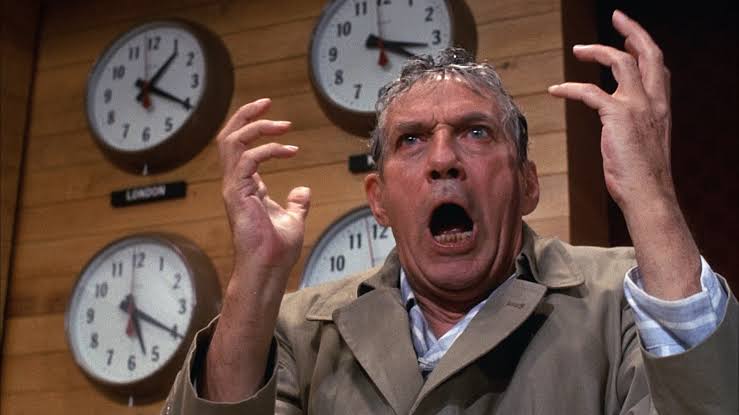
Sidney Lumet’s 1976 film “Network”, which is going to be 50 years old in this year, is chillingly prophetic and vividly timeless. Yes, its satiric materials are not so outrageous or shocking because, as we all know, our world has already surpassed them in very alarming ways. However, its sharply perceptive insights on media remain universal as before, and it still powerfully reminds us of how far media can possibly go down in the name of sensation and profit.
The story mainly revolves around UBS, a fictional national TV broadcasting company which has been struggling behind its several main competitors for years. Howard Beale (Peter Finch) has been a prominent anchorman of its daily evening news program, but he gets fired just because of the lousy rating. Mainly due to his deteriorating mental condition due to alcoholism and depression, he suddenly announces in the middle of his evening news program that he is going to kill himself on the very next day, and that certainly leads to a big headache for everyone in UBS including Max Schumacher (William Holden), who has been Beale’s close colleague and friend.
When Beale causes more trouble on TV later, he inadvertently draws more attention from millions of viewers out there, and that is quickly noticed by Diana Christensen (Faye Dunaway), one of the UBS executives who has supervised its programming department. Once she gets the permission to keep Beale on TV more, she becomes ready to go all the way for more rating and profit, and that is when Beale begins to cross the line between sanity and insanity. In the end, there comes that famous moment when he galvanizes his countless viewers with that immortal catchphrase: “I’m as mad as hell, and I’m not going to take this anymore!”

Around that narrative point, the Oscar-winning screenplay by Paddy Chayefsky busily shuffles many different elements just like we casually switch from one TV channel or website from another. On one hand, there are several cheerfully prosperous scenes involved with a crazy TV program deal between Christensen and a bunch of radical left-wing organization members willing to provide her the footage clips of their latest acts of crime or terror. On the other hand, there are very serious dramatic scenes associated with Christensen’s “romance” with Schumacher, who becomes infatuated with her despite being a middle-aged married man old enough to be her father.
Mainly driven by a series of well-written individual moments, Chayefsky’s screenplay is inherently so scattershot that its wild centrifugal force definitely requires a very good director who can provide the centripetal force to complement that. Needless to say, Lumet is a master filmmaker known for considerable realism and verisimilitude, and his dexterous direction keeps holding everything in the film to the end. For example, he and his cinematographer Owen Roizman subtly establish a rough but realistic tone to draw our attention at the beginning, but then the movie gradually shifts onto a smoother and slicker tone as the story goes way over the top with its satirical elements. Eventually, we find ourselves all the more engaged in the accumulating maelstrom of greed and madness surrounding Beale, who is thrown into more insanity as he causes another big trouble for Christensen and other UBS executives.
As I watched the film again, I noticed how it often feels more dated than when I watched it for the first time in 2000. Yes, Beale’s evening news program surely looks quite tackier compared to our current ones (My late mentor Roger Ebert wrote in his Great Movie assay: “….a knotty-pine booth that makes it look like he’s broadcasting from a sauna.”), and so does the newsroom supervised by Schumacher (and then Christensen, of course). In addition, TV has become more like a past during last two decades thanks to the rise of online social media applications ranging from YouTude to Twitter. To be frank with you, I am really curious about how the movie will look and feel to my niece when she grows up enough to watch it around 10 years later.
Nevertheless, the messages delivered by the film are still bitingly relevant as it precisely perceives the timeless nature of media industry. Regardless of whether it is radio or TV or social media or whatever, rating always comes first, so sensationalism naturally comes with the territory, and the movie reminds us that, as being always driven by our endless thirst for sensation, those folks in media industry are inclined to do almost anything for higher rating. You may roll eyes a bit as watching how Christensen transforms Beale’s evening news show into a vulgar media circus which becomes a huge public sensation, but this is not so shocking at all compared to what we see on TV as well as social media everyday – or that unbelievable political rise of Donald J. Trump from a reality TV star to the US president.
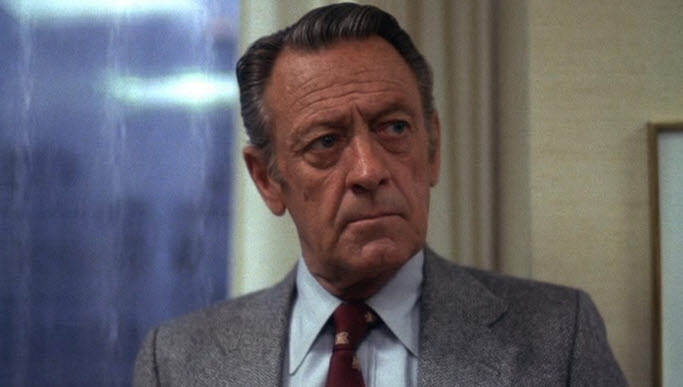
Under Lumet’s confident direction, the cast members of the film deliver many highlights to remember. Although her character is quite misogynistic at times, Faye Danaway, who deservedly won a Best Actress Oscar, is absolutely convincing as a cold but seductive goddess of media, and we see why Schumacher is alternatively attracted and repulsed by her. Peter Finch, who won a Best Actor Oscar not long after his death, is simply electrifying as his character lets out more of his despair and madness along the story, and William Holden, who was also Oscar-nominated for Best Actor, gives the best performance in the film as the weary and jaded moral center of the story. In case of a number of supporting performers in the film, Robert Duvall is equally impressive as an executive who may be more cynical and ruthless than Christensen, and Ned Beatty and Beatrice Straight also leave strong impression on us despite their rather brief appearance. As a matter of fact, both Beatty and Straight were Oscar-nominated for their respective supporting performances, and Straight actually won the award (It is still the shortest Oscar-winning performance, by the way).
In conclusion, “Network” remains a great film to be admired and appreciated for numerous reasons, and it is certainly one of many notable achievements in Lumet’s long and illustrious career. Since his very first feature film “12 Angry Men” (1957), he steadily made a number of excellent movies during next several decades before he passed away in 2011, and, like some of these memorable works, “Network” shows him at the top of his craft. We cannot laugh easily now, but the movie still works enough to engage and then alarm us, and that says a lot about its undeniably enduring cinematic qualities.


![Light Show [Explored 2026-10-09]](https://live.staticflickr.com/65535/55578539818_958ce4fa9c_s.jpg "Light Show [Explored 2026-10-09]")


