
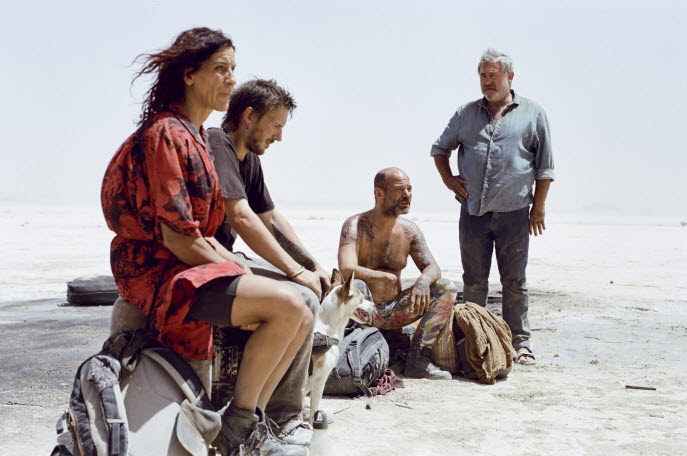
“Sirāt”, which was recently selected as the Spanish submission to Best International Film Oscar, impresses me a lot with its stark existential wasteland. As its few main characters are merely heading to somewhere across that vast and remote wasteland, the movie often captivates us with its striking visual qualities, and you will admire that more once you come to see what and how it is about.
The movie opens with a big outdoor rave party being held in the middle of some wasteland region of southern Morocco. After the camera wanders here and there around many different European people, the movie eventually comes to focus on a guy named Luis (Sergi López, who looks much shabbier compared to his memorably villainous role in Guillermo del Toro’s “Pan’s Labyrinth” (2006)). He comes along with his young son just for looking for his daughter, and they keep asking a number of people whether they saw her or not, but they only get frustrated more and more as time simply goes by. It seems that nobody saw her at all, and all they can learn is that she could already go to some other spot where another rave party is being held,
Anyway, not long after the arrival of this father and son, the rave party is aborted by the local soldiers due to a sudden global crisis. While most of the attendees follow the evacuation order, a small group of people impulsively decide to drive away and then go to another rave party, and Luis also chooses to follow after them mainly because he believes that they will probably lead him to his daughter’s whereabouts.
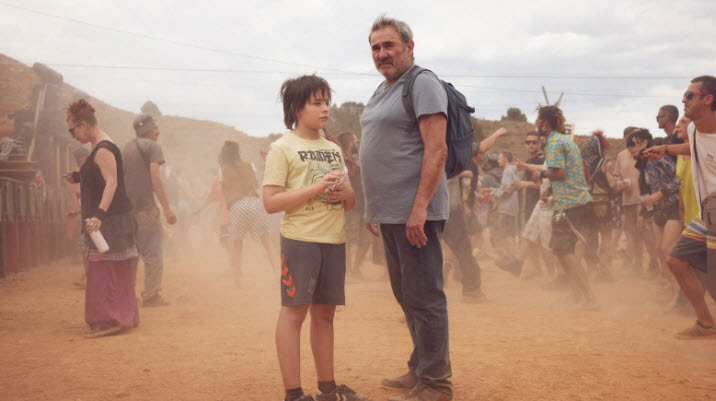
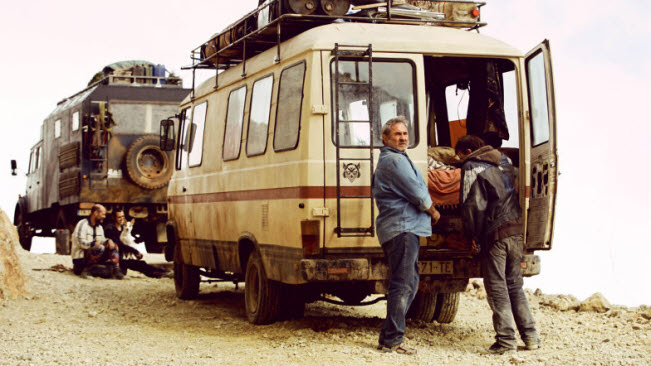
Of course, they soon come to see how the situation is much more serious than they thought at first. At one point, they see hundreds of local people evacuating from their region, but they are not so bothered about this while merely annoyed by how it becomes more difficult for them to get more fuel for their vehicles. Fortunately, despite being woefully unprepared for his journey, Luis can provide a bit of help to his new friends, who later help him and his son when his car cannot go across a rather wide stream unlike their vehicles.
Remaining distant to its story and characters, the screenplay by director/co-producer Óliver Laxe, who won the Un Certain Regard Jury Prize at the 2019 Cannes Film Festival for his previous film “Fire Will Come” (2019), and his co-writer Santiago Fillol provides a bit of spirit and humor while its main characters look more like driving into nowhere. As they keep driving their vehicles across a series of endless wastelands, you will probably be reminded of George Miller’s great science fiction action film “Mad Max: Fury Road” (2015), and we later get a little humorous moment when they suddenly decide to drive their vehicles faster for a while.
However, things gradually become more unnerving for the main characters as they drive deeper and deeper into the wasteland region. Although it seems the world is falling apart rapidly according to the radio news reports, they are still not so concerned about that while only focusing on getting to their aforementioned destination, and the movie comes to feel more like an existential drama along their seemingly endless journey.
And then something quite devastating happens later. For avoiding spoiling anything for you, I will only tell you that 1) the main characters of the film have to drive along a route as perilous and suspenseful as the one shown in Henri-Georges Clouzot’s great thriller film “The Wage of Fear” (1953) and 2) you will be surprised by how this sequence subsequently throws a shocking moment for its inevitable dramatic punctuation.
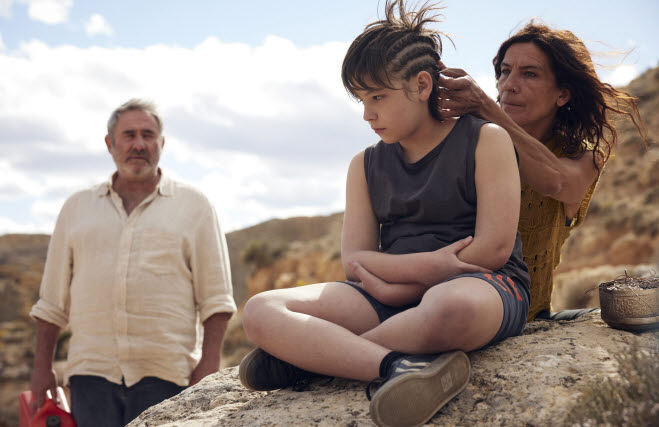
This sequence certainly resonates a lot with the very title of the movie. Not long after I watched the film, I came to learn about its meaning thanks to my friend Wael Khairy, and that surely made me reflect more on what I observed from the climactic part of the movie. In Islamic belief, the Sirāt Bridge is a narrow and risky bridge which every person must cross on the Day of Judgment to enter Paradise (Jannah). This bridge is not only thinner than a hair but also sharper than a sword, and the faithful can cross this pretty easily, while those sinners may fall into Hell below. When one of the main characters tries what can be regarded as sort of a crossing of faith across a very dangerous area just like that, you will surely come to brace yourself more.
The film is basically an exercise in style and mood, but Laxe and his crew members including cinematographer Mauro Herce and composer Kangding Ray, whose electronic score deservedly won Cannes Soundtrack Award when the movie was premiered at the Cannes Film Festival early in this year (It also won the Jury Prize along with Mascha Schilinski’s “Sound of Falling” (2025), by the way), did a splendid job of filling the screen with a stark sense of existential dread. The main cast members besides López are actually non-professional performers, but they look convincing in their respective roles, and López subtly takes the center while never trying to outshine his fellow cast members.
In conclusion, “Sirāt” is one of the most interesting films of this year, and I am willing to revisit it soon for appreciating more of its distinctive mood and style. Although I must point out that I was a bit disappointed with its eventual arrival point, the rest of the film vividly remains on my mind even at this point, and that is more than enough for recommendation in my inconsequential opinion.


 Seongyong's Private Place
Pingback: 10 movies of 2025 – and more: Part 2 | Seongyong's Private Place
Pingback: My Prediction on the 98th Academy Awards | Seongyong's Private Place