
If there had not been any shark movie at all after Steven Spielberg’s 1975 film “Jaws” came out, we would not complain that much in my humble opinion. After all, this great film tried and then succeeded in nearly everything we can possibly imagine or expect from shark movie, and it has been virtually impossible for any subsequent shark film to escape from what was achieved so well here in this movie.
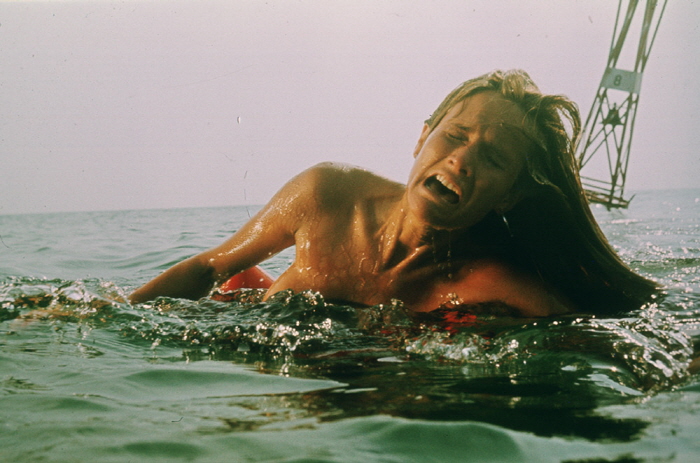
As a first-class horror film, “Jaws” takes time as skillfully setting the stage first, just like William Friedkin’s “The Exorcist” (1973) does during its first act. After that terrifying opening scene showing the first shark attack, the movie pays a lot of attention to establishing its mundane main background and characters on the screen, and everything in the story including that shark becomes all the more believable, as we get totally immersed in the situation surrounding its plain ordinary main characters including Chief Martin Brody (Roy Scheider), a policeman who recently moved to Amity Island from New York City along with his family mainly for getting away from all the danger and anxiety he experienced in the city.
Well, it turns out that his first summer in this little beach town ready for another swimming season is not as uneventful as he hoped. When it is confirmed to that there was indeed a shark attack, Chief Brody is certainly ready to close the beach, but this is promptly objected and then blocked by the mayor, who, like many local people in the island, does not want anything to interfere with their upcoming summer business.

Needless to say, the circumstance becomes all the more serious with more shark attacks to follow, and there are a number of striking scenes which are still quite effective even though the movie does not show much of that big white shark in question. Yes, it has been well known that Spielberg and his crew had a lot of problems with that mechanical shark on the set, and not showing much of it on the screen was a practical choice for them, but Spielberg brilliantly used this technical limit to the big advantage of the movie, just like Val Lewton and his director Jacques Tourneur did in classic B horror film “Cat People” (1942). While we do not see much of the shark during the first half of the movie, Spielberg and his crew members including editor Verna Fields and cinematographer Bill Butler make us all the more aware of the presence of shark, which is usually announced by the unforgettable Oscar-winning score by Spielberg’s longtime collaborator John Williams (The movie also won in Best Editing and Best Sound by the way).
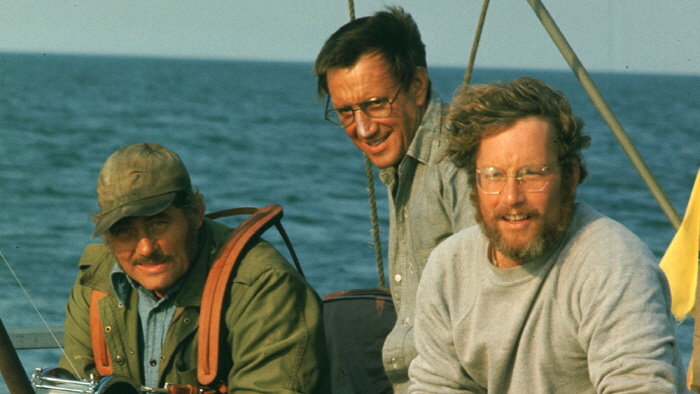
Around the narrative point where Chief Brody must hunt and then kill that shark as soon as possible, the movie is turned into a little but undeniably compelling sea adventure story along with him and the two other main characters already introduced early in the story. One is a young but knowledgeable oceanographer named Matt Hooper (Richard Dreyfuss), and the other is Quint (Robert Shaw), a tough and seasoned shark hunter who does not like sharks at all for a personal reason revealed later the story. As these three dudes go out to the sea, Williams’ score becomes a bit cheerful, and the movie shows some sly humor as observing the personality clashes among its three main characters on Quint’s little boat.
Needless to say, that shark comes to show more of itself, and we get that memorable line delivered by Chief Brody in utter shock and awe (“You’re gonna need a bigger boat”). Like Hitchcock, Spielberg plays us like a piano as dexterously shifting this film amid different modes including horror, action, thriller, and drama, and you will be all the more amazed by how much he and his crew and actors achieved within their rather limited setting. Yes, its scale of action and spectacle may look pretty modest on the surface in comparison to the standard of many summer Hollywood blockbusters to follow during next 50 years, but most of them look pale compared to its almost flawless technical aspects and the pulsating emotional power behind them.

The three main performers in the film, who has been and will always be associated with it, are simply terrific in each own way as bringing enough life and spirit to the screenplay by Peter Benchley and Carl Gottlieb, which is based on the pulpy (and occasionally soapy) bestseller novel by Benchley (I still remember how much I was disappointed with that novel not long after watching the film). Whie Roy Scheider, who became more notable thanks to his Oscar-nominated supporting turn in Friedkin’s “The French Connection” (1971) at that time, functions as the earnest center of the film, Richard Dreyfuss, who was a rising newcomer at that time, ably balances his character between humor and seriousness, and Robert Shaw frequently steals the show with his colorfully masculine performance, which incidentally reaches to the peak during that disturbing but absorbing monologue scene of his.
Thanks to its enormous commercial/critical success, the movie opened the door for not only countless summer Hollywood blockbuster films to follow but also the burgeoning filmmaker career of Spielberg, who only made a theatrical film debut with “The Sugarland Express” (1974) right before moving onto “Jaws”. Although 50 years have passed, the movie is still quite interesting and thrilling while also clearly showing that he was already on the top of his crafts, and he kept impressing us more and more during next five decades as shown from a heap of great films such as “Close Encounters of the Third Kind” (1977), “E.T. the Extra-Terrestrial” (1982), “Raiders of the Lost Ark” (1981), “The Color Purple” (1985) “Schindler’s List” (1993), “Saving Private Ryan” (1998), “A.I. Artificial Intelligence” (2001), “Minority Report” (2002), “Lincoln” (2012), and “The Fabelmans” (2022).
On the whole, “Jaws”, which was re-released in South Korean theaters yesterday for its 50th anniversary, is a nearly perfect entertainment film, probably except regrettably vilifying sharks (We could not possibly say anything if they ever sue Spielberg and Benchley for slander). Although I have watched it more than 5 times at least, I have never got bored as admiring it more and more, and I sincerely hope that young local audiences out there will experience and then learn a lot from its greatness.


 Seongyong's Private Place
Spielberg’s first theatrical release was Duel, which he made as a TV film in 1971. I saw it in my local cinema in England as a second feature, which we had in those days. I don’t recall now what the main film was that afternoon – it might have been a Bond. Anyway, I hope Jaws comes to a theatre near me. I saw it with my late brother in law in London when it was released.
SC: I know, but “Duel” (1971) is listed as a TV movie on IMDB, so I guess “Sugarland Express” (1974) is officially his theatrical debut work. This is rather confusing, isn’t it?