
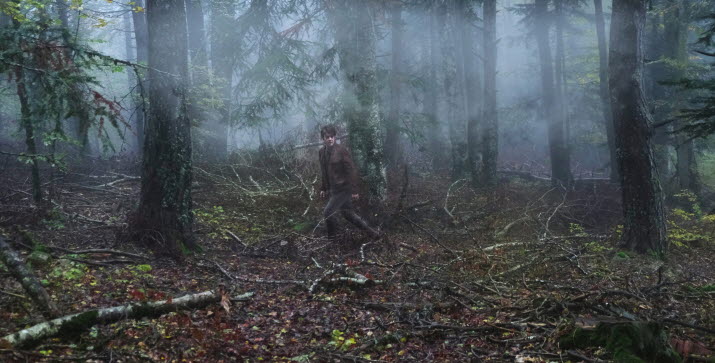
Alain Guiraudie’s latest film “Misericordia” is a wry comedy thriller which has some naughty fun behind its back as steadily maintaining its deadpan attitude to its hero’s absurd predicament. No matter how much he tries in one way or another, he only finds himself getting stuck more in his increasingly complicated circumstance, and you will get a fair share of amusement once you go along with how it is about.
The movie opens with its hero returning to his little rural hometown for attending the funeral of his former boss. A long time ago, Jérémie Pastor (Félix Kysyl) worked under a local baker before eventually leaving the hometown, and it is later turned out that he was actually quite emotionally attached to his boss during that old time.
Anyway, the surviving wife of his former boss, Martine (Catherine Frot), warmly welcomes Jérémie into her house, and she even allows him to stay there as long as he wants. As feeling a bit more relaxed thanks to the tranquil mountain forest environment surrounding the hometown, Jérémie is willing to receive more of her kind hospitality, and almost everyone in the village has no problem with that, even though it gradually becomes more possible that Martine wants some emotional support or comfort from him.
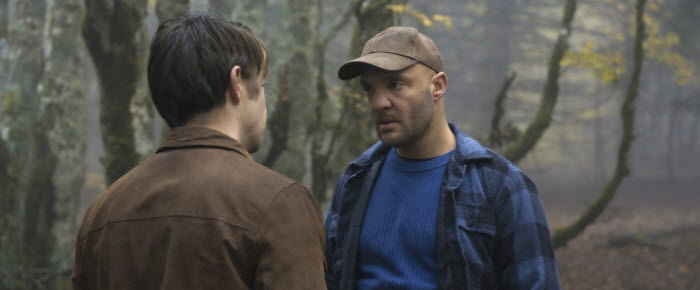
This is not welcomed much by Martine’s son Vincent (Jean-Baptiste Durand), who formally greeted Jérémie at first as an old friend but then becomes increasingly hostile to Jérémie for a rather ambiguous motive. On the surface, he seems to be angry just because it seems to him that Jérémie is going to take over his deceased father’s spot as seducing his mother more, but it is also implied to us that there is something else besides that. For example, whenever he physically threatens Jérémie, they promptly engage in a clumsy physical struggle between them, and the ambiguous intensity generated between them may make you wonder more about what actually makes Vincent tick.
This baffling aspect of their conflict turns out to be a bit more complex as we observe the odd relationship tension among them and Walter (David Ayala), who is a mutual old friend of theirs. Walter lives in his family house alone by himself, and he is often willing to spend some drinking time with Jérémie, but then we come to wonder more about whatever he actually wants from Jérémie – and why Vincent does not approve much of Walter drinking with Jérémie in private. At one point, Walter suddenly takes off his shirts just because he feels rather hot after drinking a lot, and Jérémie does not mind this at all, though Walter is not so pleased when Jérémie takes a little forward step later.
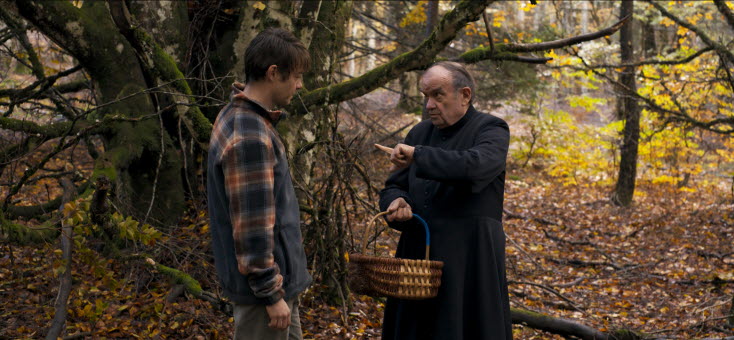
And there is also an old local priest who seems quite interested in Jérémie for his own hidden reason. He and Jérémie frequently encounter each other in the nearby forest, and the priest simply looks like searching for any edible mushroom in the forest, but then it becomes all the more plausible that he wants to see Jérémie as much as the aforementioned guys in the story.
Subtly building up the elusive emotional undercurrents swirling around its rather plain hero who somehow attracts several figures revolving around him to our little amusement, the movie also palpably conveys to us the increasing sense of isolation around him. The village often feels look empty and abandoned without much sense of living, and its isolated environment is often accentuated by how cinematographer Claire Mathon, who did a superb job in Céline Sciamma’s great film “Portrait of a Lady on Fire” (2019), beautifully and ominously shot the forest shrouded in fog under the cloudy sky.
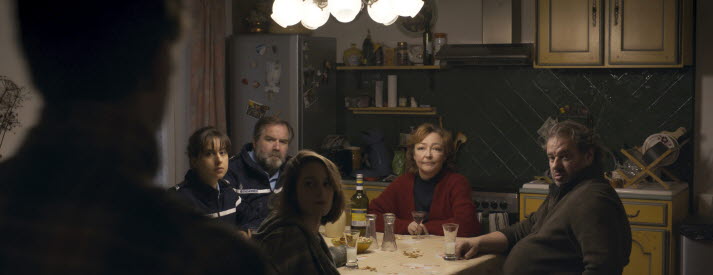
For not spoiling anything to you, I will not go into detail into how Jérémie gets himself into more predicament later in the story, but I can tell you instead that Guiraudie’s screenplay often gets both us and its hero off guard along its dryly twisty narrative. As lying more and more for getting out of his ongoing predicament as soon as possible, Jérémie only finds himself held more by the other lies from several main characters in the story, and things become all the more amusing for us when a local police officer entering the picture later in the film also seems to be quite fixated on Jérémie for no apparent reason on the surface.
As often observing how Jérémie is not particularly sexy or handsome, you will keep wondering about what exactly others around Jérémie see from him, and I guess that is one of the sly main jokes inside the film. As previously shown from “Stranger by the Lake” (2013), Guiraudie does not refrain from full frontal nudity for more comic or dramatic effect, and one of the funniest moments in the movie actually comes from when it casually shows a fully erected penis later in the story.
In case of the main cast members of the movie, they play their respective parts as straight as possible for generating more absurd humor and amusement for us. While Félix Kysyl humbly holds the center as required, his fellow cast members including Catherine Frot, Jacques Develay, Jean-Baptiste Durand, David Ayala, and Sébastien Faglain ably suggest their characters’ ambiguous motives, and Frot and Develay are particularly good whenever their characters say one thing while possibly suggesting the other.
In conclusion, “Misericordia”, which incidentally means “clemency” in Latin, may require some patience from you at first due to its slow narrative pacing and ambiguous storytelling, but it can be a rewarding experience if you pay more attention to its nuances and details. In short, this is one of the most interesting films I saw during this year, and I wholeheartedly recommend you to give it a chance if you are looking for something different from usually predictable summer Hollywood blockbuster films.


 Seongyong's Private Place
Pingback: 10 movies of 2025 – and more: Part 2 | Seongyong's Private Place