

“I.S.S.”, which is currently available on Netflix in South Korea, is a modest space thriller film about several astronauts suddenly finding themselves under a rather tricky circumstance. While it is often hampered by plot contrivance and superficial characterization, the movie has some entertaining moments to enjoy at least, and it certainly reminds me again of why I am still not so willing to go to the space.
The movie opens with the arrival of two American astronauts at the International Space Stain (ISS). They are Dr. Kira Foster (Ariana DeBose) and Christian Campbell (John Gallagher Jr.), and we soon see them gladly welcomed by the four astronauts who have already been staying inside the ISS for a while. Besides Gordon Barrett (Chris Messina), who is also an American, the other three astronauts are from Russia, and they and the American astronauts are supposed to work together harmoniously inside the space station, regardless of whatever is going on between their countries at present. Because she happens to have her first day inside the ISS, Dr. Foster is naturally a bit nervous, but she gradually gets accustomed to the zero-gravity environment of the space station while starting to work on her science project and befriending her fellow astronauts more.
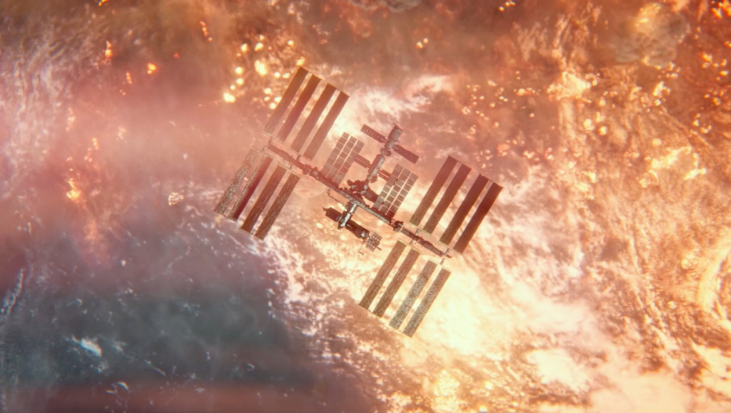
However, something serious occurs on one day. The continents of the Earth are suddenly covered with what looks like nuclear bomb explosions, and it soon becomes apparent that a war is started between US and Russia. Via his emergency communication line, Barrett is instructed that he and his fellow American astronauts should take over the space station by any means necessary, and they naturally begin to regard the Russian astronauts with growing suspicion, because the Russian astronauts probably also received the same order from their country.

During its first half, the movie steadily accumulates the sense of uneasiness around its few main characters, and there are several effective scenes including a suspenseful one where one of the American astronauts must go outside the space station for fixing an antenna alone by himself. With only Dr. Foster assisting him via their radio communication, he must be careful with each of his physical movements, because, as many of you know, even a very small movement can be quite perilous in the zero-gravity environment.
Around its middle point, the screenplay by Nick Shafir unfortunately eliminates all the ambiguity surrounding the main characters, and that is where the movie becomes less engaging. Without providing enough ground for character development from the beginning, the main characters remain to be more or less than flat archetypes, and we do not get to know that much about any of them along the story. For example, there is a brief moment when the movie delves a bit into Dr. Foster’s personal life, but this feels rather perfunctory instead of making her a bit more interesting at least. In case of several other characters in the story, they are mostly defined by their appearance and attitude, and you will not be so surprised by how they will come to function as mere plot elements later in the story.
During the last act, the movie naturally attempts to generate more suspense to accompany its eventual climax, and the overall result is mildly entertaining despite more distracting plot contrivance along the story. While a certain plot turn at one point later in the film is quite artificial to say the least, that leads to one intense physical fight scene, and I also like a key scene where the three main characters must be very tactful to each other with one sharp object to be used in one way or another.
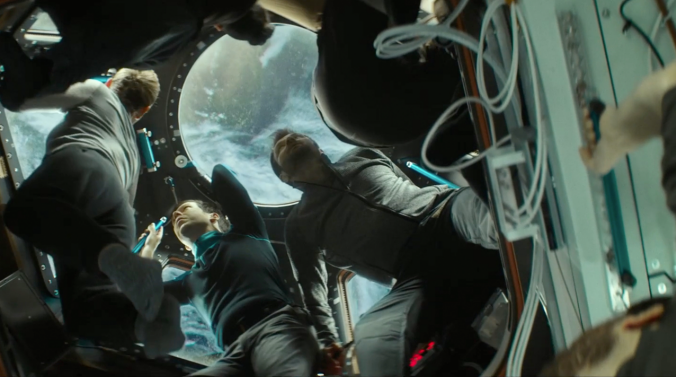
Director Gabriela Cowperthwaite, who has been mainly known for her acclaimed documentary film “Blackfish” (2013), and her crew members including cinematographer Nick Remy Matthews did a credible job of establishing the zero-gravity environment on the screen. Yes, this has not been a novelty anymore because of Alfonso Cuarón’s “Gravity” (2013) and a number of other recent space films following that ground-breaking masterpiece, but “I.S.S.” looks fairly realistic in its limited background as far as I can see.
The main cast members of the film fill their respective roles as much as possible. While Ariana DeBose, who has become more notable thanks to her Oscar-winning breakthrough turn in Steven Spielberg’s “West Side Story” (2021), manages to bring some personality to her rather underwritten role, Chris Messina and John Gallegher Jr. do a bit more than required by their rather thankless parts. In case of Masha Mashkova, Costa Ronin, and Pilou Asbæk, they acquit themselves well even though they are usually demanded to look like hiding something behind their back, and Asbæk, a Danish actor who was terrific in Oscar-nominated Danish film “A War” (2015), is especially good as his character goes through a series of conflicts along the story.
In conclusion, “I.S.S.” does not bring anything particularly new to its familiar genre territory, and it has already been fading in my mind even though I watched it early in this morning. Yes, that high standard set by “Gravity” is surely something which cannot be surpassed during next 10 years at least, but “I.S.S.” feels subpar even compared to many other space films out there, and I am already ready to move onto whatever I am going to watch next.


 Seongyong's Private Place