
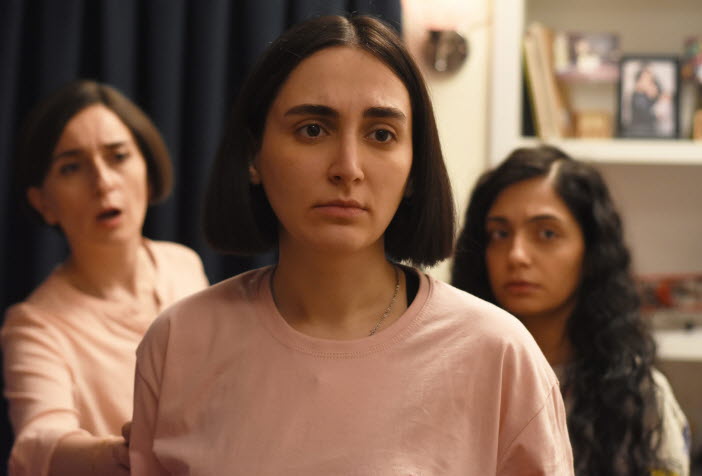
Iranian film “The Seed of the Sacred Fig”, which was recently selected as the German submission to Best International Film Oscar, is a masterful work which will hold your attention from the beginning to the end. Deftly balancing itself between political and family drama throughout its rather long running time (167 minutes), the movie often unnerves us as closely observing the toxic effect of patriarchy and theocracy on one plain family, and the result is one of the most interesting movies of this year.
The story behind the production of the movie has been known quite well to many of us since it was premiered at the Cannes Film Festival early in this year, where it received the special award from the jury of the festival. Director/writer/co-producer Mohammad Rasoulof, who previously won the Golden Bear for “There Is No Evil” (2020) at the 2020 Berlin Film Festival, and his crew and cast members had to make their film under absolute secrecy as Rasoulof got into more legal conflict with the Iranian government just like some of his fellow Iranian filmmakers including Jafar Panahi, and then the Iranian government sentenced him to 8 years in prison, shortly after he managed to escape and then attended its premiere at the Cannes Film Festival.
Despite many limits during its production and post-production period, Rasoulof’s film never looks rough or shabby at all in addition to being quite brave and ambitious. While it can be regarded as a chamber family drama in modest scale, the movie seldom feels stuffy or limited thanks to the splendid efforts from cinematographer Pooyan Aghababaei and editor Andrew Bird, and the main cast members of the film, who surely took a lot of risk as closely working with Rasoulof, are all believable as ordinary people you may come across in the middle of Tehran.

The story, which is set in Tehran around 2022, opens with the recent promotion of Iman (Missagh Zareh), who is the father in the family at the center of the story. For many years, he has worked in the Revolutionary Court in Tehran, and now he seems to get finally rewarded when he is newly appointed as an investigating judge. Although there are still a few more steps he has to go up for his career, this promotion will certainly benefit him as well as his family a lot, and his devoted wife Najmeh (Soheila Golestani) is naturally happy to hear this good news from him.
However, their two young daughters, Rezvan (Mahsa Rostami) and Sana (Setareh Maleki), are not so excited or impressed. After all, their parents have rarely told them about their father’s job throughout their whole life because of the secretive aspects of their father’s job, and they do not care that much even when their mother firmly emphasizes to them that they should be much more careful in their behavior and appearance for not causing any trouble to affect their father’s position.
We soon see the signs of the troubles to come into this family. As the Iranian society becomes agitated more and more due to the increasing number of riots and demonstrations outside, the mood in the family apartment gets gradually tense day by day as Najmeh and Iman come to conflict more with their daughters, who come to care more about the ongoing political situation in their country after a friend of theirs gets seriously injured and then unjustly arrested. No matter how much Iman and Najmeh try to get things under control, Rezvan and Sana come to show more defiance and disobedience instead, and that certainly frustrates and exasperates both of their parents.
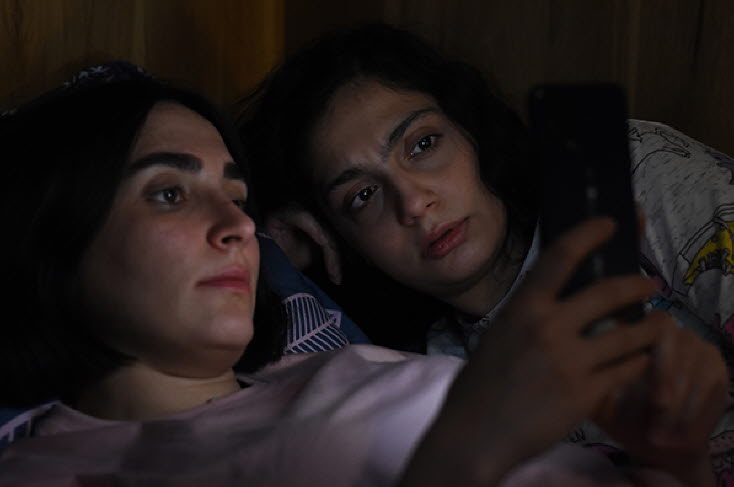
While mostly sticking to what is happening inside the apartment of the family, the movie also shows us more of how things became more volatile in Tehran during that time. It occasionally presents a series of raw footage clips showing not only riots and demonstrations but also some police brutality, and this surely puts more dramatic tension on the ongoing personal drama among its main characters, especially when a certain important item given to Iman is disappeared at one point in the middle of the story. Because this incident can actually destroy his whole career, Iman becomes quite determined to get to the bottom of this troubling situation, and it goes without saying that both Najmeh and her daughters come to see how cruel and authoritative he can really be.
I will not go into details on how this family conflict eventually reaches to the inevitable breaking point, but I can tell you instead on how its main cast members ably carry the story and their characters to the dry but undeniably intense climax which somehow reminds me of Stanley Kubrick’s “The Shining” (1980). While Missagh Zareh is effective as a plain dude who lets himself driven further by the misogyny and theocracy of his system despite his initial compunction, Mahsa Rostami, Setareh Maleki, and Soheila Golestani, who all courageously ignored the certain oppressive rules on female Iranian actresses for the film (They were all supposed to wear a hijab in front of the camera, for example), are impressive in each own way as the heart and soul of the film, and Golestani is particularly devastating as Najmeh comes to have more doubt and frustration on her relationship with Iman later in the story.
In conclusion, “The Seed of the Sacred Fig” is another superlative Iranian film after Panahi’s equally acclaimed movie “No Bears” (2022), which I and South Korean audiences belatedly watched early in this year. Considering not only how that fierce public demand for social change in Iran was eventually ended in 2023 without much difference but also how fascism and totalitarianism have been raging all over the world during last several years, this defiant piece of work feels all the more bitter to say the least, but the allegorical aspects of its powerful human drama made me reflect a bit on how every totalitarian regime is bound for eventual collapse when it begins to regard its own people as the enemies of the state. The problem is, when will that ever happen to Iran and its people?


 Seongyong's Private Place
Pingback: 10 movies of 2024– and more: Part 1 | Seongyong's Private Place
Pingback: My Prediction on the 97th Academy Awards | Seongyong's Private Place