

“We Grown Now” is a little but intimate coming-of-age drama about growing up in the Cabrini-Green neighborhood of Chicago in 1992. Mostly sticking to the viewpoint of two young African American boys living there during that time, the movie often glimpses on the grim reality of their small world, but it also shows some warmth and sensitivity via not only their friendship but also their parents who really care about them.
At the beginning, we are introduced to the two young heroes of the movie: Malik (Blake Cameron James) and Eric (Gian Knight Ramirez). Their respective families have been close neighbors for years as living together in one of the apartment buildings in Cabrini-Green, and the opening scene shows them having another usual fun with several other kids at a nearby playground.
As they go through their daily life, we get to know a bit about their respective families. While Malik has been raised along with his younger sister by their single mother Dolores (Jurnee Smollett) and their grandmother Anita (S. Epatha Merkerson), Eric has lived with his older sister under the care of his single father Jason (Lil Rel Howery), and the movie sometimes observes how much their parents struggle to make ends meet for themselves and their respective families day by day.
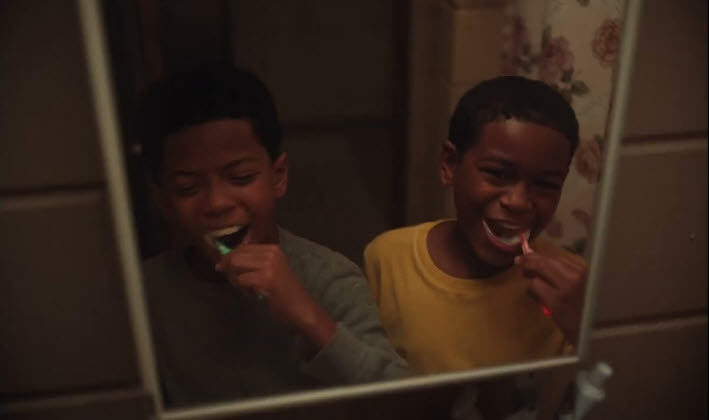
To Malik and Eric, it seems nothing will possibly separate them as they cheerfully spend time together in one way or another, but then, of course, they are reminded of how dangerous their neighborhood can be. Not long after the tragic death of a young kid around their age, the police and the authorities put more restriction on their neighborhood in the name of law and order, and Dolores as well as Jason become more concerned about their kids’ safety and welfare, even though there is really nothing they can do about protecting their kids from the harsh reality of the outside world.
However, Malik and Eric remain rather innocent about what is happening around them. At one point, they decide to go outside their elementary school just because they are just bored, and we accordingly get a lovely scene where they go to the downtown area of Chicago for visiting the Art Institute of Chicago, where they cannot help but marveled by lots of impressive artworks. As looking at several paintings involved with American slavery and racism, Malik is reminded of those old personal stories told by his grandmother, and this stimulates his young receptive mind more to our little fascination.
Of course, Dolores is not so pleased about what her son did with his best friend, and neither is Jason, who scolds his son as punishing him a bit. While she understands well how close her son has been to his best friend, Dolores does not want her son to hang around with Eric more, and that naturally causes some conflict between them, though she is still nice to Eric because, after all, he is not a bad kid at all.
Meanwhile, there later comes the unexpected opportunity for a better job to Dolores, and she naturally becomes quite conflicted. Mainly because she has spent her whole life in the middle of Chicago, moving to somewhere outside the city for that job in question seems impossible to her at first, but she comes to consider this possibly good option more as her neighborhood becomes a more hostile place than before.

This situation eventually leads to the conflict between Malik and Eric later in the story, but director/writer Minhal Baig, who previously made a feature film debut with “I Night” (2016), maintains the calm and sensitive mood of the film as before. While the overall mood is sometimes interrupted by the harsh reality surrounding its main characters, the movie also provides a number of gentle personal moments tinged with poetic qualities reminiscent of the works of Terrence Malick, and Baig and her cinematographer Pat Scola did a terrific job of filling the screen with enough period atmosphere and details to be appreciated.
As the movie gradually immerse us into its vivid mood and background, we come to understand and care about its two young heroes, and young performers Blake Cameron James and Gian Knight Ramirez are believable in their unadorned natural performance. Ably conveying to us their characters’ close friendship, they never hit any false note during several key scenes between them in the film, and the bond between their characters is palpable even when their characters come to conflict a lot with each other later in the story.
In case of a few notable adult performers around James and Ramirez, they fill their respective spots well without overshadowing James and Ramirez at all. While Jurnee Smollett, who also participated in the production of the film as an executive producer, and S. Epatha Merkerson have each own moment to shine, Lil Rel Howery, who will be always remembered for his scene-stealing supporting turn in Jordan Peele’s Oscar-winning film “Get Out” (2017), feels rather under-utilized in comparison, but it is nice to see more of the serious side of his considerable acting talent at least.
In conclusion, “We Grown Now”, which won the Changemaker Award when it was shown at the Toronto International Film Festival in last year, is a solid piece of work to be admired for its mood, storytelling, and performance. Yes, Cabrini-Green will always be associated with Bernard Rose’s horror film “Candyman” (1992) in my mind, but “We Grown Now” showed me a bit gentler presentation of this notorious neighborhood, and I surely appreciate that.


 Seongyong's Private Place