
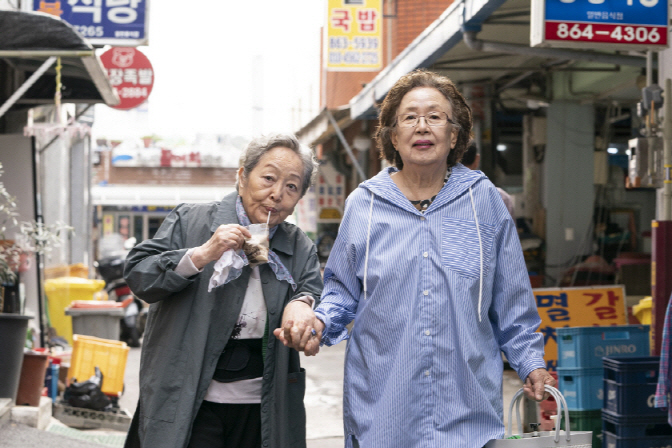
South Korean film “Picnic” is an unabashedly sappy character drama which actually earns some poignancy in the end. While it sometimes feels quite blatant in the attempts to pull our heartstrings, the movie is thankfully anchored well by two strong lead performances at its center, and you may forgive a number of shortcomings in the story as touched by the genuine emotional bond between its two main characters.
The movie begins with how things suddenly do not go that well for Eun-sim (Na Moon-hee), a fairly affluent old lady who has lived well alone in her nice apartment located somewhere in Seoul. Her only son made another big financial mess from his latest business attempt, so he and his wife come to Eun-sim’s apartment for asking for the money to solve his problem, but Eun-sim is not particularly willing to do that after seeing how selfish both her son and his wife really are, though she still feels conflicted as a good mother would.
Anyway, she is also visited by her old hometown friend Geum-soon (Young-ok), who is incidentally the mother of Eun-sim’s daughter-in-law. Delighted by this sudden visit of her dear old friend, Eun-sim eventually decides to go down to their old hometown along with Geum-soon for cooling off her mind a bit for a while, and Geum-soon gladly lets her friend stay in her old house.

While having some bittersweet feelings on how much their old hometown have been changed, Eun-sim comes across several persons in her past, and one of them is an old dude named Tae-ho (Park Geun-hyung), who once had a crush on her during their good old school days. He gladly invites her to a little evening drinking party, and Geum-soon surely feels all the more nostalgic as meeting some of their old schoolmates.
However, we also come to gather that lots of bad things happened during Eun-sim’s past in her hometown. One of her old schoolmates still does not like Eun-sim much with lots of resentment against her, and the mood becomes a bit tense when this spiteful schoolmate talks a bit about some unpleasant facts in Eun-sim’s past. It turns out that Eun-sim and her mother, who died at a rather young age, became pariahs in their town due to an unfortunate accident which killed not only her father but also several other town people. In addition, there also seemed to be something scandalous involved with Eun-sim and Geum-soon’s close friendship during that time, though nobody is willing to specify that in details.
Regardless of whether they are actually aware of whatever has been lying beneath their longtime relationship, Eun-sim and Geum-soon are just happy for being together in their hometown, and Tae-ho, still fond of Eun-sim even after all those passed years, is eager to spend more time with them. Surely feeling like being back in that good old time, they enjoy each other’s company more and more, and it looks like their fun time will be continued at least for a while.
Of course, there is already the harsh reality to be accepted by all of them in one way or another. At one point, they come to visit an old friend of theirs who has been left alone in a facility for old people by her own family, and they are reminded again of how helpless they will be sooner or later. As already revealed by herself early in the film, Eun-sim has been struggling with the early stage of Parkinson’s disease, and, not so surprisingly, both of her two friends turn out to have each own serious matter of mortality later in the story.

Around that narrative point, the movie becomes a little too heavy-handed for burdening its main characters with more conflict and frustration, and that is where I became more aware of the plot mechanism of the screenplay by Jo Hyun-mi. The subplot involved with Eun-sim’s pathetic son feels redundant and distracting while only existing for generating more misery for his mother, and the same thing can be said about another subplot associated with Geum-soon’s equally pathetic son. In case of the utterly sentimental finale, the movie is not honest and courageous enough to handle a certain choice made by Eun-sim and Geum-soon, and that consequently hurts the emotional potential of the finale.
Despite these and other weak aspects of the film, I was engaged enough in its story and characters thanks to the presence and talent of two veteran actresses who diligently carry the movie like troupers. Na Moon-hee, another grand dame of South Korean cinema who deserves to be mentioned along with Youn Yuh-jung (She was the mother character in Kim Ji-woon’s black comedy film “The Quiet Family” (1998), by the way), and Kim Young-ok, who has continued her own long acting career for many years just like Na, do a good job of establishing the long history of their old relationship right from their very first scene in the film, and the movie works whenever it focuses more on how their characters come to depend more on each other along the story. In contrast, many of the supporting characters in the film are under-developed, but Park Geun-hyung, another familiar figure of South Korean cinema to me and many other South Korean audiences, humbly holds his own place well while never overshadowing Na and Kim.
Overall, “Picnic”, directed by Kim Yong-gyun, is not entirely successful, but its strong elements including the wonderful chemistry between Na and Kim are good enough to compensate for its glaring weak points at least. Right from the beginning, I knew it was going to be quite sappy, but I did not mind at all while actually moved by its sincere drama about aging and friendship, so I will not grumble for now as reflecting more on whatever I am going to do about the last years of my life.


 Seongyong's Private Place