
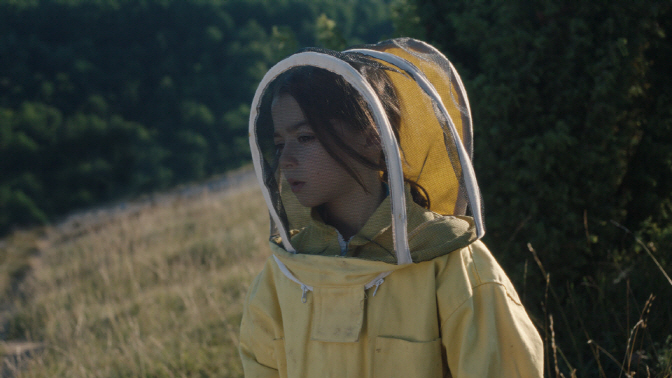
Spanish film “20,000 Species of Bees” is a little but intimate coming-of-age tale of one trans kid who becomes more serious and conflicted about her sexual identity during one summer. As gradually immersing us in her confused emotional state, the movie emphasizes with not only her but also several adult figures around her while each of them try to deal with her gender issues, and we become more touched as it calmly observes and depicts her emotional journey with lots of care and sensitivity.
At first, the movie slowly lets us gather the situation surrounding its 8-year-old trans heroine and her family. Not long after she caused some unspecified trouble with one of those neighborhood kids, she and two older siblings of hers go to their mother’s hometown located in Spanish Basque Country, but they are accompanied only with their mother because their father seems to be too busy with his job at present.
When our young heroine, who will name herself as Lucía later in the story, arrives along with her mother and siblings in their mother’s hometown, their relatives wholeheartedly welcome them all, and they all look forward to having a good time after the upcoming baptism ceremony for the young baby son of Lucía’s aunt. We soon see Lucía hanging around with a bunch of local kids, and she presents herself as a girl to them without much problem, though there is one brief moment when she has to hide her physically sexual identity from others.

Lucía’s mother is certainly well aware of what Lucía has been doing, and so does Lucía’s grandmother, who can only tolerate the sexual identity of Lucía to some degree. When she walks along with Lucía outside at one point, Lucía’s grandmother is not so pleased to see that Lucía is regarded as a girl, so she instantly emphasizes to others that Lucía is a boy, and that certainly hurts Lucía’s feelings to say the least.
Compared to Lucía’s grandmother, Lucía’s mother is more tolerant of Lucía’s emerging sexual identity, though she does not know much of how to deal with these serious issues of her kid. When they go to a local swimming pool, she generously allows Lucía to use the locker room for women, but she does not hide Lucía’s physically sexual identity at all, and this causes another conflict between her and Lucía.
In case of Lucía’s two older siblings, they turn out to be more tolerant of her sexual identity than they seemed at first. While they sometimes annoy Lucía, they become more accustomed to her sexual identity as their summer days go by, and the same thing can be said about a local girl around her age who comes to befriend Lucía later in the story. As a matter of fact, the girl is not so shocked at all when Lucía shows more of herself to the girl during their little private free time, and this actually deepens their friendship.
The most accepting figure in the story is Lucía’s great aunt, who has always dedicated to beekeeping with admirable diligence and passion. As she often takes Lucía to her little workplace outside the town, Lucía finds herself become more relaxed and comfortable with herself, and Lucía’s great aunt accepts Lucía exactly as who she is without any judgment.

While steadily following Lucía’s emotional narrative, the screenplay by director/writer Estibaliz Urresola Solaguren also pays some attention to what is going on among several female members of Lucía’s family including her mother and her great aunt. As a woman reaching for a chance to revive her old artistic career, Lucía’s mother cannot help but feel frustrated while still feeling like being overshadowed by her late artist father’s reputation, and that causes some tension between her and her mother, who probably tolerated a lot from her husband during their marriage. In addition, they also clash a lot with each other for their different viewpoints on how to handle Lucía’s gender issues, and an attempt of intervention from Lucía’s great aunt only comes to add more tension to their conflict.
In the end, the story culminates to an expected melodramatic moment, but the movie still holds itself well under Solaguren’s skillful direction, and it is also supported well by the good natural performances from its main cast members. Young performer Sofía Otero, who deservedly received the Silver Bear award for Best Lead Performance when the movie was premiered at the Berlin International Film Festival early in last year, is utterly unforgettable in her effortless illustration of her character’s emotional confusion and conflict along the story, and it must be said that Solarguren closely worked with a local association for the families of transgender minors for guiding Otero’s acting. In case of several adult performers surrounding Otero, Patricia López Arnaiz, Ane Gabarain, Itziar Lazkano, and Sara Cózar are well-cast in their respective supporting parts, and Arnaiz is particularly convincing in her character’s frequent struggle to understand and support Lucía as a flawed but fairly decent mother.
Overall, “20,000 Species of Bees” is another excellent coming-of-age queer drama to watch, and I admire its sensitive and thoughtful handling of the story and characters. To be frank with you, I do not know that much about transgender people, but a number of recent good films have given me some understanding and enlightenment on how they often struggle to understand and accept who they are, and “20,000 Species of Bees” is certainly one of such good films to recommend.



Pingback: 10 movies of 2024– and more: Part 2 | Seongyong's Private Place