“Benediction”, which is now the last film by Terence Davies after he died a few days ago, is a melancholic collection of personal memories from a real-life British poet who had a fair share of bitter anger and sadness as often reflected by his several poems quoted throughout the movie. While broadly covering his life story, the movie calmly and sensitively focuses on vividly illustrating his personal feelings and thoughts in front of our eyes, and the overall result is often hauntingly poetic to say the least.
At the beginning, the movie shows how things have been hopeful and promising for Siegfried Sassoon (Jack Lowden, who steadily carries the film with his solid acting) and his brother before the World War I begins. We see them going to a tailor’s shop for their suits, and then we see them enthusiastically waiting for the beginning of the performance of a certain groundbreaking work by Igor Stravinsky, but then everything becomes quite grim and serious both of them are drafted to the British Army after the war is started not long after that.
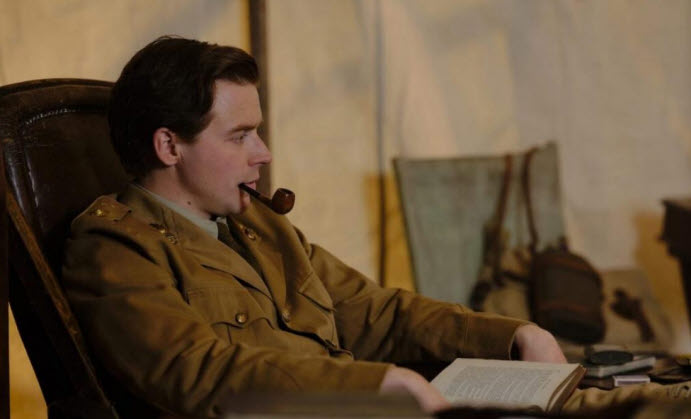
Subsequently devastated a lot by not only the death of his brother on a battlefield but also what he saw during his military service, Sassoon makes a public statement protesting against the ongoing war, and that gets him into a big trouble because he is still in the army. He actually could be put into a court martial, and he is not afriad of that, but, thanks to his good friend Robbie Ross (Simon Russell Beale, who previously collaborated with Davies in “The Deep Blue Sea” (2011)), he is ordered to be examined by a military medical board instead for his supposedly unstable mental state.

As Sassoon tries to process his feelings and thoughts on all those tragic human casualties of the war, some of his poems associated with World War I are quoted while a montage of archival photographs and film clips convey to us a bit of the horror of the war witnessed by him during that period. His bitter and anxious feelings generated from the war experience still haunt him even around 30 years later, and that is the main reason why older Sassoon, played by Peter Capaldi with weary but brittle bitterness during this part, chooses to convert to Catholicism later, though that does not seem to give much peace or comfort as he wants.
After clashing a lot with those officers of the military medical board on his adamant opinion on the war, Sassoon is eventually sent to a military hospital located in Scotland for “recovery”, and, to his little surprise, he finds some comfort and sympathy as staying there a for while. Although the chief medical officer of the hospital, played by late Julian Sands, is not so friendly at all, Sassoon’s doctor is much more sympathetic in comparison, and Sassoon also befriends a young soldier who comes to share a lot of artistic passion with him.
It does not take much time for us to sense that Sassoon and this young soldier come to feel more than friendship between them, though neither they nor Sassoon’s doctor dares to talk or discuss directly about what is going on between them. After all, homosexuality was regarded as an unspeakable abnormality during the early 20th century, and it is rather amusing to observe how Sassoon and his doctor talk about homosexuality in very, very, very discreet ways while not admitting too much.
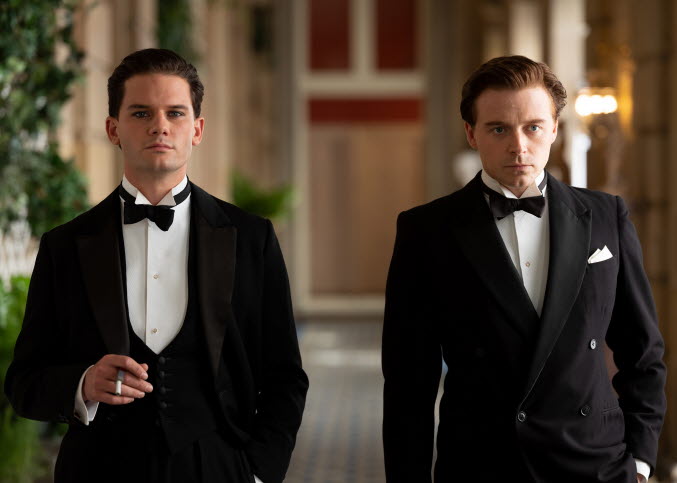
After the war gives him another bittersweet memory not long before it eventually ends, Sassoon continues to go on with his artistic career, but his personal life comes to have some melodramatic ups and downs in the meantime. At one point, he happens to get romantically involved with famous musician Ivor Novello (Jeremy Irvine, who is brimming with your typical bad boy vibe), but, as even noticed by Sassoon’s mother right from the beginning, Novello is not a very good lover to say the least, and Sassoon certainly gets quite frustrated no matter how much he tries to tolerate and accept his lover.
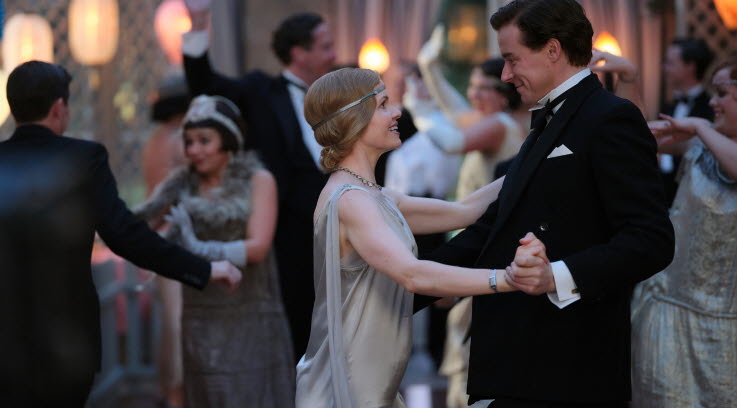
In the end, just because of being afraid of being lonely for the rest of his life, Sassoon chooses to marry a girl willing to marry him despite knowing quite well about his homosexuality, but, as bitterly illustrated by a brief but sad fantasy moment showing him joylessly dancing with several partners in his life one by one, his marital relationship with this young woman does not give him much consolation at all. During one flash-forward scene, the movie shows how loveless their relationship has become, and it is implied that their estranged relationship also affects Sassoon’s strained relationship with his defiant son.
In the meantime, the memories of the war keep haunting Sassoon’s mind, and Davies gives us several artificial but undeniably striking visual moments for conveying more to us on his hero’s emotional state. When one of the poems appearing in the film is quoted around the end of the story, it is accompanied with the visual presentation of the content of the poem, and the result is quite powerful even when the camera simply regards Sassoon’s deeply troubled face from the distance.
Since I happened to watch his deeply personal documentary “Of Time and the City” (2008) in 2009, I have admired Davies’ distinctive filmmaker career while impressed a lot by “The Deep Blue Sea” and “A Quiet Passion” (2016), and “Benediction” is surely another excellent drama film. Although he is not with us anymore now, he left a number of fine works to be cherished, and he certainly deserves to be remembered as one of the most interesting filmmakers in our time.