
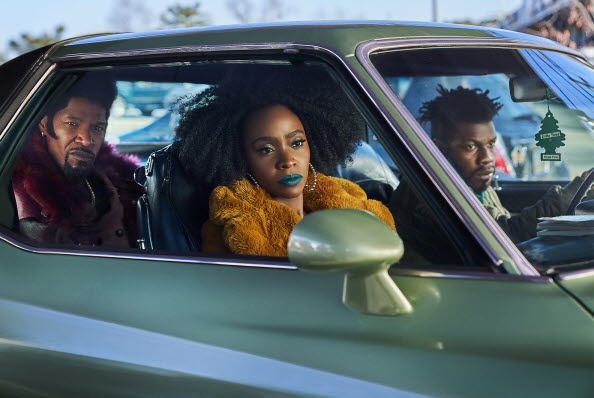
Netflix film “They Cloned Tyrone”, which was released yesterday, is a modest genre mix which is often very familiar but also engaging enough in its own way. Definitely reminiscent of a bunch of notable African American films ranging from those classic Blaxploitation flicks of the 1970s to Jordan Peele’s “Get Out” (2017) and Boots Riley’s “Sorry to Bother You” (2018), the movie wildly swings back and forth between social satire and conspiracy thriller for more thought and amusement, and you will simply go along with that once you get accustomed to how it is about.
The opening part of the film feels like your average African American crime movie. First, we are introduced to a young drug dealer named Fontaine (John Boyega), and then we observes how he gets himself into a trouble with some rival drug dealer in his slum neighborhood. In the end, right after visiting a local pimp named Slick Charles (Jamie Foxx) at a local motel for some little business issue between them, Fontaine gets shot multiple times outside the motel, and that seems the end of his life story.
However, what do you know, we see Fontaine waking up at his shabby residence in the very next morning without any sign of trauma, and Slick Charles is naturally confused and frightened when Fontaine subsequently visits the motel again. Although Fontaine do not remember anything about what occurred on the previous day, Slick Charles and one of his prostitutes, Yo-Yo (Teyonah Parris), did witness that incident, and Fontaine decides to look for the answer to this befuddling matter of his along with Slick Charles and Yo-Yo.

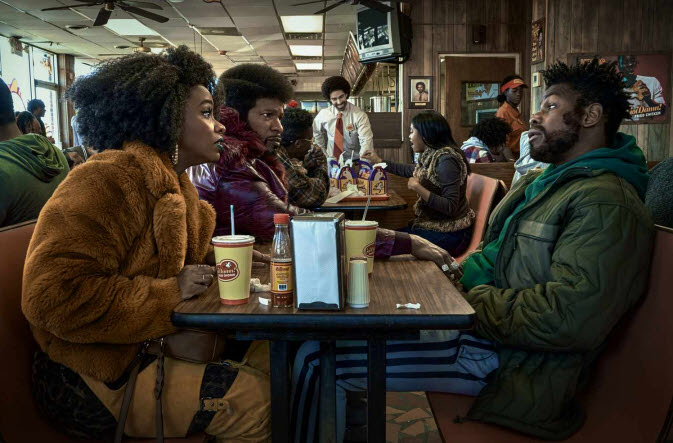
What follows next is a series of funny moments which make these three main characters have more doubt and question about their surrounding world. It looks like there has been some hidden conspiracy involved with their slum neighborhood, and they come to see more signs and clues as they try to get to the bottom of their increasingly peculiar circumstance. For example, they happen to find an underground laboratory where a certain kind of substance is being produced, and they later discover that this substance is actually one of special ingredients used by, surprise, a certain popular fried chicken brand among black people.
Because of the very title of the movie, it is not much of a spoiler to tell you that Fontaine eventually comes to learn that he is actually a clone, but there are some small, nice surprises I will let you behold for yourself. I will not tell you much here, but I can tell you instead that things become more preposterous when a certain supporting character played by Kiefer Sutherland enters the picture later in the story, and the movie shifts itself onto the realm of John Carpenter’s classic B-action films and their numerous juniors such as Kleber Mendonça Filho and Juliano Dornelles’ “Bacurau” (2019) when Fontaine and several other characters eventually decide to fight against the insidious conspiracy on them and many other black people out there.
While it does not reach to the devious horror satire of “Get Out” or the no-holds-barred farce of “Sorry to Bother You”, the screenplay by director Juel Taylor and his co-writer Tony Rettenmaier takes its time to build up some comic momentum along the story, and the movie has enough mood and details to hold our attention. Although the story is clearly set in the 21st century background, Taylor and his crew members including cinematographer Ken Seng deliberately fill the screen with grainy texture in retro style, and we are amused more as observing the blatantly old-fashioned interior design of those hidden underground places to be discovered by Fontaine and his gangs.

As the center of the film, John Boyega plays as straight as possible just like he did in his breakout performance Joe Cornish’s “Attack the Block” (2011), another preposterous but interesting genre flick which depends a lot on Boyega’s considerable talent and charisma. Compared to his rather strained lead performance in “Naked Singularity” (2021), Boyega’s quietly intense acting here in this film looks much more convincing as dutifully carrying the film to the end, and he also has some fun when he is required to do some multi-tasking during the climatic part (This is not a spoiler, right?).
With Boyega firmly holding the ground, the two main cast members of the film have each own moment to shine. Although his prime period mainly represented by his Oscar-winning performance in Taylor Heckford’s “Ray” (2004) may be already passed, Jamie Foxx is still an interesting actor to watch, and he brings a flamboyant sense of fun to his supporting character. Besides, he is also matched well by Teyonah Parris, a wonderful actress who has steadily advanced since her key supporting turn in Justin Simien’s “Dear White People” (2014).
On the whole, “They Cloned Tyrone” is an enjoyable genre mix to be appreciated for its mood, style, and performance, and Taylor, who previously wrote the screenplay for “Space Jam: A New Legacy” (2021), did a solid feature film debut here. The movie is a bit overlong (The epilogue scene, which explains the title of the movie, is rather perfunctory in my humble opinion), but it succeeds as much as intended at least, and I will not grumble for now while savoring its several effective satiric moments.


 Seongyong's Private Place