Aquaman and the Lost Kingdom (2023) ☆☆1/2(2.5/4): The passable last product from DCEU

“Aquaman and the Lost Kingdom”, which is the last product from DC Extended Universe (DCEU), is not a catastrophe at all to my relief even though I was not so impressed by its overall result. While it does not surpass its predecessor that much on the whole, it is not exactly the bottom of DCEU compared to most of disappointing DCEU flicks such as, yes, “Batman v Superman: Dawn of Justice” (2016), and there are actually some goofy charm and fun despite being another your average superhero adventure flick.

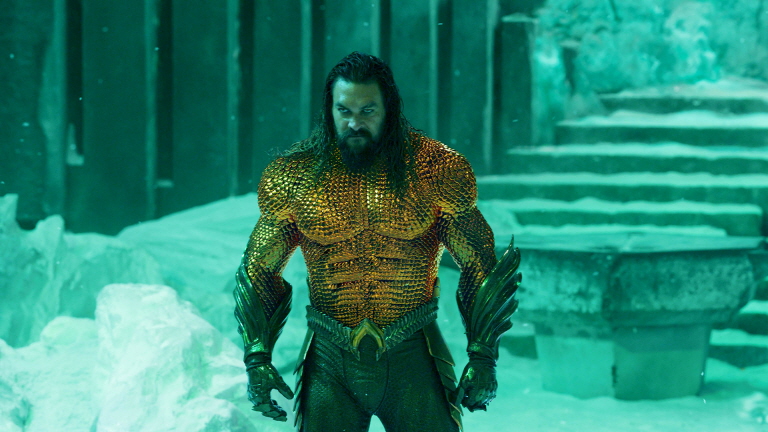
The opening part quickly establishes how things have been fairly good for Arthur Curry / Aquaman (Jason Momoa), who, as many of you remember, became the new King of Atlantis at the end of “Aquaman” (2018) after beating his younger half-brother Orm Marius (Patrick Wilson). While he continues to do heroic stuffs including fighting against a bunch of pirates, Curry also has to go back and forth between his domestic matters on the earth and his royal duty in the sea, and he actually prefers the former because, well, he has been frustrated with what he can or cannot do as the King of Atlantis. As a result, he is often absent in Atlantis as spending more time on the earth along with his family, and we get a series of silly moments associated with his little baby son.

Of course, there soon comes a serious threat to not only Atlantis but also the whole human world on the earth. Still quite determined to revenge for his father’s death caused by Curry, David Kane / Black Manta (Yahya Abdul-Mateen II) has looked for any possible opportunity for that, and, what do you know, he and his cronies eventually come upon a mysterious place in the Antarctic region. This place turns out to be associated with the old hidden history of Atlantis, and its dark evil power, which surely feels as insidious as that ring in the Lord of the Rings trilogy, promises Kane that it will help him fulfill his goal if he follows its bidding to the end.

As Kane embarks on a diabolical plan involved with accelerating the ongoing global climate disruption, he soon comes to draw the attention of Atlantis, and Curry must stop his opponent as soon as possible before it is too late for both the human world and Atlantis. After discerning that Om may help him in locating Kane’s hideout, Curry has no choice but help Om escape from a dangerous prison where he has been kept during last several years, and it goes without saying that Om is not so pleased to see his older half-brother again even though Curry takes a considerable political risk for his escape.

The movie works best during its middle act which mainly focuses on Curry and Om’s strained partnership. While he eventually agrees to help Curry because he cares about Atlantis as much as Curry, Om still does not like his older half-brother a lot, and the mood becomes amusing as they often bicker with each other on their family issues. Even during several silly moments including the one involved with a cockroach, Patrick Wilson plays straight as much as possible in front of Jason Momoa’s more laid-back attitude, and they are as engaging as a mismatched duo as, say, Chris Hemsworth and Tom Hiddleston in those Thor movies from Marvel Cinematic Universe (MCU).

As these two main characters bounce from one spot to another for locating and stopping Kane, the movie provides a number of entertaining moments which show more of the world hidden from the human one. While we surely see more of Atlantis, the movie also serves us several different colorful places ranging from an underwater gangland (Martin Short makes a hilarious cameo as its crime lord, by the way) to a tropical island full of gigantic animals and plants which may remind you of “Mysterious Island” (1961).
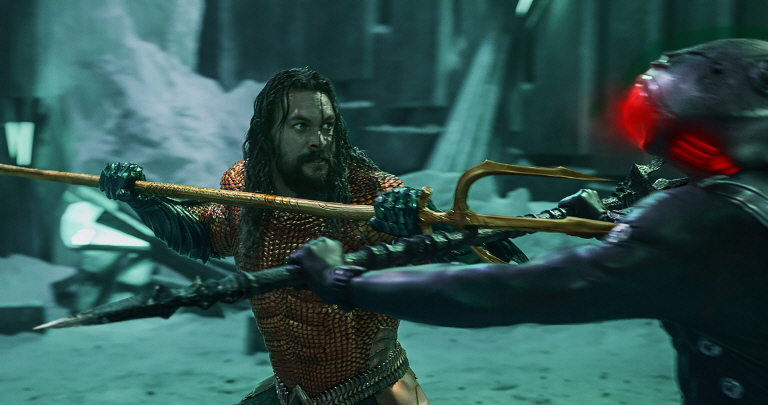
It is a shame that, instead of savoring these good moments more, the movie is too busy with heading to its eventual climax sequence drenched in lots of CGI. Director James Wan, who wrote the story along with several co-writers including Momoa, and his crew members including Oscar-nominated cinematographer Don Burgess certainly try hard for impressing and exciting us more, but things become less fun than before, and I got rather distant as becoming more aware of the weak aspects of the film including its incoherent storytelling and thin characterization.

And I was disappointed to see that many of notable cast members in the film are under-utilized while merely filling their supporting roles. As the main villain of the story, Yahya Abdul-Mateen II, who has been known for his Emmy-winning supporting turn in HBO TV miniseries “Watchmen”, is as intense as required, but that is all he is allowed to do throughout the film. In case of Amber Heard, Dolph Lundgren, Temuera Morrison, Randall Park, and Nicole Kidman, they simply come and go as demanded by their perfunctory parts, though Morrison manages to make the best of his few scenes with Momoa.

In conclusion, “Aquaman and the Lost Kingdom” is not recommendable enough, but it will probably entertain you to some degree if you just want to spend your free time at your home. Considering how much we all have been tired of heaps of run-of-the-mill superhero movies for last 10 years, the movie may look a bit better several years later, but it is still an underwhelming end to DCEU, and I can only hope that I and others will be more entertained by whatever is being planned by James Gunn at present.
Posted in Movies | Tagged , , , | Leave a comment

The Kitchen (2023) ☆☆1/2(2.5/4): The Boy Who Follows Him

Netflix film “The Kitchen”, which was released in last week, takes some time for building its shabby dystopian world, and I admire that to some degree. Although it often feels like a warm-up for whatever will come next from its filmmakers, the movie has enough mood and style to distinguish itself from those countless dystopian flicks at least, and you may overlook its several flaws in terms of story and characters.

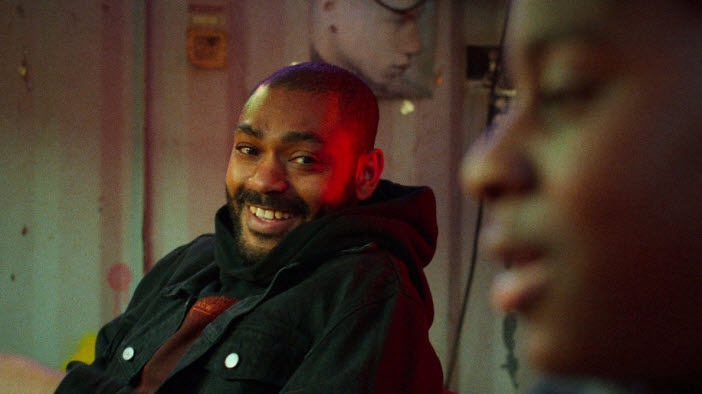
At the beginning, we observe how things have been quite grim and daunting for Izi (Kane Robinson) and many poor people stuck inside a ghetto area in the middle of London. Some years ago, the government decided to eliminate all the social housing areas for some unspecified reasons, and now this ghetto area, called “the Kitchen”, is the only social housing area remaining in London, but its residents have been quite defiant despite enduring lots of pressures from the government and the police day by day.

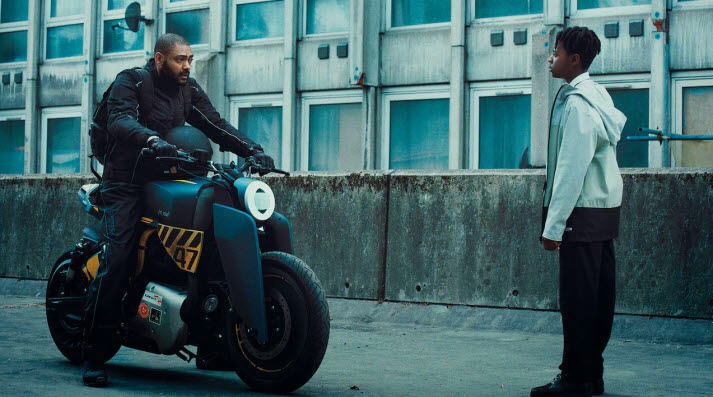
In case of Izi, he does not give much damn about the ongoing situation of his neighbors, because he has been eager to move up to some new neighborhood someday. As diligently working at a company providing a cheaper funeral service in which dead people are turned into trees to grow, he has saved a considerable amount of money, and it seems that he will finally be allowed to move to that new neighborhood.

While working as usual on one day, Izi notices the ongoing funeral service of a certain woman he used to know a long time ago. Observing that her funeral service is attended by her adolescent son alone, he feels sorry for this boy, and, what do you know, he soon comes across the boy later when he is about to go back to his current residence in the Kitchen. For a personal reason of his, Benji (Jedaiah Bannerman) wants to go inside the Kitchen, but Izi advises against that as a person who has struggled a lot there for many years since he was very young.

Anyway, Benji eventually goes inside the Kitchen because he has been left alone after his mother’s death, and he soon finds himself getting involved with a local gang led by a dude named Staples (Hope Ikpoku Jr.). Although their first encounter is not exactly pleasant, Staples does not mind taking Benji under his wing, and Benji feels a bit more relaxed as he is being gradually pushed toward crime and violence by Staples and his gangs instead.

Because they often steal the resources for the people of the Kitchen from the outside world, Staples and his gangs are regarded as heroes by many people in the Kitchen, but Izi does not like them that much, and he becomes concerned about Benji when he happens to see Benji hanging around with Staples and his gangs. He willingly lets Benji stay in his current residence in addition to spending more time with him, but, due to his reluctance to become a father figure for him, Benji keeps getting involved with Staples and his gangs.

Now this is surely a familiar slum neighborhood tale, but the screenplay by co-director Daniel Kaluuya, who also directed the film with Kibwe Tavares, and his co-writer Joe Murtagh does not force genre conventions upon its main characters while paying more attention to building its dystopian background around them. As Izi and Benji go here and there in the Kitchen during the middle act of the story, the movie fills the background with enough mood and details to notice, and they and many other characters really feel like living inside this gloomy but interesting dystopian society.

In contrast, the movie also seems to be hesitating in developing its story and characters more. While it is often implied that Izi may be actually Benji’s father, Izi does not admit or deny at all throughout the film, and we are not so sure about his motive behind a certain decision he comes to make when he has to choose between two different options later in the story. In case of Benji, he remains a rather blank figure to the end, and that is the main reason why the last scene between him and Izi feels perfunctory instead of emotionally dramatic.

At least, the movie is supported well by its two good lead actors. Kane Robinson, who has been known mostly for his rapper career, remains as stoic and taciturn as required, but he and his young co-star Jedaiah Bannerman are engaging as their characters tentatively approach to each other along the story. In case of several main cast members in the film, Hope Ikpoku Jr. manages to bring presence and personality to his under-developed supporting character, and Ian Wright provides spirited levity as a local radio DJ not so far from Samuel L. Jackson’s character in Spike Lee’s “Do the Right Thing” (1989).

In conclusion, “The Kitchen” is not entirely satisfying in my inconsequential opinion, but its competent technical aspects make me have some expectation on its filmmakers, who incidentally make a feature film debut here together. I do not know how much they respectively contributed to the final result, but I think Tavares is another interesting young filmmaker to watch, and I am also delighted to see another side of the considerable talent of Kaluuya, a British actor who has been known quite prominent since his unforgettable Oscar-nominated turn in Jordan Peele’s “Get Out” (2017). I still do not like “The Kitchen” enough for recommendation, but I sincerely hope that I will be more entertained by what may come from them in the next time.

Posted in Movies | Tagged , , , , | Leave a comment

Rise (2022) ☆☆☆1/2(3.5/4): How she starts over

French film “Rise”, which is incidentally another foreign film which belatedly comes to South Korean early in this year, is an amusing and touching story about one young ballet dancer’s struggle for starting over after one big setback in her life and career. While its story and characters may feel clichéd to the core at first, the movie injects an ample amount of spirit, personality, and realism into the story and characters, and the result is one of the most likable films I have ever watched during last several months.

The opening part of the film feels like a humorous send-up of, of course, Darren Aronofsky’s “Black Swan” (2010). As a promising young ballerina, Élise (Marion Barbeau) is surely ready for her big performance to be presented in front of lots of audiences including her family members, but then, alas, she gets struck by two different unfortunate incidents. Right before coming onto the stage, she happens to discover that her boyfriend, who is also her co-star, is cheating on her behind his back, and she is certainly shocked and devastated. She manages to perform mostly well on the stage as a professional, but then she gets injured in one of her anckles in the middle of the finale, and she is all the more depressed to be notified later that her burgeoning career must be suspended during next several months for the following recovery and rehabilitation.

Now facing a long period of considerable void in her life and career, Élise natuarally feels conflicted and confused. Yes, she may be back on the stage later if things go well during next several months, but it still hurts her to see her many years of passion and dedication being ruined by her unexpected injury. While she is often consoled by not only her family but also a generous physical therapist who is clearly carrying a torch for her, she still does not know what to do next for her during next several months, and she also comes to wonder whether she should pursue a different life and career instead.

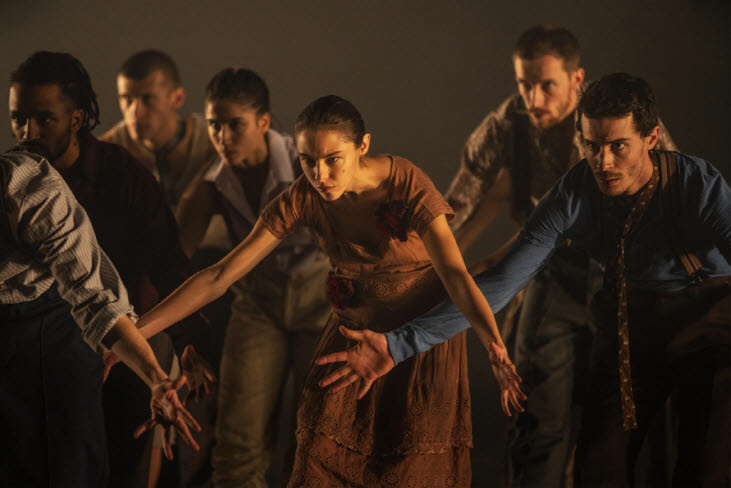
And that is how Élise becomes interested in contemporary dance, which looks and feels relatively less formal and rigorous than ballet. At one point, she and her close friends watch how free and joyous the members of a company led by Hofesh Shechter are in their dynamic dance movements, and she also finds herself attracted to one of these modern dancers.

However, the screenplay by director Cédric Klapisch, who previously made “Back to Burgundy” (2017), and his co-writer Santiago Amigorena does not hurry itself at all as Élise leisurely spends more time on determining on how to start over. At one point later in the film, she meets a friend who was once a promising ballerina just like her before eventually quitting, and she comes to see that she really does not have to hang onto her current career. When her friend suggests that Élise should accompany her and her chef boyfriend during their brief stay at a rural house for artists, Élise does not hesitate to accept her friend’s suggestion, and she feels much more relaxed than before as working along with them for a while.

Coincidentally, Shechter and his company members subsequently arrive at the house for their workshop week, and it does not take much time for Élise to pay more attention to what Shechter and his company members are doing day by day. She is still concerned about her ankle injury despite being recovered a lot, but she cannot help but drawn to the bouncing spirit felt from their practice session, and, what do you know, she eventually participates in their practice session while also getting closer to that certain member of the company.

Steadily sticking to its leisurely tone, the movie is often energized by music and dance as expected, and it certainly helps that many of its main cast members are actually professional dancers in real life. While Marion Barbeau, a newcomer who incidentally makes a movie debut here in this film, is a professional dancer and ballerina in fact, Hofesh Shechter has really been famous for being the founder and artistic director of the Hofesh Shechter Company as shown in the movie (He was also Tony-nominated for his choreography in Bartlett Sher’s 2016 Broadway revival of “Fiddler on the Roof”, by the way), and his several company members are virtually playing themselves on the screen. Whenever these performers are together for another dance, the mood and spirit are spontaneous to say the least, and the movie often gets elevated by that even when the camera looks at them from the distance.

Meanwhile, the movie also pays some attention to several supporting characters in the story, who brings extra personality to the story in one way or another. We get amused a bit from time to time as observing the tumultuous but ultimately loving relationship between Élise’s friend and her chef boyfriend, and Muriel Robin and Pio Marmaï constantly steal the show whenever their characters pull or push each other on the screen. As Élise’s caring physical therapist, François Civil has a very funny scene when his character comes to realize that it is already too late for him to express his romantic feeling toward Élise, and Denis Podalydès and Muriel Robin are also well-cast in their respective supporting parts.

In conclusion, “Rise” is quite spirited and charming as effortlessly dancing between drama and comedy, and it certainly does not disappoint us when its young heroine is finally on the road to new opportunities for her life and career on the horizon. Regardless of whatever will happen next, she will go on anyway, and you will definitely cheer for that.

Posted in Movies | Tagged , , , , | Leave a comment

Il Buco (2021) ☆☆☆1/2(3.5/4): Inside and outside the hole

“Il Buco”, which means “the Hole” in Italian, is surprisingly compelling in its dry and distant approach to its main subject. Simply following the discovery and exploration of a certain deep hole in the cave region of Pollino in Southern Italy in August 1961, the movie slowly rolls from one moment to another without much explanation for us, but the result is a very fascinating meditation on nature and human life, and its many haunting images will linger on your mind for a long time after it is over.

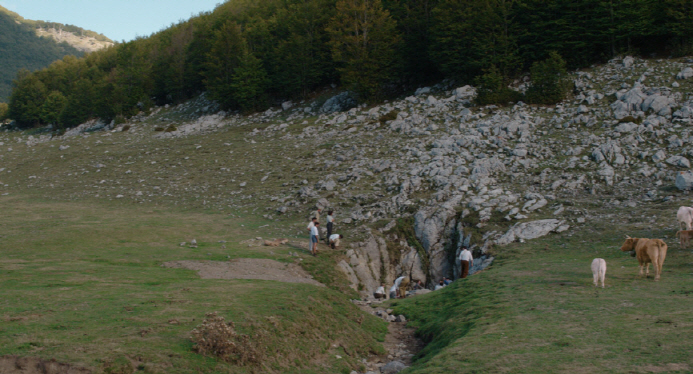
At first, the movie gradually sets its main background bit by bit. As the camera of cinematographer Renato Berta quietly looks around the landscapes of one little rural village near the cave region of Pollino, we observe the villagers and their surrounding area, and there is an interesting moment when their rather old-fashioned daily life is contrasted with what many of them watch from a small black and white TV outside a local bar in every evening. At one point early in the film, the TV shows a modern skyscraper built in Milano, and we can palpably sense the villagers’ wonder and curiosity to some degree even when the camera focuses on the TV screen for a while.

In the meantime, the movie also observes the arrival of a bunch of speleologists at the village. They arrive at a nearby train station at one night, and their arrival in the village on the next day certainly draws some attention from the villagers. After staying at the storage room of the local church for a while, they go outside the village for exploring a certain spot located in the aforementioned cave region, and, what do you know, this spot in question turns out to be much more interesting than expected.

The movie patiently follows their following exploration process step by step. At first, they carefully examine the opening part of a big hole which would be named “Abisso del Bifurto” (Bifurto Abyss), and they are marveled by how deep this hole really is. As they go down and down during next several days, there seems to be no bottom to reach, and that makes them more motivated about their unexpected academic discovery.

While there are a number of minor dialogue scenes throughout the film, director/co-writer Michelangelo Frammartino, who previously impressed me a lot with “Le Quattro Volte” (2010), deliberately does not provide the subtitle for non-Italian audiences. To our little surprise, this actually does not hinder us at all, because everything we need to observe and understand is clearly conveyed to us under Frammartino’s masterful direction. For example, one particular scene merely observes a plain conversation among old local farmers, and we do not need any subtitle at all because we can somehow sense whatever they are talking about on the screen.

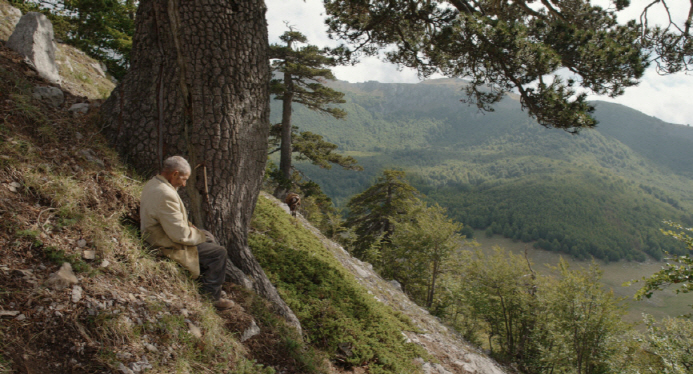
The movie comes to focus on one particular old farmer, who is already introduced to us at the beginning of the story. Although he does not say or express much on the surface, his aging face conveys to us a bit of his life history, and we come to wonder more about his thoughts and feelings as he silently regards the landscapes of his little area outside the village. Does he actually sense those inevitable changes coming into the village via modern culture and technology? If so, what does he really feel and think about that?

Meanwhile, the exploration of Bifurto Abyss is continued, and there are a series of wondrous moments which will make you wonder how Frammartino and his crew members shot these exceptional moments. I cannot tell whether they actually shot the film at sets or real locations, but these scenes look quite realistic in my humble opinion, and Frammartino wisely takes his time until the speleologists eventually arrive at the real end of their exploration project. In addition, the film shows some sense of humor at times, and you may be tickled a bit by an early morning scene between one horse and several speleologists sleeping in their tent.

This descending exploration process of theirs is juxtaposed with the increasingly declining physical condition of that old local farmer. After found quite unconscious by his neighbors at one point later in the story, he is immediately taken to his little residence and then examined by a local doctor. It does not take much time for us to perceive that he does not have much time to live, and there is nothing his neighbors can do for him except waiting for his eventual end. As usual, the movie sticks to its detached attitude, but this part is undeniably poignant as we witness how an old way of life is slowly dying.

On the whole, “Il Buco”, which won the Special Jury Prize when it was shown at the Venice International Film Festival in 2021, often feels elusive and distant at times, but it is still a rewarding cinematic experience with which you should take a chance. Despite receiving lots of critical praises on “La Quattro Volte” (It was one of my ten best films of 2011, by the way), Frammartino did not make any feature film for more than 10 years before eventually making “Il Buco”, and “Il Buco” shows that he should be more active for sharing his own distinctive artistic vision and style with us. Although it is rather late in its arrival in South Korea (It will be released here a few days later), I am glad that it gets an opportunity to be shown at local arthouse theaters, and I will certainly recommend it to any serious local moviegoer like me.

Posted in Movies | Tagged , , , | Leave a comment

Dumb Money (2023) ☆☆1/2(2.5/4): How they beat those Wall Street guys

“Dumb Money” tries to present the absurd aspects of the GameStop short squeeze incident in 2021, but it somehow fails to intrigue and engage me enough despite some entertaining moments. Sure, its main subject is certainly an interesting example showing how flawed the financial system of Wall Street is, but the movie often tries too hard as busily cramming numerous stuffs into its rather shorting running time (105 minutes), and now I am wondering whether it can have more depth and insight if it is made a few more years later.

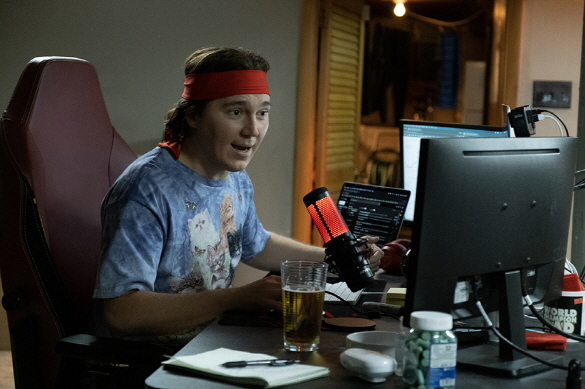
As many of you remember, the GameStop short squeeze incident was a dramatic case of David vs. Goliath. Mainly via YouTube and Reddit, a small-time stock market analyst named Keith Gill (Paul Dano) presented his prediction on the stock price of a video game retailer company named GameStop, and, what do you know, this supposedly inconsequential prediction of his ultimately led to a catastrophe for several hedge fund companies of Wall Street. These companies actually bet a lot on the decrease of GameStop stock price, but then Gill and his numerous online followers banded together for raising the stock price a lot more than before, and this eventually resulted in an unprecedented happening to remember.

Like Adam McKay’s “The Big Short” (2015), the screenplay by Laurent Schuker Blum and Rebecca Angelo, which is based on “The Antisocial Network” by Ben Mezrich (Yes, he is the one who wrote that book which was adapted into David Fincher’s “The Social Network” (2010)), juggles a bunch of different characters besides Gill. As Gill sticks to his prediction on GameStop stock price, many of those people watching his YouTube clips certainly become willing to buy some GameStop stock just in case, and we see how some of them are financially desperate in one way or another. There is a single mother nurse who really needs any chance for more money as soon as possible, and then there is a college lesbian couple who has been burdened by their college tuition debt, and then there is also a young GameStop employee who simply wants to walk away from his menial job someday.

As these and many other people begin to buy more GameStop stocks day by day during next several months, this sudden unexpected trend surely draws the attention of several major figures in Wall Street. At first, Gabe Plotkin (Seth Rogen) and his several associates including Steve Cohen (Vincent D’Onofrio) think this trend will eventually be over sooner or later, but then, as already shown at the beginning of the film, they are all thrown into sheer panic as facing the grim possibility of a big financial disaster to strike them all.

While these Wall Street dudes try to stop Gill and many small-time investors as much as possible, the movie generates some tension as Gill and several other characters are pressured more and more along the story. Watching their stock price going up much more than they ever imagined, they are all surely excited about their unexpected luck, but they all know that the stock price may stop rising at any point – if any of them steps back in their growing battle against Wall Street.

Director Craig Gillespie, who previously directed “I, Tonya” (2017) and “Cruella” (2021), and his crew members including Oscar-winning editor Kirk Baxter keep things rolling here and there as occasionally throwing heaps of information bits onto the screen, but the result only feels like scratching the surface instead of delving deeper into its main subject. As observing how the movie fumbles more than once in its attempts to present and explain the main subject, I often felt like not totally understanding everything in the film, and I came to appreciate more of how “The Big Short” was not only informative but also entertaining even to audiences not so familiar with the financial system of Wall Street (Full Disclosure: I am one of such people).

Another reason for the failure of “Dumb Money” is the lack of strong characters to hold or support everything together in the film. While Gill is supposed to be the center of the film, he is not that interesting compared to many of colorful main figures in “The Big Short”, which are one of the main reasons for why it works as an effective comedy. In case of a bunch of supporting characters in the story, they are no more than flat archetypes, and we come to observe them from the distance without much care or attention.

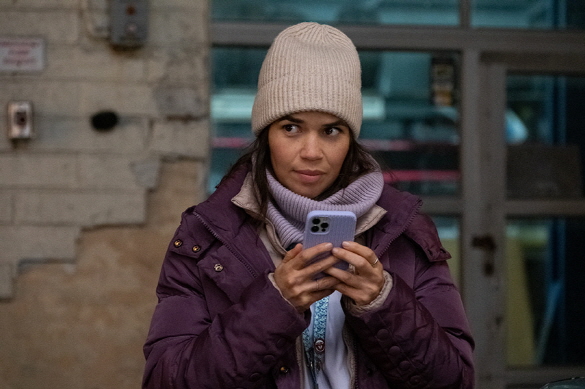
Anyway, the main cast members of the movie try as much as possible with their respective parts. Paul Dano is no stranger to looking nerdy and earnest, and he certainly does not disappoint us when his character has to deliver a public statement later in the story, though Shailene Woodley does not have much to do in contrast as Gill’s ever-supportive wife. On the opposite, Seth Rogen, who recently worked along with Dano in Steven Spielberg’s “The Fabelmans” (2022), is an effective counterpart in his low-key comic performance, and Vincent D’Onofrio, Sebastian Stan, and Nick Offerman are also well-cast, but I must point out that many other notable cast members including Anthony Ramos, Dane DeHaan, Olivia Thirlby, Pete Davidson, Clancy Brown, Kate Burton, and America Ferrera are sadly wasted due to their bland supporting characters.

On the whole, “Dumb Money” does not reach at all to the level of excellence achieved by “The Social Network” or “The Big Short”. To be frank with you, not so entertained during my viewing, my mind somehow could not help but think of American film critic Gene Siskel’s advice on stock investment to his close friend/colleague Roger Ebert, and I think I will stick to that advice for the rest of my life: “You can never outsmart the market, if that’s what you’re trying to do. Find something you love, for reasons you understand, that not everyone agrees with you about, and put your money in it.”

Posted in Movies | Tagged , , , , | Leave a comment

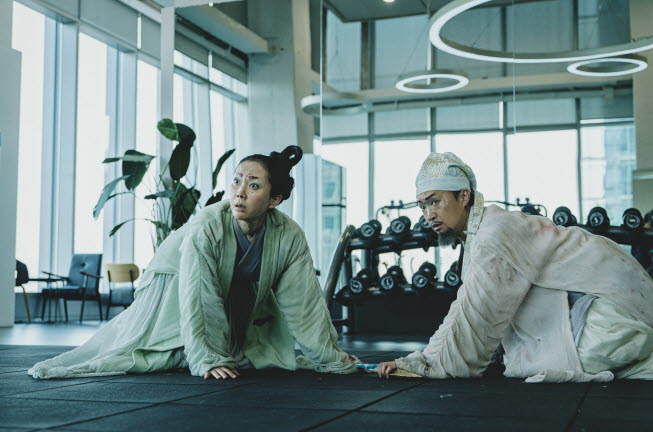
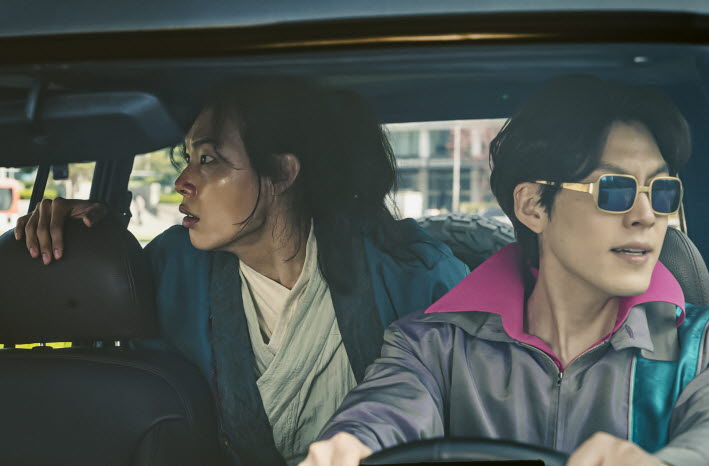
Alienoid: The Return to the Future (2024) ☆☆1/2(2.5/4): An obligatory finale

South Korean film “Alienoid: The Return to the Future” is not as boring as I feared, and that is the only consolation for me. Thanks to the sprawling narrative of “Alienoid” (2021), the movie has lots of things to gather and then explain during the first half, and then it feels too hurried and jumbled with lots of busy actions thrown into the second half. I did not care much about the story and characters, but the overall result is a little better than the tedium of “Alienoid” at least while amusing me a bit from time to time.

Just in case, I will summarize on what happened in the previous film, which alternates between two different time periods. On one hand, the movie presents a young girl living with an alien robot which has been the guard for alien prisoners trapped inside human bodies for a very, very, very long time, and then there comes a serious problem when one of the most dangerous alien prisoners on the Earth attempts to escape right in the middle of Seoul in 2022. On the other hand, the movie also presents a number of different characters living in the 14th century, and, not so surprisingly, some of them turn out to be connected with what is happening on in Seoul in 2022.

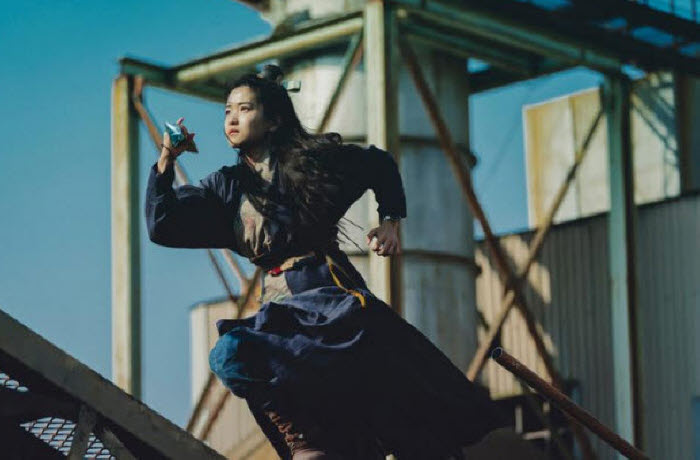
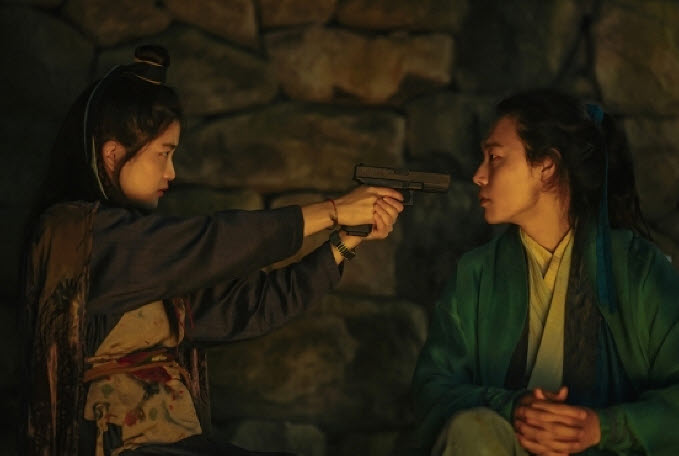
One of these characters is Lee Ahn (Kim Tae-ri), who is incidentally that aforementioned young girl and has been stuck in the 14th century for 10 years since she went there as shown at the end of the previous film. She has looked for a certain alien object which will help her go back to Seoul in 2022, but, of course, this alien object is wanted by not only her but also several others including Mureuk (Ryu Jun-yeol), a goofy lad who has a particular set of special skills just like many of the main characters in the story.

Anyway, Mureuk eventually comes to learn that he was actually involved with whatever happened shortly after Lee Ahn came to the 14th century, and that makes the situation quite awkward between them even though they come to like each other more than they can admit on the surface. Lee Ahn thinks she should distance herself away from him as much as possible, but Mureuk only finds himself getting more involved into Lee Ahn’s ongoing adventure along with his trusted two magical companions, who can be transformed into cats or humans under his command.

The movie also pays some attention to a couple of silly but undeniably gifted mages who become very determined to get to the bottom of what is going on around them after also getting involved into Lee Ahn and Mureuk’s circumstance. Later in the story, they happen to encounter a blind swordsman who has also been looking for that alien object, and, what do you know, this dude turns out to have a private motive behind his back.

Meanwhile, the movie also shows us what is happening in 2022 mainly via the aunt of Lee Ahn’s best friend, who becomes more crucial in the whole story due to her personal and professional background. After watching a little video clip shot by Lee Ahn in the previous film, she quickly goes all the way for stopping a disaster to be unleashed sooner or later upon not only Seoul but also the whole world, and she actually has some resource for that daunting cast.

After finally unfolding every piece of its story on the front, the movie is shifted onto full action mode, but it fails to engage us more due to its deficient narrative and thin characterization. As hurriedly shuffling between a number of different plots, the story frequently feels too scattershot to hold our attention, and its main characters remain as bland cardboard figures as they were in the previous film. While there are some unexpected plot turns later in the story, that does not bring much depth or drama to the main characters at all, and we only come to observe them without much care or attention.

In case of the action sequences in the movie, they look relatively more expensive than the ones in the previous film, but they are merely drenched in lots of digital special effects without any substantial dramatic effect, and, above all, they seriously lack style, personality, and imagination. To be frank with you, those alien villains and several other alien stuffs in the film are mediocre at best and uninspired at worst without much artistic qualities, and that is another main reason why the expected climax sequence does not work at all.

Many notable South Korean performers are assembled here, but most of them are sadly under-utilized in one way or another. Although Kim Tae-ri brings some spirit to her character in addition to having some fun, but she is eventually limited by her inherently flat role, and she and Ryu Jun-yeol unfortunately lack enough chemistry to care about their characters’ relationship development along the story. While Kim Eui-sung and Lee Hanee are wasted due to their thankless supporting roles, Yum Jung-ah and Jo Woo-jin provide some amusement for us at least, and it is a shame that they are not allowed to show more of their comic talent.
Compared to director/co-writer Choi Dong-hoon’s more successful films such as “Tazza: The High Rollers” (2006) and “The Thieves” (2012), “Alienoid” and “Alienoid: The Return to the Future” are a big letdown to say the least. At least, “Alienoid: The Return to the Future” manages to give us a fairly decent resolution for everything shown in the previous film, but it is still dissatisfying for many substandard qualities including its uneven storytelling and weak characterization, and, folks, I am already ready for moving on something better than this massive fiasco.

Posted in Movies | Tagged , , , , | Leave a comment

The Old Oak (2023) ☆☆☆1/2(3.5/4): A community place for him and others

Ken Loach’s latest film “The Old Oak”, which is supposedly his last movie, is another bittersweet British working-class drama you can expect from him. While it is a bit preachy and sentimental at times, its quiet but big heart is surely in the right place in addition to being supported well by the strong performances from its two lead performers, and the overall result is the commendable last chapter for Loach’s long and illustrious career.

At the beginning, the movie quickly establishes how things get tense in a little town of Northern England. There was a time when the town was a prominent mining community, but now it has been going down without much hope and possibility for many years, and then a bunch of Syrian refugees come to stay in the town at least for a while. While many people including TJ Ballantyne (Dave Turner) are willing to help the refugees, some other people are not so pleased about that, and the opening scene shows one of these mean people viciously harassing one of the refugees.

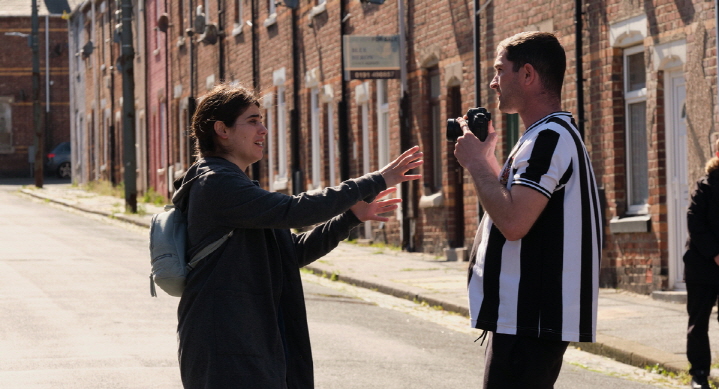
That harassed refugee in question is a young Syrian woman named Yara (Ebla Mari), who fled to England along with her mother and siblings not long after her father was arrested and then imprisoned in Syria. Her precious camera happens to be broken during that harassment incident, and she needs to get it repaired as soon as possible. TJ, who becomes more sympathetic to her, gladly helps her a bit, and that is the beginning of their little friendship. As getting to know her and her family and fellow refugees more, he is reminded more that they do need more help, and he willingly helps them along with several other town people day by day.

Of course, the tension rises more in the town because of the hate and prejudice against Yara and other refugees. TJ has been struggling to run his little local pub for years, so he often depends a lot on his remaining customers who frequently come to his pub, but some of his regular customers do not hesitate to show their resentment and bigotry against the refugees. Mainly because 1) he does not want any more trouble and 2) he understands well where these disagreeable people’s hate and prejudice come from, TJ does not respond much to their rude and detestable behaviors at first, but then they continue to annoy and exasperate him more and more as he keeps trying his best for both his pub and the refugees.

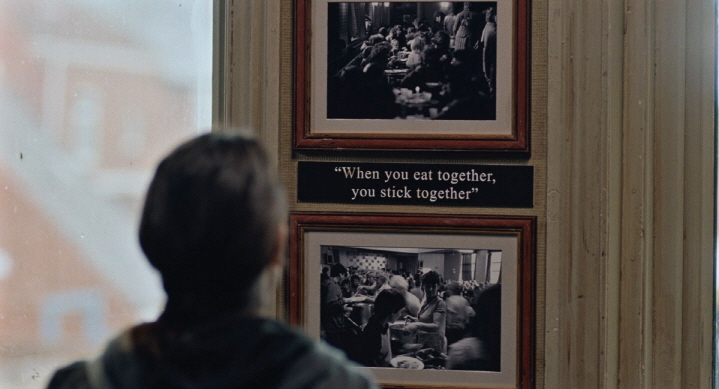
Meanwhile, we get to know more about TJ’s melancholic life of solitude. His wife left him along with their son some years ago because he often cared more about others instead of them, and he was more devastated when his dear father, who shot many of old photographs kept in a big room of his pub, died a few years ago. As a man who managed to avoid the worst thanks to a little accidental happening, he naturally empathizes with the refugees’ grim situation to some degree, and he becomes more determined to help and support them even after he is struck by another loss later in the story.

What follows next is a series of little heartwarming moments as TJ, Yara, and several others work together for turning that big room of his pub into a new public place for not only the town people but also the refugees. They somehow acquire enough money and help from here and there for their little project, and, what do you know, that abandoned empty place becomes a precious spot of generosity and solidarity once it is opened for everyone in the town.

Not so surprisingly, we also come to sense troubles more from some of TJ’s regular customers, who still do not want to see their last public space in the town being filled with, well, outsiders. What eventually happens next will not surprise you much, but it is really saddening and infuriating to see how hate and prejudice cause more misery and unhappiness, and you may not mind at all when Loach and his frequent screenplay writer Paul Laverty express their feelings and thoughts directly to us via a certain big moment of speech around the last act of the story. This is surely a bit too blatant, but, considering how much our world has been damaged by hate and prejudice during last several years, I will not deny that the message feels quite important nonetheless.

As usual, Loach draws good natural performances from his main cast, most of whom are relatively unknown performers or non-professional ones. While Dave Turner ably anchors the movie with his low-key acting, Ebla Mari brings warmth and spirit into her character, and she has her own lovely little moment when she gets a chance to look around the interior of an old cathedral outside the town. I must point out that the following scene between her and Turner feels like Loach and Laverty lecturing more on us, but Mari handles this scene with enough sincerity at least, and Turner dutifully supports her as before.

In conclusion, “The Old Oak” is relatively less impressive than Loach’s recent films “I, Daniel Blake” (2017) and “Sorry We Missed You” (2019), but it still works enough to engage and then touch us besides being a quintessential Ken Loach film. Considering that he has steadily advanced as making one interesting film after another for more than 50 years since his first feature film “Poor Cow” (1967), it is really a shame that this great British filmmaker will supposedly be retired after “The Old Oak”, but he gives us one last movie to be appreciated and admired at least, and that is surely a good thing for us for now.

Posted in Movies | Tagged , | 2 Comments

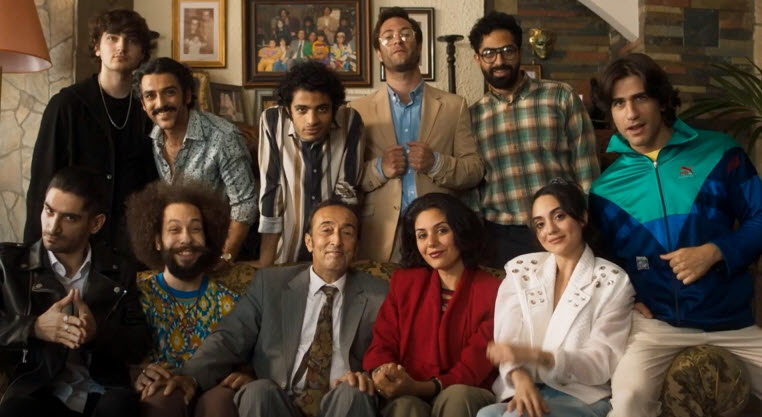
The Persian Version (2023) ☆☆☆1/2(3.5/4): Her Persian family

“The Persian Version”, which won the Audience Award when it was premiered at the US Dramatic Competition of the Sundance Film Festival early in last year (It also received the Waldo Salt Screenwriting Award, by the way), is funny, charming, and touching as cheerfully bouncing around its young Iranian American heroine and her immigrant family story. Mainly driven by the mother and daughter relationship at its center, the movie presents the story and characters with an ample amount of humor and care, and the result will alternatively amuse and move you a lot.

At first, we get to know about how it was often difficult for Leila (Layla Mohammadi) to grow up in her Iranian immigrant family during the 1980s. Around the time her parents moved to US from their country in the 1970s, things were mostly okay between US and Iran, but then these two countries became quite hostile to each other due to the revolution in Iran several years later, so young Leila often struggled between her two cultural identities as shown from one amusing moment early in the film.

In the early 2000s, Leila has lived independently now as your average young New Yorker, but things are still difficult for her. As a young aspiring filmmaker, she is not going anywhere as struggling to finish her new screenplay, which is incidentally based on her family story. In addition, her mother Shireen (Niousha Noor) remains not so pleased about Leila’s homosexuality – even after Leila married and then divorced some woman. When Shireen’s ailing husband finally receives a heart transplant surgery, nearly all of their children come together for support, but Shireen prefers not to be around Leila, so Lelia goes to their family home instead for taking care of her grandmother, who has no problem at all with her granddaughter being a lesbian.

Meanwhile, we also get to know about an unexpected happening in Lelia’s private life. During one Halloween party, she comes across a guy in a drag costume, and she comes to have a little hot night along with this dude, who happens to be the lead performer of the latest Broadway revival of “Hedwig and the Angry Inch”. It seemed to both of them that this is just a quick and simple moment of desire which will be forgotten sooner or later, but, what do you know, Leila is caught off guard when she is notified a few months later that she is actually pregnant.

 While eventually deciding that she will have a baby without marrying that dude, Leila comes to learn from her grandmother that there is a little secret behind her mother, and she soon became quite curious about what happened to her mother before she came to US along with her husband. As shown from a series of flashback scenes, she and her mother were not particularly close to each other, but she really wants to know more about her mother’s secret because it may anchor her screenplay as the emotional core of the story.

As Shireen’s hidden past is gradually unfolded along Lelia’s ongoing narrative, the screenplay by director/writer/co-producer Maryam Keshavarz freely swings back and forth between comedy and drama along with more character development. We come to admire and respect Shireen more as observing more of her sheer determination which has steadily carried her family during all those years. We also come to see that, as Leila’s grandmother points out early in the story, Leila is actually not so different from Shireen in many aspects. A number of scenes between Leila and her grandmother are constantly warm and sweet, and the movie also pays some attention to Leila’s sick father, who was not a very good husband to his wife but tried his best for his family anyway before getting too ill to work.  

In case of Leila’s eight older brothers, they are depicted with each own personality instead of becoming mere background details. Even though you cannot remember all of their respective names, they are often distinguishable from each other even when they are together on the screen, and it is certainly nice to see how all of them show unconditional care and support to their younger sister just like their grandmother.  

Keshavarz draws good performance from her main cast members. While Layla Mohammadi and Niousha Noor are believable in the long and complicated personal history between their characters, and their solid performances are flawlessly connected with Chiara Stella and Kamand Shafieisabet, who respectively played young Leila and young Shireen. Bijan Daneshmand, Bella Warda, and Tom Byrne are also well-cast in their supporting parts, and Byrne is hilariously awkward when his character is invited to join a family dinner as the biological father of Lelia’s baby.

In conclusion, “The Persian Version” is an endearing mix of coming-of-age comedy and immigrant family drama, and its vibrant charm and spirit still linger on my mind. Although I have not watched her two previous feature films “Circumstance” (2011) and “Viper Club” (2018), I can clearly discern here that Keshavarz is another talented filmmaker to watch, and it will be interesting to what she will do next after this little wonderful film which deserves to be cherished more in my inconsequential opinion. In short, this is one of more notable works of last year, and I sincerely recommend you to check it out as soon as possible.

Posted in Movies | Tagged , , | Leave a comment

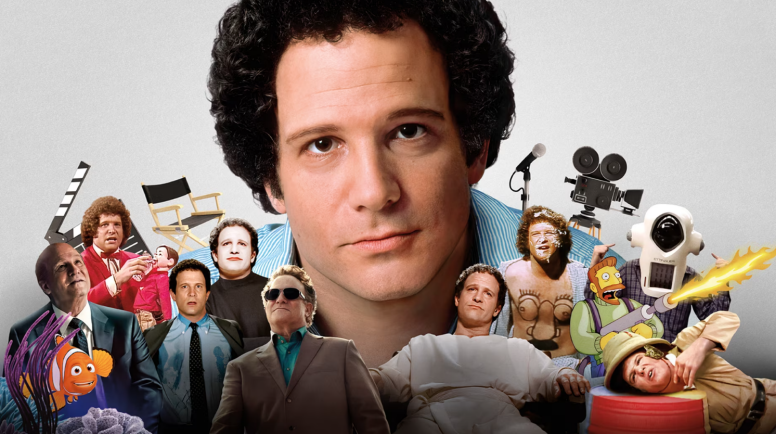
Albert Brooks: Defending My Life (2023) ☆☆☆1/2(3.5/4): Brooks on Albert

I must confess that it took some time for me to appreciate more of that immense talent of Albert Brooks. When I was just a young South Korean moviegoer a long time ago, he seemed to me like a merely good American comedian who had sometimes drawn my attention via a series of solid movie performances including his stellar (and sweaty) Oscar-nominated turn in James L. Brooks’ “Broadcast News” (1987), but I gradually came to admire his long and illustrious career as getting to know more about his old and new achievements during next several years.

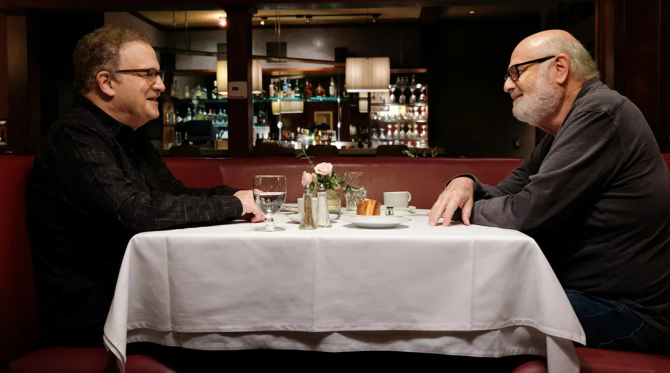
In HBO documentary film “Albert Brooks: Defending My life”, Brooks surely has lots of things to tell as casually talking with his longtime friend Rob Reiner, who also serves as the director/co-producer of the documentary. As a matter of fact, Brooks and Reiner were already close to each other when they were studying at the same high school in Beverly Hills, California along with the kids of many different Hollywood celebrities ranging from Groucho Mark to Lee J. Cobb, and they were no exception at all in case of their family background. As many of you know, Reiner is the son of legendary comedy writer Carl Reiner, and Brooks is the son of Harry Parke, a radio comedian star who was also known as “Parkyakarkus”.

Probably because of his real surname which I will not reveal here for not spoiling a good laugh for you, Brooks was always ready to go for laughs even when he was just a teenager, and his comic talent even impressed Reiner’s father a lot as both he and Reiner fondly remember. Eventually, he went all the way for comedy just like his father when he subsequently entered adulthood, and a number of archival footage clips from his early career show us how much he was willing to go for more laughs in his own distinctive comic methods. While often quite silly and outrageous, his comic tactics were always accompanied with wit and intelligence behind all those absurdities of his, and that surely makes many of his comedy sketches not only richer but also timeless.

As he drew more attention as a young promising comedian to watch, Brooks started to appear in a number of major TV shows including NBC’s The Tonight Show Starring Johnny Carson, where he never disappointed his audiences at all whenever he appeared as a special guest. Believe or not, he seldom tested or practiced most of those comic sketches of his in advance, and that certainly tells us a lot about how unhesitant he was for taking risks for spontaneously comic moments to tickle his audiences. 

Just like many other comedians, Brooks certainly had his own anxiety and security behind his comic persona. As the son of a famous comedian whose death was absurdly legendary to say the least, he definitely had to try a lot for proving his own talent to others, and he also had a rather strained relationship with her mother, which is incidentally incorporated into his little comedy film “Mother” (1996). While quite frank about the emotional distance between him and his mother, Brooks knows how to tell his personal story with some sharp sense of humor, and I was particularly tickled by an anecdote involved with his mother’s simple wish about her funeral.   

The second half of the documentary mainly revolves around Brooks’ movie career, and that is where it will become more interesting for anyone familiar with his movies. After making his first feature film “Real Life” (1979), Brooks impressed critics and audiences more with “Lost in America” (1985) and “Defending Your Life” (1991). In case of the latter, Brooks plays a guy who comes to reflect a lot on his whole life after he suddenly dies and then is transferred to a state of afterlife, and I strongly suggest you that you should check out this little gem which is also one of the most hilarious and intelligent movies about life and humanity.

After “Mother”, “The Muse” (1999), and “Looking for Comedy in the Muslim World” (2005), Brooks became less prominent as a filmmaker, but he steadily worked as a versatile character actor to be appreciated. While he continued to show his usual comic talent here and there as shown from his funny guest performance in HBO comedy series “Curb Your Enthusiasm”, he also demonstrated a more serious side of his acting talent in Nicholas Winding Refn’s “Drive” (2011), and it is really a shame that he was not Oscar-nominated again for his chillingly against-the-type villain performance despite receiving the enthusiastic recognition from several major film critics associations including the National Society of Film Critics.

While it is constantly fun and amusing to see the frequently comic interactions between Brooks and Reiner, Reiner also assembles a bunch of various interviewees ranging from David Letterman and Conan O’Brien to James L. Brooks and, surprise, Steven Spielberg, who actually often hanged around with Brooks when they were starting their respective careers during the early 1970s. All of these interviewees in the documentary have each own interesting story to tell about Brooks, and that surely makes the documentary all the more engaging.       

On the whole, “Albert Brooks: Defending My Life” is a splendid documentary which will show a lot about Brooks’s life and career, and you will come to admire his undeniable talent more like I did after watching this entertaining documentary. He is indeed one of the best comedians of our time, and we should cherish his singular talent as long as we can.

Posted in Movies | Tagged , , , , , | Leave a comment

Little Richard: I Am Everything (2023) ☆☆☆(3/4): Beyond his legendary flamboyance

Documentary film “Little Richard: I Am Everything” looks around the life and career of Little Richard, who has been regarded as the ground-breaking pioneer of American Rock and Roll music. As looking beyond his legendary flamboyance, the documentary illuminates an energetic but conflicted man who had a fair share of ups and downs as struggling with his sexual identity in addition to being often underappreciated throughout his lifetime, and you will surely come to appreciate more of his significant artistic contribution to the American pop music of the 20th century.

Little Richard was born to a poor African American family in Georgia, 1932. Even when he was very young, Richard, who was Richard Wane Penniman during that period, often demonstrated his considerable musical talent, and he surely helped his minister father a lot at not only his church but also his little illegal business spot, though his father sternly disapproved of how he often looked feminine and flamboyant.

In the end, Richard eventually left his family home for working along with a various number of traveling black musician groups, and he became more comfortable with his sexual identity as he and many other black queer musicians were accepted more inside their free-wheeling artistic community. As a matter of fact, Richard even willingly performed as a drag queen at times, and that was certainly an interesting part of his early career period.

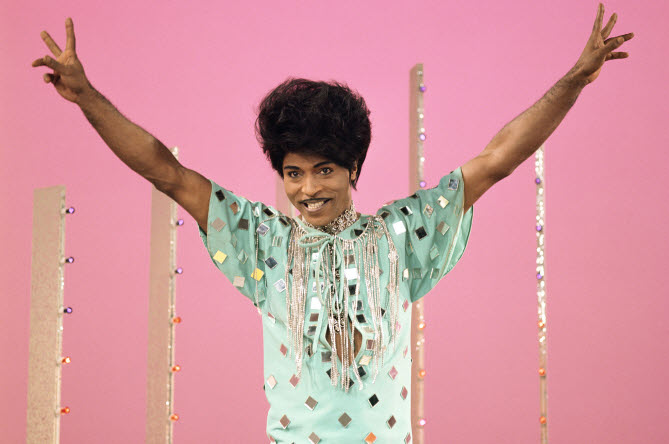
Meanwhile, Richard came to draw more attention as a young and talented musician to watch, and then there came an accidental breakthrough which boosted his career much more than he and others ever imagined. In 1955, he recorded “Tutti Frutti” with his own free style, and, what do you know, this became an immense hit not only inside but also outside black community. As a result, his name and music were widely spread around the whole country, and he soon found himself receiving the feverish adoration of thousands of black girls as well as white girls.

Ironically, Richard was allowed to be pretty and flamboyant on the stage during that time mainly because of his race and sexual identity. While intensely exuding sexuality in front of his audiences all the time, he was mostly regarded as a non-threatening oddball to white people, and that was how he could freely ride on his big success during the 1950s. When he eventually found his music and style being appropriated by major white musicians such as Pat Boone or, yes, Elvis Presley, he intentionally dialed up his performance for more intensity, and the result was pretty astounding to say the least.

However, behind all the exaggerating flamboyance of his, Richard was frequently conflicted about his sexual identity. He subsequently presented himself as a born-again Christian, and he also tried on married life as marrying Ernestine Harvin in 1959. Nevertheless, his sexual confusion, mainly fueled by his Christian upbringing, always followed him throughout his life, and the documentary details on how he often swung back and forth between his Christian background and sexual identity during next several decades. As one interviewee in the documentary points out, it is really ironic that he could not liberate himself that much even though his music has liberated so many LGBTQ+ people out there.

Anyway, Richard’s music continued to influence numerous different musicians ranging from the Beatles to David Bowie, whose flamboyantly androgynous appearance certainly owes a lot to Richard’s. When he made a comeback in London in the early 1960s, Richard actually met the Beatles when they were just newcomers who still had to prove themselves more, and he surely impressed and inspired these British lads a lot as showing the way toward their eventual success.

During the 1980s, Richard became less prominent than before, but he often reminded others that he would not just go away at all. Due to a very unfortunate accident, he missed the opportunity to attend a very special ceremony for him and several other giants of American Rock and Roll music, and he surely felt hurt about that, but he kept going like a trouper. In the end, he came to receive some overdue recognition in the 1990s, and there came a touching moment when he eventually received the American Music Award of Merit in 1997.

Around the time before his death in 2020, Richard got swung back to his Christian background as being aware of his imminent mortality, but several interviewees in the documentary including Billy Porter and John Waters still appreciate Richard’s considerable contribution to their LGBTQ+ community. He might never be totally comfortable with being himself, but he inspired and motivated other queer people a lot instead, and that deserves to be regarded as one of his significant legacies.

Overall, “Little Richard: I Am Everything”, directed by Lisa Cortés, presents its human subject with enough care and respect, and I enjoyed some nice visual touches for vividly conveying to us how Richard often electrified stages and audiences during his prime period. While it could show more, the documentary is still fairly engaging in addition to giving us a good overview on Richard’s life and career, and it is certainly worthwhile to watch if you are not so familiar with his music.

Posted in Movies | Tagged , , , , | Leave a comment