A Lonely Island in the Distant Sea (2021) ☆☆☆(3/4): As his life goes on…

South Korean independent film “A Lonely Island in the Distant Sea”, which I belatedly watched only after it unexpectedly won the Grand Prize at the Wildflower Film Awards in South Korea, simply and leisurely rolls along with its plain hero’s life. As he goes through a series of small ups and downs along the story, the movie patiently engages us via a subtle balance between humor and drama coupled with some sincere moments of self-reflection, and it is alternatively amusing and touching to observe for us how things change for him and several others around him in one way or another.

At the beginning, we get to know its hero’s current life status. While he was once a promising young sculptor many years ago, Yoon-cheol (Park Jong-hwan) has been stuck with making simple sculptures to be used for science museums, and he has been fine with that just because 1) that has supported his living day by day and 2) he has no particularly interest in rebooting his old artistic career. While her adolescent daughter Ji-na (Lee Yeon) shows some artistic potential just like he did, they have been distant to each other for some time since his divorce, and they do not talk that much with each other when he comes to her high school for a small trouble of hers.

Meanwhile, Yoon-cheol later encounters Yeong-ji (Kang Kyung-hun), a female college lecturer who instantly becomes interested in Yoon-cheol after their first meeting even though there is nothing particularly attractive about him. She eventually lets him stay more round her, and it looks like they can be a bit more serious about their developing relationship.

However, not so surprisingly, things do not go as well as he hopes. When Yoon-cheol lets himself become rather distant from Yeong-ji due to doing some work outside South Korea, she eventually decides to break up with him, and Yoon-cheol belatedly realizes how much he really needs her. He naturally pleads her not to leave him, but she remains adamant nonetheless, while also sharply pointing out his faults on their relationship.

And there comes another unexpected happening to Yoon-cheol. After wandering more and more since deciding not to pursue her artistic aspiration, Ji-na eventually decides to become a Buddhist monk, and she promptly embarks on her preparation period after shaving her head. Naturally perplexed by his daughter’s decision, Yoon-cheol keeps asking her whether she is really serious about that, but she remains unflappable in her decision, while also totally being in piece with herself in contrast to her wild time in the past.

While the movie calmly moves from one episodic moment to another, we observe a number of subsequent changes in Yoon-cheol’s life. After he later comes upon the dead end of his current status, he decides to stay more around her daughter, and he soon finds himself working as a handyman for Ji-na, who is now called “Do-maeng”, and her female mentor. In addition, he also comes to open a little noodle shop at a nearby town, which gradually becomes profitable enough to support him despite its uneventful first days.

Getting more settled than before, Yoon-cheol starts to take care of several problems in his life. Although he and his daughter are now more like an employee and an employer, they find themselves opening themselves more to each other than before, and that is why it is poignant for us to see when Ji-na becomes more affectionate to her father later in the story. When Yoon-cheol meets Yeong-ji again, he shows more care to his ex-girlfriend for a good reason, and Yeong-ji surely appreciates this considerate gesture of his.
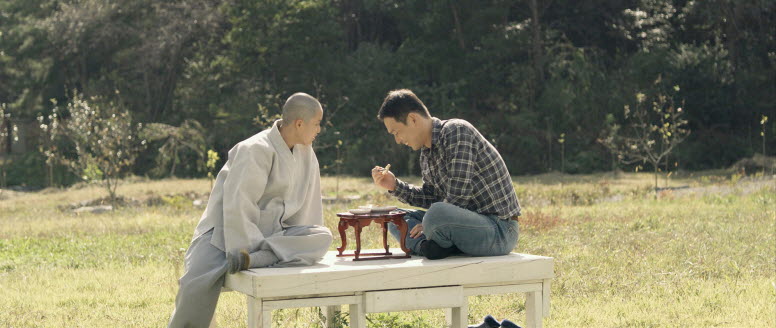
These and many other little personal moments in the film are presented well with unadorned poetic sensitivity under the dexterous direction of director/writer Kim Mi-yeong, who previously made a feature film debut with “Upstanding Man” (2016). For example, the key moments in the movie are thoughtfully composed on the wide screen of 2.35:1 ratio without drawing too much attention at all, and we accordingly get more immersed into its reflective mood as coming to care more about the story and characters.

Furthermore, Kim draws solid performances from her main cast members. Park Jong-hwan, who recently played a small but crucial supporting role in Eom Tae-hwa’s “Concrete Utopia” (2023), steadily carries the film as subtly conveying to us the slow but gradual inner changes of his character, and his effective performance comes to function as the stable ground for his fellow main cast members. While Lee Yeon, who previously drew my attention for her supporting turn in Byun Sung-hyun’s Netflix film “Kill Boksoon” (2023), is convincing in her character’s dramatic change along the story, Kang Kyung-hun is also wonderful in her supporting part, and the special mention goes to Park Hyun-sook, who always steals the show as Ji-na’s no-nonsense mentor.

In conclusion, “A Lonely Island in the Distant Island” is one of more interesting South Korean films of last year, and Kim shows here considerable potential as another talented South Korean filmmaker to watch. Although I have not watched “Upstanding Man” yet, “A Lonely Island in the Distant Island” impressed me enough on the whole, and I will certainly have some expectation on whatever will come next from her.

Posted in Movies | Tagged , , , | Leave a comment

Her 5th Room (2024) ☆☆☆(3/4): She simply needs to have her own private space…

South Korean documentary film “Her 5th Room” is a small but intimate personal story about one middle-aged woman who simply needs to have her own private space. As closely and sensitively observing her struggle for privacy and independence, the documentary often gives us aching emotional moments to remember, and we are eventually touched by when she finally decides to step forward more for what she has yearned for many years.

She is the mother of director/co-producer Jeon Chan-young, and the documentary opens with Jeon moving from Busan to her family residence in Daegu. For around 30 years, Jeon’s mother has lived with her husband and parents-in-laws in a two-story house, and Jeon tells us how her mother’s status has been upgraded a bit during last several years. When they married many years ago, Jeon’s mother and her husband were allowed to occupy a small room together while the big main bedroom belonged to her parents-ln-laws. After her father-in-law died and then she became the breadwinner of the family after her husband lost his job, Jeon’s mother was allowed to have the main bedroom. However, she subsequently decides to move up the room on the second floor, mainly because she really needs a place where she can work without any interruption from her other family members including her husband.

Jeon’s mother has worked as a qualified freelance counselor, and we see how she works here and there when she is not working in her family residence. At one point early in the documentary, she gives a little lecture to a group of people who come with their respective foreign spouses, and it is apparent that she is really proud and passionate about her current profession.

However, Jeon’s mother is still not that happy as often feeling like an outsider who has just been stuck with others in the house for years. When she was a young country girl who got fallen in love with her future husband, everything seemed to be going well for both of them, but they found themselves depending a lot on his parents in many ways after their wedding, and she was expected to take care of a lot things in the house for many years just because she was the wife of the only son of her parents-in-laws.

Moreover, her husband has not been much help to her for many years. Right from his first scene in the documentary, it is apparent that he is a useless old bum who has taken everything for granted, and we later get to know more about his worse sides. For example, he often drinks a lot whenever he gets a chance, and then he frequently annoys and interrupts his wife even though she has a lot of works to do besides those usual domestic stuffs to handle.

And then there comes an eventual breaking point for Jeon’s mother later in the documentary. Her mother-in-law suddenly makes an unexpected decision involved with the ownership of the family residence, and this hurts her feeling for good reasons. As the camera calmly observes their conversation from a static position, Jeon’s mother cannot help but show more and more of her anger and frustration while arguing with her mother-in-law, and this moment is often painful to watch for us.

In addition, her husband’s drinking habit gets worse day by day. At the funeral of one of her close family members, he happens to clash with some of her family members while getting quite drunk, and this surely exasperates his wife more than ever. In the end, Jeon’s mother and her children come to have a sort of intervention meeting between them and her husband, and we come to learn more about how much she and her children have endured and dealt with her husband’s alcoholism and occasional domestic violence.

While rightfully siding with her mother, Jeon also tries to give a fair chance to her father at least even though she comes to dislike her father more than before. Later in the documentary, she shows him several key moments in the documentary, but he just casually recognizes that he is indeed the villain of her documentary, and he does not even feel much regret or repentance on that. You may come to feel some pity to this incorrigible old man who still does not grasp at all how much he has hurt his family members for many years, and then you will become more disgusted when he drinks a lot again to cause another annoyance for his wife.

After that, Jeon’s mother finally decides that enough is enough, and what she does next is quite sensible to say the least. Now she feels more hopeful and optimistic than ever, and that makes a big contrast with her husband’s more pathetic status. While she is ready to move onto the next chapter of her life, he does not seem to know what to do next, and that will probably be continued to the end of his life.

On the whole, “The 5th Room” works as a sincere and touching family story, and Jeon presents her family members with enough care and respect despite her complex feelings about some of them. Although it could show us more in my humble opinion, the documentary is fairly solid and impactful within its rather short running time (81 minutes), and the result is one of more engaging South Korean documentaries of this year.

Posted in Movies | Tagged , , , , | Leave a comment

Godzilla Minus One (2023) ☆☆☆(3/4): One of the better Godzilla flicks

Japanese film “Godzilla Minus One”, which was belatedly released on Netflix a few days ago in South Korea, is one of the better Godzilla flicks I saw during last 30 years. While you surely get as much as you can expect whenever the titular character enters the screen, the movie also shows some care to a number of human characters in the story, and that certainly distinguishes itself from several recent Godzilla movies from Hollywood.

You do not need to see other Japanese Godzilla films first, because, as reflected by its very title, the movie is a reboot which takes the series back to the late 1940s. During the opening scene, we are introduced to a kamikaze pilot named Kōichi (Ryunosuke Kamiki), and then we see his first encounter with Godzilla, which occurs not long after he lands on the Japanese military base located in some small island. It is apparent to the lead mechanic of the base from the beginning that Kōichi is fleeing from his deadly duty, but that becomes a rather trivial matter once Godzilla appears and then attacks the base, and this certainly traumatizes Kōichi.

Anyway, he eventually returns to Japan along with many other soldiers once the World War II is over, and he is all the more devastated to see that all of his family members in Tokyo were dead due to the air raids on Tokyo. As Kōichi tries to rebuild his life, he happens to get associated with a young woman named Noriko (Minami Hamabe), and Noriko comes to live along with him and a little orphan baby girl she happened to acquire not long before she met him.

While Tokyo and its citizens subsequently go through a recovery period during next several months, things gradually get better for Kōichi and others around him. He gets a rather risky job which can provide enough money to support not only him but also Noriko and the baby, but Noriko is also willing to work for getting more money for them, and a neighbor of theirs, who happened to lose all of her children during the war, is ready to take care of the baby in the meantime.

The movie slowly establishes the imminent danger to be unleashed upon Tokyo and its citizens. Once Godzilla gets enlarged and empowered by the latest hydrogen bomb test by the US military, it is promptly going toward Tokyo, but both the US military and the Japanese government are not so willing to take any big action against this impending disaster for a complicated political reason.

Needless to say, Kōichi, whose job is incidentally removing numerous military underwater mines, and his several colleagues soon behold how unstoppable Godzilla really is, and that surely throws him into another panic. As Godzilla makes its expected appearance, the movie does a nice variation of the certain scene of Steven Spielberg’s “Jaws” (1975), and you will surely be reminded of that memorable line from when Roy Scheider’s character confronts that big white shark for the first time in that film.

Once Godzilla arrives in Tokyo, the movie certainly goes for more shock and awe for us. As it stomps here and there around one area of Tokyo, we are served with a series of spectacular moments to admire. In this film, Godzilla is a wrathful force of nature which attacks upon the city and its people with no mercy at all, and you will be chilled and then entertained when Akira Ifukube’s famous theme from those classic Godzilla flicks is boldly played on the soundtrack in the middle of this sequence.

The second part of the film mainly revolves around Kōichi and many other human characters’ attempt to stop Godzilla by any means necessary. One of his colleagues, who happens to be a former Naval weapons engineer, turns out to have a plan, and, though they are not so sure about whether it will eventually succeed or not, they decide to go all the way for saving people from more possible disasters to come via Godzilla.

It goes without saying that Kōichi becomes a key figure in this highly perilous mission, and his personal drama comes to function as a human element to hold our attention during the eventual climactic part. While Godzilla is still the main star of the film, Ryunosuke Kamiki holds his own place well even when his character is overwhelmed by Godzilla, and several other main cast members including Minami Hamabe, Yuki Yamada, Sōsaku Tachibana, Hidetaka Yoshioka, Kuranosuke Sasaki, and Sakura Ando, whom you may remember for her poignant performance in Hirokazu Kore-eda’s “The Shoplifters” (2018), are also well-cast in their colorful archetype supporting roles.

In conclusion, “Godzilla Minus One” is a solid piece of entertainment which is more enjoyable than those recent Hollywood Godzilla films, and director/writer Takashi Yamazaki, who deservedly received a Best Visual Effects Oscar early in this year, did a competent job of bringing some new and fresh energy into its longtime franchise. Considering what is shown around the end of the film, there will certainly be more Godzilla films to come (Godzilla is as hard to kill as Jason Voorhees or Michael Myers, you know), and I am ready for them after throwing more of my inconsequential snobbism on many of Godzilla flicks. They may be really trashes, but please remember what late critic Pauline Kael once said: “The movies are so rarely great art, that if we can’t appreciate great trash, there is little reason for us to go.”

Posted in Movies | Tagged , , , | Leave a comment

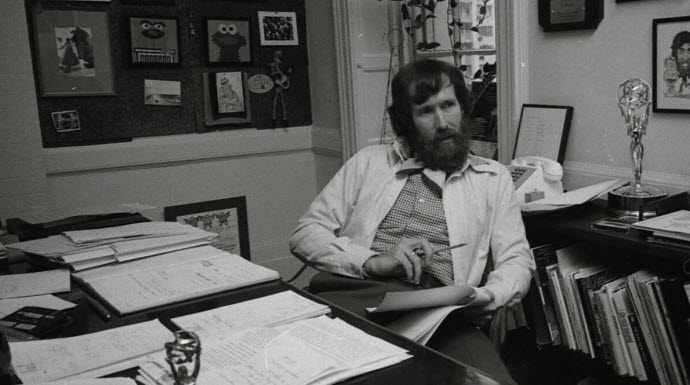
Jim Henson: Idea Man (2024) ☆☆☆(3/4): A man behind the Muppets – and more

Ron Howard’s new documentary film “Jim Henson: Idea Man”, which was released on Disney+ in last week, is an affectionate tribute to Jim Henson, who was the main creative mind behind many delightful things including “Sesame Street” and “The Muppets”. Looking around many highpoints in Henson’s illustrious career, the documentary gives us a closer look into his artistry and humanity, and it is often compelling to observe how he drove himself further and further before his untimely death in 1990.

Mainly consisting of archival photographs and video clips coupled with the occasional interview clips from Henson’s several colleagues and family members, the documentary initially shows and tells us on how everything was begun during Henson’s early years. While he showed some artistic potential during his childhood years, Henson actually got interested in becoming a puppeteer later during his high school years, and his interest grew more when he was studying in a college where he met his future wife Jane, who soon became his creative/romantic partner despite their considerable personality difference.

When he subsequently went to Europe in the late 1950s, Henson got more creative input from the mastery and dedication of many different European puppeteers, and he was ready to push himself more as he eventually began to make a series of TV comedy sketches consisting of the puppets made by him and his collaborators. Of course, many of these puppet characters were the seniors to numerous Muppet characters such as Cookie Monster, and Kermit the Frog was actually one of the early ones. Voiced by Henson himself, Kermit the Frog was more or less than the extension of Henson’s personality, and I must say that it is rather fascinating to observe Kermit the Frog appearing in several black and white TV shows during that period.

While becoming more successful than ever thanks to his Muppets, Henson never stopped at all as trying one different thing after another. As entering the 1960s, he tried a number of various things ranging from his Oscar-nominated short film “Time Piece” (1965) to a Broadway production project which was not sadly realized, and he even attempted to design a disco hall which feels more like the exhibition rooms for installation art in my humble opinion.

And then something unexpected came into his life and career. Henson and his colleagues including Frank Oz were asked to create a children’s program for National Educational TV (NET), and, yes, that led to one of the most successful children’s programs in the American TV history. Mainly thanks to the sheer artistic creativity and dedication of Henson and his colleagues, “Sesame Streets” became a phenomenal hit right from its first year, and its enduring legacy cannot possibly be exaggerated. After all, I and my younger brother were exposed to English thanks to the VHS box set of Sesame Street episodes during our kindergarten period, and we still fondly remember Big Bird and many other lovable Muppet characters.

Nevertheless, Henson was not totally satisfied yet as an ambitious workaholic. He was already eager to move onto creating something else, and that actually led to another huge success. When Henson and his colleagues worked on “The Muppets” in England, nobody expected that much from their new project, but, what do you know, the show became quite popular while also getting a bunch of notable guest stars such as Roger Moore and Rita Moreno.

After becoming quite successful in TV, Henson prepared himself for making a feature film. Making “The Dark Crystal” (1982) was very challenging for him and his colleagues to say the least, but, again, they try their best in pushing themselves more and more, and the result was a memorable fantasy film which incidentally managed to earn enough money despite competing against a certain big movie coming from Steven Spielberg at that time.

Of course, being a hardcore workaholic gradually affected not only Henson himself but also his family members. Although he loved his wife and their five children, his work always came first, and that certainly caused occasional conflicts between him and his wife despite their affection and respect toward each other. Although his children have no hard feeling on their father, they remember how their father was often absent due to his works, and it is touching to see how Henson sincerely tried to support and encourage their respective professional careers during his later years.

Despite the critical and box office failure of his second feature film “Labyrinth” (1986), Henson was still ready for doing more stuffs, though he began to slow down himself a bit. Around the time when he sold his production company to Disney, he seemed to be ready for the next possible chapters of his life and career, but then he suddenly died not long after that, and everyone around him was quite devastated. Nonetheless, Henson showed some sense of humor via his will and the instruction on his funeral, and you will be alternatively amused and moved by that.

Overall, “Jim Henson: Idea Man” is a solid documentary to engage and touch us, and Howard, who has recently made a series of notable documentaries which are actually better than his recent feature films such as “Hillbilly Elegy” (2020), handles his human subject with enough care and respect. Yes, it could have shown more, but the result is fairly satisfying on the whole, and you may want to learn more about Henson’s life and career after watching it.

Posted in Movies | Tagged , , , , | Leave a comment

I’ll See You in My Dreams (2015) ☆☆☆(3/4): As her remaining days go by

“I’ll See You in My Dreams”, which happens to be one of the movies recently available on Netflix in South Korea, is a little intimate character drama which turns out to be a bit more sensitive and thoughtful than expected. On the surface, it is another familiar drama about life, aging, and love, but it goes deeper into the story and characters without never overstepping at all, and the result is alternatively humorous and poignant.

At the beginning, the movie gradually establishes the daily life of Carol Petersen (Blythe Danner), an aging widow who has comfortably and quietly led her single life since she lost her husband due to a big accident around 20 years ago. Mainly thanks to the insurance money she received after her husband’s unfortunate death, Carol can still live alone in a cozy Californian house along with her old pet dog, and she is not so interested in living with several old friends currently residing in a nearby retirement community, though she often spends some time with them.

And then there come several small changes to interrupt Carol’s comfortable daily life. First, her pet dog has to be euthanized for some serious medical condition involved with its old age, and she is certainly devastated by the loss of her longtime companion. As she sleeps alone in the house later, she is suddenly disturbed by the appearance of a little rat appearing from somewhere inside the house, which comes to disturb her more along the story.

Meanwhile, there comes a new guy who comes to clean the pool of Carol’s house. He is a lad named Lloyd (Martin Starr), and she subsequently suggests him that they should have some wine together. Despite their considerable age difference, Carol and Lloyd find themselves becoming more casual with each other, and Lloyd comes to tell her more about himself than expected, though both of them are not so sure about what may happen next between them.

To us, it seems that another guy Carol comes across at a local supermarket is more suitable for her. He is a retired man name Bill (Sam Elliott), and he does not hesitate to show her that he is really interested in getting to know her, even though they are total strangers to each other from the beginning. She comes to learn later that he is actually known well in her friends’ retirement community, and then she does not hesitate when he approaches to her again not long after she has a pretty dissatisfying speed dating time to our little amusement. 
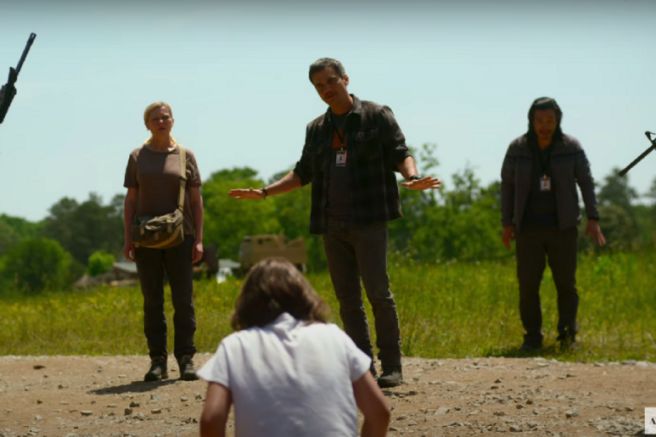
As Carol spends more time with him, it turns out that Bill is a pretty cool guy who can actually be a new love in her life. While knowing well that he is approaching to the closing chapter of his life just like Carol, Bill is willing to go for more fun and happiness instead of resorting to the boredom of retirement, and Carol eventually opens herself more to him as they talk with each other on his big boat (Its name is one of many little amusing things in the film, by the way).

In the meantime, Carol comes to befriend Lloyd more. There is a funny and thoughtful scene where they express their very different views on living, and Lloyd, who is incidentally a struggling poet/musician, becomes more impressed when Carol demonstrates a bit of her old singing skill in front of him and others at a local bar during its karaoke night.

The screenplay by director/editor/co-producer Brett Haley and his co-writer Marc Basch thankfully avoids setting a gratuitous triangle among Carol and these two different men coming into her life. As a wise and thoughtful woman, Carol surely knows what may be better for her in the end, and then she goes along with that when she really feels right about that. Her following decision is handled well with enough sensitivity and thoughtfulness, and then she comes to realize that she cares more than expected when another unexpected thing occurs later in the story.

As the center of the movie, Blythe Danner, whom I usually remember for playing the no-nonsense wife characters in several notable movies ranging from “The Great Santini” (1979) to “Meet the Parents” (2000), diligently carries the story with her unadorned but graceful performance to remember. While we only get to know a bit about her character’s past, Danner fills the character with enough life and personality to observe, and she is particularly good when she subtly conveys to us some wistful sadness inside her character around the end of the film.   

Haley assembles a number of colorful performers around Danner. While Martin Starr and Sam Elliott are effective as the two different male figures revolving around Danner’s character, June Squibb, Rhea Perlman, and Mary Kay Place, who have all been quite dependable veteran performers for many years, often provide some extra humor as Carol’s close friends, Malin Åkerman briefly appears as Carol’s caring daughter.

On the whole, “I’ll See You in My Dreams”, which is Haley’s second feature film after “The New Year” (2010), is worthwhile to watch for not only Danner’s wonderful acting but also its solid storytelling. In my inconsequential opinion, this is surely one of many little overlooked films, and you will not easily forget the movie and Danner’s performance for a while after watching it.

Posted in Movies | Tagged , | Leave a comment

For Love and Life: No Ordinary Campaign (2022) ☆☆☆1/2(3.5/4): So they step forward…

Documentary film “For Love and Life: No Ordinary Campaign”, which was released in Amazon Prime in last week, presents an extraordinary story about a bunch of people trying to make some change in the American healthcare system for themselves as well as many others out there. While its running time is short (83 minutes), the documentary is mostly solid as fully packed with enough enlightenment on its main subject, and you will be reminded more of the importance of the advance of medical care and treatment.

The main focus of the documentary is one couple who has fought hard for their future for many years since one of them was diagnosed to have one of the most terrible diseases known to the mankind. The name of that disease is amyotrophic lateral sclerosis (ALS), which is also known as Lou Gehrig’s Disease. Due to some pathological mechanism which is still not specified even at this point, the motor neuron cells inside the brain of ALS patients suddenly begin to die at a certain point, and this serious medical condition leads to the growing weakness of muscles before the eventual death within a few years for being incapable of breathing (We all need some muscle movement for breathing, you know).

For Brian Wallach and his wife Sandra Abrevaya, life had been pretty good for them before that bad news hit their happy life. Both of them were the key participants of Barack Obama’s 2008 US Presidential Campaign, and they instantly clicked with each other when they encountered each other for the first time as contributing a lot to the growing enthusiasm surrounding Obama (How optimistic most of us felt during that old time…). A few years later, Brian and Sandra married and then had two kids between them, and everything seemed to be going pretty well for both of them as they also advanced a lot in each own career in Washington D.C.

And then Brian noticed a little problem in the movement of one of his hands. While he initially disregarded it without much concern, this soon led to more serious medical symptoms, and that is how he came to learn that he has ALS. Both he and his wife were certainly quite devastated because ALS has been regarded as an incurable terminal disease for many years, but then Brian decided to take some active actions for not only himself but also others. Coming to know that there had not been much progress in the medical research on the medical treatment on ALS patients, he decided to organize a non-profit organization for ALS patients and their families, and his wife went along with that plan although she knows too well how much her husband would have to work for establishing and then managing the organization.

At first, the main purpose of their organization was increasing more public awareness of ALS. Along with numerous fellow ALS patients and their family members, Brian and Sandra has passionately worked on how to draw more attention from the public and the media, and they effectively used the social media applications as shown from that famous ice bucket challenges spread around the Internet.

However, as Dan Tate Jr., a lobbyist who also has ALS, pointed out later, the ice bucket challenge worked as much as they hoped, but, just like many other social media events, people mostly forgot about what the hell it was all about from the beginning even before several years passed. To make more changes, they had to convince the US parliament and government to pay more attention to the ALS research, and they also had to persuade National Institute of Health (NIH) to provide more funding for that.

So, again, Brian and Sandra tried to accomplish this goal as much as possible along with their fellow activists including Steve Gleason, a former professional American football player who has worked as an advocate of ALS since his ALS diagnosis as shown in documentary film “Gleason” (2016). They met a number of politicians willingly paying attention to their desperate status, and their voices were certainly heard as the several important laws on ALS patients were smoothly passed in the US Congress and then the US Senate. As a result, many of ALS patients can access a lot more easily to those newly developed drugs in the trial stages than before, and there also come more attention and funding to the ALS research.

Needless to say, the research on ALS treatment is still in research and development stages even at this point, but the documentary points out how desperate Brian and many other ALS patients are as the clock is ticking inside their worsening body day by day. They all are certainly willing to try anything for living and being with their loved ones as long as possible, and they may actually live much longer than expected as hopping from one experimental cure to another during next several years.

On the whole, “For Love and Life: No Ordinary Campaign”, is a powerful documentary on how to bring some more change to the American society and its flawed systems, Director/co-producer/co-editor/cinematographer Christopher Burke did a commendable job of handling its main subject with enough care and respect. Things are still gloomy for Brian and many of his ALS patients out there, but they keep fighting with some hope and optimism, and you will surely learn some valuable life lesson from that.

Posted in Movies | Tagged , , , , , | Leave a comment

A Brighter Tomorrow (2023) ☆☆1/2(2.5/4): A angry and bitter Moretti movie

Nanni Moretti’s latest film “A Brighter Tomorrow” is unusually angry and bitter compared to many of Moretti’s mild and gentle works such as “Caro diario” (1993). As a seasoned filmmaker who does not approve much of the current cinema trends, he has a lot of things to grunt and complain about in front of the camera from the beginning to the end, but the result is unfortunately rather dull and polemic in my trivial opinion despite several whimsical comic moments you can expect from Moretti.

As he has frequently done in his movies during last 30 years, Moretti plays someone probably not so far from himself. This time, he plays a middle-aged left-wing filmmaker named Giovanni, and the story begins with how Giovanni is preparing for his latest film along with several crew members of his including his wife/producer Paola (Margherita Buy, who was excellent in Moretti’s previous film “Mia Madre” (2015)). His new movie is about a Hungarian circus troupe invited to a little Italian town shortly after the Hungarian Revolution of 1956 was started, and its story also focuses on the relationship development between the two prominent local communist party members in the town.

Just like many other movie productions, the production of Giovanni’s new film soon becomes quite frustrating for not only him but also his crew and cast members. While his lead actress often clashes with him for her occasional improvisations, the crew member responsible for many different period props often annoys Giovanni for his glaring frequent mistakes, and his bumbling French colleague/producer, played by Mathieu Amalric, turns out to be much more unreliable than Giovanni and others imagined.

And there is also a big crisis in Giovanni’s private late. As shown from a little moment with her psychiatrist, Giovanni’s wife has been losing more of her patience with her husband, and she actually begins to consider seriously about leaving him soon. Because he needs her support as usual while beginning to shoot his latest film, she chooses to stand by him for a while at least, but then she only finds herself becoming more frustrated than before due to her husband’s ego and self-absorbance.

This negative aspect of Giovanni is evident when he comes to the set of another movie produced by his wife. Right from the beginning of the shooting, he shows a strong disapproval on the gratuitous depiction of violence, and this subsequently leads to one annoying scene where he interrupts and then stops the shooting of the last scene to the dismay of his wife and her director. If such a thing happens in real life, Giovanni would get instantly kicked out of the set within a few seconds, but he is somehow allowed to make his point again and again for more than several hours, and that is surely frustrating to watch for us as well as every other person on the set.

To be frank with you, I would tell Giovanni that he should mind his business first, considering that how the production of his latest film keeps getting into one trouble after another. While his actress continues to stick to her impromptu improvisation, there are also other problems including the one involved with animals to play those animals of the Hungarian circus troupe in Giovanni’s films, and then there eventually comes a serious finance problem which may terminate the production once for all.

Getting cornered more and more by the increasingly production problems, Giovanni eventually considers getting some financial help from Netflix, but he soon gets more frustrated to see how much he will have to compromise in exchange of getting enough money to restart the production. Needless to say, Moretti does not pull any punch at all in showing his contempt toward Netflix and many other streaming services out there, but this scene feels rather blunt and hollow without leaving much impression on the whole.

At least, the movie sometimes shows some whimsical moments to enjoy as going back and forth between Giovanni’s movie and its production process. While things eventually get rolling to the relief of everyone on the set, the mood becomes a bit more relaxed than before, and there is a sudden moment of music and dance as Giovanni is reminded again that he still can go on despite all those current problems in his life and career.

Now this may remind you of many other movies about filmmaking ranging from Federico Fellini’s “8 1/2” (1963) to François Truffaut’s “Day for Night” (1973), but Moretti’s movie looks rather middling compared to these two great films as often failing to balance itself between its two different narratives. Despite Moretti’s usual amiable presence, his character is sometimes a bit too obnoxious and self-absorbed to care about, and the narrative of his character’s movie and its production process is also too superficial to engage us. While Moretti tries to show some gesture of hope and good will around the end of his film, that does not mesh well with the rest of the film, and that causes more dissatisfaction for us.

In conclusion, “A Brighter Tomorrow” is not as successful as intended, but it shows us at least that Moretti is still willing to continue as usual despite being over 70 at present. Sure, I would rather recommend his better films such as “The Son’s Room” (2001), but it is certainly nice to see him keeping working as before, and I sincerely hope that whatever will come next from him will be more enjoyable than this sour piece of ranting.

Posted in Movies | Tagged , , | Leave a comment

Dream Scenario (2023) ☆☆☆(3/4): From dream to nightmare

“Dream Scenario” pushes its preposterous surreal story idea as much as possible, and I often enjoyed that during my viewing. Steadily anchored by one of better performances from its lead actor, the movie doles out a series of dryly absurd moments to be appreciated, and the result is a wry comic fable of social fame and notoriety.

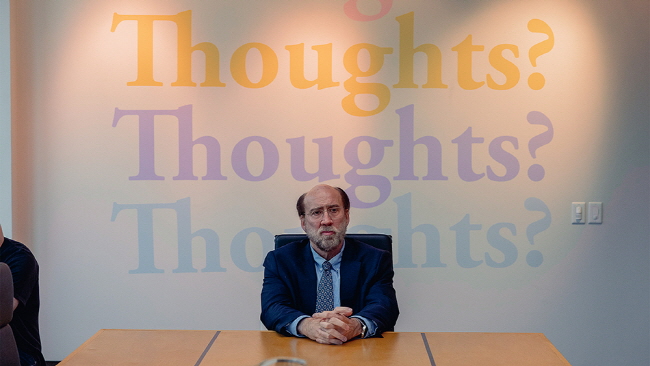
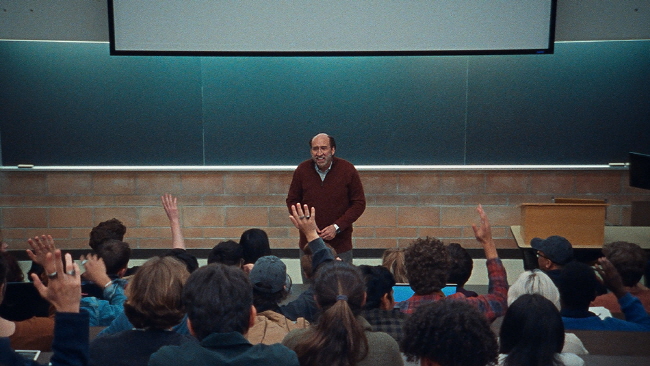
Nicholas Cage, who looks meeker and more inconsequential than usual thanks to some makeup, plays Paul Matthews, a plain college professor who has often been daunted by almost everyone around him. While his college class is not that popular, he is not so highly regarded by his peers as well as his family members, and there is a little humorous moment when he pathetically attempts to persuade one of his more famous peers to recognize his contribution to her latest academic article.

And then, as shown from the opening scene, something very, very, very, weird starts to happen to Matthews. When a few people around him tells him that they saw him appearing in their respective dreams for no apparent reason, he does not pay much attention to that, but, what do you know, even total strangers also begin to recognize him for the very same reason. Once an old friend/colleague of his publishes an article on this inexplicable happening, he becomes quite famous around not only US but also the whole world, and he is surely glad to see that he is now finally getting some attention.

During its first half, the screenplay by director/writer/editor has some cheerful fun with how Matthews keeps appearing the dreams of many others – and how he clumsily tries to capitalize on that. While he simply appears here and there in others’ dream with no control over that, he keeps getting more and more popular as one of the latest celebrities to watch, and he even finds himself invited by a colleague who has ignored him for years just because of thinking that he is not so important. He later decides to use his growing popularity for publishing a book of his at last, but he does not even begin to write that, and he becomes quite frustrated with his meeting with a bunch of PR company people who do not seem to understand at all what he actually wants. He subsequently comes to have a little private moment with one of them, and he seems attracted to this woman at first, but he eventually steps back because he does not feel right about that.

Meanwhile, there comes another unexpected thing for him. His avatar in the dreams of many others somehow becomes quite vicious and violent, and now Matthews finds himself disliked and hated a lot by many people out there, though he has absolutely no control over the circumstance. As things get worse and worse for him day by day, he tries to deal with this growing trouble as much as possible, but, not so surprisingly, he only comes to make the circumstance all the worse.

Still not explaining anything about its hero’s extraordinary situation, the movie sticks to its detached attitude while occasionally catching us off guard. Many of the dream and nightmare scenes are mostly plain and realistic except some surreal touches, and we come to discern more of how Paul’s presence affects many others’ unconsciousness. They are just amused by seeing him there in their dreams, but then they are scared and traumatized by him later in the story, and there is a bitter comic moment when Paul and a therapist try to calm down some of these people without much success.

As his character is cornered more and more during the second half of the story, Cage surely has lots of stuffs to do, and, as many of you know, he is always good whenever he is busy with doing many things on the screen. Without any unnecessary exaggeration, he is believable in his character’s longtime desperation and frustration, and that becomes the solid ground for several big comic scenes where his character comes to embarrass himself a lot more than expected. With Cage constantly holding the film together, the movie works as a cautionary tale about how one can easily be famous and then instantly become infamous on the Internet, and you will be more amused by how Borgli’s screenplay later pushes the story more with a Brave New World which I sincerely wish will never come true at least during my lifetime.

The main weakness of the movie is how many of supporting characters feel rather undeveloped compared to its hero. Julianne Nicholson has a few acerbic moments as Matthews’ no-nonsense wife, but she does not have much else to do, and the same thing can be said about Tim Meadows and Dylan Baker. In case of Michael Cera, who has diligently advanced since his nerdy appearance in TV comedy series “Arrested Development” and Jason Reitman’s Oscar-winning film “Juno” (2007), he brings some extra humor to the story as the self-absorbed CEO of the PR company Matthews deals with, and I would be more delighted if the movie utilized his character more.

In conclusion, “Dream Scenario” is another solid comedy film from Borgli, who previously drew our attention for his previous film “Sick of Myself” (2022). As shown from “Sick of Myself”, Borgli is a smart and competent director who knows how to push a comic story further for our entertainment and amusement, and “Dream Scenario” confirms to us that he is another interesting filmmaker to watch. The movie feels a bit like an acquired taste, and you will soon enjoy its comic moments once you go along with that, and it will surely remain in your unconsciousness for a while at least.

Posted in Movies | Tagged , , , | Leave a comment

Soup and Ideology (2021) ☆☆☆1/2(3.5/4): Eating together as family despite all that

Documentary film “Soup and Ideology”, which I belatedly checked out yesterday, presents a modest but intimate personal story closely associated with the dark past of the Korean history during the 20th century. As its Korean Japanese director tries to understand her aging mother, the documentary gradually reveals the longtime pain and sorrow inside her mother, and it is often moving to see how the mother and daughter in the documentary come to have some moments of understanding and acceptance.

At first, director Yang Yonghi, who won the World Cinema award at the Sundance Film Festival for her previous documentary “Dear Pyongyang” (2005), shows us what happened after the end of “Dear Pyongyang”, which was mainly about her attempt to understand her father’s staunch loyalty to North Korea and its dictators. After her father passed away in 2009, her mother came to live alone in their old residence, and Yang came to focus more on her mother as she occasionally visited a Korean neighborhood of Osaka where her mother lived for many years.

During its early part, the documentary summarizes how Yang and her parents became separated from many of their close family members. Around the 1960s when the conflict between North and South Korea became more intensified after the Korean War, many of Korean Japanese people had to choose between South and North, and Yang’s parents did not hesitate at all in siding with North Korea. As a matter of fact, Yang’s father was one of the prominent local figures associated with North Korea, and he and his wife even sent all of their three sons to North Korea just for showing more of their loyalty to North Korea.

Needlessly to say, this hurt Yang a lot, who was not so pleased about being separated from her three older brothers. One of them was actually forced to go to North Korea against his will just because of being selected as one of those human tributes to be sent to its dictator, and, not so surprisingly, he died rather early after struggling a lot with his resulting manic depression. In addition, many of their close family members were also sent to North Korea as a part of the ambitious nationalistic project during that time, and we can only imagine how things turned out to be really bad for them as well as numerous other Korean Japanese people, who erroneously believed that North was relatively better than South.

Nevertheless, Yang’s mother still sticks to her loyalty to not only her family but also North Korea and its dictators. Although she is now living on a small amount of pension, she often sent some money to her surviving family members in North Korea, and that often causes conflicts between her and Yang. To Yang, her family members in North Korea have been distant figures for a long time, but her mother still insists that she should not stop supporting them at all, and that surely makes Yang quite frustrated from time to time.

The most amusing moment in the documentary comes from when Yang subsequently introduced her fiancé to her mother. Just like her husband, Yang’s mother often said that they opposed to having a Japanese son-in-law, but she cannot help but delighted when Yang’s Japanese fiancé visits her house along with Yang during one hot summer afternoon. She gladly prepares her special stuffed chicken soup for her daughter and future son-in-law, and the mood becomes more casual as she talks more with him while eating their little meal together in her kitchen.

Yang’s fiancé, who incidentally serves as the producer of the documentary, is understandably amazed by his future mother-in-law’s political belief – and how much that has influenced her daily life. At one point, we see the photographs of Kim Il-sung and Kim Jong-il, the father and son dictator of North Korea, hung high on the wall of her living room, and I must confess that I rolled my eyes a bit as a hardcore anti-North Korea liberal guy.

Nevertheless, Yang’s mother is still a gentle and likable human figure, and I was touched by how willingly Yang’s fiancé listens to her more as they spend more time together. As Yang’s mother points out at one point later in the documentary, they are still a family who can eat together regardless of their different political opinions, and her plain words of wisdom will remind you of that undeniable value of humane tolerance.

Not long after Yang marries her fiancé, Yang’ mother begins to show the signs of Alzheimer’s disease, and that is certainly a devastating news for Yang and her mother. Even though she and her husband show more care and attention, Yang’s mother gets more faded in her deteriorating mind, and this becomes worse and worse day by day.

Meanwhile, Yang’s mother also comes to talk more about what happened to her when she was just a young girl in the 1940s. As Japan was ravaged by the World War II in 1945, she and her two siblings were sent to Jeju Island of South Korea where many of her family members resided, but the island was turned upside down by the Jeju Uprising and the following massacre in 1948. While she managed to escape along with her siblings and then went back to Osaka, she lost many of family members and neighbors, and this painful incident still hurts her a lot even though its memories are being faded just like many other memories of hers from the past.

The most poignant moment in the documentary comes from when Yang’s mother can finally visit Jeju Island along with her daughter and son-in-low for attending the memorial ceremony for the massacre. As getting to know more about the massacre, Yang begins to understand and empathize with her mother more than before, and there is a little bittersweet melodramatic moment when they come to connect with each other more than ever.

Overall, “Soup and Ideology” presents a powerful family story to remember, and you may also want to watch Yang’s previous documentary “Dear Pyongyang” for getting to know about her family. In my humble opinion, this is one of the best documentaries I have ever encountered during last several years, and I think you should check it out if you happen to have a chance to see it.

Posted in Movies | Tagged , , , , , , | Leave a comment

Civil War (2024) ☆☆☆1/2(3.5/4): America Under Fire

Alex Garland’s latest film “Civil War” is a chillingly powerful dystopian war drama. Starting with a grim story promise which may not be that implausible considering the ongoing polarization inside the American society, the movie takes its time for immersing us more into its main characters’ perilous journey across the country torn apart by a civil war, and you will be alternatively amused and horrified by what and how it is about.

The story is mainly told via the viewpoint of a small group of war journalists reporting on the second civil war in US. Mainly due to the president who seems quite dictatorial (He is serving his third term in addition to dissembling FBI, by the way), the country has been divided into several different parts, and you may be amused to see that Texas and California come to band together for fighting against the president despite their considerable social/political differences.

Anyway, the president has declared that his government and military will soon win and then end the war, but many of war journalists working in New York City are understandably skeptical because the country has been going down into more chaos and uncertainty. Not so surprisingly, the value of dollar has gone down to the bottom, and many people in the city are suffering from the frequent lack of food and water while the city is occasionally struck by suicide terror attack. I do not know whether such a dystopian situation can really happen there someday, but, folks, nothing seems totally impossible to us these days, especially after that outrageously shocking political rise of Donald J. Trump.

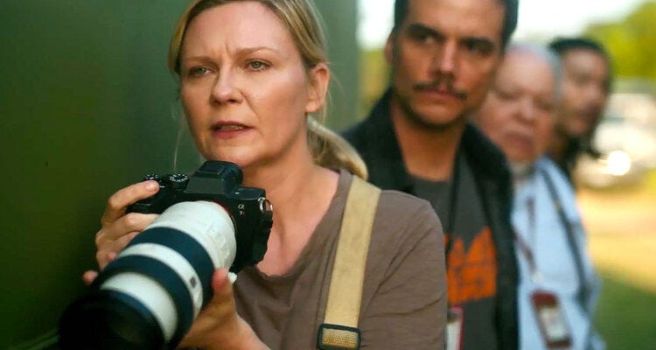
When her fellow journalist Joel (Wagner Moura) suggests that they should go to Washington D.C. for interviewing the president, Lee (Kirsten Dunst) is reluctant because she does not think that is possible, but she eventually agrees to join Joel along with two other figures: Sammy (Stephen McKinley Henderson) and Jessie (Cailee Spaeny). While Sammy is an older journalist working for the New York Times who has also been Lee’s mentor, Jessie is a young woman willing to learn and experience more via Lee, who has been incidentally a role model for many young female war photographers like Jessie.

As these four different journalists begin their journey across the country, the movie slowly and steadily doles out a series of gloomy moments showing how the country has been ravaged by the ongoing war. We see lots of ruins here and there, and we are horrified to see how the country is filled with numerous dangerous war zones. Think about the horrors of many different modern wars ranging from the Vietnam War to the Israel-Hamas War, and then imagine these horrors being unleashed onto the American society in full scales.

However, the movie takes a rather distant position to the horrors of war just like many other similar war journalism films such as “Under Fire” (1983) or “The Year of Living Dangerously” (1983). To Lee and her fellow journalists, this is just another war to be photographed and reported, and their weary detachment and cynicism are evident from how Garland and his cinematographer Rob Hardy phlegmatically presents several atrocious moments of cruelty and apathy on the screen. Everything in the film is handled with dry and stark objectivity, and that is further accentuated by the sparse score by Ben Salisbury and Geoff Barrow, which mostly sticks to its restrained mode without glorifying anything on the screen.

In the end, the movie becomes more about the gray moral areas of professional journalism, and Lee’s emotional arc comes to take the center along the story. While she is a weary professional who has nearly seen all, she is also reminded that she still has the heart to bleed, and that is how she comes to bond more with Jessie, who probably reminds Lee a lot of who she once was at the beginning of her professional career. Kirsten Dunst, who has been one of the most interesting actresses working in Hollywood during last 30 years, did a good job of embodying her character’s weariness and vulnerability, and Cailee Spaeny makes an interesting contrast with her throughout the film.

In case of Joel and Sammy, they also find themselves affected by the horror of war in one way or another. As a more seasoned professional, Sammy is often quite cautious, but then he finds himself taking a big risk later in the story because, well, he has no other choice from the start. While simply focusing on his ambitious mission, Joel is eventually cornered to his breaking point just like others, and the movie throws more bitter irony upon him around the point when he and others arrive at Washington D.C. at last. While Wagner Moura is effective as his character’s seemingly laid-back attitude crumbles more and more along the story, Stephen McKinley Henderson provides the stable ground for his co-stars, and several notable performers including Nick Offerman and Jesse Plemons are also solid in their brief appearances.

In conclusion, “Civil War” is another compelling work from Garland, who made a stunning directorial debut with “Ex Machina” (2014) and then moved onto “Annihilation” (2018) and “Men” (2022). While it does not reach to the haunting qualities of “Ex Machina” and “Annihilation”, it is relatively more engaging at least than the interesting but ultimately jumbled experiment of “Men”, and I admire how it sticks to Garland’s ambitious vision to the end. In short, this is one of more fascinating movies of this year, and I think you should check it out as soon as possible.

Posted in Movies | Tagged , , , | 1 Comment