Companion (2025) ☆☆☆(3/4): The Trouble with Iris

“Companion” is one of those solid thriller films which you can enjoy more if you do not know at all what it is about. Therefore, I will try to be very discreet about describing the story and character in this review, but I strongly recommend you not to read my review further if you want to be entertained by this little genre piece as much as possible.

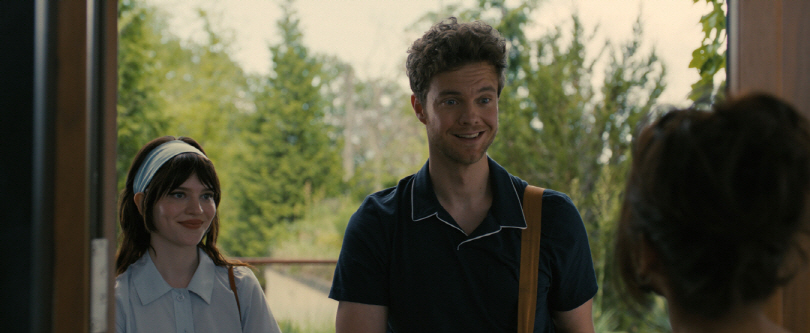
At first, the movie focuses on the seemingly good romantic relationship between a pretty young woman named Iris (Sophie Thatcher) and her boyfriend Josh (Jack Quaid). The opening scene shows her reminiscing about that almost perfect Meet Cute moment between them, but then we come to learn in advance that things will not go that well between them in the end.

Anyway, the very next scene showing Iris and Josh going to a certain remote place belonging to the rich Russian boyfriend of one of Josh’s friends. Although Iris does not feel comfortable about going there, Josh assures her that it will be a fun time for not only them but also a few others who will spend some time along with them, and Iris cannot possibly say no to Josh just because, well, she loves and cares about him as before.

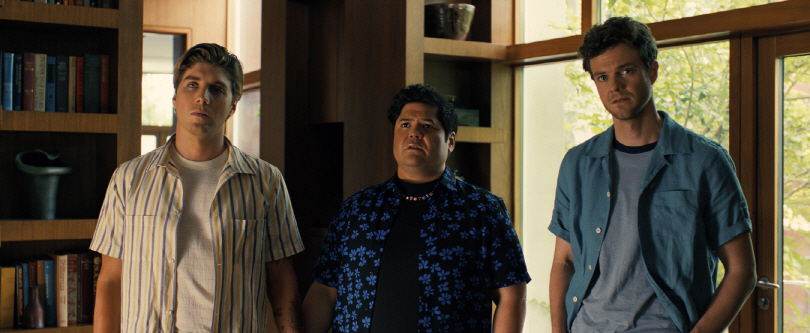
After they eventually arrive at a big modern house located in the middle of that place, we are introduced to the four people waiting for them. Eli (Harvey Guillén) and his boyfriend Patrick (Lukas Gage) seem to be a loving couple, and we later get a flashback scene showing how they fell in love with each other after encountering each other by sheer coincidence. In case of Kat (Megan Suri), she has been having an affair with her rich Russian boyfriend Sergey (Rupert Friend), and she does not seem to mind that he is a married guy who can go back to his wife at any time.

Anyway, the mood soon becomes quite pleasant as these six people in the house enjoy their little drinking party together during the following evening, but then we come to sense something awkward as observing more of how Iris interacts with others. For example, when she has a supposedly friendly conversation with Kat at one point, you may notice some tension beneath their conversation, and you will probably come to wonder more about why Kat does not like Iris much as Iris said early in the story.

On the next morning, Iris goes to a nearby lake alone by herself just because Josh happens to suffer a lot of hangover because of drinking too much at last night. Not long after her arrival at the lake, someone else suddenly appears, and Iris feels quite nervous, because this figure seems ready to do something inappropriate to her while no one else is around them.

Now, for avoiding any possible spoiler, I really should be all the more discreet about what is actually happening around Iris. All I can tell you instead is the screenplay by director/writer Drew Hancock, who incidentally makes a feature film debut here after directing several short films and TV episodes, did a good job of setting the ground for a number of surprises to come along the plot, and the main pleasure of the movie is how the trouble with Iris becomes more complicated in one way or another after she belatedly comes to learn about the true nature of her relationship with Josh. 

Around the middle point of the story, it will probably remind you of a lot of several other certain genre films for good reasons I do not dare to reveal here, and you may have a pretty good idea about how it arrives at its expected ending. Nevertheless, Hancock’s screenplay deftly handles the story and characters with enough suspense and some sense of black humor, and it even shows a bit of poignancy from Partick and Eli, who turn out to be a bit more than your average token gay couple.
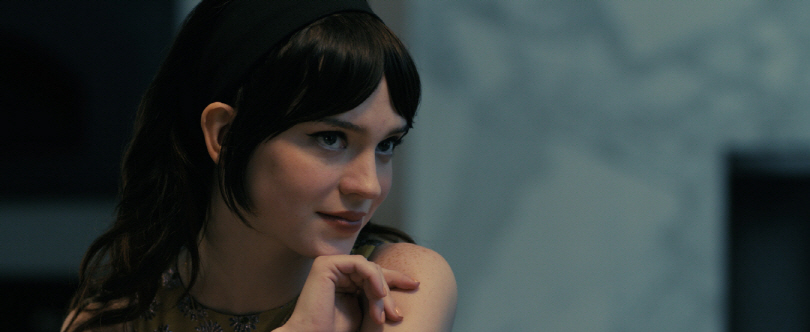
The movie also works as the showcase for its lead actress’ talent and presence, and Sophie Thatcher, who was wonderful as ably holding her own place well along with Chloe East in front of Hung Grant’s devious performance in “Heretic” (2024), demonstrates well here that she is indeed a talented newcomer to watch. Besides illustrating her character well with some subtle details during the early part of the film, Thatcher is also believable as her character is going through several changes as required by the plot, and her engaging performance supports well the movie even when it loses some of its narrative momentum later in the story.

Several other cast members of the film dutifully support Thatcher without overshadowing her at all. Jack Quaid, who is Dennis Quaid’s son and has steadily advanced since his small supporting role in “Logan Lucky” (2017), is effective as his character shows petty and nasty sides to Iris along the story. Megan Suri, Lukas Gage, and Harvey Guillén are also well-cast in their respective supporting parts, and Rupert Friend gleefully brings some hammy touches to his rather unpleasant character.

In conclusion, “Companion” does not bring anything particularly new to its specific genre territory, but it is still fairly enjoyable for its competent direction and Thatcher’s strong lead performance. Even though I already knew what the movie is about, I came to care about her character more than expected, and that is what a good film can do in my humble opinion.
Posted in Movies | Tagged , | 1 Comment

The Ministry of Ungentlemanly Warfare (2024) ☆☆1/2(2.5/4): A middling WWII action flick

Guy Ritchie’s latest film “The Ministry of Ungentlemanly Warfare” is a middling copy of many similar World War II actions flicks ranging from “The Dirty Dozen” (1967) to “Inglourious Basterds” (2009). While it surely attempts to have some fun as borrowing a lot from its numerous seniors, the movie is often too flat and bland in terms of story and characters, and we can merely enjoy a few good moments not caring that much about the story and characters.

As emphasized at the beginning and end of the film, the movie is based on one of those interesting real-life stories during World War II. Yes, there were the members of the British Special Forces who accomplished a number of very dangerous missions, and their activities were certainly crucial in fighting against Nazi Germany.

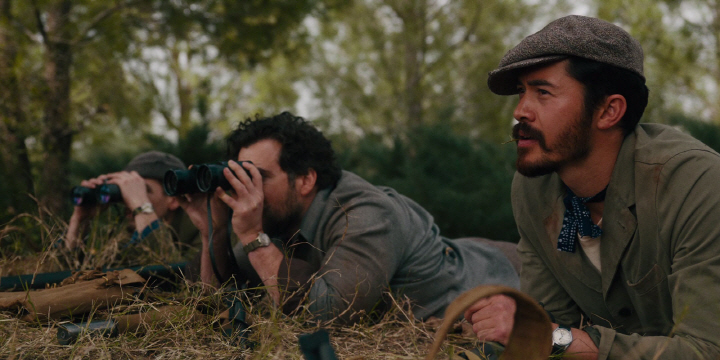
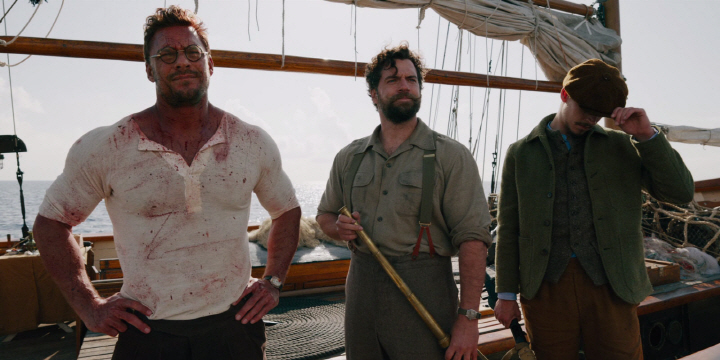
However, it is apparent from the beginning that the story, which is set in 1942, is not interested at all in giving us the realistic presentation of what those brave soldiers went through during that big war. During the opening scene, we are introduced to a British military officer named Gus March-Phillipps (Henry Cavill) and his several comrades, but they are more like archetypes instead of real human figures to observe, and this aspect becomes more evident as they swiftly eliminate a bunch of Nazi German soldiers and their ship within a few minutes.

After that, we get to know more about where they are heading at present. When US eventually joins the war after the Pearl Habor attack in late 1941, Winston Churchill (Rory Kinnear, who vaguely resembles his real-life counterpart) and his British government are certainly relieved a bit, but there is one big problem. US certainly is ready to send soldiers and many other things necessary for the war via ships to sail across the Atlantic, but the Nazi Germany Navy armed with many U-boats and ships is blocking their way at present, and Churchill really needs to find any possible way to deliver a damaging blow to the Nazi Germany Navy.

And then there soon comes a good chance for that. Most of those U-boats usually get their necessary supplies from a certain big cargo ship at a little island near Nigeria, which has incidentally been a neutral zone. All the British intelligence agency, headed by Brigadier Gubbins (Cary Elwes), needs to do is finding when that cargo ship will come while full of those necessary supplies for the U-boats and then handing that information to March-Phillipps and his colleagues, who are sailing to that island while avoiding both the Nazi Germany Navy and the British Navy as much as possible.

While March-Phillipps and his colleagues go through another violent adventure on their way, the movie also focuses on the two British secret agents operating in that island. Disguising himself as a fairly trustworthy broker/businessman, Richard Heron (Babs Olusanmokun, who looks a lot more dapper compared to his brief appearance around the end of Denis Villeneuve’s “Dune” (2021)) assists a female agent named Marjorie Stewart (Eiza González), and he arranges a meeting between her and Heinrich Luhr (Til Schweiger, whom you may remember for playing a crucial supporting role in “Ingourious Basterds”), a sadistic Nazi Germany officer supervising the safety of that cargo ship.

Thanks to their skillful handling of their risky operation, Heron and Stewart not only get the information about that cargo ship but also set the stage for March-Phillipps and his colleagues. Heron is deliberately going to distract those German soldiers and officers in the island via holding a couple of big parties, and March-Phillipps and his colleagues will blow up the cargo ship and then leave as soon as possible.

Of course, they face several setbacks when they are about to begin their perilous operation, but the movie does not generate much suspense as they casually and brutally eliminate any Nazi solider on their way to accomplishing their mission. Sure, Nazi soldiers are run-of-the-mill villains whose death we can usually cheer for without much guilt, but those numerous Nazi soldiers in the movie feel more and more like video game figures to be killed, and the rather laid-back attitude of March-Phillipps and his colleagues on their brutal and ruthless killings further emphasizes that.

Moreover, the screenplay by Ritchie and his co-writers Paul Tamasy, Eric Johnson, and Arash Amel, which is based on Damien Lewis’ nonfiction book “Churchill’s Secret Warriors: The Explosive True Story of the Special Forces Desperadoes of WWII”, fails to develop many of its main characters into interesting figures to amuse or engage us. March-Phillipps and his colleagues just remain as stock war movie characters from the beginning to end, and you may want to check out Lewis’ book for really getting to know who March-Phillipps and his colleagues were in real life (He was actually one of the main inspirations for the character of James Bond in the novels by Ian Fleming, who is incidentally played by Freddie Fox in the film)

Henry Cavill and several notable performers including Alan Ritchson, Alex Pettyfer, Henry Golding, and Cary Elwes try as much as they can do with their caricature roles, but they are often limited by superficial characterization. In case of Eiza González, she brings some genuine spirit to the movie during several key scenes of hers, and the movie could be more interesting if it just focused on her character’s espionage adventure.

Overall, “The Ministry of Ungentlemanly Warfare” does not distinguish itself much compared to its many seniors out there, and it is also underachieving even compared to Ritchie’s recent solid works such as “The Gentleman” (2019) or “Wrath of Man” (2021). To be frank with you, I am considering revisiting “Ingourious Basterds” right now, and I think you should watch it instead of this pale imitator.

Posted in Movies | Tagged , , , | Leave a comment

Snow White (2025) ☆☆(2/4): Not that fair, shall we say

“Snow White”, which is another re-packaged live action product from Walt Disney Pictures, does not have much reason for its existence in my trivial opinion. Probably because I have seen numerous movie adaptations of that famous fairy tale by the Brothers Grimm since I was very young, I saw nothing particularly new here during my viewing while observing how spiritless and insipid it mostly is, and that made me crave more for the greatness of animation film “Snow White and the Seven Dwarfs” (1937).

Considering the movie is simply titled “Snow White”, I should have known better before watching it. To be frank with you, the titular character is a fair but rather boring figure compared to all those other characters including that evil queen, and “Snow White” is no exception at all. While she is presented with some modern touches as required in addition to having some extra pluck, she is still not that interesting despite Rachel Zeagler’s sunny and gentle charisma, and we inevitably come to pay more attention to the rest of the movie.

Alas, I am sorry to report to you that the rest of the movie is not so engaging either. When Walt Disney produced “Snow White and the Seven Dwarfs”, he and a bunch of animators under his command were really trying to make something new and challenging, and their considerable care and spirit shown and felt from the screen is the main reason why it has been regarded as one of the greatest animation films from Walt Disney Pictures for many years. In contrast, “Snow White” simply follows the story and characters in a mechanical fashion without trying anything particularly new or fresh, and it only reminds us more of why live action film often cannot surpass animation film.

The glaring difference in quality between the movie and the 1937 animation film is evident especially when Snow White runs away from her little kingdom and then tumbles into the darkness of a big nearby forest. While the movie surely put a lot of CGI for illustrating the terror surrounding Snow White across the screen, most of you will miss how the 1937 animation film skillfully handles this disturbing moment with much more style and details in comparison. In case of a number of CGI animal characters which later appear to help Snow White, they certainly look as realistic as possible, but, folks, they are less cute and colorful compared to their animation counterparts which are drawn with more personality and spirit.

And there are those dwarf characters in the story, which are incidentally also presented as CGI characters here in this film. Yes, I still cannot remember all of their names, but I remember well how they look colorfully different from each other in the 1937 animation film, and that makes them quite lovable in one way or another. In contrast, those CGI dwarf characters in “Snow White” feel rather creepy even when they cheerfully sing together that famous classic song during their first scene in the film, and, yes, “uncanny valley” immediately came to my mind as my eyes and mind were struggling to adjust to their artificial aspects. Sure, uncanny valley could be overcome to some degree as shown from Gollum in the Lord of the Rings trilogy by Peter Jackson or Robert Zemeckis’ underrated animation film “The Polar Express” (2024), but it is only more exacerbated in case of “Snow White” – especially when its dwarf characters are around Snow White or some other supporting characters on the screen.

In case of the other main characters besides the dwarfs, most of them do not have much personality on the whole. The character played by Andrew Burnap is certainly a modern substitute for the Prince Charming figure in the original story, but he is still as boring as the similar figures in many other Disney animation films. Compared to the 1937 animation film, the movie looks more crowded with lots of secondary characters, but they are more or less than background details, and that is why the final confrontation scene between Snow White and the evil queen later in the story does not have much gravitas to hold our attention.

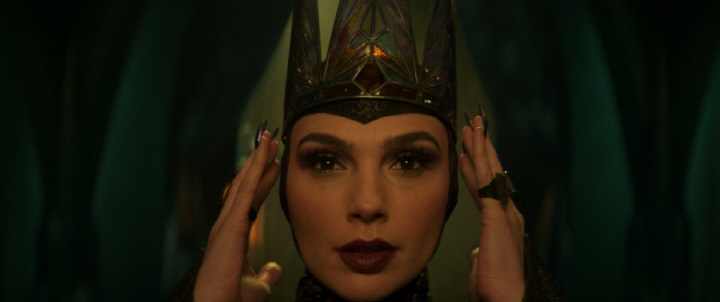
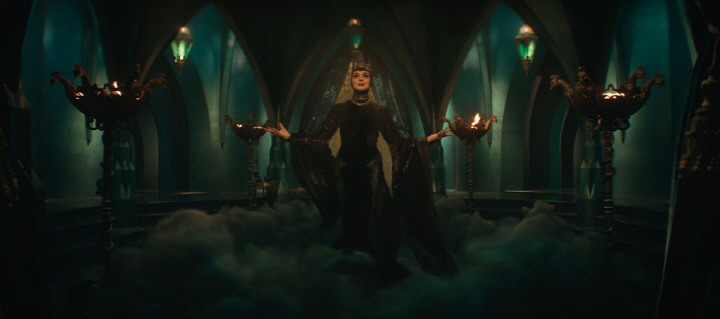
Speaking of the evil queen, she is indeed the showiest character in the story as always, and Gal Gadot willingly chews every devious moment of hers in the film as distancing herself from her most famous movie character as much as possible. Although her efforts are still one or two steps below Charlize Theron in “Snow White and the Huntsman” (2012) and Julia Roberts in “Mirror Mirror”, Gadot is clearly having some hammy fun with her thoroughly evil character besides demonstrating a bit of her singing ability, and my complaint is that the movie presents her character’s eventual exit a little too easily.

Compared to Gadot’s showy villain performance, Zegler is relatively less distinctive at times, but her earnest performance provides a bit of precious warmth and spirit into the movie. As already shown from Steven Spielberg’s “West Side Story” (2021), she is a very good singer, and she ably handles not only the old songs from the 1937 animation films but also several passable new songs provided by Benj Pasek and Justin Paul.

In conclusion, “Snow White”, which is directed by Marc Webb, sadly forgets what really makes the 1937 animation film so special, and I am sure that it will be quickly forgotten just like many other recent Disney live action adaptation products during last several years. Right now, I begin to have an urge to revisit “Snow White and the Seven Dwarfs”, and I think you should do that instead of watching its disappointing live action film version.

Posted in Movies | Tagged , , | Leave a comment

Megalopolis (2024) ☆1/2(1.5/4): Coppola’s disastrous folly

Francis Ford Coppola’s comeback work “Megalopolis” frustrated and baffled me a lot more than once. Here is a legendary filmmaker reaching for another chance for greatness, but the result only shows that he merely wasted a lot of the talents assembled by him as well as the production budget mostly provided by himself (It was more than 100 million dollars, as many of you already know). To be frank with you, this is not even an enjoyable or interesting folly at all compared to Tarsem’s “The Fall” (2006) or the Wachowskis and Tom Tykwer’s “Cloud Atlas” (2012).

The main problem of the movie is that Coppola does not seem to have any clear idea on whatever he wants to achieve here. Sure, lots of literature/philosophical stuffs pop here and there throughout its 138-minute running time, and he looks like trying to present a modern fantasy fable reflecting not only the despairing chaos of our time but also the defiant artistic individual spirit standing against that. However, the movie ends up being a total mess in terms of both idea and narrative, and I must confess that this is one of those very rare cases where I was really at a loss about how to follow and process whatever was going on.

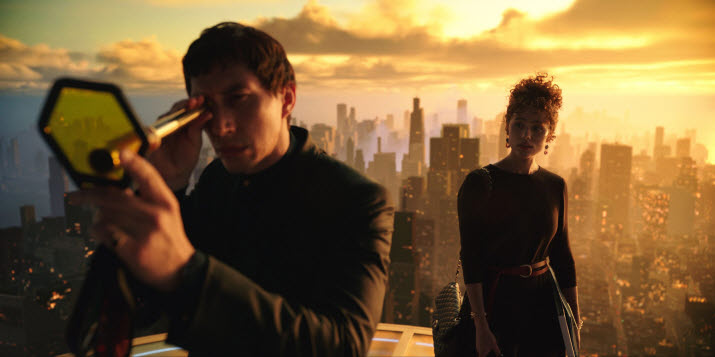
The story, which is set in the post-modern version of New York City which is called “New Rome”, is supposed to be about Cesar Catilina (Adam Driver), a very talented architect who is also an ambitious individualistic visionary a la Ayn Rand. Besides recently receiving the Nobel Prize for inventing some revolutionary metallic material (No, it is not called Unobtainium or Vibranium), he also has a certain special power, and we see him testing his power at the top of the Crysler building during the opening scene.

All Catilina wants to do seems to be unfolding his exceptional futuristic vision upon the city, but he has been involved in a rather complicated political turmoil along with some of the most powerful figures in the city. One of them is the arch-conservative mayor of the city, and Mayor Cicero (Giancarlo Esposito) was incidentally once the district attorney who brought Catilina to the court after Catilina’s wife died under a rather mysterious circumstance. Because he does not approve of Catilina disrupting the status quo of the city, Mayor Cicero is determined to stop Catilina as much as possible, but that is not so easy because Catilina has a wealthy and powerful uncle who is incidentally the head of a very important bank in the city.

Meanwhile, Mayor Cicero’s rebellious daughter Julia (Nathalie Emmanuel) becomes curious about Catilina, and, what do you know, she soon finds herself quite attracted to him even though he has been very promiscuous since his supposedly beloved wife’s death. Naturally, her father is not so amused by this, but she only gets more involved with Catilina while things seem crumbling around them and many others in the city.

Indeed, as Catilina’s driver and assistant Fundi Romaine (Laurence Fishburne) phlegmatically observes via his narration, things do fall apart in the city no matter how much Mayor Cicero tries to get the city and its citizens under control, and we are accordingly served with a lot of wild and chaotic moments including a big public event held for celebrating the recent marriage of Catilina’s rich uncle. During this sequence, the movie randomly mixes lots of Roman stuffs into the 21st century background as expected, and that looks a bit entertaining at first, but then it sadly loses its way in its unruly excessiveness along with its hero having a lot of hallucination in his drugged state.

The movie subsequently attempts to sort out its resulting mess after something eventually occurs as expected from the beginning, but it only comes to ramble and trudge a lot without really intriguing or engaging us at all. We never get to know that much about whatever Catilina is trying to do for the city – or how he is going to pull that off in the end. We never get the full picture of all those political intrigues swirling around Catilina, Mayor Cicero, and many others including Catilina’s opportunistic cousin. And we never get any clear understanding about who they are or what motivates them.

Adam Driver somehow does not embarrass himself throughout this daunting mess, and that is sort of an achievement in my humble opinion. There are several vapid moments of big speech he must deliver with uttermost seriousness, but he manages to survive them all thanks to his own distinctive presence, and I am sure that he will move on as usual after this colossal cinematic catastrophe.
In case of many other cast members, only a few of them are as lucky as Driver. While Giancarlo Esposito and Laurence Fishburne maintain some dignity, Nathalie Emmanuel, Aubrey Plaza, Talia Shire, and Kathryn Hunter are stuck in their respective thankless female roles, which show a lot about how Coppola is hopelessly out of touch in case of female characters. In case of Jon Voight, Shia LaBeouf, and Dustin Hoffman, they simply come and go without much purpose, and I wonder whether Coppola hired them just because they became quite cheaper to get due to their respective controversies during last several years.

Overall, “Megalopolis” is an almost total disaster, and, to make matters worse, Coppola and his distributor Lionsgate Films damaged its public image in one way or another even before it came out in US 6 months ago (You probably heard about the allegation about his serious misconduct on the set, by the way). The movie is an epic mistake, but, folks, Coppola gave us no less than four great films when he was at the height of his filmmaking career during the 1970s, and I think he can afford to make such a humongously self-indulgent mistake like this at least once.

Posted in Movies | Tagged , , | Leave a comment

All We Imagine as Light (2024) ☆☆☆1/2(3.5/4): Three women in Mumbai

“All We Imagine as Light”, which won the Grand Prix award at the Cannes Film Festival early in last year, is a haunting character drama about three different women in Mumbai. While phlegmatically illustrating their daily lives in the middle of the city, the movie dexterously balances itself between vivid realism and delicate poetry, and the result often exudes quiet emotional power along its reflective narrative.

After the opening scene where the movie looks here and there in Mumbai as a number of people casually talk about their life and hope outside the screen, we are introduced to its three main female characters: Prabha (Kani Kuscruti), Anu (Divya Prabha), and Parvathy (Chhaya Kadam). While they are different from each other in many aspects including their respective backgrounds, they all work in a big local hospital, and the early part of the movie observes how they respectively go through another usual working day of theirs.

Besides being close colleagues at their workplace, Prabha and Anu have lived together as roommates mainly because Prabha’s husband has been absent for years since he left for Germany for working there not long after their hasty marriage. There was a time when Prabha and her husband frequently corresponded with each other over the phone, but he has become more distant to her day by day after stopping calling her at some point, and she is reminded more of his absence when she later receives a big package probably sent from her husband.

Meanwhile, we come to sense something being developed between Prabha and one of those doctors working in her hospital. It is apparent from one brief moment between them that the doctor is interested in getting closer to her, and it seems that Prabha is also attracted to this decent dude, but she naturally hesitates as a woman who has always been expected by her social tradition to be a faithful wife despite her husband’s continuing absence. Observing how courteous they are to each other without revealing their respective feelings much to each other to the end, you may be reminded of the restrained but undeniably exquisite romance melodrama of David Lean’s great film “Brief Encounter” (1945) – and how it is usually more interesting to observe two people hesitating to follow their romantic feelings instead of going all the way for that.     

Prabha’s increasingly frustrating personal status is often contrasted with Anu’s burgeoning secret romance, which has incidentally been an open secret among many of her co-workers including Prabha. As a younger woman who is less weary compared to her roommate, Anu does not mind the social restrictions on her romantic relationship with a handsome young Muslim lad, and neither does he, though both of them should be discreet from time to time even when they meet each other outside. Alternatively amused and touched by a series of romantic interactions between these two young people, I could help but reflect more on how numerous social restrictions and taboos have pathetically failed to stop millions of secret lovers out there from passionately following their heart throughout the human history.

Meanwhile, we also get to know more about the ongoing problem of Parvathy, who has worked as a cook in the hospital for many years. She has lived alone by herself in an old building to be demolished sooner or later by some greedy builders eager to build a skyscraper at the spot, but, despite some help from Prabha, it soon turns out that there is not any possible way to stop those greedy builders from evicting her from her old residence.

As director/writer Payal Kapadia’s screenplay takes its time, these three female main characters’ personal stories slowly run in parallel while occasionally resonating with each other, and the streets, buildings, and many various people of Mumbai are also presented as another crucial element in the story. As we listen again to the words from a number of citizens later, the mood becomes more reflective on millions of individual lives in the city later in the movie, and that is quite moving to say the least.  

Not long after Parvathy eventually makes an important decision on her life, the movie surprises us a bit via changing its main background, and that is where its three female main characters come to reflect more on how their respective lives are going – and what they should do for themselves. I will not go into details here, but I can tell you instead that there are several sublime human moments including the one which will linger on your mind for a long time because of its somber but effortless incorporation of magic realism. Around the time when the movie arrives at its very last scene, we observe some important changes from its three main female characters, and Kani Kusruti, Divya Prabha, and Chhaya Kadam are convincing as before while ably carrying the film to the end. 

On the whole, “All We Imagine as Light”, which was sadly not chosen as the Indian submission to Best International Film Oscar (They instead chose “Laapataa Ladies” (2023), which is a fairly good female film but is not a better choice in my inconsequential opinion), is a terrific movie to be admired for its excellent mood, storytelling, and performance. Kapadia, who previously won the Golden Eye award for the best documentary film for her first feature documentary film “A Night of Knowing Nothing” at the 2021 Cannes Film Festival, demonstrates here that she is another new rising filmmaker to watch, and her remarkable first feature film may be just the beginning of whatever she will achieve during next several years. In short, this is indeed one of the best movies of last year, and you will not be disappointed especially if you are looking for something fresh and different.

Posted in Movies | Tagged , | Leave a comment

Hard Truths (2024) ☆☆☆1/2(3.5/4): This bitter woman

Mike Leigh’s latest film “Hard Truths” gives us one of the most abrasive characters in his filmography since “Naked” (1993). While this is definitely not a pleasant experience at all, Leigh presents this troubled human figure with a lot of care and compassion as he has done many of the memorably flawed but realistic human characters in his numerous acclaimed films for more than 50 years, and the movie is also anchored quite well by one of the best performances of last year.

Marianne Jean-Baptiste, who incidentally collaborated with Leigh in “Secrets & Lies” (1996) nearly 30 years ago, plays Pansy Deacon, a middle-aged married black woman who is quite bitter and angry to say the least. Not long after she wakes up in the morning, Pansy verbally harasses her working-class husband as well as their introverted adult son, and we come to sense that both her husband and son have endured her irascible temper for years while being quite unhappy and miserable in each own silent way.

And we see how Pansy also often wields her bitter anger outside her house. As she frequently clashes with others over little petty issues, we are all the amazed and horrified by her hostile attitude full of vitriolic aggression, while also keeping wondering more about her. What is exactly wrong with this apparently problematic woman? Is she actually aware of how much she is making herself as well as others unhappy?

As wincing more for her rather pathological human behaviors, I was reminded of the equally problematic hero of “Naked”, who, embodied so well by one of the best performances from David Thewlis, also often cannot help but make not only himself but also others quite miserable in a decidedly self-destructive way. As he gradually turns out to be a far more complex human figure with considerable wit and intelligence, we come to have some understanding and compassion for him, but he remains to be a very, very, very, unpleasant person to the end, and we continue to cringe for his toxic behaviors as before.

Just like him, Pansy mostly sticks to her very unpleasant sides to the end, but the movie slowly delves into her pain and vulnerability, which brings some human complexity to this very unlikable heroine. Yes, she is indeed the most miserable human being in the story, but we come to gather that she has been helplessly stuck in her anger and torment for so many years that, like many of the pitifully inarticulate characters in Leigh’s films, she does not know how to reach out to others for help or support while keeping scratching and scorching others around her as usual.

Meanwhile, we also get some achingly human moments as she lets herself softened a bit in front of her hairdresser sister Chantelle (Michele Austin), who is the yang to Pansy’s yin just like the two contrasting twin sister characters in Leigh’s “Life Is Sweet” (1990). Quite different from her sister in many aspects, Chantelle is happy and content with her ongoing life, and we also observe how casual and friendly she is to her two adult daughters, each of whom is leading a fairly good life of each own as shown from their respective brief moments in the middle of the film.

The happy mood among Chantelle and her two daughters makes a big contrast to how barren and cheerless Pansy’s domestic environment feels. Her suburban house looks as sterile and lonely as a rather empty apartment I have simply resided alone by myself during last several months, and we come to sense more of the emotional barrier between her and her son and husband. Instead of confronting their festering domestic issues, both her husband and son usually hide behind that for enduring another bout of her anger, while still being miserably stuck in each own lethargic psychological status.

Even as Pansy comes to show more of her worst sides, the movie continues to show more compassion toward Pansy just like Chantelle, who still accepts and tolerates Pansy as a person who knows and understands her sister better than anyone else. During one particular private scene between her and Pansy, we come to learn a bit more about how unhappy they were during their childhood period, and Leigh wisely lets us have some more understanding of what makes Pansy tick instead of directly explaining to us.

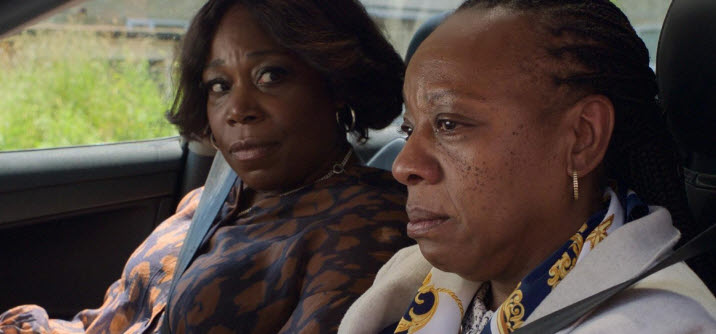
It is known well to many of us that Leigh always fleshes out his screenplay as closely interacting with his performers right from the very beginning, and what he and his main cast members bring to the screen is another vivid slice of life to be admired and appreciated. Deftly balancing itself between immediate intensity and subtle human nuances even during the painfully awkward family meeting scene reminiscent of “Secrets & Lies”, Jean-Baptiste’s terrific performance here in this film surely deserves all the praises and awards given to her during the Oscar season of this year, and her failure to get the nomination for Best Actress will be remembered as another biggest mistake in the Oscar history just like Sally Hawkins in “Happy-Go-Luck” (2008) or Timothy Spall in “Mr. Turner” (2014). Around Jean-Baptiste, several performers including David Webbe, Tuwaine Barrett, Ani Nelson, Sophia Brown, and Jonathan Livingstone have each own moment to shine, and Michele Austin, who played minor supporting roles in Leigh’s several previous films including “All or Nothing” (2002), complements Jean-Baptiste well during their several key scenes in the film.

In conclusion, “Hard Truths” shows Leigh back in element after the minor disappointment of his previous film “Peterloo” (2018). While it is surely interesting to observe how Leigh’s own storytelling approach is flawlessly applied to the colored main characters in the film, the movie surely shows that he is still a great filmmaker, and we can only hope that Leigh, who recently had his 82nd birthday in last month, will continue to impress us more during next several years at least.

Posted in Movies | 2 Comments

White Bird (2023) ☆☆(2/4): A Holocaust tale to reform him

Marc Forster’s new film “White Bird” presents its well-intentioned tale in a way so rote and manipulative that I felt like shaking my head more than once during my viewing. As another typical Holocaust drama flick, it does not bring anything particular new or interesting to its old genre territory, and it is also hampered a lot by the superficial handling of story and characters without much human depth or insight to be observed and then appreciated.

The movie is based on R.J. Palacio’s 2019 graphic novel “White Bird: A Wonder Story”, which is incidentally a spin-off work to Palacio’s 2012 children’s novel “Wonder”. As many of you know, that novel was subsequently adapted into the 2017 feature film, and, if you watched that movie, you probably remember Julien (Bryce Gheisar), that young prick who got deservedly expelled for cruelly bullying the young hero of that movie.

At the beginning of “White Bird”, Julien is recently transferred to a new school, and now he finds himself struggling a lot in adjusting himself to a new environment. After his another difficult school day is over and then he returns to his family residence, he is surprised by the visit of her Jewish grandmother Sara (Helen Mirren), and, after seeing that her grandson still does not learn that much from why he got himself expelled, she is ready to tell him a very important life story for the first time. 

As Julien listens to his grandmother’s story, the movie moves back to a little rural French village in the middle of the World War II era, and we are introduced to young Sara (Ariella Glaser) and her loving Jewish parents. When she was very young, everything felt fine and well to Sara, but, of course, she becomes aware of how things are getting worse in her little world due to the Nazi Germany occupation of France, and her parents are often despaired and frustrated as realizing more of how they become more helpless and cornered along with their dear daughter.

In the end, there comes a point where Sara’s parents begin to prepare for escape, but, alas, their situation becomes much worse than expected within a very short time. Not long after Sara begins another school day on one day during the winter of 1942, a bunch of German soldiers suddenly burst into her school, and Sara manages to escape thanks to a young boy named, surprise, Julien (Orlando Schwerdt). She did not pay much attention to him along with many other classmates just because he is physically disabled by polio, but he is now the only one on whom she can depend for survival, and Julien chooses to save and protect Sara along with his parents, because, well, that is the right thing to do for any decent human being.   

What follows next will not surprise you much if you have ever read “The Diary of a Young Girl” written by Anne Frank. As the village is disturbed more and more by those evil Nazi soldiers and a number of despicable collaborators including a vicious local boy with whom Sara was once smitten, Julien and his parents became more cautious about what they are courageously doing for Sara, and Sara feels more desperate and lonely day by day in her secret hiding place, while also hoping for the day when she will be finally free and safe. 

Not so surprisingly, Sara comes to lean more on Julien as they spend more time together in private, and he does not mind this at all because he has been carrying a torch for her as already shown to us around the beginning of the story. While frequently aware of the serious danger surrounding them, they cannot help but feel happy as forming more connection and solidarity between them, and then we get a sentimental sequence where they try a bit of imagination game together inside Sara’s hiding place.

It is not much of a spoiler to tell you that their circumstance inevitably takes a dark turn later in the story, and that is where the movie stumbles more than once. The adapted screenplay by Mark Bomback fails to develop its archetype main characters into real human figures we can really care about, and the last act of the story is quite ham-fisted to say the least for a number of blatant plot contrivances. For example, it is apparent from the start that the aforementioned bully in the story will function as the main villain of the story, but he is more or less than a walking plot element solely existing for generating more anger and suspense, and I was also quite disappointed with how this loathsome bastard eventually gets punished as expected (Is this a spoiler, folks?).

The main cast members of the film try to sell their rather bland characters as much as possible. Ariella Glaser and Orlando Schwerdt are mostly engaging, but they are often limited by their thin parts, and the same thing can be said about Gillian Anderson, who is often wasted as only requiring to look gentle and compassionate throughout the film. In case of Bryce Gheisar, he looks engaged at least when his character is supposed to be listening to Helen Mirren’s, and Mirren certainly brings some class and dignity to her functional character.         

In conclusion, “White Bird” feels rather hollow and banal compared to “Wonder” while also failing a lot in its genre category. Sure, every movie associated with the Holocaust does not always have to be as great as, say, “Schindler’s List” (1993) or “The Zone of Interest” (2023), but “White Bird” is quite underwhelming in one way or another without leaving much impression on us, and now I sincerely want to recommend you Louis Malle’s great film “Au Revoir les Enfants” (1987) instead right now. Believe me, you will thank me if you watch that haunting World War II drama film later.

Posted in Movies | Tagged , , , | Leave a comment

I’m Still Here (2024) ☆☆☆1/2(3.5/4): A family under the dictatorship in Brazil

Walter Salles’ latest film “I’m Still Here”, which recently won a Best International Film Oscar, calmly but powerfully observes a real-life personal struggle under the dictatorship period in Brazil during the early 1970s. While never overlooking the grim and horrific aspects of that time, the movie stays focused on small but resonating human moments along the story, and these intimate moments become all the more poignant to us as the story eventually arrives at its two-part epilogue.

The story begins with how things were mostly fine for Rubens Paiva (Selton Mello) and his wife Eunice (Fernanda Torres) and their five children in Rio de Janeiro, Brazil during December 1970. The country has been under the military dictatorship for years since the 1964 Brazilian coup d’état, and Rubens and his family had to go through a brief period of exile due to his left-wing political career during that time. However, he is now back in his old civil career as focusing more on his family’s welfare, and we see how he and his family happily go through their mundane daily life together.

However, the political circumstance of their country gets more volatile day by day, and both Rubens and Eunice become more aware of the possible danger around their family and many others around them. When a close friend of theirs are about to move to London for safety, they decide to have their eldest daughter move to London along with that friend, because they are afraid that she may get into any serious trouble for becoming more politically active just like many other young people in the country.

Meanwhile, Eunice also comes to notice that her husband has been hiding something behind his back. He sometimes has a phone conversation in private while not telling anything about that to her, but Eunice does not ask too much as taking care of the rest of their children after their eldest daughter eventually leaves for London.

And then something unexpected happens on one day. Several guys suddenly come into Ruben and Eunice’s house, and Ruben is soon taken away to somewhere just because he needs to be interrogated for some unspecified reason. As those guys start to watch over her and her children at the house, Eunice begins to fear for the worst, but those guys do not tell anything about why her husband was taken away or when he will be back, so she has no choice but to wait while also protecting her children from the ongoing circumstance to some degree.

In the end, Eunice is also taken away to somewhere along with her second eldest daughter, and what follows next is the darkest part of the story. Although the movie depicts Eunice and her daughter’s following plight with considerable restraint, that is more than enough for us to be disturbed and chilled by the brutal political horror surrounding their circumstance.

Fortunately, Eunice and her daughter are eventually released, but her husband remains missing as before. While the government refuses to admit anything about his disappearance, Eunice decides to search for anything which may help her find her husband, but, of course, it becomes more apparent to her that her husband will never return, and she and her children soon find themselves monitored by some suspicious people who may be government agents.

The screenplay by Murilo Hauser and Heitor Lorega, which is based on the memoir of the same name written by Marcelo Rubens Paiva (He is one of Eunice’s five children, by the way) and received the Best Screenplay award when the movie was premiered at the Venice International Film Festival in last year, wisely sticks to its restrained attitude even at this point. While there are a few melodramatic moments as expected later in the story, the movie patiently follows how much Eunice struggles in one way or another as continuing to search for any information about her husband, and we come to admire her will and determination more when she eventually makes a big decision for herself as well as her children.

Everything in the movie depends a lot on the beautifully nuanced performance of Fernanda Torres, who was deservedly nominated for Best Actress Oscar (The movie was also nominated for Best Picture Oscar, by the way). Subtly conveying her character’s growing worry and desperation to us, Torres gradually takes the center along the story, and her excellent acting comes to function as the heart and soul of the film.

Around Torres, several main cast members have each own moment to shine. While Selton Mello is well-cast as Eunice’s decent husband, Guilherme Silveira, Valentina Herszage, Luiza Kosovski, Barbara Luz, and Cora Mora hold their respective spots well as Eunice’s five children, and Fernanda Montenegro, who is Torres’ mother and known to most of us mainly for her Oscar-nominated performance in Salles’ 1998 film “Central Station” (1998), makes a brief but effective appearance during the epilogue of the movie.

On the whole, “I’m Still Here” is seemingly plain but undeniably absorbing thanks to several commendable aspects including its thoughtful storytelling and the strong lead performance. Although he has been rather silent since his previous feature film “On the Road” (2012), Salles demonstrates here that he has not lost any of his talent yet, and, in my trivial opinion, the result is his best work since “Central Station”. As I heard from many others, this is indeed one of the main highlights of last year, and I wholeheartedly recommend you to check it out as soon as possible.

Posted in Movies | Tagged , , , , | 1 Comment

Exorcism Chronicles: The Beginning (2024) ☆☆1/2(2.5/4): The passable first chapter

South Korean animation film “Exorcism Chronicle” is a modest genre piece simply doing some warm-up exercise for whatever may follow next. Probably because I remember too well the first entry of the short story series it is based on, there is not much surprise for me on the whole, so I just focused on its mood and style during my viewing, but I was only mildly entertained without caring that much about the story and characters.

Phlegmatically observing the story and characters, I became a bit nostalgic about Lee Woo-hyuk’s short story series “Exorcism Chronicles”, which was one of numerous pulpy stuffs I eagerly absorbed when I was young and wild during the 1990s. Like those trashy novels by V.C. Andrews or Sidney Sheldon, they were mostly fun, but I have never felt any desire to revisit the series. To be frank with you, the series is not exactly the worst thing I read during that time, but I think I could have focused on reading something more meaningful instead, such as the works of Henry James or Virginia Woolf.

Anyway, the movie feels like your average TV pilot episode in terms of narrative. First, we are introduced to the principal characters of the series one by one, and the rest of the story is about how they come to gather via their little supernatural adventure, which is involved with a certain clandestine cult hidden somewhere in the rural mountain region of South Korea.

As shown from the opening scene, the leader of the cult is your typical megalomaniac who is also quite dangerous for his growing evil superpower, and this certainly disturbs not only his followers but also several elders who have each own superpower. It is quite apparent to them that the leader is already beyond the point of no return, and they eventually decide to stop the leader before the day when the leader will perform a big ritual which may give him much more power than before.

Besides stopping the leader by any means necessary, their another main goal is protecting a boy who has been training under them and the leader since he was very young. This little boy, Joon-hoo (voiced by Jung Yoo-jung), has already shown considerable potential as learning and practicing a lot under the guidance of the leader and the elders, and the elders must find someone willing to protect the boy at least for a while.

That person in question is Priest Park (voiced by Choi Han), who, like many other priest heroes in occult horror films, knows a lot about how to fight against those evil entities out there. I must tell you that he looks a bit too bulky compared to what I imagined during my reading, and now I cannot help but think of that Jack Black comedy film about a priest moonlighting as a luchador to earn money for the orphanage where he works. Considering his tough confrontation with a very powerful demon early in the story, I guess muscle and stamina are the basic requirement in the battle against demons besides all those necessary holy stuffs.

Anyway, Priest Park is approached by one of the elders who happens to be an old schoolmate of his. Despite some initial reluctance, he agrees to help his old friend as much as possible, so they soon go together to the secret temple of the cult, while not knowing at all that there is someone else on the same path from the start.

That person in question is a young man named Hyeon-am (Nam Doh-hyeong), who is looking for that secret temple for a rather unspecified reason. Via several flashback scenes, it is revealed that this lad, who is also incidentally his own superpower (His right hand seems to be cursed but powerful like that of the hero of “Princess Mononoke” (1997), by the way), has tried to find a way to revenge someone very close to him, and he is quite determined to do anything for that, even though that may lead to his death.

It is not much of a spoiler to tell you that the story eventually culminates to a big battle between good and evil, and director Kim Dong-cheol and his crew members naturally put a lot of efforts onto the screen. The result looks a bit blunt and shabby compared to American or Japanese animation films in terms of detail and style, but the overall result is fairly competent with enough sense of fun and thrill, and that compensates for the rather thin characterization and predictable plot to some degree.

As far as I remember, the screenplay by Lee Dong-ha is mostly faithful to the first short story of the series, but I wish it could take some more time for fleshing out its main characters more. Sure, we are supposed to get to know them more if there really come the following sequels, but the movie does not go further than doling out their respective little background stories bit by bit, and we are only left with the promise on their next adventure to watch in the end.

In conclusion, “Exorcism Chronicle: The Beginning” deserves some attention considering the saddening rarity of South Korean animation feature films during last 25 years, but it does not have enough personality to distinguish itself more. After Lee’s short story series came out, I and South Korean audiences went through a bunch of similar genre products including the 1998 film which is based on Lee’s short story series, and we recently had “Dr. Cheon and the Lost Talisman” (2023) and “Exhuma” (2024). Compared to them, “Exorcism Chronicle: The Beginning” looks like a late guest, and I hesitate to recommend it for now, but I sincerely hope that there will be some improvement in whatever may come next.

Posted in Movies | Tagged , , | Leave a comment

No Other Land (2024) ☆☆☆1/2(3.5/4): “We have no other land”

Documentary film “No Other Land”, which won the two awards including the one for Best Documentary at the Berlin International Film Festival early in last year and then won a Best Documentary Oscar in last week, calmly and thoughtfully follows a personal perspective on what has been unjustly happening in Palestine for many years. It may not shock or surprise you much if you have ever paid any attention to that gross injustice being committed by the Israeli government even at this point, but the documentary is still alternatively heartbreaking and infuriating while never losing its human dimensions, and the result is one of the most powerful documentaries of last year.

The central figure of the narrative of the documentary is a young Palestinian man named Basel Adra, who incidentally directed, wrote, and edited the documentary along with Hamdan Balla, Rahel Szor, and Yuval Abraham. During the early part of the documentary, a series of archival footage clips shot by Adra’s father show us how things have become worse and worse for him and many others in their little village in the West Bank region during last two decades thanks to the oppressive tactics of the Israeli army and government, and the documentary observes how Adra and many villagers including his father have struggled to record their longtime suffering via video cameras and smartphones.

What they recorded is sadly not so far from what I watched from Oscar-nominated documentary “5 Broken Cameras” (2011) more than 10 years ago, which is the personal chronicle of a plain Palestinian man and his neighbors struggling with the same issues day by day just like Adra and his fellow villagers. Despite frequently harassed by the Israeli army and government, Adra and his fellow villagers defiantly try to stick and stand together because, as one of the villagers flatly says at one point, they have no other land of theirs to live, but their stubborn defiance only leads to more oppression, and Adra and others sometimes cannot help but have more doubt on their ongoing resistance.

At least, Adra and others get some consolation as reminded at times that there are still many people who do care a lot about their increasingly despairing status. One of such people is Abraham, and he and Adra have been close colleagues even though Abraham is a Jewish Israeli. While sometimes reminded that there is always a gap between his position and what Adra and many others have to endure everyday, Abraham is always ready to do more for them, and we observe the genuine mutual trust and admiration between him and Adra during their several casual conversations in the documentary.

As the documentary phlegmatically doles out what they recorded from 2019 to 2023 via their video cameras and smartphones, we see more of the atrocities committed by the Israeli army and government. Once the Israeli Supreme Court rules in the favor of the Israeli army, the Israeli army push into the region containing Adra’s village and several other villages just for making a “military training zone”, and they begin to demolish the villages bit by bit while totally disregarding the angry protests from hundreds of villagers – even after one of those villagers is shot and then seriously injured.

Not so surprisingly, the Israeli army also put more oppression on Adra and Abraham’s defiant journalistic activities. While their activities are blocked more frequently than before, Adra’s village is disturbed more and more by Israeli soldiers suddenly coming for arrest or search, and there is a tense moment showing how Adra manages to evade the Israeli soldiers coming for him on one day. In case of Abraham, his sincere efforts on the Israel media are often undermined by those deplorable right-wing folks, and he even finds himself openly ridiculed by one of those extreme settlers later in the documentary.

However, the documentary does not resort to easy anger at all as quietly and intimately focusing on the human moments observed from Adra and many others in the village. As observing more of the aching humanity of these people, we come to empathize more with their simple human wish to remain in the land which has always been theirs for many years, and there is a poignant moment when Adra bitterly muses a bit on his future during his conversation with Abraham. Sure, he wants to have his own good life just like many other ordinary people out there, but who can possibly try that under such an unstable circumstance like his? 

As many of us know too well, the situation became all the worse for Adra and many other Palestinian people out there during last several months, and now I reflect more on a number of good films and documentaries about the conflict between Israel and Palestine during last two decades besides “5 Broken Cameras” and “The Gatekeepers” (2012), another Oscar-nominated documentary which will make a striking double feature show with “5 Broken Cameras” for good reasons. In one way or another, all of these movies and documentaries emphasize that the conflict must be resolved as peacefully as possible before things will get much worse, but their sincere messages and warnings were mostly ignored by those figures in power, who could begin some change and then peace but choose more violence and oppression instead just for their petty political reasons.     

 Seriously, I have a reasonably pessimistic doubt on whether it can actually do anything about what is going on between Palestine and Israel, but that does not diminish the emotional power of “No Other Land” at all in my inconsequential opinion, and I can only hope that it will bring a bit more awareness on its urgent social/political issue at least. After all, hope is definitely not something we can afford to give up that easily during this increasingly grim period of ours at present, isn’t it?

Posted in Movies | Tagged , , , , | 1 Comment