Kneecap (2024) ☆☆1/2(2.5/4): Meet Irish rappers

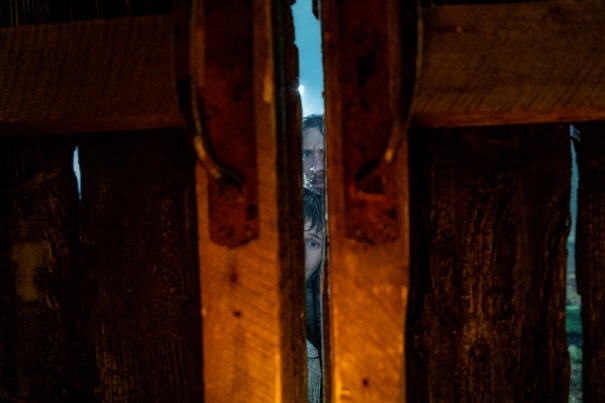
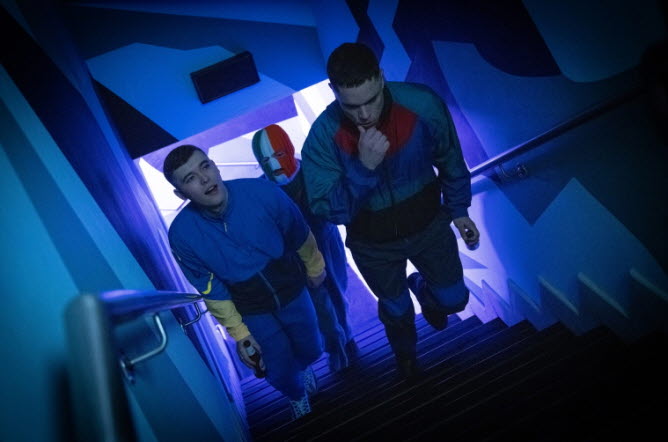
“Kneecap”, which was selected as the Irish entry to Best International Film Oscar in last year, is a typical rapper movie with some local flavor. While it has a substantial amount of irreverent wit and bouncy energy to hold our attention, the movie feels rather flawed at times due to some plot contrivance and thin characterization, and that is rather disappointing considering its interesting main subject.

The movie is a fictional story loosely based on Kneecap, a real-life Irish hip-hop trio from Belfast, Northern Ireland. I have no idea on how much the movie is actually based on their real-life story, but the members of Kneecap, Liam Óg Ó hAnnaidh, Naoise Ó Cairealláin, and JJ Ó Dochartaigh, play themselves in the film besides writing the story with director/screenplay writer Rich Peppiatt, and I guess they bring a lot of themselves to the film in more than one way.

At the beginning, the story, which is set in Belfast around the 2010s, depicts how things are not so good for Liam and Naoise. two wild local lads who have not thought much about their future as throwing themselves into a lot of fun and drug. When they were little boys, Naoise’s father, played by Michael Fassbender, often reminded that they tried to speak Irish more as being prouder of their heritage, but he eventually left Naoise and her mother for evading the police due to his political activities during that time, and this certainly hurts both Naoise and his mother, who has never left their house since that point.

When Liam and Naoise are going through another hedonistic night of drug and music along with many other young people during one evening, the police ambush them all, and Liam is arrested while Naoise manages to escape. At the police station, Liam pretends that he does not know English at all, and that is how JJ, who incidentally works as a music teacher at some local school, is brought to the police station for functioning as a translator instead of his activist wife.

During the interrogation, JJ takes away Liam’s little notebook as asked by Liam, and that notebook contains something to interest JJ. After reading several song lyrics written in Irish, JJ attempts to juxtapose one of them with one of a piece of beat music created by himself, and, what do you know, the result is good enough to prompt him to do more. After subsequently meeting Liam and Naoise, they decide to make more hip-hop songs together in JJ’s little private space, and they also do a lot of drug just for more fun and excitement for themselves

Their first public performance, which is held at a little local pub, is not so successful to say the least, but, of course, someone eventually shoots their modest performance, and their music soon goes viral on the Internet in addition to causing the unexpected controversy in Belfast. As JJ’s wife and many other local activists and people demand that Irish should be recognized as a public language, the music and lyrics of Kneecap certainly draw more attention due to the sensitive contents, and that makes JJ quite conflicted – even while hiding his identity in public because he may lose his job because of his little musical activity.

In case of Liam and Naoise, they also find themselves facing a big problem as their popularity grows more and more day by day. A local republican paramilitary group is not so pleased about Kneecap because Kneecap causes a lot of trouble via not only its wild rap songs but also drug, and they are certainly ready to suppress Kneecap as much as possible just like the local police.

Around that narrative, we should care more about the main characters of the film, but the movie does not seem to have much thought and point on the serious aspects of their reckless musical activities. Sure, their music can bring some life and attention to their local language for the younger generation, but, as reflected by the rather disapproving stance of JJ’s wife, it can also be regarded as the thoughtless vandalism on Irish, and, not so surprisingly, Naoise’s father is not so amused by what his son is doing.
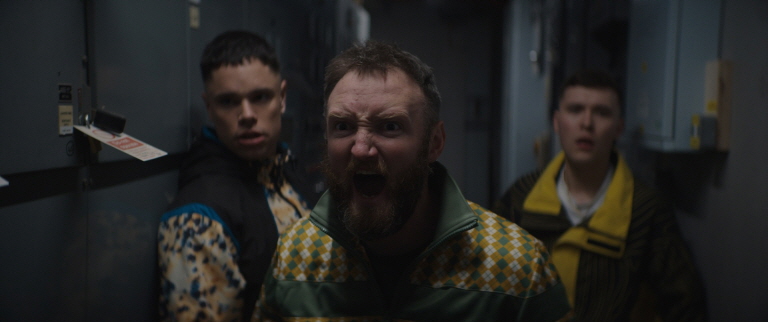
During the last act, the movie leans more on plot contrivance, but it is still supported well by its fairly good soundtrack. When everything culminates to what is going to be a major public breakthrough for Kneecap, Peppiatt and his crew members including cinematographer Ryan Kernaghan pull all the stops as demanded, and the result is fun and exciting as expected.

Regardless of how much their performances in the film are actually overlapped with their real lives, the three lead actors of the film are engaging in their unadorned acting, and the chemistry among them is always palpable whenever they perform together on the screen. In case of several supporting performers around them, Josie Walker, Fionnuala Flaherty, Jessica Reynolds, and Simone Kirby are rather under-utilized due to their underwritten characters, and the same thing can be said about Fassbender, who simply fills his thankless role as much as possible.

In conclusion, “Kneecap”, which received the NEXT Audience Award when it was premiered at the Sundance Film Festival early in last year, could be more improved in terms of story and character, and, after observing what is shown during its end credits, I wonder now whether their story would be more interesting if it were presented via a documentary instead. Sure, I had some fun during my viewing, but, folks, the movie could delve into its main subject more in my trivial opinion.


Posted in Movies | Tagged , , , , | Leave a comment

Naked Lunch (1991) ☆☆☆(3/4): Welcome to Interzone

David Cronenberg’s 1991 film “Naked Lunch”, which happens to come to South Korean theaters shortly after the local theatrical release of Luca Guadagnino’s “Queer” (2024), tackles on an impossible task, and the result is alternatively interesting and baffling. Loosely based on William S. Burroughs’ controversial novel of the same name and his own messy (and dopey) life, the movie attempts to present a despairing hell of addiction driven by a stream of drugged conscience, and you may admire its bold cinematic experience even while often feeling repulsed or disoriented a lot during your viewing. 

The early part of the film effectively sets its dryly petrified tone right from the beginning. It is 1953, New York City, and William Lee (Peter Weller), who is virtually a fictional version of Burroughs himself, has earned his meager living as a bug exterminator, but things have not gone particularly that well for him and his wife Joan (Judy Davis). It turns out that he frequently runs out of bug powder during his worktime, and, what do you know, both he and his wife, who happen to be addicts still far from clean and sober, are seriously addicted to bug powder (Don’t ask me how the hell that toxic substance can make them high).

When his mind does not crave for another dose of drug, Lee often spends time with his two fellow Beat Generation writer friends, who are apparently the fictional version of Jack Kerouac and Allen Ginsberg. They talk and discuss a lot about writing, but Lee’s mind seems mostly disaffected and disinterested, and he finds himself more and more addicted to the bug powder – even after he attempts to get some medical help from a shady local doctor introduced to him later by one of his colleagues.

 In the end, there comes a shocking tragic incident which did happen in Burroughs’ real life. While quite high and dopey due to their latest moment of drug abuse, Lee attempts what he and his wife call “William Tell Game”, and this accidentally leads to his wife’s unfortunate death, which consequently turns his life upside down. Around that point, Lee is so addicted to the bug powder and some other substances that he begins to experience one hallucination after another, and one of them features a big bug talking to him via a big rear orifice which does look more like a sphincter on big screen due to some little hairy details. 

Now you may sense that Lee is not only a junkie but also a conflicted gay dude not so comfortable with his sexuality as reflected by the morbidly sexual aspects observed from some of his crazy hallucinations in the film. As depending more and more on his substances of choice, Lee’s mind eventually enters a place called “Interzone”, and this supposedly imaginary exotic place, which often looks like a secondhand version of Casablanca, Morocco, is packed with handsome local gay lads as well as a bunch of odd people who come and then go around Lee as fueling his anxiety and paranoid more and more.

One of these strange figures, who is also a writer just like him, has a wife who exactly looks like Lee’s wife and is also played by Davis. Lee naturally gets attracted to this woman who seems relatively sharper than his dead wife, and the movie later gives us a very strange moment of writing and sex as they try a bit on a kinky Arabic typewriter belonging to her husband.

Around that narrative point, I kept scratching my head again as wondering more about Lee’s actual state of mind, but I admire Cronenberg’s uncompromising exploration on what makes Lee (and Burroughs) tick. Because of Burroughs’ deliberately random writing style coupled with a lot of morbid and freakish sexualization beyond NC-17 rating, the faithful movie adaptation of his novel is nonsense from the start, so Cronenberg chooses to go for the collage of the fragments of the novel and Burroughs’ life instead, and you will appreciate that more if you are familiar with his life and writing career. Thanks to cinematographer Peter Suschitzky, the overall atmosphere of the film is deliberately drab and dispirited with a palpable sense of misery, fear, and despair beneath the surface, and that is further accentuated by the ominous score by Howard Shore, who closely collaborated with legendary jazz musician Ornette Coleman for injecting some free jazz style to the film.

The main cast members flawlessly tune their performance to the detached overall tone of the movie. Peter Weller ably embodies the pathetically hollow state of his character’s mind, and it is clear that he studied a lot of that distinctive appearance and speech pattern of Burroughs, who was incidentally still alive when the movie was made. On the opposite, Judy Davis, who came to show the considerable range of her immense talent via this film and the Coen Brothers’ “Barton Fink” (1991) in the same year, is terrific in her dual performance, and several notable performers including Ian Holm, Julian Sands, and Roy Scheider are also solid as some of those odd denizens of Interzone. 

On the whole, “Naked Lunch” is often interesting for its mood, detail, and performance, but I must warn you that it can also be a little too weird and distant for some of you. I do not think it is one of Cronenberg’s best works, but, like many of Cronenberg’s cult films such as “Videodrome” (1982), it will definitely make you quite uncomfortable and baffled, and you will probably never forget all those weird stuffs in the movie.

Posted in Movies | Tagged , , | Leave a comment

Saving Private Ryan (1998) ☆☆☆1/2(3.5/4): Just for one private

Steven Spielberg’s 1998 film “Saving Private Ryan”, which happens to be re-released in South Korean on this Wednesday, definitely earns its own place in the pantheon of war movies via its stupefyingly stunning opening battle sequence, but it is much more than that. This is a seemingly modest but undeniably powerful drama about nobility, brutality, vulnerability, and humanity, and its somber but indelible human qualities do not age at all just like a number of impressive battle sequences in the film.

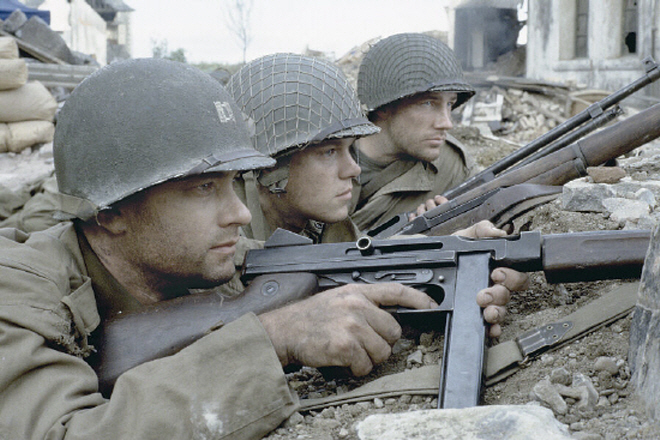
After the brief prologue scene, the movie goes straight into in the middle of the Normandy Landings on June 6th, 1944. While this big military operation of the Allied Forces was quite successful enough to change the course of the World War II on the whole, hundreds of soldiers were killed right from when they arrive at the beach of Normandy, and the movie often overwhelms us with its horrifyingly realistic depiction of chaos, violence, and death as steadily following Captain John H. Miller (Tom Hanks) and many other American soldiers around him. Yes, there had already been many movies showing that war is indeed hell, but Spielberg and his crew members including editor Michael Kahn and cinematographer Janusz Kamiński, both of who deservedly won an Oscar for this film, pushed the envelope for more visceral verisimilitude, and the commercial/artistic success of the movie opened the door for its numerous juniors ranging from Ridley Scott’s “Black Hawk Down” (2001) to Mel Gibson’s “Hacksaw Ridge” (2016).     

Not long after Captain Miller and several soldiers under his command manage to survive and then win their big battle in the end, they receive an unexpected assignment. One mother living in some rural area of Iowa, US happened to lose three of her four enlisted sons within a short time, and the Chief of Staff of the US Army eventually decides that one remaining son, Private James Francis Ryan (Matt Damon), must be safely returned to his mother right now. However, Private Ryan was already sent to somewhere around Normandy along with many other soldiers of his division, and it is Captain Miller’s job to locate and then retrieve him as soon as possible.

As Captain Miller and several soldiers selected by him for this little but supposedly important mission move from one dangerous region after another for finding Private Ryan, some of his men naturally come to have questions and doubts on whether their mission is really necessary from the beginning. Yes, they are simply following the order as demanded, and they are supposed to do the morally right thing for Private Ryan’s dear mother, but putting no less than 8 men into a lot of danger just saving one person does not make sense much to them – especially whenever they face more of how risky their mission can be. 

Along their perilous journey, the movie expectedly gives us one battle sequence after another, and these battle sequences are skillfully handled under the masterful direction of Spielberg, who incidentally won his second Best Director Oscar for this film (The movie lost to John Madden’s “Shakespeare in Love” (1998) in case of Best Picture Oscar, by the way). Each of them is intense and compelling in one way or another, and the restrained score by Spielberg’s another usual collaborator John Williams wisely steps back completely, while mostly focusing more on the enormous human cost of war reflected by their bitter aftermath.

Between these striking battle sequences, Spielberg and his screenplay writer Robert Rodat gradually and thoughtfully develop several main characters in the story, and these characters’ little personal moments are balanced well between humor and drama. Yes, they do merely look like familiar archetypes expected from your average war drama flick at first, but they come to show their personality and humanity along the story bit by bit, and that is why we come to pay more attention to what is being at stake for them as they go through one peril after another.

And we also come to know and admire more of Captain Miller’s quiet but aching human aspects. Tom Hank is surely no stranger to playing a man of decency and integrity just like James Stewart, but his earnest low-key performance here in this film, which received an Oscar nomination, is one of the best moments in his career. Even when his rather taciturn character does not seem to signify much on the surface, we clearly sense a plain good man dutifully trying to do his best for not only accomplishing his mission but also surviving the war, and Hanks ably exerts a gentle but strong leadership over the other main cast members around him.

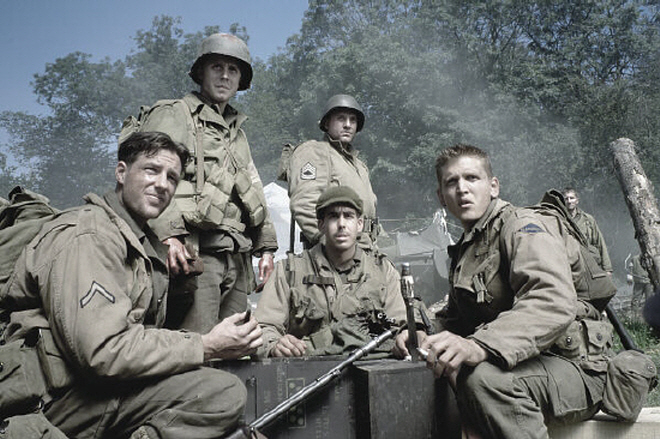
As revisiting the film yesterday, I was particularly impressed by how a bunch of recognizable performers are effectively cast in their respective supporting roles. Tom Sizemore, Edward Burns, Jeremy Davies, Vin Diesel, Adam Goldberg, Barry Pepper, and Giovanni Ribisi are believable along with Hanks as one solid bunch, and Matt Damon, who just rose to his emerging stardom after winning a Best Screenplay Oscar for Gus van Sant’s “Good Will Hunting” (1997) along with his best friend Ben Affleck, is an almost perfect casting choice. In addition, you may also notice Ted Danson, Harve Presnell, Nathan Fillion, Bryan Cranston, and Paul Giamatti appearing in small but crucial supporting parts, and it is fun to see how Giamatti, who eventually became one of the best character actors working in Hollywood, showed considerable potential even at that point (He also appeared in Peter Weir’s “The Truman Show” (1998) in the same year, by the way).

On the whole, “Saving Private Ryan” is one of the best films from Spielberg besides remaining as an excellent war drama film to be admired and appreciated. Besides recognizing the huge human sacrifice behind the biggest war in the 20th century, the movie also makes a humble but poignant human answer to the central question of the story, and, considering how our world may be entering another grim time of brutality and inhumanity right now, that is something we should always remember regardless of whatever will happen to us and our world next.

Posted in Movies | Tagged , , | Leave a comment

Alphaville (1965) ☆☆☆(3/4): A literally distant SF noir from Godard

It is ironic that Jean-Luc Godard’s 1965 film “Alpaville”, whose 4K remastered version is being shown in South Korea at this point, is quite dry, distant, and abstract to the end without much feeling to sense. While the story itself seems to emphasize the importance of human emotion and spirit, this is another clinically cerebral exercise in style and genre from Godard, and I become more aware of its glaring flaws while admiring its striking style and mood enough for recommendation.

I must confess that “Alpaville” is one of the few films which actually made me quite drowsy more than once. When I watched it for the first time in 2002, I somehow fell asleep in the middle of the film, and that happened again when I revisited it a few years later. This time, I fortunately did not become drowsy, probably because everything felt bigger and louder as I watched it along with a few audiences in a fairly big screening room,

Oh, yes, just like some of Godard’s works, the movie draws our attention with its striking presentation of images and sounds right from the beginning, and it goes on and on. While we are served with plenty of philosophical/political statements, there are also a lot of other stuffs thrown to us here and there, and these stylish moments surely show us how much the movie is conscious of itself – or full of itself, shall we say.

The story is set in a futuristic world called “Alphaville”, which is supposed to located somewhere in the space outside the Earth. The people of Alphaville have been thoroughly dominated and controlled by an omnipresent supercomputer which is virtually your average AI computer just like HAL 9000 in Stanley Kubrick’s “2001: A Space Odyssey” (1968), and they are not allowed to show or have any kind of emotion while only following the cold and emotionless logic of their technology.

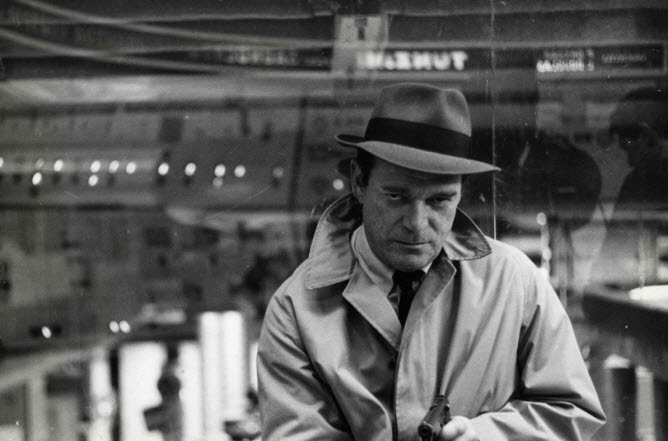
The movie opens with the arrival of Lemy Caution (Eddie Constantine), an undercover agent who incidentally disguises himself as a journalist. Right from his arrival at a nice big hotel located in the middle of Alphaville, Caution, who is your typical film noir tough guy, is baffled a lot by the behaviors of the denizens of Alphaville, and there is an absurd moment when he adamantly refuses the service from a female hotel employee who is willing to provide sex if that is necessary.

As Caution works on his secret mission, we get to know more about the absurd aspects of Alphaville via Natacha von Braun (Anna Karina, who divorced Godard around the time when the movie was released in 1965), a young beautiful woman who turns out to be the daughter of a certain important scientist working behind that supercomputer. At one point later in the story, she takes Caution to a special government ceremony where a group of subversives are executed just for being emotional, and that is one of the most chilling moments in the film. 

 Around that narrative point, Caution comes to face that supercomputer as expected. As the supercomputer asks him a series of supposedly important questions, we notice several microphones moving above his head more than once, and you may wonder what the hell the point of this actually is. Don’t ask me, because I can only tell you that Godard probably wants us to be more conscious of how the movie is about.

And the movie will always keep you alerted about how it is about. As going back and forth between the words of Caution and that supercomputer, it frequently inserts a number of various images and signs for no apparent reason, and it will continue to disorient you as before, but you may appreciate how Godard and his frequent cinematographer Raoul Coutard establish the distinctively alien mood and background on the screen. They deliberately shot the streets and alleys of Paris in extreme high contrast, and the overall result is often quite striking with the dryly ominous ambience surrounding the main characters in the film. Sure, you may be occasionally amused by some tacky details including those big and ungainly computer machines, but you become more intrigued as getting more immersed in its odd futuristic world.

However, I also must tell you that it is still hard and difficult to care more about the story and characters. For example, Caution is supposed to be a man more emotional than others around him, but he simply comes to us as a callous dude often wielding blatant sexism and misogyny along with the movie, which reminds me again of that unmistakable gender limit of many European white filmmakers during the 1960s. As far as I can see from the film, most of female figures in the film including Natasha are sexually objectified in one way or another throughout the story, and I would not be surprised at all if they all turned out to be female robots instead of real human beings. Furthermore, Eddie Constantine and Anna Karina do not generate much feeling between them although their characters are supposed to be gradually attracted to each other along the story, and that is the main reason why the last scene is not as emotionally effective as intended. 

In conclusion, “Alphaville” is worthwhile to watch for its intriguing style and mood, but I still feel rather ambivalent about it for the reasons mentioned above. Yes, any serious moviegoer needs to watch a Godard film at movie theater at least once, but I would select “Breathless” (1959) or “Vivre sa vie” (1962) instead, and I sincerely advise you to be fully aware of what and how the movie is about in advance.

Posted in Movies | Tagged , , , | Leave a comment

Queer (2024) ☆☆1/2(2.5/4): That frustrating object of lust

Luca Guadagnino’s latest film “Queer”, which came out not long after his previous film “Challengers” in the same year, often frustrated and baffled me. While this is another distinctive work of Guadagnino which is packed with an ample amount of mood and details, the movie is sometimes too languid and distant to engage me on the whole, and I got rather bored even when it belatedly interested me to some degree around its last act.

The movie is based on the novella of the same name by William S. Burroughs, a Beat Generation writer mainly known for his wild dopey works such as “Naked Lunch”, which was also adapted into a feature film by David Cronenberg in 1991. I still vividly remember when I came across the 1991 film via a cable TV movie channel at one late night in 2001, and, even though I am not so sure whether I love it or not, it was fairly interesting as a loony and weird mix of fiction and Burroughs’ messy personal life.

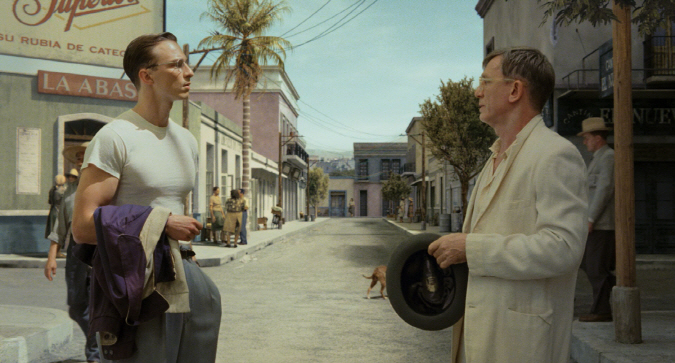
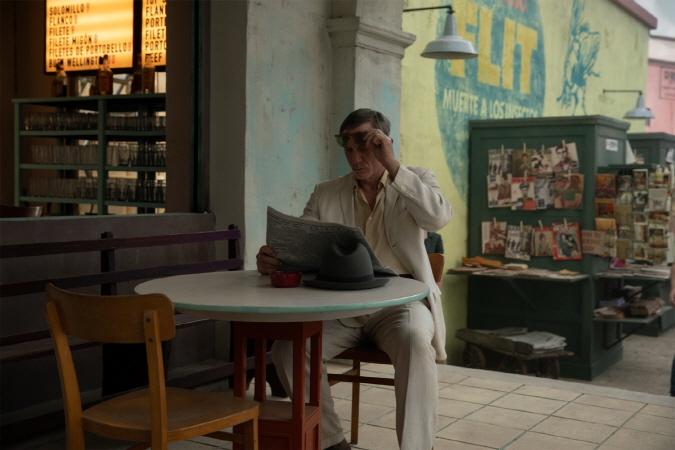
Like that film, “Queer” has a hero who is a fictional version of Burroughs. William Lee (Daniel Craig) is an American expatriate staying in Mexico City in the early 1950s, and the early part of the movie is mainly about how aimlessly he spends one day after another unless his mind focuses on drug or sex. There are always local young guys bound to attract his attention at local bars, and we later see him having a sex with one of those local lads in a shabby hotel.

On one day, Lee comes to notice one handsome American lad which instantly draws his attention. This young American in question is Eugene Allerton (Drew Starkey), and, regardless of whether Allerton is really gay or not, Lee finds himself more attracted to him, and Allerton seems to be aware of this, even though he does not signify that much while usually flirting with some young woman right in front of Lee.

Eventually, there comes a point where Lee finally gets his wish, and we are accordingly served with an obligatory sex scene as expected, but, not so surprisingly, Lee finds himself still lonely and miserable as usual. Although he simply demands Allerton to hang around with him as much as he can, Allerton remains beyond his reach at times without making any genuine emotional connection between them, and this certainly annoys and frustrates Lee. Sure, he knows too well that Allerton is the one holding the power over their relationship, and he certainly tries to live with that, but, not so surprisingly, this makes him all the more discontented than before. 

As a consequence, Lee comes to depend more on his drugs of choice, and then he becomes interested in using a certain South American natural drug, which may open his mind and will also probably help him connect more with Allerton. Although Allerton is not so willing at first, he agrees to accompany Lee when Lee decides to travel to somewhere in Ecuador, and the change of scenery seems to make Lee a bit better, though his drug addiction problem soon turns out to be more troublesome than expected.

Around that narrative point, we are supposed to be more engaged in Lee’s despair and frustration, but the screenplay by Justin Kuritzkes, who previously collaborated with Guadagnino in “Challengers”, does not delve that deep into its two main characters. Lee remains as a merely pathetic figure going down further toward the bottom of addiction just like Burroughs did in real life, and we never get to know anything about Allerton, who frequently looks like being beyond Lee’s reach as well as ours. In the other word, he is more or less than a distant object of desire like that pretty boy who captures the heart of the artist hero of Luchino Visconti’s “Death in Venice” (1971).

At least, Guadagnino and his crew members including cinematographer Sayombhu Mukdeeprom, who did a first-rate job in “Challengers”, decorate the screen with a lot of stylish elements to be appreciated. The first half of the movie is filled with a palpably languid sense of ennui and anxiety, and Daniel Craig, who is already moving onto the next phase of his career after his last James Bond film, and several other main cast members including Jason Schwartzman, who is rather unrecognizable due to his chubbier appearance here in this film, look believable as the unhappy inhabitants of their little hedonistic world. Although he does not have much to do except looking handsome and distant at first, Drew Starkey manages to fill his character to some degree, and his performance gets a little more interesting when his character goes into a remote Ecuadorian jungle area along with Lee later in the story.

With the delightfully hammy supporting turn by Leslie Manville, who plays a loony American botanist who may help Lee get that South American natural drug in question, the movie becomes more energized than before, but it is still too late in my trivial opinion. A series of following hallucinogenic moments may not impress you that much if you have seen “Naked Lunch”, and the last scene does not have enough emotional ground to be genuinely poignant from the beginning.

Overall, “Queer” is the first time Guadagnino disappoints me, and that is a shame because he has seldom disappointed me since “I Am Love” (2009), which was incidentally one of the best films I saw in 2010. At this point, he is already preparing to release a new movie a few months later, and I sincerely wish I will be more entertained.

Posted in Movies | Tagged , , | Leave a comment

Queen of Katwe (2016) ☆☆☆(3/4): An unlikely chess player in Uganda

Mira Nair’s 2016 film “Queen of Katwe”, which is currently available on Disney+ presents a remarkable story about one extraordinary female chess player in Uganda. She was born in a slum neighborhood of Kampala, Uganda, but she and several other neighborhood kids came to find their unexpected talent and potential thanks to their dedicated chess coach, and, as touchingly shown at the end of the film, that did change their lives a lot.

The story mainly revolves around a 10-year-old girl named Phiona Mutesi (Madina Nalwanga), and the early part of the film focuses on how things have been difficult and desperate for her and her family. After losing her husband and eldest child some years ago, Phiona’s mother Nakku Harriet (Lupita Nyong’o) has struggled a lot with the following economic hardship, and Phiona and her younger brother often have to sell maize on the streets of Katwe, a slum neighborhood outside Kampala, along with their mother for supporting their family as much possible.

Meanwhile, the movie also pays attention to Robert Katende (David Oyelowo), a young man who has worked as a soccer coach at a local youth center as trying to get hired as an engineer someday. On one day, he decides to start a little chess club for those poor kids in Katwe because 1) he sincerely wants the kids to go for more intelligence and confidence 2) he happens to have considerable knowledge on chess. Although the first day of his chess club is not that promising, the kids gradually show more interest in chess, and this draws the interest of Phiona when she comes to the chess club along with her younger brother.  

While she does not even know how to read, Katende willingly lets Phiona into the chess club, and we see how she gets to know the rules of chess game bit by bit and then begins to surprise everyone around her. Within a short period of time, she becomes the most prominent chess player in the group, and Katende is willing to support not only her but also several other considerably talented kids as much as he can. Although there is not any available money for allowing his talented kids to participate in a big local junior chess tournament, he manages to get the money in the end, and, of course, Phiona and her fellow chess players prove themselves more at that tournament.

However, the movie never overlooks that there is still the harsh reality for Phiona and her family whenever she is not playing chess – especially when they get much poorer due to an unexpected incident. As things become all the more desperate for her and her family, Phiona naturally comes to wonder whether chess can really help her and her life, but she keeps getting supported by her coach as well as her mother, who does not know that much about chess but is always ready to do anything for her children’s welfare.              

Clearly recognizing the complex aspects of its young heroine’s situation, the screenplay by William Wheeler, which is based on the nonfiction book of the same named by Tim Crothers, patiently builds up the story and characters along its engaging narrative. Yes, there eventually comes a point where our young heroine comes to have some painful lesson about life and chess, but this and several expected moments in the film are handled with enough thoughtfulness and sensitivity, and we come to root more for not only her but also several supporting characters around her. There is a little touching moment when Katende shows more of his goodwill and sincerity to Phiona as a man who also had a fair share of childhood hardship, and then we get a poignant scene when her mother eventually decides to make some sacrifice for helping Phiona more. 

In case of several chess game scenes in the film, they do not reach to what is so electrifyingly shown in recent Netflix miniseries “The Queen’s Gambit” as having less detail and excitement in comparison, but the movie stays focused on character and drama as before, while occasionally showing some humor via Phiona’s fellow chess players. They may be less skillful than her, but they are bright and colorful kids nonetheless, and that is another reason why the obligatory epilogue part of the film feels so inspiring. 

Above all, the movie is anchored well by the unadorned natural performance by young performer Madina Nalwanga. Although she did have any previous acting experience before, Nalwanga did a commendable job of imbuing her role with enough spirit and pluck besides holding her own place well between her two much more experienced co-starts, and several other young cast members in the film are equally splendid in their respective supporting parts. In case of David Oyelowo, who incidentally became more notable after his substantial supporting performance in Kevin Macdonald’s Oscar-winning film “The Last King of Scotland” (2006), Lupita Nyong’o, their understated actings ably embody their characters’ decency and dignity. and they are particularly wonderful when their characters come to have a serious conversation on Phiona’s future at one point in the middle of the story.    

On the whole, “Queen of Katwe” is recommendable for its solid storytelling and good performances to watch, though it is less impressive than director Mira Nair’s previous acclaimed works such as “Salaam Bombay!” (1988) and “The Namesake” (2006). It is really a shame that she has been relatively quiet during last several years since “Queen of Katwe” came out, and I sincerely hope that she will soon be back in action.

Posted in Movies | Tagged , , , , | Leave a comment

Young Woman and the Sea (2024) ☆☆1/2(2.5/4): A passable biopic about one remarkable woman

“Young Woman and the Sea”, which is currently available on Disney+, is a biographic film about one remarkable woman who showed that women can do anything as much as men. While her extraordinary achievement certainly deserves to be known more to us, the movie is unfortunately rather plain and clichéd in comparison, and that is a shame considering the commendable efforts from its lead actress.

Daisy Ridley, who seems ready to go further than the recent Star Wars trilogy, plays Gertrude “Trudy” Ederle, an American competition swimmer who became the first woman to swim across the English Channel in 1926. The early part of the film focuses on her childhood years in New York City during the 1910s, and we see how young Ederle became interested in swimming just because her older sister was allowed to learn swimming under their no-nonsense mother’s insistence. Although she has to be careful about losing hearing after suffering a severe case of measles, young Ederle enjoys swimming more and more, and she and her older sister eventually join a local Woman’s Swimming Association later.

Under their trainer who comes to recognize Ederle’s potential and passion, Ederle keeps going further during next several years. In the end, she comes to participate in the 1924 Paris Olympics, but her older sister, who has been content with her younger sister swimming better than her in many competitions, cannot go just because there is only one spot available.

Anyway, Ederle and several other members of the US women’s team are supervised by a German trainer named Jabez Wolffe (Christopher Eccleston) during their trip to the 1924 Paris Olympics, and we see how much they are disregarded and discriminated by their mean trainer. While those American male athletes are allowed to do routine training on the ship everyday, Ederle and the other American female athletes are not allowed to do that in contrast, and Wolffe does not pay much attention to their training or welfare while more concerned about his seasickness.

As a result, Ederle shows a worse result than expected at the 1924 Paris Olympics, and she feels all the more daunted when her older sister subsequently chooses to follow their conservative parents’ wish and then marry some German immigrant guy to help their father’s butchery business. However, after seeing that she has been a role model for many young girls out there, she becomes determined to find any possible way for swimming more and then getting recognized more, and she soon sets herself against a very demanding challenge: swimming across the English Channel.

From that narrative point, the screenplay by Jeff Nathanson, which is based on Glenn Stout’s nonfiction book of the same name, takes a more predictable course. After succeeding in getting full sponsorship, Ederle begins to prepare along with Wolffe just because he happens to be assigned to her as a guy who attempted to swim the channel more than once, and, not so surprisingly, they do not get along that well with each other from the beginning. The movie even suggests that Wolffe deliberately sabotaged Ederle’s first attempt to swim across the channel, but I must tell you that this is entirely fictional as far as I learned from Wikipedia later.

The last act of the movie focuses on Ederle’s second attempt, which is assisted by Bill Burgess (Stephen Graham), who was the second guy who successfully swam across the channel. Despite looking crude and coarse on the surface, Burgess turns out to be a much better trainer for her than Wolffe, and her family show full support as usual.

What follows next is a series of grueling obstacles Ederle has to face as trying to swim across the channel for the second time. Besides her accumulating physical exhaustion, she must endure the cold water temperature and unpredictable current changes of the channel, and she also has to be careful about those jellyfish in the sea.

Now some of you are probably reminded of recent Oscar-nominated Netflix film “Nyad” (2023), which is about a real-life competitive swimmer swimming against a similar challenge. Although the climatic part of “Young Woman and the Sea” looks fairly realistic under the competent direction of director Joachim Rønning, this still looks less palpable and impressive compared to “Nyad”, and the movie also is deficient in terms of story and characters. While Ederle is presented as your average clean-cut heroine, many supporting characters around her are more or less than stereotypes, and this often makes the film less engaging in my humble opinion.

At least, Ridley and the other main cast members in the movie try as much as they can. While her earnest performance carries the film to the end, Christopher Eccleston Tilda Cobham-Hervey, Kim Bodnia, Jeanette Hain, Glenn Fleshler, and Sian Clifford dutifully fill their respective spots around her, and the special mention goes to Stephen Graham, who brings some spirit and personality to the story as well as his character.

On the whole, “Young Woman and the Sea” does not impress me enough for recommendation, but it made me want to know about its admirable real-life heroine at least. As shown at the end of the story, Ederle continued to live the life of a trailblazer during the rest of her life, and her life and achievements certainly deserve something better than this passable biography film.

Posted in Movies | Tagged , , , | 1 Comment

28 Years Later (2025) ☆☆☆(3/4): Danny Boyle back in Zombieland

Danny Boyle’s latest film “28 Years Later” reminds me again that he is a filmmaker who has rarely repeated himself. Yes, he is back in that post-apocalyptic world explored in “28 Days Later” (2002), and we are surely served with a number of gory and bloody moments involved with those raging zombies, but, to my little surprise, the movie turns out to be more thoughtful and meditative than expected.

At the beginning, the movie quickly establishes how things have been grim and hopeless in Britain and Ireland since what happened at the beginning of “28 Days Later”. After a highly infectious virus nicknamed the “Rage virus” was spread from a medical research center in London, Britain and Ireland were eventually quarantined, and the remaining survivors have been stuck there during next 28 years while nearly isolated from the outside world.

The early part of the film is mainly set in an island where a bunch of survivors have peacefully lived together for many years. Except for a tidal causeway to the mainland, the island has been totally and safely separated from the mainland filled with lots of infected people, and the movie observes a bit of how the survivors in the island go through another day of their shabby life as doing their respective tasks.

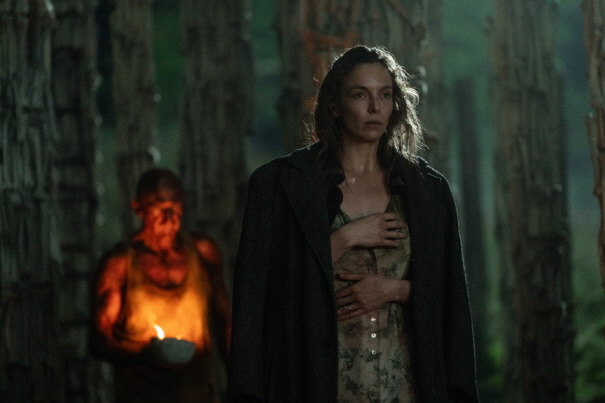
One of them is a guy named Jamie (Aaron Taylor-Johnson), a scavenger who has lived with his ailing wife Isla (Jodie Comer) and their 12-year-old son Spike (Alfie Williams). He is going to supervise a coming-of-age initiation to be done by his son in the mainland, and Spike seems to be ready for that, though he is more concerned about how his mother has become sicker day by day for some unspecified medical problem.

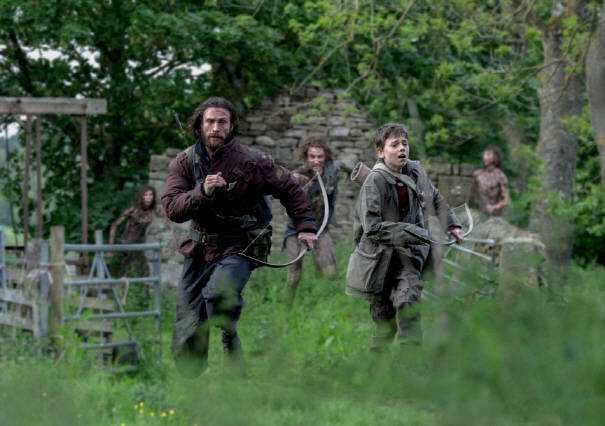
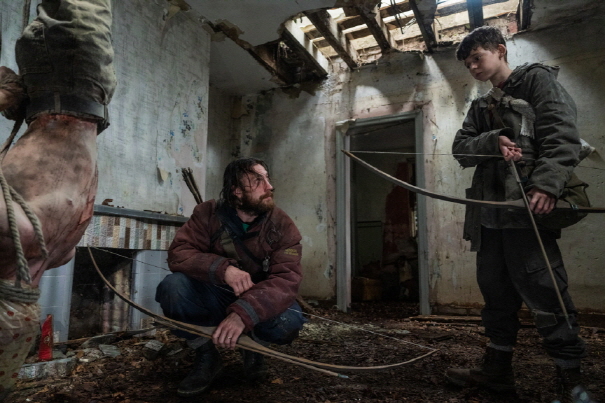
Once Spike and his father enter the mainland with their bows and arrows, we get to know more about how dangerous the mainland is despite looking quiet and peaceful on the surface. There are still a lot of infected people here and there in the mainland, and some of them are more dangerous due to having more strength due to that virus. Not long after Spike manages to kill one infected person as required, he and his father find themselves chased by one of those more dangerous infected people, and that leads to one of the most intense moments in the film.

After learning about a certain mysterious survivor who may be a doctor, Spike naturally becomes interested in bringing his mother to that figure who lives somewhere in the mainland, and the second half of the film follows his following impulsive journey along with his mother. Again, Spike is reminded of how he is not totally prepared for dealing with those infected people out there, but he tries as much as possible nonetheless, and his mother turns out to be more helpful than expected even though her medical condition keeps getting worse as before.  

 As their perilous journey is continued, the screenplay by co-producer Alex Garland, who also wrote the screenplay for “28 Days Later” and then impressed us more as directing several feature films including “Ex Machina” (2014) and “Civil War” (2024), takes some time for more character development. While we certainly get several scary scenes involved with those infected people, the movie stays focused on the relationship between Spike and his mother, and we come to sense more of the strong emotional bond between them.

In addition, the movie constantly emphasizes how everything looks alien and unsettling to its main characters in one way or another. The cinematography by Anthony Dod Mantle, who won an Oscar for Boyle’s previous film “Slumdog Millionaire” (2008), often conveys to us the anxious mood surrounding the main characters, and that is why a few brief but surprisingly tender moments later in the film are quite effective. The editing by Jon Harris feels rather distracting at first due to frequent jump cuts throughout the film, but this jumpy editing style somehow works along with the increasing dread and anxiety along the story, and that is accentuated further by the intentionally jarring score by Young Fathers.

The main cast members of the film are terrific on the whole. While Jodie Comer and Aaron Taylor-Johnson dutifully hold the ground, young performer Alfie Williams is convincing in his character’s gradual growth and maturation along the story, and Jack O’Connell and Edvin Ryding are well-cast in their substantial crucial supporting parts. In case of Ralph Fiennes, he has some juicy fun with that mysterious character who will surely remind you a bit of Colonel Kurts in “Apocalypse Now” (1979), and he is particularly wonderful when his character gently handles an important moment between Spike and his mother later in the story.   

Overall, “28 Years Later” is relatively more somber compared to the sheer intensity of “28 Days Later”, and that may let you down a little, but it will engage you with its good mood, storytelling, and performance instead. As reflected by its final scene, there will be the following sequel in the next year, and, considering how “28 Years Later” demonstrates more potential and interest in its familiar genre territory, I think we can have some expectation on whatever may come next after this solid installment.

Posted in Movies | Tagged , , , , , | 1 Comment

Elio (2025) ☆☆☆(3/4): A boy’s little cosmic adventure

“Elio”, the latest animation feature film from Pixar Animation Studios, is a modest but sweet SF fantasy tale which often amused me for good reasons. While it will be fairly enjoyable to young audiences thanks to its bright and colorful visual elements, the film will touch you especially if you were ever eager to learn more about whatever is beyond our home planet, and you may also appreciate how much it is influenced by a number of notable American SF films in the 1980s.

 The early part of the film focuses on the aching loneliness of its little hero. After suddenly losing his dear parents due to some unspecified incident, Elio Solis (voiced by Yonas Kibreab) has felt quite alone and unwanted, and even his aunt Olga (voiced by Zoe Saldaña), an army officer working in a big military facility monitoring those dangerous space debris outside the Earth, does not provide him much comfort, even though she really tries her best for raising her nephew alone by herself. 

Anyway, Elio has been quite interested in the universe and the possible existence of aliens thanks to his chance encounter with an exhibition associated with Carl Sagan and Voyager I, and he has aspired to be taken to anywhere but the Earth just because he has not often felt like being at home on the Earth. As soon as summer starts, he goes to a nearby beach, and then he tries to receive any message from the space beyond the Earth via his amateur radio, while a certain famous song from Talking Heads is humorously played on the soundtrack.

And then there comes an unlikely opportunity for Elio. When he later happens to be with his aunt at that military facility, he comes upon a chance to respond to what may be a reply from whoever met Voyager I somewhere in the universe, and he instantly grabs that chance without any hesitation. This eventually causes a big trouble for both him and his aunt, but, what do you know, it turns out that his response was actually received by a group of alien creatures out there, who subsequently transport him to their headquarters in a way reminiscent of the climax of Robert Zemeckis’ “Contact” (1997).  

These aliens are the members of an interplanetary organization called “Communiverse”, and, not knowing that he is actually a young kid, they mistake Elio for the leader of the Earth. Just because he can live there once he gets accepted into Communiverse, Elio lies to the aliens, but, of course, his deception soon gets threatened due to an aggressive alien warlord who is not so pleased about not getting accepted by Communiverse. In exchange for getting accepted into Communiverse, Elio agrees to deal with that alien warlord for himself, and his task seems rather easy up to a certain point.

Around that point, Elio come to befriend a little alien who is also a kid just like him, and that makes the film look like a cross between Nick Castle’s “The Last Starfighter” (1984) and Joe Dante’s “Explorers” (1985). As a matter of fact, the movie borrows a certain story idea from the former (Hint: It involves with cloning), and you may be more amused by how the film also adds a bit of John Carpenter’s “The Thing” (1982) and “Starman” (1984) to this borrowed story idea later.

Needless to say, Elio and Glordon (voiced by Remy Edgerly), who incidentally looks like a cuter version of those aliens in Bong Joon-ho’s “Mickey 17” (2025), become each other’s best friend along the story. At one point in the middle of the story, they have to crawl inside a labyrinthic network of narrow tunnels, and you may be a bit tickled by how Glordon can actually talk in more than one way, which somehow reminds me of that bizarre talking bug in David Cronenberg’s “Naked Lunch” (1991).

The film feels a bit too hurried as shifting to action mode during the last act, and I think the screenplay by Julia Cho, Mark Hammer, and Mike Jones could provide more depth and personality to its story and characters before eventually arriving at the expected ending, Nevertheless, the film has enough humor and sensitivity to engage us, and, as a guy who once memorized all the planets in the solar system and many of their numerous satellites during his childhood years, I could not help but feel a little sentimental as watching Voyager I and then listening to a piece of audio recording from Carl Sagan (I still had an old translated copy of that famous book written by him, by the way). 

The voice cast members of the film are mostly solid on the whole. Young performer Yonas Kibreab did a fine job of imbuing his character with vibrant spirit and likability, and he and his fellow young performer Remy Edgerly are convincing in the relationship development between their characters. In case of several notable adult voice cast members including Zoe Saldaña, Brad Garrett, Jameela Jamil, Shirley Henderson, and Matthias Schweighöfer, they simply fill their respective supporting roles, and that is another weak aspect of the film.

In conclusion, “Elio”, directed by Madeline Sharafian, Domee Shi, and Adrian Molina, is one or two steps down from the recent better offering from Pixar Animation Studios such as “Coco” (2017) or “Turning Red” (2022), but it is still entertaining enough to compensate for its flawed aspects. Sure, Pixar Animation Studios can do much better than this, but, folks, after not so impressed by the live action adaptations of “Lilo & Stitch” (2002) and “How to Train Your Dragon” (2010), I felt an urgent need for any good new animation film out there, and I am glad that “Elio” satisfies me a bit more than expected.

Posted in Movies | Tagged , , , , , | 2 Comments

Predator: Killer of Killers (2025) ☆☆☆(3/4): Three Predator tales

Animation feature film “Predator: Killer of Killers”, which was released on Disney+ early in this month, tries an interesting variation on what we have seen from “Predator” (1987) and several films from its franchise. This time, we get three different Predator tales presented in animation, and the overall package is fairly enjoyable enough to make you have some expectation on whatever may come next.

The first story, which is set in Scandinavia, 841, is about a female Viking chieftain named Ursa (voiced by Lindsay LaVanchy). For many years, she has been quite determined to avenge for her dead father, and now her moment of revenge seems almost close to her as she and several others including her young son are about to corner a figure responsible for her father’s death.

However, as you have already expected, something is silently pursuing Ursa and her men, and that is one of those Predators. Not long after Ursa and her men eventually accomplish her personal mission, this Predator finally reveals itself for killing them all, and we are accordingly served with lots of bloody and violent actions which are definitely not for young audiences.

The second story, which is set in Japan in the early 17th century, begins with a conflict between two brothers of some powerful lord. When they were just little young boys, they were inseparable from each other, but then they were forced to have a duel by their stern father just for determining who will succeed him later. Kenji (voiced by Louis Ozawa) refused to fight, but he only found himself betrayed and then defeated by his brother, who subsequently succeeds their father after he died several years later.

Kenji, who has been in exile after that humiliating defeat, returns to settle his old score with his brother at one night, but, unbeknownst to him, a Predator is quietly following after him. What follows next is basically not so far from what is presented during the first story, but different atmosphere and details bring some personality at least, and the second story also provides a fair share of brutal violence for more thrill and excitement for us.

Around this point, the film feels a bit repetitive, but the screenplay by Micho Robert Rutare, which is developed from the story written by him and director/co-producer Dan Trachtenberg, thankfully changes the setting a lot in case of the third story, which is mainly set in the early 1940s. The hero of this story is a young Latino American pilot named John J. Torres (Rick Gonzalez), and the early part of the story succinctly establishes how much this lad is eager to fly a fighter plane someday.

And then there comes an unexpected chance for Torres not long after he got drafted into the US Navy. In the middle of the North African campaign, his squadron happens to encounter an unidentified aircraft, and, after coming to learn that this unidentified aircraft is something beyond their skill and knowledge, Torres quickly gets into a rather shabby fighter plane for warning his fellow squadron members as soon as possible.

It is not much of a spoiler to tell you that Torres eventually finds himself confronting that unidentified aircraft alone, which turns out to be one of those Predator spaceships. Although he seems quite disadvantaged at first, Torres eventually discovers how he can outwit his deadly opponent, and that leads to a thrilling action sequence to watch.

As already implied to us in advance, all these individual stories converge on the last act of the film, and that is where the film becomes less interesting. We get to know a bit about Predators, and we later get a brief moment linked with “Prey” (2022), the previous Predator movie which is incidentally directed by Trachtenberg. In addition, the cliffhanger ending makes the film itself more like a teaser for the next film to follow, and we become more aware of how it is rather thin in terms of story and character.

Nonetheless, the film is pretty competent on the whole while packed with enough style and energy to distinguish itself to a considerable degree. I like how its digital animation often emulates a rough cell animation style, and the action scenes in the film are slick, fast, and efficient without ever confusing us at all. In case of the voice cast members, Lindsay LaVanchy, Louis Ozawa, who incidentally appeared in “Predators” (2010), and Rich Gonzalez did a commendable job of imbuing their respective characters with enough intensity and personality, and Michael Biehn brings some little extra fun as Torres’ no-nonsense squadron leader.

Overall, “Predator: Killer of Killers” is another entertaining film from its franchise after “Prey”. Like that movie, the film demonstrates that there is still some potential for more intrigue and entertainment in the franchise, and I come to have more admiration on the skills and talent of Trachtenberg, who made a solid feature film debut with “10 Cloverfield Lane” (2016) and will soon give us another Predator flick around the end of this year. In my humble opinion, the franchise is finally in the right direction thanks to him, and I am already ready to be entertained by his next Predator film.

Posted in Movies | Tagged , , , | Leave a comment