Materialists (2025) ☆☆☆(3/4): A matchmaker between two choices

Celine Song’s second feature film “Materialists” is a calm romance film about one matchmaker who both calculates and cares a lot. While her practical mind seems interested in someone supposedly quite ideal for any woman out there, her heart cannot help but get drawn to a person she still loves despite some issues between them, and the movie illustrates her confusion and conflict with a lot of care and sensitivity.

The opening part of the movie quickly establishes how its heroine works as a fairly good matchmaker in New York City. Lucy (Dakota Johnson) has worked in a local matchmaking service agency for a while, and the movie observes her caring professionalism at one point early in the story. When one of her recent female clients comes to have a sudden serious doubt right before marrying some suitable guy introduced by Lucy, Lucy has a little private conversation with this lady, and she really listens to her client with enough empathy and understanding while respecting whatever her client is going to do right now.

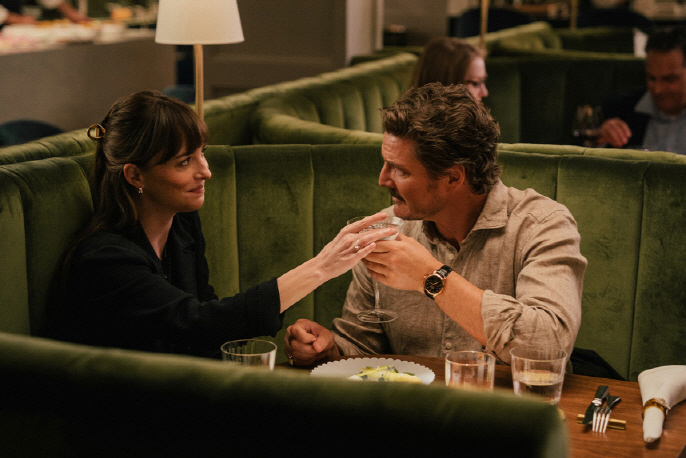
Anyway, her client eventually marries that dude, and that is how Lucy encounters Harry (Pedro Pascal), a handsome bachelor who happens to be the brother of the groom. As they talk more and more with each other during a little party after the wedding, something seems to click between them, and Lucy comes to see more of what an ideal guy Harry is in many aspects. Besides being quite good-looking to say the least, he is also a wealthy financial businessman with a very nice family background. As Lucy points out later, he is virtually what is called a “Unicorn” in her business field, and that certainly makes her all the more interested in him.
However, there comes another unexpected moment for her while she is talking with Harry. One of the employees of the catering service for the wedding turns out to be her ex-boyfriend John (Chris Evans), and both Lucy and John are pleased to meet each other, even though they had a painful breakup some time ago. John is one of those struggling NYC actors who are often quite poor, and that was actually what caused their painful breakup as shown from a brief flashback scene.

Now you will have a pretty good idea about where the story is heading, but Song’s screenplay takes its time for fleshing out its main characters more as deftly maintaining its leisurely narrative pacing. As Lucy comes to spend more time with Harry, Harry turns out to be a lot more decent and thoughtful than expected, and Lucy naturally comes to consider going further with him. Although she does not mind being a single woman at all, she cannot help but yearn for someone to love and lean on, and Harry looks quite ready for being that person as they become more aware of how they seem ideal for each other according to their respective standards.

Nevertheless, Lucy’s heart feels conflicted as she also lets herself get involved with John again. They act as if they were just old friends now, but we gradually notice that the chemistry between them still exists, and we are not so surprised when Lucy subsequently calls John first after having a very unfortunate day at her workplace due to some really bad male client. He patiently listens to her on the phone, and she surely appreciates his generous thoughtfulness.

However, as your average materialist, Lucy is also often reminded of how economically unstable John has been compared to Harry, and the movie makes a sharp point on that from time to time. While it looks like his acting career is finally about to have a little breakthrough, John is still stuck in his old and shabby apartment along with a couple of roommates who are no better than him, and this surely makes a glaring contrast with Harry’s big and expensive apartment.

Needless to say, there eventually comes a moment when Lucy must make a big decision during the last act, but the movie sticks to its calmly restrained attitude as usual. Although it stumbles a bit due to a rather contrived dramatic moment, the story stays true to its three main characters nonetheless, and we come to understand and care more about them than before.

The three principal performers of the film are well-cast in their respective roles, and they all give believable performances filled with enough nuances and details to engage us. Dakota Johnson, who has shown more of her presence and talent since “Fifty Shades of Grey” (2015), exudes somber grace and charm from the beginning to the end, and this surely shows that she is quite ready to move on from that disastrous Marvel Cinematic Universe film which unfortunately garnered her a Razzie award early in this year. While Chris Evans, who seems to be aging well enough to become a more interesting actor, is likable in his earnest acting, Pedro Pascal, a naturally charismatic actor who has become very prominent during last several years, has several good scenes where his character comes to show more of himself to Lucy, and we can easily see why Lucy becomes so conflicted between these two guys.

In conclusion, “Materialists” is relatively lightweight compared to Song’s sublime first feature film “Past Lives” (2023), but it confirms to us more of Song’s considerable storytelling talent. The result is rather typical on the whole, but I found myself amused and touched enough during my viewing, and I will certainly look forward to observing how Song will advance more from her first two feature films.

Posted in Movies | Tagged , , , | 1 Comment

The Friends (1994) ☆☆☆1/2(3.5/4): Three kids and an old man

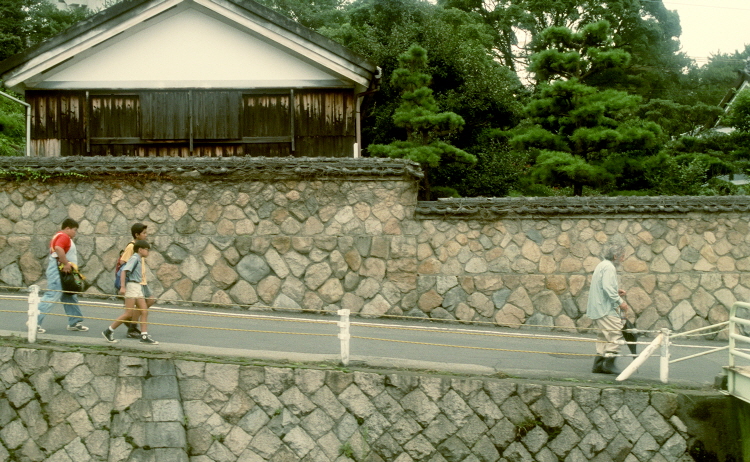
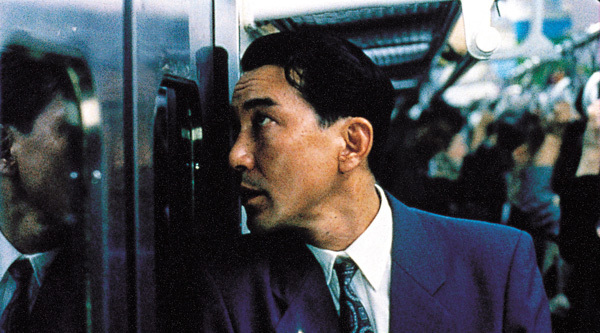
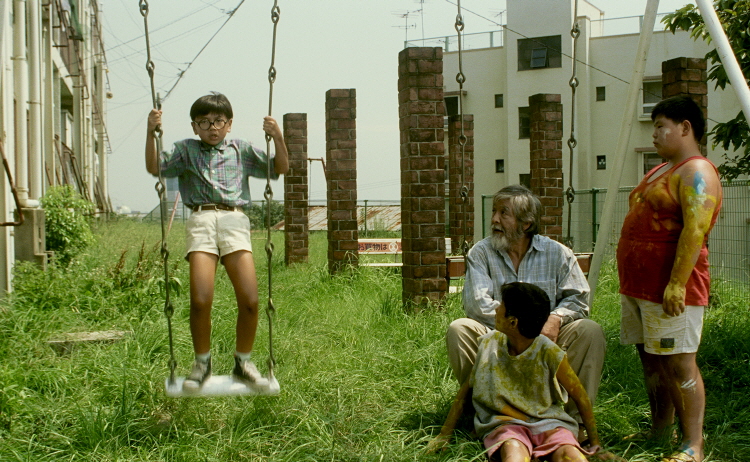
Shinji Sômai’s 1994 film “The Friends”, whose 4K restoration version was released in South Korean theaters yesterday, is gentle, humorous, and poignant in its unadorned coming-of-tale to remember. Calmly and sensitively following its three little young heroes’ eventful summertime, the movie goes much deeper into its main subjects along with them than expected, and we are eventually quite touched as reflecting more on how much they come to learn and then grow up around the end of the story.

At the beginning, we are introduced to three elementary school kids: Kiyama (Naoki Sakata), Kawabe (Yasutaka Oh), and Yamasita (Ken’ichi Makio). Because Yamasita, who is incidentally your average chubby boy, recently went to his grandmother’s funeral, Kawabe and Yamasita have been quite curious about death, and there is a morbidly amusing moment when Kawabe shows more of his curiosity about death while being quite reckless on the railing of an overpass (I sincerely hope that the three child performers of the film were protected enough during the shooting).

These three boys’ shared curiosity leads them to one particular old shabby house in their neighborhood. This house belongs to one reclusive old man who may die sooner or later, and Kawabe, who is often quite imaginative for a harrowing personal reason, suggests that they should monitor this old guy just for getting a chance to watch death someday. At first, they simply watch his house from a gap in the fence surrounding the house, and then, what do you know, they soon get themselves into his reclusive daily life more as becoming more curious about him.

Of course, it does not take much time for the old man to notice the attention from these three boys. At first, he is just surprised and annoyed, and that makes the boys all the more focused on watching on the old man. At one point, they follow after him when he goes to somewhere in the neighborhood, and their silly act of following merely amuses us for a while, and then the movie surprises us as suddenly entering the realm of surrealism along with one of the boys. This may feel jarring at first, but it is so skillfully handled that we have no problem with accepting whatever is experienced by the boy’s very imaginative mind.  

Anyway, as you have already guessed, the old man gradually comes to accept the boys into his residence, and the movie observes how things get changed in his little solitary environment thanks to the boys. First, he has them help him a bit on drying his laundry, and that is just the beginning of how the boys get themselves involved much more with the old man than before. They gladly clean up the foreground of his residence full of tall weeds for planting flower seeds there later, and they also assist him in a bit of renovation inside and outside his house.

It is not much of a spoiler to tell you that our little heroes come to learn a little more about their unlikely friend as caring a lot more about him than expected, but the screenplay by Yôzô Tanaka, which is based on the novel of the same name written by Kazumi Yumoto, takes its time as subtly developing its story and characters via mood and details. As the camera of cinematographer Noboru Shinoda patiently follows or focuses on the boys and the old man, we get to know more about them as well as their developing relationship, and there is an absolutely compelling scene where the old man phlegmatically reveals his longtime personal guilt in front of the boys in the middle of one dark and stormy night.

The following third act of the story depends on a little Dickensian coincidence, but what follows next is presented with a considerable amount of emotional power to engage us more than before. I will not go into details here, but I can tell you at least that the movie handles its expected melodramatic finale with a lot of sensitivity and thoughtfulness to admire, and I assure you that the poetically bittersweet quality of the last scene will linger on your mind for a while. Now I am reminded of that unforgettable quote from Errol Morris’ great documentary “Gates of Heaven” (1978): “Death is for the living and not for the dead.”  

Sômai also draws the wonderful natural performances from his three young actors. They are often quite effortless in their interactions on the screen (You may smile a little when one of them cheerfully sings a song from Hayao Miyazaki’s great animation film “My Neighbor Totoro” (1988), by the way), and it is quite clear to see why Sômai has been admired so much by Hirokazu Kore-eda, who surely knows a lot about how to get good performances from child performers. While never overshadowing his much younger co-stars, Rentarô Mikuni is believable as a man slowly coming out of his shell at last thanks to his unexpected little friends, and Naho Toda and Ritsuko Nemoto are also effective as the two small but crucial supporting characters in the story.

 In conclusion, “The Friends”, whose Japanese title is incidentally “Summer Garden (夏の庭)”, is another hidden gem in Sômai’s fascinating filmmaker career. Although it has been more than 20 years since he passed away in 2001, “Typhoon Club” (1985) and “Moving” (1993), which were already introduced to South Korean audiences before “The Friends”, do not look old at all, and these two films and “The Friends” surely deserve to be introduced to more audiences out there for more recognition on its rather overlooked maker. After watching these three interesting films from him, you will understand why Sômai has been respected a lot by Hirokazu and many other current Japanese filmmakers, and you may want to check out more of his filmography just like me.

Posted in Movies | Tagged , , , | Leave a comment

Jaws (1975) ☆☆☆☆(4/4): Still on the top of the field

If there had not been any shark movie at all after Steven Spielberg’s 1975 film “Jaws” came out, we would not complain that much in my humble opinion. After all, this great film tried and then succeeded in nearly everything we can possibly imagine or expect from shark movie, and it has been virtually impossible for any subsequent shark film to escape from what was achieved so well here in this movie.

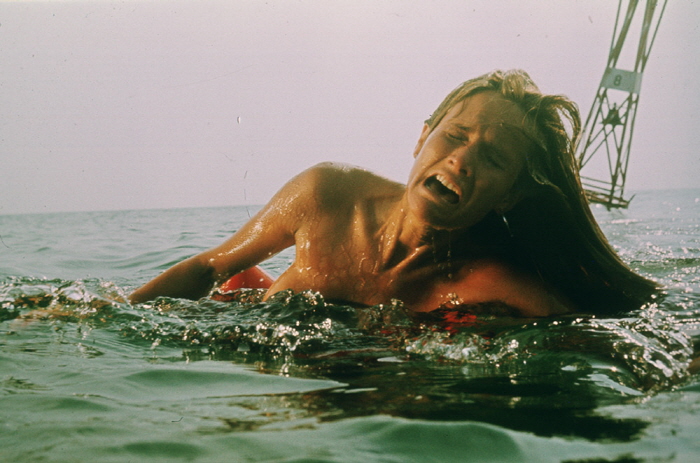
As a first-class horror film, “Jaws” takes time as skillfully setting the stage first, just like William Friedkin’s “The Exorcist” (1973) does during its first act. After that terrifying opening scene showing the first shark attack, the movie pays a lot of attention to establishing its mundane main background and characters on the screen, and everything in the story including that shark becomes all the more believable, as we get totally immersed in the situation surrounding its plain ordinary main characters including Chief Martin Brody (Roy Scheider), a policeman who recently moved to Amity Island from New York City along with his family mainly for getting away from all the danger and anxiety he experienced in the city. 

Well, it turns out that his first summer in this little beach town ready for another swimming season is not as uneventful as he hoped. When it is confirmed to that there was indeed a shark attack, Chief Brody is certainly ready to close the beach, but this is promptly objected and then blocked by the mayor, who, like many local people in the island, does not want anything to interfere with their upcoming summer business.

Needless to say, the circumstance becomes all the more serious with more shark attacks to follow, and there are a number of striking scenes which are still quite effective even though the movie does not show much of that big white shark in question. Yes, it has been well known that Spielberg and his crew had a lot of problems with that mechanical shark on the set, and not showing much of it on the screen was a practical choice for them, but Spielberg brilliantly used this technical limit to the big advantage of the movie, just like Val Lewton and his director Jacques Tourneur did in classic B horror film “Cat People” (1942). While we do not see much of the shark during the first half of the movie, Spielberg and his crew members including editor Verna Fields and cinematographer Bill Butler make us all the more aware of the presence of shark, which is usually announced by the unforgettable Oscar-winning score by Spielberg’s longtime collaborator John Williams (The movie also won in Best Editing and Best Sound by the way).

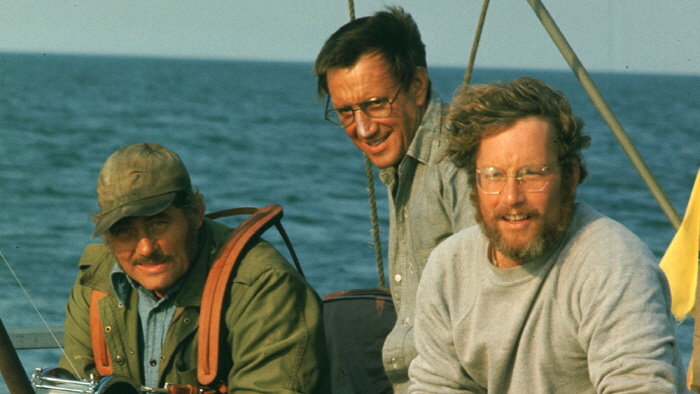
Around the narrative point where Chief Brody must hunt and then kill that shark as soon as possible, the movie is turned into a little but undeniably compelling sea adventure story along with him and the two other main characters already introduced early in the story. One is a young but knowledgeable oceanographer named Matt Hooper (Richard Dreyfuss), and the other is Quint (Robert Shaw), a tough and seasoned shark hunter who does not like sharks at all for a personal reason revealed later the story. As these three dudes go out to the sea, Williams’ score becomes a bit cheerful, and the movie shows some sly humor as observing the personality clashes among its three main characters on Quint’s little boat.

Needless to say, that shark comes to show more of itself, and we get that memorable line delivered by Chief Brody in utter shock and awe (“You’re gonna need a bigger boat”). Like Hitchcock, Spielberg plays us like a piano as dexterously shifting this film amid different modes including horror, action, thriller, and drama, and you will be all the more amazed by how much he and his crew and actors achieved within their rather limited setting. Yes, its scale of action and spectacle may look pretty modest on the surface in comparison to the standard of many summer Hollywood blockbusters to follow during next 50 years, but most of them look pale compared to its almost flawless technical aspects and the pulsating emotional power behind them.

The three main performers in the film, who has been and will always be associated with it, are simply terrific in each own way as bringing enough life and spirit to the screenplay by Peter Benchley and Carl Gottlieb, which is based on the pulpy (and occasionally soapy) bestseller novel by Benchley (I still remember how much I was disappointed with that novel not long after watching the film). Whie Roy Scheider, who became more notable thanks to his Oscar-nominated supporting turn in Friedkin’s “The French Connection” (1971) at that time, functions as the earnest center of the film, Richard Dreyfuss, who was a rising newcomer at that time, ably balances his character between humor and seriousness, and Robert Shaw frequently steals the show with his colorfully masculine performance, which incidentally reaches to the peak during that disturbing but absorbing monologue scene of his.

Thanks to its enormous commercial/critical success, the movie opened the door for not only countless summer Hollywood blockbuster films to follow but also the burgeoning filmmaker career of Spielberg, who only made a theatrical film debut with “The Sugarland Express” (1974) right before moving onto “Jaws”. Although 50 years have passed, the movie is still quite interesting and thrilling while also clearly showing that he was already on the top of his crafts, and he kept impressing us more and more during next five decades as shown from a heap of great films such as “Close Encounters of the Third Kind” (1977), “E.T. the Extra-Terrestrial” (1982), “Raiders of the Lost Ark” (1981), “The Color Purple” (1985) “Schindler’s List” (1993), “Saving Private Ryan” (1998), “A.I. Artificial Intelligence” (2001), “Minority Report” (2002), “Lincoln” (2012), and “The Fabelmans” (2022).   

On the whole, “Jaws”, which was re-released in South Korean theaters yesterday for its 50th anniversary, is a nearly perfect entertainment film, probably except regrettably vilifying sharks (We could not possibly say anything if they ever sue Spielberg and Benchley for slander). Although I have watched it more than 5 times at least, I have never got bored as admiring it more and more, and I sincerely hope that young local audiences out there will experience and then learn a lot from its greatness.

Posted in Movies | Tagged , , , , | 1 Comment

Shall We Dance? (1996) ☆☆☆1/2(3.5/4): His little lively hobby

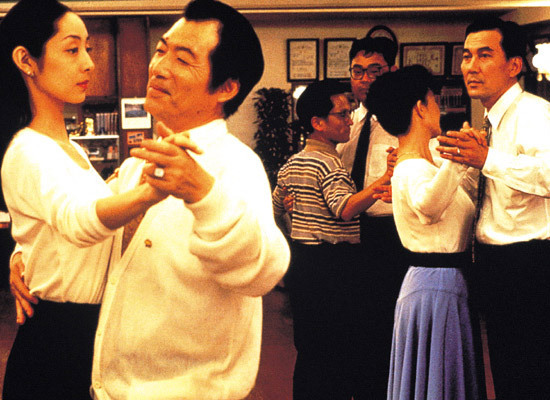
1996 Japanese film “Shall We Dance?” humorously and touchingly reminds us that we human beings often need a bit more than merely going through our life day by day. Leisurely following its plain middle-class hero’s accidental venture on dancing, the movie smoothly and cheerfully dances between comedy and drama, and we come to root more for not only its hero but several other characters around him. 

 Kōji Yakusho, who has been one of the best movie performers working in Japan during last three decades, plays Shohei Sugiyama, a fortysomething company accountant who suddenly finds himself feeling rather empty when he is going to accomplish almost everything for him and his dear family. Since his marriage, he diligently worked hard for providing a stable domestic life for the family, and they are now living in a fairly good suburban house, but he feels rather depressed as reflecting more on what may be next for his life.

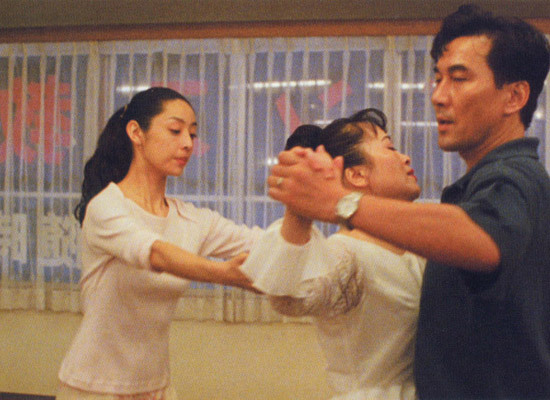
Shortly after another routine drinking evening with his fellow employees, Shohei goes back to his home by train, and then he notices something when the train stops at one particular station. There is a little dance studio in a nearby building, and his eyes are drawn to a young beautiful woman who later turns out to be one of the instructors working there. As he continues to watch her from the distance evening by evening, he feels something awakened inside him just like the hero of Sam Mendes’ Oscar-winning film “American Beauty” (1999), and he eventually takes the first forward step toward this woman as reluctantly walking inside that dance studio.

Not so surprisingly, that young lady, Mia Kishikawa (Tamiyo Kusakari), still seems beyond his reach, but Shohei decides to join the class for beginners along with two guys much more eager to learn how to dance. The movie certainly generates some good laughs from Shohei’s painfully awkward attempts to learn dance steps, but we also come to observe his gradual inner change ignited by this accidental lesson of his. As he practices and then makes some progress step by step, he cannot help but feel enlivened more and more, and, what do you know, he often finds himself looking forward to having another good time at the dance studio.

Of course, it does not take much time for Shohei’s wife and their adolescent daughter to notice how he feels a bit livelier than before. In contrast to her husband, Shohei’s wife knows what she wants to do next for her life once their common goal is almost accomplished, but she cannot help but feel confused and anxious as wondering more about whatever her husband is doing behind his back. In the end, she decides to hire a private investigator, and she soon comes to learn more about her husband’s little secret hobby.

Rather than hurrying itself to the expected ending after that narrative point, the screenplay by director/writer Masayuki Suo wisely takes its time for building up its main characters with details and nuances to observe. As continuing to focus on its hero’s inner growth along the story, the movie also pays attention to several other main characters around him, and you may be surprised a bit by the complex human aspects of Shohei’s relationship with Mai. Sure, he was quite infatuated with her from the very beginning, but he subsequently finds himself driven more by his growing passion toward dancing, and this actually touches Mai, who is later revealed to have her own serious emotional issues behind her frigidly haughty attitude.

In the meantime, the movie also generates some low-key dramatic tension from why Shohei does not want to tell anyone about his dance lesson. He is afraid that this may hurt his appearance in both his work and house, and he certainly sympathizes with one of his colleagues, who turns out to be a passionate dancer behind his meek appearance. Despite that horrendous wig for hiding himself a bit, this dude looks much more alive whenever he dances in the dance studio, and he willingly draws Shohei more into the world of dancing even though Shohei often hesitates as usual.

It is not much of a spoiler to tell you that Shohei is eventually pushed toward a big local dancing competition later in the story. While we surely get several expected moments of laugh and surprise during this climactic part, the movie stays focused on the story and characters as before, and that is why its rather overlong finale keeps holding our attention to the end. Around that narrative point, dancing in the film becomes a lot more meaningful than before, and you will gladly overlook the contrived aspects of the final scene. 

The solid performances of its main cast members wonderfully carry the film on the whole. The movie was a breakthrough point for Yakusho’s movie acting career which has constantly impressed us for many years, and this movie and Kiyoshi Kurosawa’s creepy horror film “Cure” (1997) will definitely show you a lot of the considerable range of Yakusho’s acting talent. On the opposite, Tamiyo Kusakari complements her co-star well as subtly conveying to us her character’s human sides, and Naoto Takenaka and Eriko Watanabe frequently steal the show as the two most colorful characters in the story.  

In conclusion, “Shall We Dance?”, whose title incidentally comes from that famous song from Rodgers and Hammerstein’s musical “The King and I”, is a lovely movie even though almost 20 years have passed since it came out. Yes, you can clearly see where its dance steps are heading from the start, but it will alternatively amuse and touch you a lot, and you may come to consider being more serious about whatever you are passionate about in private. After all, that is how our inconsequential life feels a bit joyful and meaningful to us at least for a while, isn’t it?

Posted in Movies | Tagged , , | Leave a comment

My Daughter Is a Zombie (2025) ☆☆1/2(2.5/4): It’s hard to take care of a zombie daughter…

South Korean film “My Daughter Is a Zombie” tries to be a cross between horror comedy and family melodrama, and the result is mildly engaging on the whole. As a horror comedy, it is not absurd enough to be, shall we say, biting, though there are some amusing moments to tickle you at times. As a family melodrama, it surely tries to tug the heart of the audiences especially during the last act, but this is a bit too sappy and mellow with some blatant plot contrivance, and the movie eventually fizzles with its rather contrived ending.

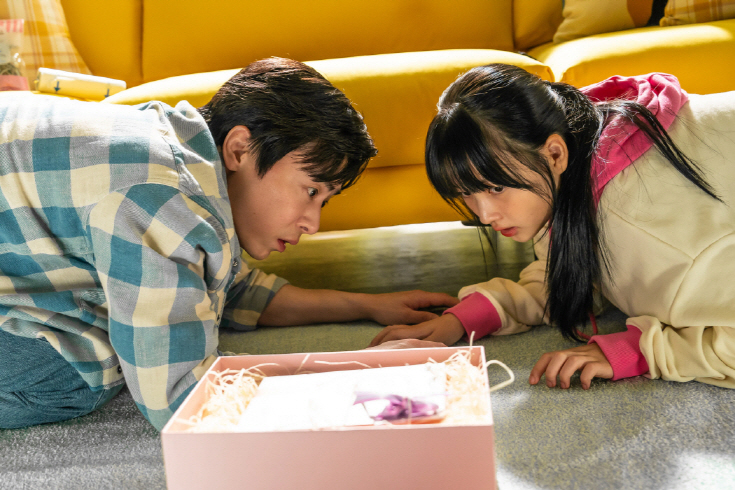
The first act of the movie establishes how its hero has been stuck with his zombie daughter for a while. When Seoul is suddenly swept by a zombie virus epidemic on one day, Jung-hwan (Jo Jung-suk) and his adolescent daughter Soo-a (Choi Yoo-ri) are naturally thrown into panic and fear, but they and their pet cat manage to escape from the city by a car mainly because the zombies in the film are relatively less scary and fast compared to those fearsome zombies in “28 Years Later” (2025). Alas, it turns out that Soo-a was bitten by a zombie at the last minute, and she is soon turned into a zombie in the car to her father’s horror.

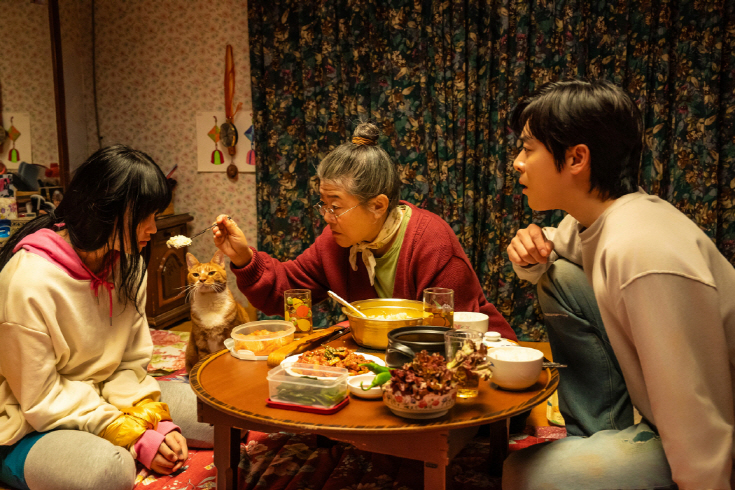
After managing to suppress his zombie daughter for now, Jung-hwan drives the car to his rural seaside hometown. His mother Bam-sun (Lee Jung-eun) surely greets her son when she returns to her house not long after Jung-hwan and his daughter’s arrival, but she soon comes to find what happened to her dear granddaughter. While naturally horrified at first, Bam-sun eventually agrees to hide Soo-a inside her house, and, what do you know, she turns out to be quite unflappable as assisting her son’s attempt to keep his zombie daughter under his control.

Because he has incidentally worked as an animal trainer in a local zoo, Jung-hwan believes that he can tame his zombie daughter, and he becomes all the more motivated as observing Soo-a still showing a bit of her human personality despite her currently zombified condition. With some reluctant help from not only his mother but also a hometown friend of his who is incidentally a town pharmacist, he keeps trying one method after another to our little amusement, and, surprise, there soon comes some little progress from Soo-a.

However, as being constantly aware of how dangerous his zombie daughter can be at any point, Jung-hwan also comes to fear more of the worst possibility for him and Soo-a. The government subsequently manages to get things under control via instantly eliminating any infected person, and it goes without saying that Jung-hwan should be all the more careful about taking care of his zombified daughter.

His circumstance becomes a little more complicated when he later comes across Yeon-hwa (Cho Yeo-jeong), his old sweetheart who recently moved back to their hometown as a middle school teacher shortly after losing someone close to her due to the epidemic. Needless to say, the movie attempts to bring more absurdity to the story as Yeon-hwa inadvertently gets herself involved with what Jung-hwan has tried to hide behind his back, but we only get several silly moments which sadly do not develop much of their rich comic potential. While you may be a bit amused when Jung-hwan tries to make Soo-a more, uh, presentable to others out there, this only leads to silly physical gags without any biting sense of humor, and the same thing can be said about the sequence where Jung-hwan tries something potentially risky just for cheering up Soo-a a bit.

Around the narrative point where the story becomes predictably melodramatic, we are supposed to care more about Jung-hwan and Soo-a, but the movie, which is based on the South Korean graphic novel of the same name by Yun-chang Lee, leans too much on sappy sentimentalism, and that is where my interest in the film became more decreased. To make matters worse, the movie unfortunately resorts to what may be wholeheartedly disapproved by any screenplay writing class, just because it does not want its audiences to feel bad at any chance when the end credits are about to roll.

The main cast members of the film deserve some praise for their good efforts for selling their respective characters. Although he initially looks a bit too young and immature to play his character, Jo Jung-suk fits to his role better than expected – especially after when the rather complex family history between Jung-hwan and Soo-a is revealed later in the story. While Choi Yoo-ri did a fairly commendable job of handling her thankless role, Yoon Kyung-ho is solid as Jung-hwan’s bumbling pharmacist friend, and Lee Jung-eun and Cho Yeo-jeong, who incidentally appeared together in Bong Joon-ho’s Oscar-winning film “Parasite” (2019), are wonderful as slyly balancing their acting between humor and drama. In case of that adorable pet cat in the film, I must report to you that it effortlessly steals its every minute, and its undeniable cuteness almost made me overlook many flawed aspects of the movie.

In conclusion, “My Daughter Is a Zombie”, directed by Pil Gam-sung, is neither very funny nor quite scary compared to many other similar genre works out there, but, considering the reactions from the audiences around me, it will probably be quite successful at the local box office. As a seasoned moviegoer who has experienced a fair share of zombie horror or comedy flicks, I do not like the movie enough, but I will not complain at all if its local box official success actually boosts the South Korean movie industry a bit at least.

Posted in Movies | Tagged , , | 1 Comment

Happy Gilmore 2 (2025) ☆☆☆(3/4): He’s back on the green…

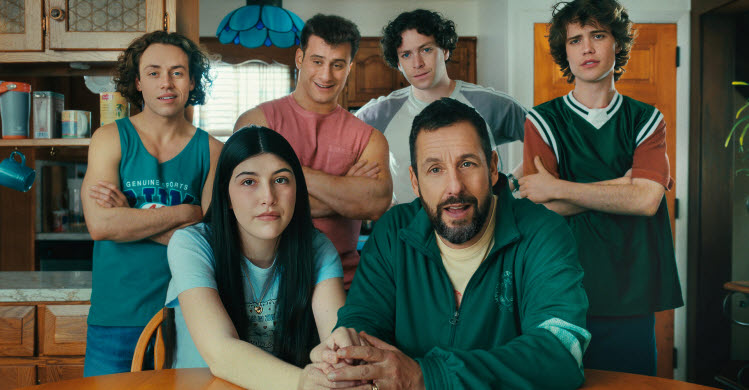
Netflix film “Happy Gilmore 2”, which was released a few days ago, made me laugh and chuckle much more than its predecessor did, and that is sort of achievement in my inconsequential opinion. While I dislike “Happy Gilmore” (1996) a lot mainly for the dull and witless handling of its story and characters, I like its sequel for being willing to go further for more ridiculousness in addition to bringing some depth and wit to its titular character.

This substantial change in terms of story and character sometimes resonates with how its lead actor have gained some admiration from us during the last three decades. Sure, Adam Sandler still tends to waste his time and talent on many forgettable flicks which even do not deserve to labeled as comedy, but he has also become more interesting thanks to several acclaimed films including Paul Thomas Anderson’s “Punch-Drunk Love” (2002), and he even demonstrated that he can easily dial down his usual comic persona as shown from Jeremiah Zagar’s recent Netflix film “Hustle” (2022).

The movie opens with the summary of what Sandler’s titular figure went through after his glorious victory at the end of the 1996 film. Thanks to his rather unorthodox but undeniably powerful golf swing method as well as his tempestuous personality, Happy Gilmore became legendary during the next several years, and he also had a happy family life thanks to his wife Virginia (Julie Bowen) and their five kids. Alas, Virginia accidentally got killed when he demonstrated his own special golf swing again at his latest golf tournament, and his consequent grief and guilt on her death drove him into alcoholism besides ruining both his career and family life.

At least, Happy, who is now working as a local supermarket employee, has been a bit wiser about controlling his temper issues, and he still gets a lot of love and support from his dear children, but then there comes a serious financial matter. His only daughter Vienna (Sunny Sandler, who is one of Sandler’s two real-life daughters) is now a promising ballet dancer, and her teacher, who is incidentally played by Sandler’s real-life wife Jackie Sandler, recommends that Vienna should go to Paris for joining a prestigious ballet company, but, of course, the annual tuition for that is pretty expensive to say the least.

And that is when Happy is approached by Frank Manatee (Benny Safdie, who previously collaborated with Sandler in “Uncut Gems” (2019), the sleazy CEO of a popular energy drink company. Manatee has been planning a new professional golf league called “Maxi Golf”, and he wants Happy to join the Maxi Golf League, but Happy is not so interested even though his unconventional career inspired the Maxi Golf League to some degree.

However, Happy soon begins to consider being back in the game, and that naturally leads to several hilarious moments including the scene which has the brief appearances by Eric André, Martin Herlihy and Margaret Qualley. Although the start is quite rocky for him, Happy soon comes to see that he has not lost any of his skill and talent yet, and then he willingly steps forward as one of many professional golfers to compete against the members of the Maxi Golf League.

Around that narrative point, the main source of comedy comes from how Happy must hold himself as much as possible. Thanks to a regrettable incident caused by his alcoholism, he has to attend an Alcoholic Anonymous meeting which turns out to be quite suspicious mainly because it is managed by Ben Stiller’s character from the 1996 film, and he also still finds himself haunted by his wife’s unfortunate death. While he is less edgy compared to how he was in the 1996 film, Sandler somehow strikes the right balance between humor and gravitas for his relatively more matured character, and this actually makes Happy likable even during his most preposterous moments in the film.

Meanwhile, the movie recalls the story elements and characters from the 1996 film as frequently as Christopher McQuarrie’s “Mission: Impossible – The Final Reckoning” (2025) did from its 1996 predecessor, and some of them are fairly funny while the others are merely redundant. As vividly remembering the blatant promotion of that famous sandwich franchise company in US in the 1996 film, I smiled a bit as noticing its logo on Happy’s golf bag (the company is still in business at present, you know), and I will not deny that I laughed and winced hard as watching Happy introducing his own way of physical training to his several fellow professional golfers at one point later in the story. In case of several minor characters associated with the certain supporting characters in the 1996 film, I do not think their scenes are particularly necessary except evoking some nostalgia from the 1996 film, and these scenes actually slow down the narrative pacing of the movie to a considerable degree.

Sandler places a bunch of various figures around himself, and their game efforts support the film to the end even though it often stumbles a bit during the expected climactic part where his character must cope with a lot of outrageous stuffs as competing against those Maxi Golf League members. As the main villain of the film, Benny Safdie gleefully chews every moment of his before he is upstaged by Christopher McDonald, who is absolutely hysterical as Happy’s loony arch-nemesis who eventually works with Happy after beholding the sheer vulgarity of the Maxi Golf League. While Benito Antonio Martínez Ocasio, a popular musician who is also known as “Bad Bunny”, shows some comic talent as Happy’s woefully inexperienced caddy, Sunny Sandler and Julie Bowen provide some warmth and common sense as required, and Sadie Sandler, who is Sandler’s another real-life daughter, has her own small moment as one of Happy’s fellow alcoholics.

Overall, “Happy Gilmore 2”, directed by Kyle Newacheck, is more enjoyable compared to its 1996 predecessor, and it amused me enough to consider showing it to my parents someday. Who knows? Considering how much they often have enjoyed playing golf as well as watching those golf tournaments on live TV, they may actually enjoy the movie as well as its 1996 predecessor more than me.

Posted in Movies | Tagged , , | Leave a comment

Happy Gilmore (1996) ☆☆(2/4): There is something schizophrenic about Sandler

Dennis Dugan’s 1996 comedy film “Happy Gilmore” is a prime example of how schizophrenic many of those early comedy movies of its lead actor Adam Sandler feel even at present. Sandler always seems ready to go all the way with playing deeply unpleasant characters with violent and destructive temper, and he is very good at that, but this abrasive comic persona of his is usually limited or dulled by the half-hearted attempts to be ingratiating and likable to audiences.

Sandler probably knew well this inherent vice of his early comedy films, considering that they all written or produced by him, but he kept repeating himself just because “Happy Gilmore” and several subsequent comedy films of his including “The Wedding Singer” (1998) and “Big Daddy” (1999) were commercially successful on the whole. Fortunately, Paul Thomas Anderson, who is a longtime admirer of Sanders’s comic talent, demonstrated in “Punch-Drunk Love” (2002) that Sandler can be really funny and even quite poignant, but Sandler continued to make more dumb comedy movies, even while truly impressing us at times as shown from his stupefyingly intense performance in the Safdie Brothers’ “Uncut Gems” (2019).

Compared to Sandler’s superlative achievements in “Punch-Drunk Love” and “Uncut Gems”, what he did in “Happy Gilmore” is pretty much like a lumpy test drive on what he is naturally capable of. As a matter of fact, you can actually see a lot of Barry Egan or Howard Ratner from his titular character, and that is why it is often so depressing to see that the movie does not have enough wit or skill or guts to push its edgy hero for real mean and uncomfortable laughs.

Anyway, let me talk a bit about how Sandler’s titular character made me wince more than once during the first 20 minutes of the film. On the surface, Happy Gilmore looks like a plain sweet loser to amuse you, but he often cannot control his serious temper problem, and many of the gags in the film come from how easily he is triggered to punch or hit anyone to annoy or insult him. Despite his longtime aspiration of being a professional ice hockey player someday, he is reminded again and again that he is not a very good ice hockey player from the beginning, and this certainly makes him quite angry more than once as shown from Sandler’s very first scene in the movie.

Nevertheless, Happy’s grandmother still sees the better sides of her dear grandson (Please don’t ask me how the hell that is possible), and he surely appreciates that, but there comes a big trouble for her on one day. Due to some serious tax problem, her old house and everything inside it get foreclosed by Internal Revenue Service, and the house will be put on an auction unless she and her grandson find any possible way to pay no less than $ 250,000 within 30 days.

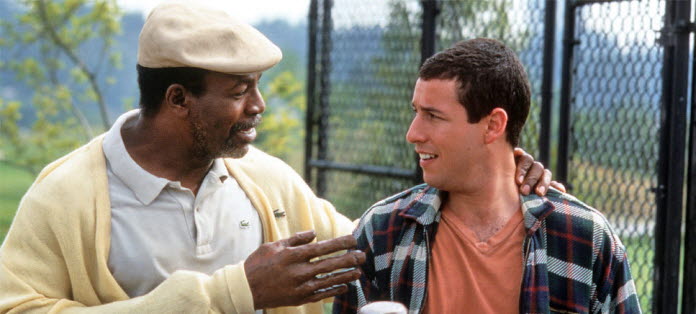
After his grandmother has no choice but to go to a local facility for old people (Ben Stiller makes a cameo appearance as a vicious employee of that facility, by the way), Happy becomes quite devastated to say the least, but then there comes an unexpected opportunity when he discovers his unlikely potential in playing golf. Because he is pretty good at slapshot, his golf swing can actually drive a ball 400 yard (around 365 meter) at least, and his following golf hustlings get noticed by a retired professional golf player named Derick “Chubbs” Peterson (Late Carl Weathers, who fortunately manages to keep his dignity intact despite being required to many silly things throughout the film).

After getting some advice from Peterson, Happy participates in a local golf tournament, and he surely gets a lot of public attention right from the first day thanks to his powerful swings, though he remains to be a rather clumsy player and still shows a lot of temper problems. Nevertheless, he subsequently becomes more popular as playing in a series of the following golf tournaments, and he also learns a bit on how to make him a little more likable in public thanks to the public relations director of the professional golf tour who somehow finds herself quite attracted to Happy (Julie Bowen is sadly stuck in this fairly thankless supporting role, by the way).

Of course, like many of sports comedy films out there, the movie has a villainous opponent, who is determined to stop Happy’s earnest quest for earning $250,000 by any means necessary. That figure in question is an arrogant professional star golfer named Shooter McGavin (Christopher McDonald), and he is definitely not amused at all as Happy keeps drawing all the attentions away from what may be the highest point in his professional sports career.

Like Sandler, McDonald seems quite committed to go all the way as required by his role, but, again, the movie often does not support his game efforts well. His character’s several attempts of sabotage on Happy are so predictable that they look merely silly and annoying on the whole, and we are not so surprised even when, after deliberately heckled more than once, Happy comes to clash with a certain celebrity who happens to be playing with him on the spot. In case of the expected climactic part, it is riddled with not only countless clichés and but also a lot of the blatant promotion of a certain famous sandwich franchise company in US, and I absolutely agree with what my late mentor Roger Ebert observed in his 1.5-star review: “Halfway through the movie, I didn’t know what I wanted more: laughs, or mustard.”

So, is it still worthwhile to watch “Happy Gilmore” just for watching its recent sequel later or observing what was bound to emerge in Sandler’s much better films including “Punch-Drunk Love”? Yes, I was often quite bored or repulsed by its lame comedy during my viewing, but I also came to appreciate more of how far Anderson and the Safdie Brothers pushed Sandler’s genuine acting talent glimpsed a bit from the movie. Therefore, I guess there is some value in this deeply disagreeable comedy film and Sandler’s other equally ludicrous comedy films, and I hope that my 2-star review will help you decide on whether you will watch “Happy Gilmore” or not.

Posted in Movies | Tagged , , | Leave a comment

When This Summer is Over (2024) ☆☆☆(3/4): A bad influence

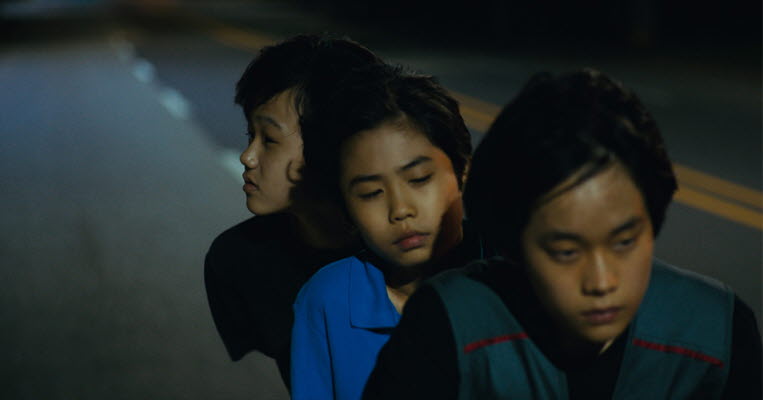
South Korean independent film “When This Summer is Over” is often disturbing for good reasons. Phlegmatically following how its plain young hero tumbles down into a number of crimes and misdemeanors thanks to his new “friends”, the movie gives us a sobering examination of toxic masculinity, and that often keeps us on the edge even when the story is approaching to its inevitable finale.

The story, which is set in a rural town which will be redeveloped sooner or later for urbanization, opens with the arrival of a 12-year-old boy named Gi-joon (Lee Jae-joon) and his mother. Very dedicated to her son’s future education and welfare, Gi-joon’s mother decided to move into this town in advance because its upcoming urbanization will affect not only its education system quality but also its real estate value, but Gi-joon is not so pleased about this environmental change because, well, the town looks quite boring without nothing much to do outside his new school and home.

And the first day in Gi-goon’s new school is not so promising to say the least. He comes along with his mother for completing his transfer process, and his new teacher is certainly ready to welcome him, but then he gets his new pair of sneakers stolen. While the teacher suspects that one of his class students stole Gi-joon’s sneakers, there is no incriminating evidence, and Gi-joon’s mother is not bothered that much, because she can surely afford to buy the new ones for her son as your average affluent middle-class mother.

Once he begins to study along with his new classmates, Gi-joon comes to befriend some of them including Seok-hoon (Jeong Joon), who is incidentally the prefect of their classroom. Seok-hoon often comes to Gi-joon’s new house for playing a video game together for a while, and Gi-joon’s mother does not mind this at all as long as her son does not cause any serious trouble in the school. After all, she is now quite busy as participating in a local protest along with many of her new neighbors just for getting a bit more benefit from the upcoming urbanization in their town.

Of course, a trouble soon comes when Gi-joon later gets himself associated with one of his classmates, who was the prime suspect of that theft incident. His name is Yeong-moon (Choi Hyun-jin), and we get to know more about how problematic he and his older brother Yeong-joon (Choi Woo-rok) are. Although they are technically orphans due to their parents’ absence, they defiantly refuse to receive any social service, and many of the town residents feel sorry for them even though Yeong-joon is clearly your typical juvenile delinquent.

And Gi-joon soon comes to witness what these two problematic brothers have been doing behind their back. Yeong-joon often extorts money from some of Gi-joon’s classmates, and, not so surprisingly, nobody in the class dares to mess with Yeong-moon. As Gi-joon befriends Yeong-moon more, Yeong-joon willingly has Gi-joon under his protection, and he savagely beats a student who punched Gi-joon in the face for a petty issue.

This unnerving scene is soon followed by more disturbing moments of violence, but the movie wisely avoids being unnecessarily gratuitous in the depiction of these violent moments. Most of the acts of violence in the film are not shown on the screen, but their virulent emotional effects on Gi-joon are palpably conveyed to us as the camera often focuses on his face, and we come to understand more of how he becomes more involved with Yeong-joon and Yeong-moon.

As our young hero commits more crimes and misdemeanors along the story, the level of tension is quietly increased under the competent direction of director/writer Jang Byung-ki, who previously made a feature film debut with “A Family Man” (2019). He and his crew members including cinematographer Choo Kyeong-yeob did a commendable job of establishing the mundane but realistic atmosphere of the rural background of the film, and that is why those restrained moments of violence in the movie feel quite intense and striking at times.

In addition, Jang’s screenplay also brings some human complexity to its story and characters. While Yeong-joon and Yeong-moon are surely the main source of bad influence upon Gi-joon, the movie also recognizes how vulnerable they are in one way or another – especially when they get punished hard by an older juvenile delinquent later in the story. In case of Gi-joon, he was not a totally innocent victim at all from the beginning, and that makes him all the conflicted when he eventually faces the consequences of his reckless actions.

Jang draws good performances from his main cast members. While Lee Jae-joon is convincing as his character willingly lets himself drawn more into the criminal world of Yeong-joon and Yeong-moon, several other young actors including Choi Hyun-jin, Choi Woo-rok, and Jeong Joon are well-cast in their respective supporting roles, and Ko Seo-hee holds her own small place well as Gi-joon’s increasingly concerned mother.

Overall, “When This Summer is Over” is quite uncomfortable to watch at times, but it will still hold your attention thanks to its deft handling of story and character. In my trivial opinion, this is one of more interesting South Korean films of this year, and you will be reminded of why the education on toxic masculinity is important for boys as well as girls.

Posted in Movies | Tagged , , , | 1 Comment

The Uniform (2024) ☆☆☆(3/4): A tale of two students

Taiwanese film “The Uniform” is a typical coming-of-age tale about two different female high school students who happen to share the same desk in their classroom right from their first year. As their accidental friendship goes through several ups and downs during next several years, they become more aware of the social distance between them, and it is touching to observe how they still care about each other despite that.

The story begins with their first day at some prestigious high school in Taipei, 1997. Because she unfortunately underperformed in the high school entrance examination, Ai (Buffy Chen) has no choice but to enroll in the night program of that school, and she understandably cannot help but feel inferior compared to those day program students, who all got a better score in the examination. Her widow mother, who is incidentally a teacher, is quite excited about her daughter’s enrollment in the high school and ready to support and motivate her daughter as much as possible despite their poor economic status, but this only pressures Ai more than before.

Anyway, Ai and her fellow classmates are going to share the same classroom with a group of day program students, and Ai comes to share a desk with Min (Chloe Xiang), who is incidentally one of the most promising students in the day program of their school. As they subsequently exchange some notes between them during next several days, Ai and Min get closer to each other, and they eventually become each other’s best friend, though there is not much time for them to be together in their school.

Nevertheless, they soon find how to spend more time with each other. Min gladly lends one of her uniforms to Ai for helping her disguise as a day program student, and Ai is certainly delighted as getting more chance to be with her best friend, while also experiencing how things are a bit different to the day program students compared to the night program students in the school. As frequently going back and forth between the day and night program thanks to her best friend, she feels more like belonging to the day program, but, not so surprisingly, skipping her night program more than once consequently affects her test scores, and she comes to hide this serious problem from her mother.

Meanwhile, the situation becomes a little more complicated due to a hunky boy Ai met at a local table tennis coaching academy where she has worked as a part-time employee. He turns out to be a day program student of her school, and, what do you know, he also turns out to be the boy on whom Min has had a crush for a while. Unfortunately, Ai is also attracted a lot to this boy, and he seems to be more interested in Ai, but Ai lets her best friend try to get closer to him while hiding her personal feelings toward him

 As this tricky triangle is continued among its three main characters during their second year at the school, the movie immerses us more into their youthful daily life with some amusing period details to notice. If you are around their age in the late 1990s like me, you surely remember those early years of the Internet, and you will be tickled a bit when Min, who is incidentally much more affluent than Ai compared to Ai, casually talks about how fast her Internet connection is (Remember when even a one-megabyte file was too hefty to download?).

When that boy eventually comes to show more of his feelings toward Ai, she lies a bit to him just for impressing him more, and, of course, this consequently leads to more conflict for her. Becoming more aware of how promising and privileged he is just like Min, she feels more like an imposter, and, of course, there inevitably comes a point where she cannot maintain her little lies anymore.

Around its three main characters’ final year at the school, the screenplay by Hsu Hui-fang and Wang Li-wen expectedly becomes melodramatic. After a sudden big catastrophe occurs all over Taiwan (Yes, this did happen in 1999), Ai becomes more serious about what she should do for her future, and she also comes to appreciate more of the sincere support from her mother, who has struggled a lot for the family in one way or another while hoping for the best for her two daughters. In case of her strained relationship with Min, she eventually finds a way to mend their relationship, and there is a brief but moving moment when they come to show each own anxiety to each other.

The three main cast members are well-cast in their respective parts. Buffy Chen is engaging in her introverted character’s gradual maturation along the story, and she also did a good job of handling a certain cliché associated with Superman’s human alter ego later in the story. On the opposite, Chloe Xiang complements her co-star well with her more confident appearance, and Yitai Chiu looks good enough as the object of admiration to Ai and Min. Around the main story, Chi Chin often steals the show as Ai’s mother, and her adamantly frugal lifestyle is a constant source of amusement throughout the movie.

On the whole, “The Uniform”, directed by Chuang Ching-shen, does not bring anything particularly new or fresh to its genre territory, but it has enough heart and spirit to interest us just like many other solid coming-of-age tale drama films. I surely knew where it is heading from the very beginning, but I could feel that its main characters do grow up in the end, and that is enough for me for now.

{
Posted in Movies | Tagged , , , , | Leave a comment

The Fantastic Four: First Steps (2025) ☆☆☆(3/4): A lightweight fun in retro style

“The Fantastic Four: First Steps”, the latest product from Marvel Cinematic Universe (MCU), is a lightweight fun in retro style. Although this is not exactly new or fresh in my humble opinion, it is relatively more entertaining than many of recent MCU flicks, and I could forget my growing exhaustion about superhero flicks at least for a while.

Because there were no less than three movies based on its four superhero characters (and, to put it mildly, none of these movies was not so successful as many of you remember), the obligatory introduction part of the film is fairly quick and brief. In the Earth in an alternative universe different from the one associated with most of MCU flicks, the four prominent scientists, Reed Richards (Pedro Pascal), Sue Storm (Vanessa Kirby), her younger brother Johnny Storm (Joseph Quinn), and Reed’s best friend Ben Grimm (Ebon Moss-Bachrach), were sent into the space for their scientific mission, but they had an unexpected incident involved with a big wave of space radiation. When they were subsequently back on the Earth, they found that they somehow acquired each own superpower, and they soon became a lot more famous as the dependable guardians of their planet during next several years.

And then there comes an unexpected change to Reed and Sue, who has incidentally been Mrs. Richards and suddenly finds herself pregnant. When they later notify this surprise news to Ben and Johnny, Ben and Johnny are certainly delighted about that, but, alas, their happy time is soon interrupted by what turns out to be the biggest threat they have ever faced as superheroes. This entity in question is a mighty (and humongous) alien named Galactus (Ralph Ineson), and he is mainly represented by a metallic figure nicknamed “Silver Surfer” (Julia Garner), who comes to the Earth in advance for delivering a very, very, very bad new for all the people and every other life forms on the Earth. Galactus is going to devour the whole planet as he has done to many other planets selected by his dutiful servant, and he is already heading to the Earth from somewhere outside in the universe.

Needless to say, our four superheroes quickly ready themselves for confronting their very powerful opponents, but they are reminded again of how daunting the situation is. They try to do some negotiation at first (How nice it is to see superheroes attempting a reasonable talk first instead of going all the way for a senseless fight!), but both Galactus and Silver Surfer do not step back at all, and Galactus corners them into a difficult moment of choice. After sensing how special Reed and Sue’s child really is, he demands that Reed and Sue give up their child to him in exchange for not eating the Earth, and Reed and Sue certainly become quite conflicted about what to do next. Yes, giving up their precious baby for saving the planet as well as the humanity looks like a right and logical choice in this circumstance, but they know too well that this is also a big compromise against what they and their two colleagues have stood for.

 While we can easily guess what our four superheroes will choose to do in the end, the movie keeps us engaged as ably balancing the story and characters between humor and sincerity, and it also has some stylish fun with its futuristic world decorated with a lot of retro touches to notice. Although the technology of this alternative world looks quite advanced on the whole, the production design and costumes of the film are often reminiscent of New York City during the 1950-60s, and this amusing aspect is further accentuated by the busy and colorful design of the main title and end credits of the movie. The score by Michael Giacchino is often as colorful and exuberant as the one he composed for Oscar-winning Pixar superhero animation film “The Incredibles” (2004), and this certainly contributes some extra fun and style to the film.

In addition, like recent Superman movie, the movie is also willing to go further for more hope, care, and optimism. Sure, it eventually becomes quite loud and bombastic when the story eventually reaches to the big climatic action sequence where a lot of things are smashed or crushed across the screen, but it thankfully does not overlook small human moments amid lots of crashes and bangs, while maintaining well its sense of fun as before.

The four main performers of the film click well together as deftly going back and forth between comedy and drama. Pedro Pascal brings enough charm and gravitas to his character, and Vanessa Kirby is believable during her character’s several big moments including the one which may take you back to her Oscar-nominated turn in “Pieces of a Woman” (2020). Joseph Quinn, a British newcomer who previously appeared in “A Quiet Place: Day One” (2024) and “Gladiator II” (2024), and Ebon Moss-Bachrach, who has been more notable thanks to his Emmy-winning supporting turn in TV comedy series “The Bear”, have each own moments around Pascal and Kirby, and Moss-Bachrach is particularly good whenever he brings a surprising amount of quiet sensitivity to his literally rocky character.

In case of several other main cast members in the film, they fill their respective parts as much as possible. While Julia Garner and Ralph Ineson generate enough menace as required, Sarah Niles, Mark Gatiss, Natasha Lyonne, and Paul Walter Hauser are also solid as the substantial supporting characters in the story, and it is rather interesting to see how Lyonne, who plays Ben’s possible love interest, can effortlessly dial down her distinctive persona to some degree.

In conclusion, “The Fantastic Four: First Steps”, directed by Matt Shakman, is as promising as its subtitle suggests besides being fairly entertaining enough for recommendation. Although I must point out that “The Incredibles” is still relatively better because of handling its similar superhero story more dexterously and memorably, the movie did its job as well as intended, so I will not grumble for now as having a bit of expectation on whatever will come next.

Posted in Movies | Tagged , , | Leave a comment