Exit 8 (2025) ☆☆☆(3/4): Trapped in a loop

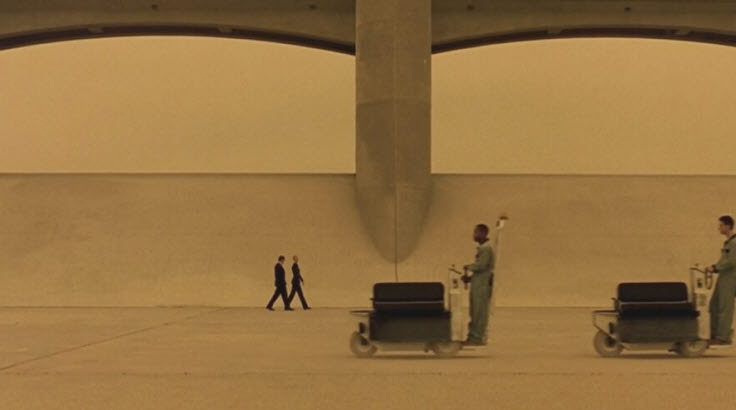
Japanese film “Exit 8” is simple but effective in its rather limited setting. Based on the 2023 Japanese video game of the same name, the movie follows the desperate struggles of a few figures helplessly trapped in a seemingly endless loop of subway hallways, and it is often fun to watch how it ably balances itself between repetition and variation before eventually reaching to its expected final stage.

The movie opens with an anonymous man riding a subway along with many others. While he is merely spending some time on his smartphone, there comes an unexpected phone call from his ex-girlfriend, who notifies him that she has just found that she is pregnant. Needless to say, he becomes quite confused and conflicted to say the least, while also being quite indecisive about what to do about this circumstance.

Anyway, as he tries to talk more with his ex-girlfriend after getting off from the subway later, something really perplexing happens to him. He goes through a series of stairs and hallways while looking for an exit, but then he suddenly finds himself walking along an almost empty hallway. At first, this does not surprise him much, but then he comes to realize that he is actually walking the same hallway again and again.

The movie takes some time for us to get accustomed more to this strange setting. Along this very odd hallway, there are several advertisements on the left wall while there are three steal doors on the right, all of which are incidentally locked. In addition, our hero always comes across some guy walking from the opposite end of the hallway, and it is evident that this figure is nothing more than one of the mere details of this weird hallway.

Our hero soon comes to learn the simple golden rule of the hallway. Whenever he walks along the hallway, he must confirm whether there is any kind of anomaly in the hallway. If there is really any anomaly to notice, he must turn back and walk in the opposite direction. If there is not anything different at all, he must walk along the hallway as before. If he is correct in his observation, he can move up to the next level before eventually arriving at “Exit 8”. If he is not correct, he will be back to the first level.

Now, this seems pretty easy at first, but, of course, things gradually become tricky for our hero as he struggles to advance stage by stage. At first, it is not so difficult to notice an anomaly along the hallway, but, just like many other video games, the hallway becomes more challenging at the higher levels. For example, our hero is stopped by something quite unexpected at one point, but he is not so sure about whether this is actually an anomaly or not, and that naturally generates some suspension on the screen.

As steadily rolling its story and characters in one direction or another, the movie tries a number of interesting variations on its limited setting. As the camera of cinematographer Keisuke Imamura smoothly and fluidly follows the actions of our hero, we become more engaged and watchful as the movie pulls out small and big surprises along the hallway, and you may have some fun if you notice any anomaly before our hero does. The score by Yasutaka Nakata and Shohei Amimori is effective in generating more tension and dread on the screen, and the movie also shows some twisted sense of humor via a certain famous classic piece by Maurice Ravel, whose repetitive rhythm certainly resonates with the narrative structure of the movie.

Although the characters in the film are more or less than the figures to be moved here and there as required, we come to care a bit about some of them later in the story, and the movie adds a bit of extra drama to the main story via that walking dude and a few other figures appearing in the hallway. For example, one of these figures becomes an unexpected ally for our hero later in the story, and our hero’s relationship with this particular figure makes him reflect more on his life – and what he really should do about that situation involved with his ex-girlfriend.

Under the competent direction of director/co-writer/co-director Genki Kawamura, who previously made a feature film debut in “A Hundred Flowers” (2022), the small main cast member of the film are all believable in their respective parts. As the main center of the film, Kazunari Ninomiya is particularly good when his character comes to face more of his human flaws along the story, and he is also supported well by Yamato Kochi, Naru Asanuma, Kotone Hanase, and Nana Komatsu.

On the whole, “Exit 8”, which incidentally received the Best Poster Design award when it was premiered at the Midnight Screenings of the Canne Film Festival early in this year, is a fairly enjoyable case of video game adaptation which actually made me interested in playing its original video game someday. While certainly reminiscent of several other similar genre films such as “Cube” (1997), the movie has its own style and mood to distinguish itself, and it also may make you reflect a bit more on how mindlessly we often go through our daily life. After all, repetition is always bound to bore and then numb you, isn’t it?

Posted in Movies | Tagged , , | 1 Comment

Good Boy (2025) ☆☆☆(3/4): From a dog’s viewpoint

“Good Boy” is a little genre film which tries something different, and I like that. Mainly driven by the viewpoint of one good dog, the movie unfolds its rather simple horror story step by step, and the growing sense of fear and dread along the story is more palpable to us as it adamantly sticks to the limited viewpoint of its lead animal character.

At first, the movie establishes how things are not good for the male owner of a dog named Indy. For some unspecified reason, his health has been seriously deteriorated for a while, and he is eventually sent to a hospital after his sister belatedly finds his unconscious body, but he decides to get out of the hospital and then go to his grandfather’s house, which is incidentally located in the middle of some remote forest area.

Through Indy’s viewpoint, we already see some bad signs unnoticed by the owner. During the opening scene, the dog senses something quite insidious, which seems to have some toxic influence on the owner’s increasingly bad health. When the owner goes to the his grandfather’s house in the middle of one dark and rainy night along with his dog, the dog senses that insidious entity again, but, again, the owner does not notice anything even though it is apparent to us from the beginning that his grandfather’s house is not a good place to stay to say the least.

Anyway, Indy keeps trying to stand by its owner as your average good dog, and the owner, whose face is seldom shown on the screen mainly because the camera usually follows the dog’s viewpoint, looks a bit more relaxed than before. At one point, he goes for a walk outside his house, and he seems soothed a bit by his trusted dog, regardless of how sick he really is at present.

However, there soon come more ominous signs to disturb Indy in one way or another whenever its owner is not looking. It often hears some strange sounds heard from somewhere inside the house, and there are also several typical moments including a door suddenly being moved a bit for no apparent reason. Needless to say, the dog becomes all the more disturbed and terrified, but the owner remains occupied with his worsening condition as before. His concerned sister often calls, but he gets only annoyed by that, and he even becomes rather harsh to his dog later in the story.

Director/co-producer/cinematographer/editor Ben Leonberg, who also wrote the screenplay along with Alex Cannon, trusts his audiences enough. There are a number of wordless key scenes depending a lot on the dog’s responses and behaviors, and they are fairly effective despite some clichéd elements including an old neighbor living not so far from the house. Although we can usually see as much as Indy within its limited viewpoint, we become more aware of whatever is approaching to its owner, and we come to empathize more with its emotional disturbance, especially when Sam Boase-Miller’s unsettling score is played on the soundtrack.

As a result, the movie so completely immerses us into the dog’s viewpoint around the middle point of the story that we do not mind at all even when it goes a bit deeper into Indy’s unconsciousness more than once. That is rather conventional, but it gives us some more understanding on how much Indy is scared about whatever is happening around it and its owner. After all, the owner is virtually the center of Indy’s small world, and we can only imagine how terrible it will be for Indy to lose its owner.

When the story arrives at its expected finale, the mood becomes all the more tense and ominous than before. Sensing more of how much its owner is menaced by something inside the house, Indy becomes more determined to take some action for saving its owner, and you will certainly root for it more as it goes through a bit of action. What eventually happens may not surprise you much, but there is some little poignancy as we are reminded again of how loyal a dog can be.

It surely helps that the animal performer of the film is actually quite convincing from the beginning to the end. Not so surprisingly, Leonberg, who is incidentally the owner of Indy, spent around 300 days for drawing the right reactions and behaviors from Indy in front of the camera, but the result looks quite seamless on the screen. Regardless of whatever it felt or thought about whatever its owner was doing behind his camera at that time, Indy did a good job of functioning as the center of the story, and it is also quite likable just like any good dog. While there are also a handful of human performers in the movie, the main focus of their acting how to serve or enhance Indy’s “performance” more, and we easily accept Indy as the main star of the film.

Overall, “Good Boy” occasionally feels rather slight in terms of narrative, but it is taut and efficient during its relatively short running time (72 minutes). I must confess that I am mostly a cat person, but the movie appealed to me more than expected, and I admire the considerable efforts shown from the screen. In short, Leonberg, who previously made several short films before making a feature film debut here, deserves all the praise for his modest but commendable achievement, and it will be interesting to see how he will advance further after this promising beginning for his filmmaking career.

Posted in Movies | Tagged , , | 1 Comment

Frankenstein (2025) ☆☆☆1/2(3.5/4): The Shape of Creation

Guillermo del Toro’s latest film “Frankenstein”, which happens to be released in South Korean theaters before getting released on Netflix a few weeks later, is certainly something he is born to make. After all, he is an undeniably talented filmmaker of darkly vivid and fantastic imagination, and his utterly impressive adaptation of Mary Shelley’s classic horror novel will solidify his status more just like many of his other excellent works in the past.

As many of you know well, the story is about an ambitious medical doctor named Victor Frankenstein (Oscar Isaac) and his monstrous creation. As shown from the early part of the film, Dr. Frankenstein has been quite obsessed with conquering death since he lost his dear mother during his childhood years, and we later get a grotesque scene where he proudly presents the latest result of his obsessive medical study in front of many scholars and doctors in London.

While his presentation is not welcomed much on the whole, the doctor is approached by Henrich Harlander (Christoph Waltz), a wealthy arms manufacturer who is incidentally the uncle of the fiancée of the doctor’s younger brother. He is willing to finance the doctor’s ongoing experiment on exchange for doing some favor for him later, and the doctor cannot possibly say no because he really needs more money and support for reaching to the breakthrough point of his experiment someday.

Harlander happens to have a right place for the doctor’s experiment, which is a big abandoned castle located somewhere in Scotland. As the doctor and his benefactor furnish this moody place step by step, del Toro and his production designer Tamara Deverell, who previously collaborated with him in “Nightmare Alley” (2021), have a lot of fun with filling the screen with a bunch of darkly fascinating stuffs to observe, and the movie also has some gory fun with how the doctor collects his “materials” for his experiment thanks to Harlander, who surely knows well where he can get them as a merchant of death.

Meanwhile, the doctor also finds himself gradually attracted to Lady Elizabeth Harlander (Mia Goth) once he meets her in Harlander’s house. While she is soon going to marry his younger brother, he cannot help but be impressed by her intelligence and independent spirit, and she also seems to be interested in getting closer to him even though she still finds him too arrogant and egoistic. She does not flinch at all about whatever he is studying, but she instantly senses the possible trouble from that, and that always holds her back from him. 

Anyway, everything in the doctor’s experiment eventually culminates to its finishing point in the middle of one dark and stormy night (What do you expect, folks?), and the movie naturally pulls all the stops for this expected highlight moment. As the score by Alexandre Desplat, who won his second Oscar for del Toro’s previous film “The Shape of Water” (2017), becomes quite tense and bombastic as required, cinematographer Dan Lausten, who also worked in “The Shape of Water”, unleashes a series of overwhelming visual moments on the screen, and then we soon see the eventual result of the doctor’s experiment.

Of course, what the doctor creates in the end horrifies and disgusts him a lot, and that is when the movie shifts itself more toward his creation. While this creature looks quite hideous on the surface, it gradually shows a lot more intelligence and sensitivity than expected. As a matter of fact, there is a brief but poignant moment of communication between him and Elizabeth at one point later in the story, and this will certainly remind you of that oddly touching romance between the heroine of “The Shape of Water” and that mysterious creature in that film.

While the story steadily heads toward its predetermined finale, the movie constantly mesmerizes us with its superb visual qualities. I still remember its many grand touches including the striking crimson dress of the doctor’s mother and the huge library belonging to the doctor’s father, and these and many other interesting details certainly contribute a lot to the overall Gothic atmosphere of the film.

Above all, the complicated conflict between the doctor and his creation continues to hold our attention to the end. While Oscar Isaac, who is no stranger to playing a mad scientist considering his memorable performance in Alex Garland’s Oscar-winning film “Ex Machina” (2014), fills his role with a lot of fierce arrogance, Jacob Elordi brings enough pathos and sensibility to the doctor’s creation while also looking fearful and intimidating as required. Several notable cast members including Lars Mikkelsen, David Bradley, Felix Kammerer, Christoph Waltz, and Charles Dance are well-cast in their respective supporting parts, and Mia Goth, who also plays the doctor’s mother besides Elizabeth, brightens up the film a bit with her interestingly uncanny presence.       

 On the whole, “Frankenstein” is a first-rate horror film which is also as good as you can expect from del Toro, who has never disappointed me and many other audiences throughout his long and illustrious career packed with a number of distinctive achievements to enjoy and cherish. I think it is too good and epic to watch at home, and I strongly urge you to grab a chance to watch it at movie theater as soon as possible – especially if you admire del Toro’s works as much as I do.

Posted in Movies | Tagged , | 1 Comment

The World of Love (2025) ☆☆☆1/2(3.5/4): How she is

South Korean film “The World of Love” is simply extraordinary for how it is about as well as what it is about. As gradually and sensitively conveying to us its heroine’s inner struggle along the story, the movie will make you muse more on how she is, and you will come to care about her more while surprised and then touched by a sublime ending you will have to see for yourself.

At first, the movie phlegmatically follows the daily life of Ju-in (Seo Soo-bin), a 17-year-old female high school student who often looks irrepressibly plucky and forthright in front of everyone around her in the school. She seems pretty casual when she talks with her classroom teacher on what she wants to be, and we also see how she actively tries to have a more intimate moment with her current boyfriend.

In case of her family, Ju-in lives with her divorced mother and her younger brother in one small apartment. Her mother runs a little local kindergarten, and we come to gather that she has a serious drinking problem as shown from one moment early in the film. Her younger brother is as spirited as his older sister, and his earnest preparation for the presentation of his magic skills gives us some amusement at times.

We also get to know a bit about one of the male students in Ju-in’s class. This boy happens to have a little younger sister who is incidentally one of those kids in the kindergarten of Ju-in’s mother, and he is often quite concerned about his younger sister because their single father is usually too busy to pay attention to them. When a certain infamous sex criminal is going to return to the neighborhood after serving his rather short time in prison, he is naturally alarmed as much as many others in the neighborhood, so he decides to request his schoolmates to sign the petition against that sex criminal’s return.

However, Ju-in does not seem so interested in signing the petition, even though almost all of her schoolmates willingly do that in contrast. As he keeps asking for the sign from her, she becomes all the more adamant and annoyed for no apparent reason, and then she says something which makes everyone surprised and flabbergasted.

I will not go into detail into what follows next for not spoiling anything for you, but I can tell you instead that you will come to pay more attention to how she really is. She remains cheerful and bouncy as usual, but you will begin to sense more of how much she actually struggles to look like that on the surface, and you will also come to focus more on how she often gets emotional support from a certain local group. At first, they just look like a bunch of social service volunteers, but then there comes a moment to show us more of who they are, and that leads to more understanding on Ju-in.

And we also come to observe how Ju-in’s family silently struggles without telling much to Ju-in. As frequently feeling helpless about her daughter’s issues, Ju-in’s mother comes to depend more on drinking, and there is a bitter scene between Ju-in’s mother and her ex-husband, who has been estranged from his daughter as living away from his ex-wife and their kids during last several years. While Ju-in’s younger brother is a bit closer to their father, he later turns out to have a little matter he wants to hide from his older sister as long as possible.

The situation becomes more serious as a series of anonymous notes are sent to Ju-in, the movie never resorts to melodrama as tentatively observing how its heroine comes to find more will and strength from not only herself but also others around her. While her family keeps standing by her as before, those members of her support group always show her understanding and solidarity, and her several classmates turn out to be more considerate than expected, though they understandably struggle and fumble a bit in processing what they came to learn about her at that time.

With its sensitive handling of its story and characters, the screenplay by director/writer Yoon Ga-eun keeps us engaged to the end, and I particularly admire how it delivers the ending with genuine poignancy. As thinking more about this crucial moment, I came to reflect more on a certain social stigma associated with the subject of the story, and I also appreciated how thoughtfully it is presented while also being powerful enough to touch my heart.

 The movie certainly depends a lot on the presence and talent of its lead actress. Newcomer Seo Soo-bin is astounding as bringing an ample amount of life and personality to her complex human character, and I am sure that the movie will be a big starting point for her promising acting career. While Jang Hye-jin, who has mainly been known for her supporting turn in Bong Joon-ho’s “Parasite” (2019) but has also appeared in a number of other notable South Korean films including Yoon’s previous two feature films “The World of Us” (2016) and “The House of Us” (2019), is the most prominent one in the main cast, she dutifully supports Seo just like several other substantial supporting performers including Kim Jeong-sik, Kang Chae-yoon, Kim Ye-chang, and Go Min-si, and the special mention goes to young performer Lee Jae-hee, who steals every little moment of his in the film with his unadorned natural acting.

In conclusion, “The World of Us”, which was recently shown at the Toronto International Film Festival, is one of the best South Korean films of this year besides being another superlative work from Yoon. When “The World of Us” came out, I instantly embraced it and then chose it as the best South Korean film of 2016 without any hesitation, and I admired her talent more when she came back with “The House of Us” in 2019. In my trivial opinion, she makes another considerable advance with “The World of Love”, and she surely deserves to be recognized more as one of the most important South Korean filmmakers at present.

Posted in Movies | Tagged , , , | 1 Comment

She Walks in Darkness (2025) ☆☆☆(3/4): Operating in risky murkiness

Spanish Netflix film “She Walks in Darkness”, which was released in last Friday, is often compelling whenever it focuses on the quiet but intense inner tension surrounding its heroine. While she is willing to put herself into more risk and danger for a cause in which she really believes, she also cannot help but feel conflicted as a double agent dealing with one tricky situation after another, and we are engaged more as observing how she struggles to balance herself well between two opposing groups.

The main subject of the movie is quite interesting to me because I came to know a bit about ETA (Euskadi Ta Askatasuna, which means “Basque Homeland and Liberty” in English) in Spain around the early 1990s. As shown from the opening part of the film, ETA caused a lot of violent political troubles in Spain for many years as demanding the independence of the Basque region, but then it came to lose most of its support even in the Basque region as Spain became democratized after the death of Francisco Franco in 1975. In the end, ETA officially declared ceasefires around the 1990s, but a certain faction of ETA continued to commit more acts of terror in public before the conflict was eventually ended in 2011. 

The story, which is set in the 1990s, is mainly driven by a young female police officer named Amaia (Susana Abaitua). Although she has a boyfriend she would marry someday, she is quite determined to do risky jobs for stopping and then neutralizing ETA, and that is why she draws the attention of a high-ranking male police officer who eventually becomes her supervisor. Instantly discerning that she has all the right stuffs for operating as a double agent, he subsequently prepares her for a false identity to fool their opponents, and then she becomes a plain schoolteacher who looks like someone ideal to be recruited by ETA.

Needless to say, it takes some time for Amaia to get herself recruited by Begoña (Iraia Elias), who is incidentally the principles of the school where Amaia works. As the wife of a guy who was one of the key ETA members, Begoña has certainly been involved a lot with ETA for many years, and Amaia’s first mission is getting enough trust from Begoña, who soon comes to believe that Amaia is another ideal young person to sympathize with the nationalistic cause of ETA. At first, she tests Amaia a bit as casually talking with her more, and then she comes to show Amaia more of what she has been doing behind her back along with several key members of ETA.

For a while, Amaia simply remains around Begoña as a newly recruited ETA member, but she soon gets a lot of information as getting involved with ETA more and more. When she inadvertently assists the assassination of one particular local political figure, she is naturally shocked and devastated, but she also knows too well that 1) there was nothing she possibly could do from the very beginning and 2) her participation in this horrible incident will help boosting her position a bit in ETA.

However, though she is still against ETA, Amaia comes to see more humanity from Begoña. Begoña and her colleagues will instantly eliminate Amaia if her true identity is ever exposed, but Begoña is usually nice to Amaia, and, as watching more of how Begoña struggles for not only her political activities but also her daily life, Amaia cannot help but become more conflicted as feeling more care and sympathy toward Begoña.

Although it gets itself decompressed a bit around its middle point, the screenplay by director/writer Agustín Díaz Yanes is later back on its thriller mood as its heroine pushes herself more for getting her secret mission accomplished. We often see how deftly and subtly Amaia delivers bits of information to her supervisor, and there is a brief but suspenseful scene showing how she manages to send an important piece of information to her supervisor without causing any suspicion from Begoña and other key ETA members.

Needless to say, the situation gradually becomes more tense as Begoña and her fellow ETA member come to consider more of the possible existence of a spy among them, No matter how much Amaia tries to maintain her cover, there eventually comes a point where a certain figure enters the picture for tracking her down, and she becomes all the more concerned as being reminded again of how helpless she really is.

Around the narrative point where Amaia’s supervisor and his men are ready to strike upon several spots in Southern France which are very important for ETA, the tone of the movie naturally becomes more serious than before, and we later get a well-executed sequence where Amaia finds herself being totally on her own not long after receiving a subtle sign from her supervisor. What follows next is rather anti-climactic compared to the rest of the story, the main cast members including Susana Abaitua, Andrés Gertrúdix, who incidentally plays Amaia’s supervisor, and Iraia Elias keep us engaged as usual, and Abaitau is particularly commendable for constantly keeping her character’s real feelings and thoughts behind her ambiguous appearance throughout the film.

Overall, “She Walks in Darkness” does not go further than whatever you can expect from its genre, but Yanes did a competent job on the whole without losing any of human dimension in terms of story and characters. I wonder whether it would be better if its story were made into a Netflix TV miniseries instead, but it is still worthwhile to watch on the whole for many reasons, and that is all I can say for now.

Posted in Movies | Tagged , , , | Leave a comment

Mr. Scorsese (2025) ☆☆☆1/2(3.5/4): The portrait of a master filmmaker

Dear Roger

Hello, how have you been on the other side during last 12 years? Whenever I came across something really good or interesting, my mind always comes to wish you were here with us as a fellow audience, and the latest case is Rebecca Miller’s five-part TV documentary series “Mr. Scorsese”, which is currently available on Apple TV+.

I am sure that you would find the documentary quite special from the beginning as a longtime fan and supporter of Martin Scorsese, who has been one of the greatest filmmakers of our time for more than 50 years. After you came across his first feature film “Who’s That Knocking at My Door” (1967), you had steadily shown interest and enthusiasm on anything to come from him, and you also did not pull any punch when you thought he was too good to direct those rather conventional commercial films such as “The Color of Money” (1986), which was incidentally the only Scorsese film you gave a thumbs down.

The documentary consists of the five different parts respectively examining Scorsese’s life and career in chronological order, and I am sure that there are many things quite familiar to you because of many of your interviews with Scorsese. It has been known well that Scorsese’s childhood period was considerably influenced by his Italian American family background as well as the Catholic church, and Scorsese and some of his old friends including the one who is actually a real-life inspiration for Robert De Niro’s character in Scorsese’s first great film “Mean Streets” (1973) gladly tell a lot of stuffs they saw and experienced during their early years.

As Spike Lee, who is another favorite filmmaker of yours, jokingly points out, Scorsese’s chronic asthma contributed a lot to his potential as a future filmmaker. As reflected by one of the early key moments in “Goodfellas” (1990), young Scorsese often observed his neighborhood and its various denizens from the windows of his bedroom because he was usually not allowed to go outside due to his chronic illness, and the documentary makes a good point on how that viewpoint of his during that time has influenced many crucial moments in his movies. When his father later began to take him to a local movie theater, he was quite ready to absorb a lot from many different movies ranging from western to musical film, and movies soon became something he could always be passionate about.

As you know well, Scorsese once tried to become a priest, but, mainly due to many transgressions of his, he was eventually let go, and then he decided to study movies at a local college. As he became more passionate about movies, he also honed his raw skill and talent more and more, and he eventually became a new talent to watch when he made a feature film debut with “Who’s That Knocking at My Door?”.

In your review on that film at that time, you said that Scorsese would become an American version of Fellini someday, but he turned out to be too talented and distinctive to become like that. After spending a rather dissatisfying time in Hollywood not long after his considerable participation in Oscar-winning documentary film “Woodstock” (1970), he eventually went for something more personal than “Who’s That Knocking at My Door” after getting some advice from his mentor John Cassavetes, and that eventually led to “Mean Streets”, where he and De Niro took the very first step for their legendary collaboration during next five decades.

With his two subsequent films “Alice Doesn’t Live Here Anymore” (1974) and “Taxi Driver” (1976), Scorsese went through a series of big ups and downs during next several years, and he is quite frank about his addiction problem which could have cost his life not long before he was persuaded by De Niro to direct “Raging Bull” (1980). After struggling with a lot of personal problems while making “The King of Comedy” (1982), he bounced back from the bottom with “After Hours” (1985), but then there came the very unpleasant controversies surrounding “The Last Temptation of Christ” (1988). 

After his another masterpiece “Goodfellas”, Scorsese received more respect and recognition than before, but the Academy Awards kept eluding him before he eventually won the award for “The Departed” (2006), which is incidentally the remake of popular Hong Kong police drama film “Internal Affairs” (2002). In my humble opinion, it is not one of his best works, but we were all glad that Scorsese finally grabbed an Oscar for him more than 40 years after he received the Best Actress Oscar on behalf of Ellen Burstyn in “Alice Doesn’t Live Here Anymore”. 

I wish the documentary could focus more on Scorsese’s several recent works including “Killers of the Flower Moon”, but I enjoyed listening to many different interviewees ranging from Steven Spielberg and Brian De Palma to Sharon Stone and Leonardo DiCaprio, who has been crucial in several recent critical/commercial successes for Scorsese’s filmmaking career during several recent years. I also think it would be more interesting if the documentary focused more on Scorsese’s family life and his well-known film restoration projects, but I guess these interesting parts of Scorsese’s life and career will be handled by some other documentaries to come in the future.

Roger, you may already know well many things presented in “Mr. Scorsese”, but you will probably enjoy and admire how Miller presents her fascinating human subject with considerable care and admiration. This is certainly one of the best documentaries of this year, and its entertaining qualities make me miss you more. As I already said above, I really wish you were here to talk about it.

Posted in Movies | Tagged , , , , | 1 Comment

Mahjong (1996) ☆☆☆(3/4): A bunch of materialistic lads in Taipei, 1996

Taiwanese filmmaker Edward Yang’s 1996 film “Mahjong”, whose recent 4K restoration version happens to be released in South Korean theaters in this week, is a bleak comedy about a bunch of rather unpleasant lads in Taipei. As phlegmatically but starkly illustrating their materialistic lifestyle in the city, the movie is sometimes uncomfortable to watch, but it continues to hold our attention with its vividly realistic presentation of the urban mood of Taipei during the late 1990s, and it ultimately comes to us as an engaging time capsule to observe.

During its opening part, the movie introduces its four male main characters one by one. Red Fish (Tang Tsung-sheng), Hong Kong (Chang Chen), Lun-lun (Lawrence Ko), and Little Buddha (Chi-tsan Wang) have been living together in one shabby apartment in Taipei, and we get to know about how they have earned their living. Little Buddha mainly works as a soothsayer who seems to be very accurate on the surface, but his three friends actually make his predictions look quite precise in one way or another, and this fraud scheme of theirs has been fairly successful enough to provide them some extra income.

At a local nightclub, we also meet a couple of foreign figures associated with them, and one of them is a British dude named Markus (Nick Erickson), who has had a fairly substantial financial success as working as an interior designer. He is currently in the relationship with a local young woman named Angela (Carrie Ng), but then there suddenly comes a French girl named Marthe (Virginie Ledoyen), who was once quite close to him in the past. Needless to say, Markus is not so amused at all, and Marthe’s presence certainly disrupts his relationship with Angela, who eventually decides to dump him and then get involved with Hong Kong instead.

However, though he seems pretty nice on the surface, Hong Kong turns out to be much crummier than Markus. He frequently works as a male escort thanks to his very dashing appearance, and he is not willing to stop that even after he and Angela become closer to each other. Furthermore, he is also quite ready to share Angela with all of his three roommates, who are not so bothered by the shamelessly amoral aspects of this situation. It goes without saying that Angela becomes all the more furious, but then, probably because of her low self-esteem, she eventually allows herself to be regarded as a shared thing among Hong Kong and his roommates.

Meanwhile, there comes a big trouble to Red Fish as already shown to us at the beginning of the film. His supposedly wealthy father was recently driven to bankruptcy with a lot of debt, so he ran away along with his mistress, and this certainly angers his devastated wife more. Red Fish does not show much care or concern as having been estranged from his parents for a while, but there are a couple of thugs looking for him for getting any money from his father, and we see them getting closer to Red Fish and his roommates later.

Nevertheless, the movie patiently rolls its story and characters as before, while subtly establishing its realistic urban atmosphere with small details to observe and appreciate. As the camera of cinematographer Longyu Li and Li Yixu often leisurely follows or focuses on whatever is happening among its main characters, we get to know more about them even though we often observe them from the distance without much care, and there is some unexpected little poignancy from the surprisingly tender relationship development between Lun-lun and one of the substantial female characters in the story.

After the main characters are fully established during the first half of the film, its mood becomes a bit more intense as Red Fish and his roommates let themselves thrown further into the harsh reality surrounding them. Hong Kong continues to show more of his coldly uncaring sides to Angela’s frustration and exasperation, and then there comes a comically ironic moment of poetic justice for him, which painfully reminds him of how weak and inconsequential he really is. In case of Red Fish, he turns out to be a lot more vulnerable than expected behind his occasionally cocky attitude when he finds himself overwhelmed by more disillusionment toward the older generation represented by his parents, and we are not surprised when he suddenly commits a devastating act of violence around the end of the story.

The movie surely feels quite bleak and despairing at times, but it also shows some humor and warmth. While we get some good laughs from the clumsiness of the two aforementioned thugs, several brief scenes between Lun-lun and his accidental lover are illustrated with sensitive tenderness, and that is the main reason why the movie really earns the genuine emotions of its very last scene.

Yang also draws solid performances from his main cast members. While Chang Chen, who was incidentally several years after his unforgettable performance in Yang’s great film “A Brighter Summer Day” (1991) at that time, is certainly the most prominent cast member in the group, Tang Tsung-sheng, Lawrence Ko, and Chi-tsan Wang are well-cast in their respective parts, and Virginie Ledoyen, Carrie Ng, and Nick Erickson have each own small moments around the fringe of the story. 

Overall, “Mahjong” is relatively less impressive compared to Yang’s other films such as “A Confucian Confusion” (1994) and “Yi Yi” (2000), but it is still worthwhile to watch for its mood, storytelling, and performance. During last several years, I and my fellow South Korean audiences have had a fortunate chance to watch all of Yang’s seven feature films, and now our journey is over with “Mahjong”, but I am already willing to revisit them all. That says a lot about what a great filmmaker Yang is, right? 

S
Posted in Movies | Tagged | Leave a comment

Good News (2025) ☆☆☆(3/4): A South Korean disaster black comedy from Netflix

South Korean Netflix film “Good News”, which was released two days ago, is a disaster black comedy film loosely inspired by a real-life hijacking incident in March 1970. While it is clear from the beginning that most of its story and characters are fictional, the movie holds our attention with its cheerfully sardonic mix of absurd comedy and intense thriller, and the result is one of more entertaining products from Netflix during this year.

The first act of the film quickly establishes its period background. In 1970, the Japanese society was often disturbed by a radical communist terror group called the Red Army Faction, and we see how several members of the Red Army Faction could get on a Japanese passenger airplane with their hidden guns and knives on that day. Not long after the airplane left the Haneda Airport in Tokyo, they swiftly took it over as planned, and then they demanded to be flown to Pyeongyang in North Korea as soon as possible.

However, things did not go that well for them right from the start, and the movie gives us a series of absurd comic moments as a bunch of Japanese government officials struggle to handle this urgent situation. Thanks to the resourceful tactic of its pilot, the airplane subsequently lands on some other airport in Japan, but the hijackers remain adamant about their demand, and the airplane eventually leaves for Pyeongyang after a small group of hostages are fortunately released after some negotiation.

Now the ball is handled to the South Korean government as the airplane will soon fly over South Korea before entering North Korea, and the director of the Korean Central Intelligence Agency (KCIA) sees a good chance to impress the president more. The director happens to have a shadowy fixer figure known only as “Nobody” (Sul Kyung-gu), and Nobody proposes a rather risky plan to his boss, who understandably balks at the proposed plan at first but approves it anyway.

One of the crucial parts of Nobody’s plan is Seo Go-myung (Hong Kyung), a young South Korean Air Force lieutenant who is incidentally one of a very few certified South Korean Air Force officers who can handle a top-notch US military radar system. Although he is not so willing to break some rules for his sudden mission, Go-myung soon comes to see that he has no choice from the start. After all, he cannot possibly say no the direct order from the KCIA director, who can easily and instantly ruin his life and career as one of the most powerful figures in the South Korean government.

The task given to Go-myung is pretty challenging to say the least. He must pretend that he is an air controller in Pyeongyang, but he has to locate the airplane and then hijack the radio communication for contacting with its pilots first without drawing any suspicions from the hijackers, and that is not easy to do at all, especially considering that somebody on the North Korean side is already ready to outmatch him.

While Go-myung must tiptoe well among numerous risks, the movie steadily develops an immediate sense of urgency, but it also provides an ample amount of absurd humor as Nobody frequently pulls some strings here and there for the success of his risky plan. For example, he must turn the big airport in Seoul into the one in Pyeongyang within a few hours before the airplane is eventually led to there, and there is a hilarious scene showing how he can get things done within a short time thanks to a filmmaker in the middle of making his latest anti-communist propaganda.

Needless to say, the circumstance becomes more complicated due to a series of unexpected setbacks, and the movie does not pull any punch in its cynically broad depiction of many government official characters in the story. While the KCIA director is your average opportunistic bully, many of South Korean officials and military generals are no better than him as mostly caring more about saving their positions, and they are certainly willing to put all the blames on Go-myung and Nobody if the situation goes horribly wrong in the end.

While the movie continues to maintain the distance between itself and many of its main characters in the story for more absurdity and irony, we come to care a bit more about its two main characters. While his ultimate goal is boosting his military career more, Go-myung comes to care about the safety of those hostages much more than expected, and that makes him all the more frustrated with the incompetence and cowardice of those petty South Korean government officials. Although he is casually sardonic and indifferent on the surface, Nobody gradually comes to show little but genuine care and compassion along the story, and we are not so surprised when we get to know a bit more about how he ended up doing all those dirty works behind his powerful boss. As the contrasting duo of the movie, Sul Kyung-gu and Hong Kyung complement each other well throughout the film, and they are also supported well by a bunch of notable performers including Ryoo Seung-bum, who gleefully chews every scene of his in the movie as required.

In conclusion, “Good News”, directed by Byun Sung-hyun (He previously made Netflix film “Kill Boksoon” (2023), by the way), balances itself well between humor and gravitas without being too serious about itself, and a number of good elements in the film are enough to compensate for its several weak aspects including its rather long running time (136 minutes). It feels a bit too irreverent about its historical background, and I enjoyed its lightweight concoction of humor and suspense nonetheless, and that is enough for me for now.

Posted in Movies | Tagged , , , | 1 Comment

Journeys in Math and Genetics (2025) ☆☆(2/4): Looking for his biological father

South Korean film “Journeys in Math and Genetics” is so formulaic from the beginning to the end that I hardly cared about its story and characters during my viewing. While this is certainly intended to be an earnest coming-of-age drama, I could only feel instead how trite and mechanical it is in many aspects, and I must confess that I rolled my eyes a lot whenever it clumsily attempts to bring some depth to the story and characters.

In my humble opinion, one of the main problems of the film is the failure in conveying to us the considerable intelligence of its adolescent hero Hyeong-joo (Jung Da-min), who is supposed to be your average math prodigy kid. Although he makes a lot of personal reflections based on many different mathematical stuffs throughout the story, but we never get any clear sense of how smart he really is, and I must tell you that I was particularly disappointed to see his room, which only has some unspecific books besides a big board vaguely filled with whatever he is studying on. 

Above all, Hyeong-joo is too bland and colorless to hold our attention. Although he looks like a fairly promising actor, Jung Da-min is unfortunately not allowed to bring any sense of life or personality to his role, and he is only demanded to look distant and disaffected on the whole unless he delivers those supposedly intelligent but ultimately banal comments such as “Numbers never lie”.

Anyway, the main conflict of the story begins with the sudden death of Hyeong-joo’s mother. Because the cause of her death is some rare genetic illness, Hyeong-joo naturally becomes anxious about his future life, and he wants to be sure about whether his risk of that genetic illness is relatively less compared to his mother. Eventually, he decides to request a DNA test on him and his parents without telling anything to his father at all, but, what do you know, he is only notified later that he is not actually the biological son of his father.

 While struggling to process this unexpected revelation, Hyeong-joo does what is logical in his viewpoint. First, he examines those old diaries left by his mother, and, with some unofficial help from his hacker friend, he comes to focus on three highly possible candidate figures, each of whom were closely involved with her mother around the time when he was conceived. In addition, he also discovered another hidden fact about his father, which further confirms that his father is not indeed his biological father.    

As Hyeong-joo embarks on preparing for his little private search, the movie shows more of how he is often distant to his flawed but loving family. While having been quite devastated by his wife’s unexpected death for a while, Hyeong-joo’s father is now ready to keep going as before, but he and his son remain distant to each other despite his sincere attempts for getting closer to his son. In case of Hyeong-joo’s aunt and younger sister, they are relatively less tolerant of his aloof attitude, but they sincerely support him like his father nonetheless, and they are all certainly proud of him.

And there is also Hyeong-joo’s plucky girlfriend, who looks quite talented in her field of interest as much as her boyfriend. Even though Hyeong-joo wants to do his little private search alone by himself, his girlfriend insists that she should accompany him, and Hyeong-joo reluctantly lets her join his search for his biological father.

It is not much of a spoiler to tell you that Hyeong-joo comes to learn much more about his mother than expected during his journey, but what is revealed along the journey is not particularly surprising as the story takes one predictable turn after another. For instance, those three candidates surely have each own stuff to impart to our young hero, but their supposedly important scenes are riddled with platitudes to bore you, and they remain to be more or less than plot elements to decorate our young hero’s journey. Around the narrative point where Hyeong-joo’s father goes after his son after belatedly coming to learn about his son’s little private project, we already have a pretty clear idea on the eventual conclusion for Hyeong-joo’s journey, and the movie does not go further than our expectation even during its very predictable finale.

Around Jung, several main cast members try to enliven the movie in one way or another, and they mostly acquit themselves well despite being stuck with their underdeveloped supporting roles from the start. As Hyeong-joo’s good-natured father, Kwak Min-gyu generates some amusement whenever his character is rather clueless about Hyeong-joo, and Kim Se-won often outshines Jung with her lively appearance.    

Overall, “Journeys in Math and Genetics” is too flat and generic to recommend, and it is also regrettably two or three steps from director Choi Chang-hwan’s solid previous film “The Layover” (2023). Yes, I am a guy who has not been that interested in mathematics for years, I can tell you at least that the movie is not intelligent enough for what it is trying to do with all those mathematical stuffs, and now I want to recommend you recent South Korean film “In Our Prime” (2022) instead. That film did a better job of presenting mathematics on the screen as a crucial part of its predictable but fairly engaging drama, and I assure you that you will get much more entertainment from it.

Posted in Movies | Tagged , , , , | Leave a comment

Home Behind Bars (2025) ☆☆☆(3/4): Meeting the daughter of an inmate

South Korean film “Home Behind Bars” is a somber but touching human drama about one seasoned female prison guard gradually discovering that she does have a heart to feel. Leisurely following her emotional journey involved with one particular inmate and her daughter, the movie slowly develops its story and characters via a number of quietly sensitive moments, and it surely earns some human poignancy in the end.

During its first act, the movie alternates between the respective daily lives of Tae-jeo (Song Ji-hyo) and Joon-yeong (Do Young-seo). Tae-jeo has worked as a guard in some big prison for female inmates for more than 10 years, and we observe how strict and unflappable she often is compared to many of the colleagues at her workplace. Joon-yeong is a teenage girl who happens to be the daughter of one of those inmates under Tae-jeo’s supervision, and we observe how she has lived with some help from an old friend of her mother, who willingly lets Joon-yeong stay in her shabby motel.

On one day, Joon-yeong’s mother, Mi-yeong (Ok Ji-young), is notified that her mother passed away, but she is not allowed to go outside and then attend her mother’s funeral. As Mi-yeong becomes rather depressed about this, Tae-jeo feels sorry for Mi-yeong, and she agrees to go to the funeral of Mi-yeong’s mother when a junior colleague of hers suggests that later.

At the funeral of Mi-yeong’s mother, Tae-jeo comes across Joon-yeong, who happens to be handling the funeral alone by herself. Feeling some pity on her, Tae-jeo impulsively gives her smartphone number to Joon-yeong even though she is not supposed to get involved with her more, and Joon-yeong unexpectedly calls her not long after that. Even though she knows well the possible complications resulted from that, Tae-jeo chooses to meet Joon-yeong again, and, of course, she comes to care about Joon-yeong more than before.

Now this looks like your average melodramatic story, but the movie is too thoughtful to become mellow and teary, and it patiently observes instead how the accidental relationship between its two main characters causes some small ripples in their respective daily lives. As showing more care toward Joon-yeong, Tae-jeo comes to reflect more on how barren and lonely her life has been especially since her divorce, though she remains mostly firm and strict to her inmates as usual. In case of Joon-yeong, her mundane daily life is brightened up a bit by the kind compassion from Tae-jeo, and she sincerely appreciates that while still struggling with her feelings toward her mother. So far, she has been fairly fine without her mother for a while, but now Tae-jeo reminds her of what has been deficient in her life.

Meanwhile, the screenplay by director/writer Cha Jeong-yoon also pays considerable attention to small and big moments at Tae-jeo’s workplace. Even though Mi-yeong sometimes does not get along with her fellow cellmates, they tolerate and understand her moody status nonetheless, and some of the most touching moments in the film come from how they show some solidarity to each other from time to time. Although Tae-jeo also does not get along that well with some of her colleagues either, they usually show her respect and recognition nonetheless, and there are several humorous moments involved with that junior colleague of hers, who is relatively inexperienced but turns out to be more resourceful than expected.

The story eventually becomes a bit melodramatic as Tae-jeo attempts to facilitate the re-connection between Mi-yeong and her daughter, but the movie still sticks to its dry and patient attitude with considerable realism. I must confess that I have no idea on how realistic the depiction of the female prison in the film actually is, but the prison scenes in the film are presented with enough sense of life at least. As a matter of fact, I am even considering showing the film to a friend of mine who once worked as a prison guard and then asking him about his opinion on the movie.

The main cast members of the film did a commendable job of embodying the mundane qualities of their respective characters. As the jaded but palpably beating heart of the film, Song Ji-hyo diligently carries the film with her restrained performance filled with subtle nuances to be appreciated. As her character gets softened along the story, Song slowly imbued her character with small warm human touches, and we can clearly sense her character’s slow but gradual inner change along the story. While young performer Do Yeong-seo does more than holding her own place opposite Song, Ok Ji-yeong brings enough human qualities to her character without overlooking her character’s edgy sides at all, and Kim Mi-sook and Yoon Hye-ri provide extra humor and warmth to the story as Tae-jeo’s two close colleagues.

In conclusion, “Home Behind Bars” is modest but admirable for its empathetic handling of its story and characters, and Cha, who previously co-wrote the screenplay for Lee Mi-rang’s debut feature film “Concerning My Daughter” (2023) before making a feature film debut here, demonstrates her considerable potential here in this film. As far as I can see from this debut feature film of hers, she is another talented South Korean female filmmaker to watch, and it will be interesting to see what may come next from her after this solid beginning.

Posted in Movies | Tagged , , , | Leave a comment