
South Korean film “Time of Cinema” presents three little tales associated with cinema in one way or another. While the level of achievement is different in each case, all of them have each own charm and strength as you can expect from three talented filmmakers behind them, and they will all make you reflect more on why many of us are often drawn to cinema.
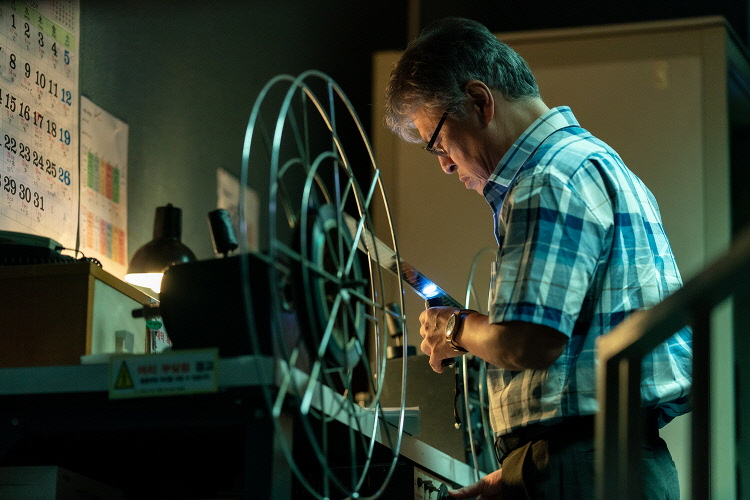
At first, we are served with the opening sequence set in a certain well-known arthouse movie theater in Seoul, which functions as a key location for all of the three stories. We meet a middle-aged projectionist working there, and we closely observe how he works. Thanks to a digital projector, things seem to be more convenient for him, but, as he points out to his young successor, digital projectors also need to be checked as much as film projectors, and some of you may feel a bit nostalgic when he later uses an old film projector.
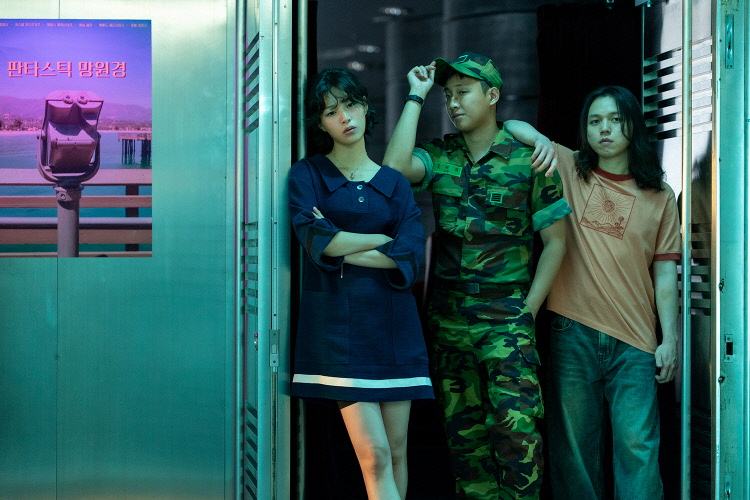
The first story, which is titled “Chimpanzee”, is directed by Lee Jong-pil, who also directed the opening and closing part of the film. This part opens with the screening of a small film based on an old memory of its director, and this fairly modest work revolves around three different young people, one of whom turns out to be a younger self of the director. As these young people roll from one humorous moment to another, Lee has some stylish fun as deliberately changing the screen ratio at times, and things get a bit more amusing as the narrative structure of the story becomes a little more complex than expected.
I think “Chimpanzee” is the least engaging one of the trio, but it still holds our attention thanks to its three likable leading performers. Wonstein, Lee Soo-kyung, and Hong Xa-bin are effortless in their playful interactions throughout this part, and Kim Dae-myung, who plays the director, provides a bit of extra amusement later. In addition, you will certainly smile in the end because of the rough but earnest homage to Jean-Luc Godard’s “Band of Outsiders” (1964).
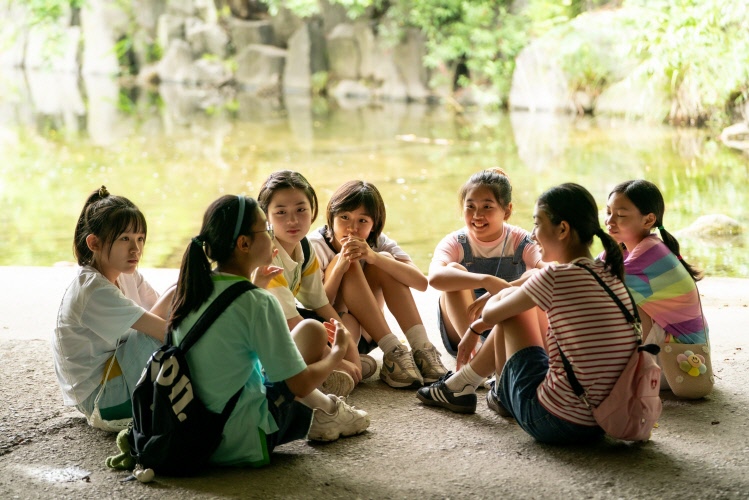
The second story, which is simply titled “Naturally”, is directed by Yoon Ga-eun, who has steadily impressed us since her first feature film “The World of Us” (2016). At first, it looks like the movie is simply watching a bunch of young girls having a good time together in their neighborhood, but, what do you know, they soon turn out to be actually performing in front of their director and a small group of film crew.
The main source of fun and humor during this part is how the director, played by Go Ah-sung, instructs and encourages her child performers. As reflected by the very title of the story, she simply wants to make their acting look as naturally as possible in front of her camera. Fortunately for her young performers as well as her crew members, she does know how to draw what she exactly wants from her young performers, all of whom are quite game under her warm and considerate direction.
Considering how Yoon has drawn excellent performances from many child performers in “The World of Us” and several other works, you may wonder about how much “Naturally” overlaps with how she actually worked with her child performers on the set. To be frank with you, I have no idea at all, but I somehow sensed that Yoon is willing to show us a bit of her filmmaking process, and I appreciated that more as observing by the very last shot of this part. Now I am reminded of what François Truffaut once said: “The most beautiful thing I have ever seen in a movie theatre is to go down to the front and turn around, and look at all the uplifted faces, the light from the screen reflected upon them.”
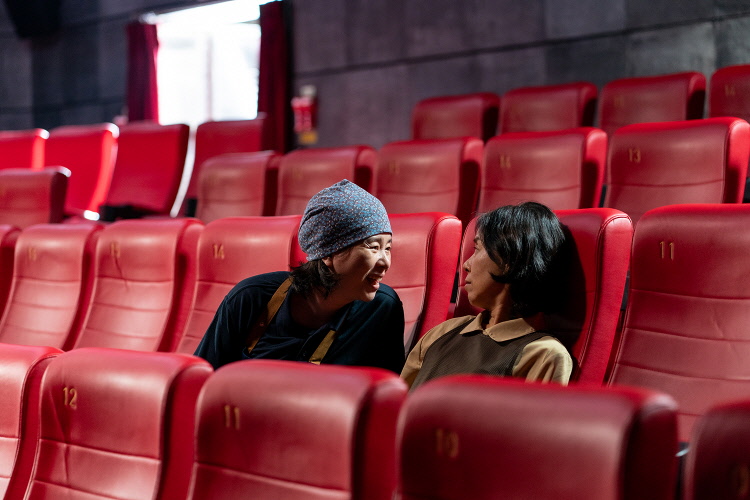
The third story, which is titled “Time of the Movie”, is directed by Jang Kun-jae, who has been mainly known for “Sleepless Night” (2012) and “A Midsummer’s Fantasia” (2014). At the start of this story, we are introduced to several different employees of the aforementioned movie theater, and then one of them, who is incidentally a cleaning lady, happens to encounter an old schoolmate of hers. Because they have not met each other for years, the mood between them is rather awkward, but the cleaning lady is still glad to meet her friend again, and then she gives her friend a free movie ticket.
What follows next is not so easy to describe. After walking into the screening room, the cleaning lady’s friend soon gets asleep, and then we are served with a brief free-flowing meditation on cinema as a sort of dream machine. Although nothing seems to happen to the cleaning lady’s friend during the screening, something in the film somehow touches upon those old memories inside her mind, and then we arrive at the faintly optimistic last scene between her and her friend. While Yang Mal-bok and Jang Hye-jin are convincing in their key moments, Kwon Hae-hyo and Kim Yeon-kyo fill their respective small spots around the story, and Kim has a little funny scene involved with a young man too late for the screening of a movie he really wants to watch right now.
On the whole, “Time of Cinema” is a solid omnibus movie, and I enjoyed its three stories to various degrees. Although I will instantly put “Naturally” above the two other parts if I have to choose, both “Chimpanzee” and “Time of the Cinema” also have each own good moments to be savored, and all of them are certainly worthwhile to watch for any cinephiles out there.


 Seongyong's Private Place