
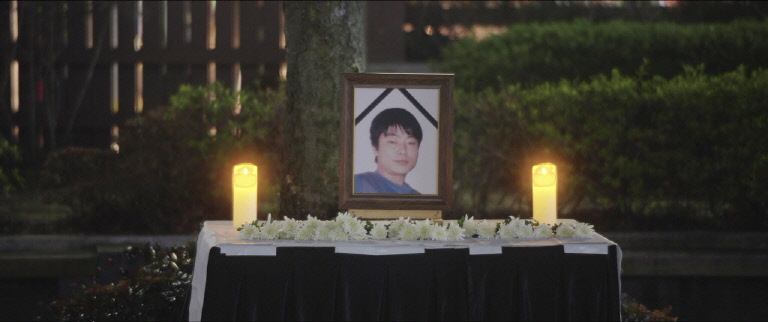
Some bad documentaries simply bore me, but South Korean independent documentary “Oh, Valentine” is alternatively excruciating and frustrating for many regrettable reasons. While its main subject itself is fairly interesting, the utterly clumsy presentation of its main subject is disastrously distracting in my trivial opinion, and I must tell you that this is one of the rare cases which made me check out the remaining running time almost every 10 minutes.
The main subject of the documentary is the democratic labor union movement in South Korea during the early 2000s, and it begins with the tragic death of a subcontracted worker named Park Il-su on February 14th, 2004. After getting so despaired and frustrated with the harsh status of his labor environment, Park eventually committed suicide on that day, and Cho Seong-woong, who was one of Parks’s close colleagues and is incidentally one of the two interviewees of the documentary, reminisces about how difficult things were for them and many other subcontracted workers. Unlike those workers under contract, most of those subcontracted workers did not have much of labor rights from the very beginning, and I must tell you that this unfair trend is being continued in the South Korean labor market even at this point in the name of efficiency and, yes, profit.
As Cho talks more about all the disappointment and disillusionment he and many other subcontracted workers experienced during their desperate labor movement at that time, the documentary often shows a bunch of various archival photographs and footage clips, but how it presents these archival materials along with Cho’s interview is very disorienting to say the least. Director Hong Jin-hown frequently uses split screen for presenting these two different elements together on the screen of 2.35 ratio, and the result may look cool and interesting for a while, but it only comes to disorient us more instead of engaging us more. Whenever we try to focus more on the words from Cho, our eyes are often distracted by whatever is shown right next to his interview clip, and that is not a pleasant experience at all.
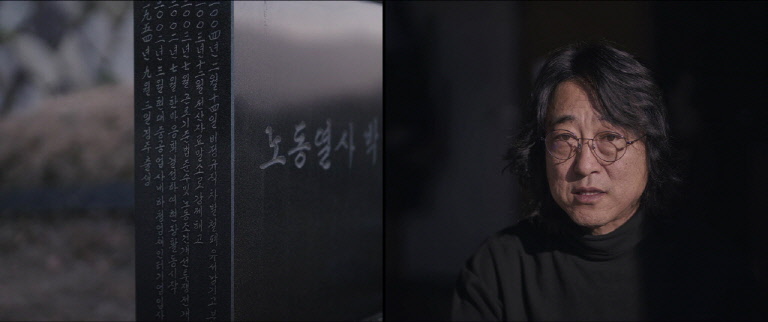
This split screen approach could actually work during several scenes where Cho’s interview clip is accompanied with the archival footage materials showing him and others during that time, but the documentary utterly fails in its juxtaposition of words and images. It never seems to know how to generate a coherent narrative from that, and we are just left with messy and confusing impressions in the end.
Moreover, I was often distracted a lot by the relentlessly blatant score of the documentary. I guess it tries to inject more tension into its narrative, but it is very overbearing instead as frequently overshadowing what we are supposed to listen to. At one point later in the documentary, several labor movement songs are overlapped with each other just for emphasizing many different voices of labor movement, but this cacophonous mix of sounds only adds more disorientation without any sense of insight or enlightenment.
By the way, the other interviewee of the documentary is a musician named Woo Chang-soo. As a guy who wrote several labor movement songs during that time, he does also have a number of things to talk about, but I am not so sure about whether his part in the documentary is really necessary. From time to time, we see him performing some of his original songs in public, but that does not help us much in getting to know him more. He also talks about the democratization movement in Myanmar at times, but, folks, this feels rather unnecessary in addition to not serving the documentary much on the whole.
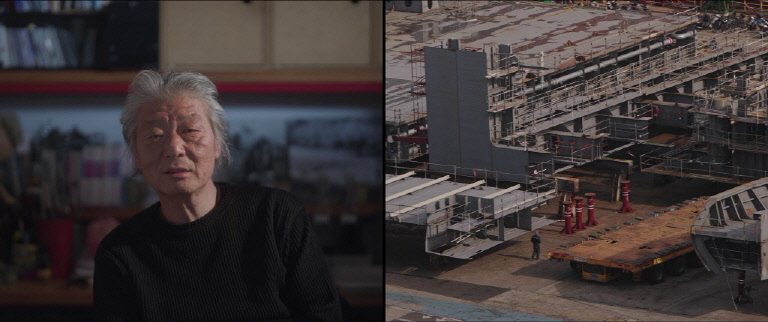
In case of Cho, the documentary does not show much of his life or personality either. Needless to say, he is admirable for carrying his hardcore left-wing belief for many years, but, unfortunately, the documentary often lets him down in its scattershot presentation of his life and political activity. When he talks about how those guys supposed to lead and supervise their labor movement let themselves compromised and corrupted, this moment simply moves from one thing after another without much sense of direction, and I was especially disappointed with how the documentary merely passes by a chance to focus on the struggles of the female participants in the labor movement at that time.
Above all, we also never get to know enough about Park. Yes, this man deserves to be known more along with many other South Korean laborers sincerely and passionately fighting for their lives and labor rights during last several decades, but he is only presented as a distant figure to be remembered by the two interviewees of the documentary. We only come to learn that he was a failed musician who later became a subcontracted worker for supporting his family, and the documentary does not provide any other particular personal moment which can give us more glimpse on his life and humanity.
In conclusion, “Oh, Valentine”, whose title incidentally comes from one of those labor movement songs written by Woo, is certainly well-intentioned, but it may be remembered as one of the worst movie theater experiences I had during this year. I was ready to learn and then get enlightened a bit more about the history of the South Korean labor movement, but I only found myself miserably enduring numerous glaring flaws of this very disappointing documentary during its 92-minute running time, and now my mind is reminded of a number of other similar South Korean documentaries I saw during last several years. I really want to recommend “1980 Sabuk” (2025) right now, and, believe me, you will have a much more compelling and enlightening time with it.


 Seongyong's Private Place