
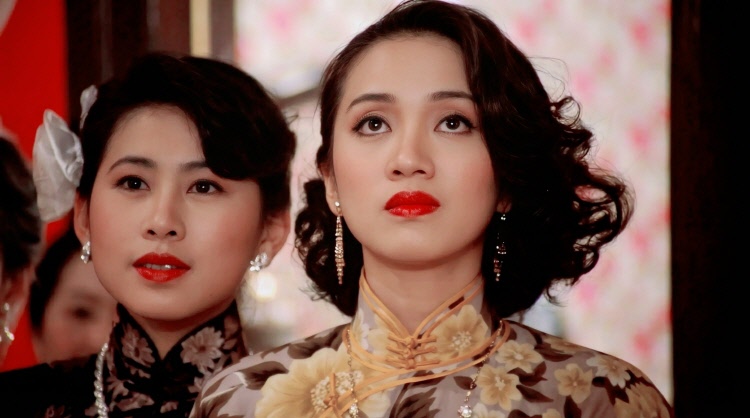
Stanley Kwan’s 1987 film “Rouge”, whose 4K remastered version was released in South Korean theaters yesterday, is a haunting melodrama about a ghost looking for her old love in the past. As following the desperate situation of this sad ghost along with her two unexpected companions, the movie comes to us as a modest but touching tale about love, loss, and memory, and we are moved more as it eventually culminates to a powerful moment of acceptance and resignation.
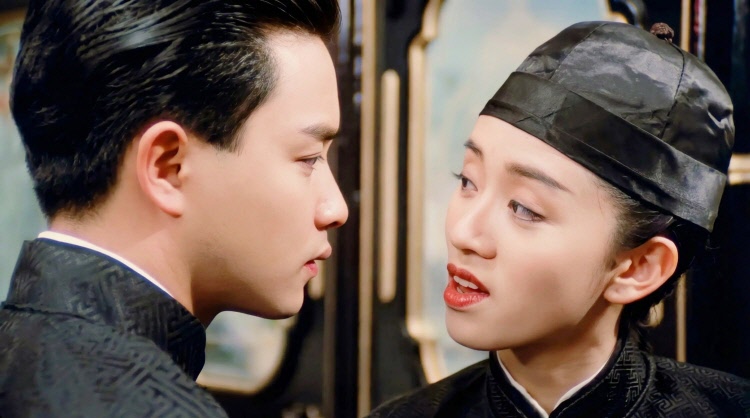
At first, the movie seems to be about the star-crossed romance between one courtesan and a wealthy playboy in Hong Kong during the 1930s. When Chan Chen-pang (Leslie Cheung) meets her for the first time in her brothel, Fleur (Anita Mui) instantly draws his attention with her lovely singing, and she soon becomes more special to him than any other courtesan around him. As they spend more time with each other with the growing mutual affection between them, he seriously considers marrying her someday, and she encourages him to become more interested in becoming an actor.
To our little surprise, the movie soon moves forward to 1987, and we come to gather that things did not go well for Fleur and her lover in the end. Her ghost suddenly appears in front of a plain newspaper employee named Yuen (Alex Man), and he is certainly flabbergasted by her odd request. She just wants to put an advertisement on the newspaper for locating her lover, but it does not take much for Yuen to realize that she is actually a ghost.
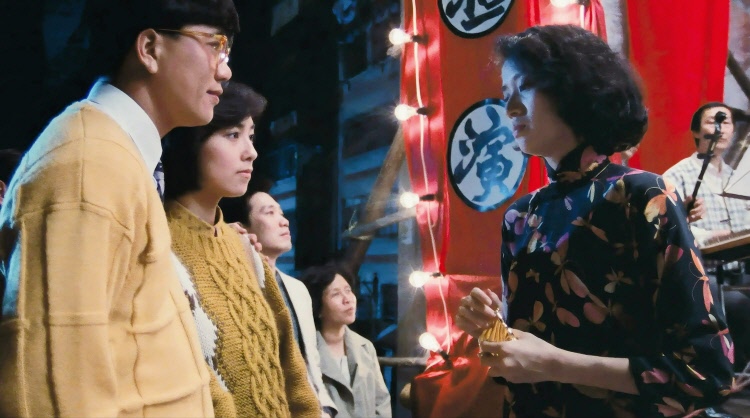
While understandably quite frightened at first, Yuen eventually lets Fleur into his residence. When he subsequently notifies this to his girlfriend Shu-Hsien (Irene Wan), she is not so amused to say the least, but then she comes to find that Fleur is indeed a ghost, and she also comes to have some pity on Fleur just like her boyfriend.
According to Fleur, who came from the realm of the dead, her lover is probably reincarnated to become someone else but still remembers where they are going to meet, and that is the main purpose of that odd advertisement of hers. However, not so surprisingly, her lover does not come to that place in question no matter how long she waits along with Yuen and Shu-Hsien, who become all the more curious about what happened to Fleur and her lover – and where the hell he is now.
Their search is often intercut with the flashback scenes showing more of the doomed romance between Fleur and her lover, and there are a number of lovely visual moments to remember thanks to cinematographer Bill Wong. Because I recently happened to watch Hou Hsiao-hsien’s “Flowers of Shanghai” (1998), which is incidentally about the brothels in Shanghai during the 19th century, many scenes of “Rouge” were compared with those similar scenes in “Flowers of Shanghai” in my mind, and I can assure you that “Rouge” often shines with its own sense of beauty.
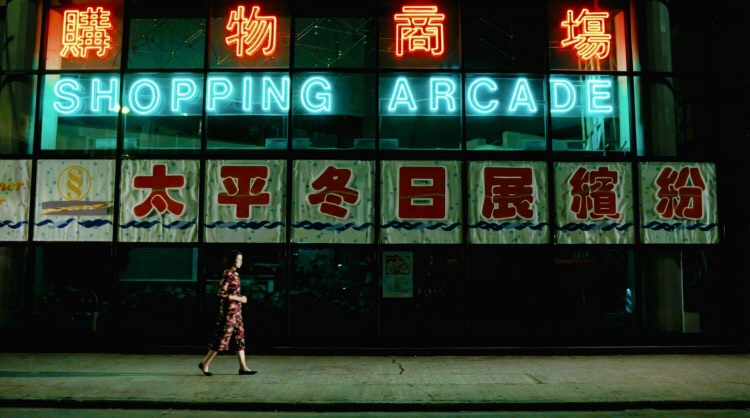
Along with the desperate love between Fleur and her lover, these gorgeous moments make an interesting contrast with the modern background of Hong Kong in the 1980s and the seemingly less idealistic relationship between Yuen and Shu-Hsien. As observing how much her old neighborhood is changed in one way or another, Fleur comes to have more doubt and despair, but she does not give up her hope at all, and this makes both Yuen and Shu-Hsien reflect more on their relationship at present. While they admit to each other that they cannot possibly love each other as intensely as Fleur loved her lover, they also come to love and understand each other more than before, and there is a bittersweet moment when Fleur glimpses a bit of the sincere intimacy between them at one point later in the story.
I will not reveal anything on where our ghost heroine will arrive in the end, except telling you instead that the movie sets a rather ironic background for the end of her journey. Anita Mui, who was regarded as “Queen of Cantopop” before she died too early in 2003, is simply magnificent as her character eventually realizes the futility of her longtime yearning, and her strong performance here in the film will leave a lasting impression on your mind for a while.
Around Mui, several other cast members dutifully support her without overshadowing her at all. Leslie Cheung, who also died early not long before his co-star’s death, is well-cast as a handsome lad helplessly stuck with his beautiful lover in their doomed romance, and you may be amused a bit by one particular scene which may take you back to his unforgettable performance in Chen Kaige’s “Farewell My Concubine” (1993). Although their characters are more or less than the observers of Fleur’s story, Alex Man and Irene Wan have their own moments along the story, and we sense that their characters come to have some valuable lesson about love and relationship as helping their unlikely guest much more than expected.
Overall, “Rouge” is engaging in its earnest handling of story and characters, and its wistful qualities remind me of Somerset Maugham’s short story “Red”, which is also about a doomed young romance lost and then forgotten via that unbeatable passage of time. As we all know too well, we always have to accept what can never be regained as things keep changing, and the movie surely makes a poignant point of that.


 Seongyong's Private Place