

JT Mollner’s 2023 film “Stranger Darling” has the familiar tone of those countless imitators of the works of Quentin Tarantino such as, yes, “Pulp Fiction” (1994). Many of them want to be funny and provocative while also trying to toy with character and narrative structure, but some of them are not so successful for only knowing how to play mere notes instead of music. Unfortunately, “Strange Darling” is one of such disappointing cases despite being slick and competent at times.
The opening part is clearly influenced a lot by those sleazy American exploitation flicks of the 1970s, which are incidentally one of the main sources of inspiration for Tarantino’s works. First, we get an ominous introduction claiming that it is based on some notorious real-life criminal case (Do you believe it, folks?). After that, we get the main title scene accompanied with a lyrical song played on the soundtrack, and then there comes a striking vehicle chase sequence which may take you back to the second half of “Grindhouse” (2007) directed by Tarantino.
The movie mainly follows a young woman chased by some guy who seems quite determined to catch her by any means necessary, but we soon come to realize that the movie has some surprises behind its back because of its non-linear narrative structure. Not long after the woman is on the verge of getting caught by her chaser, the movie moves back to when they met for the first time, and, what do you know, the situation between them turns out to be a bit more complicated than it seemed at first.
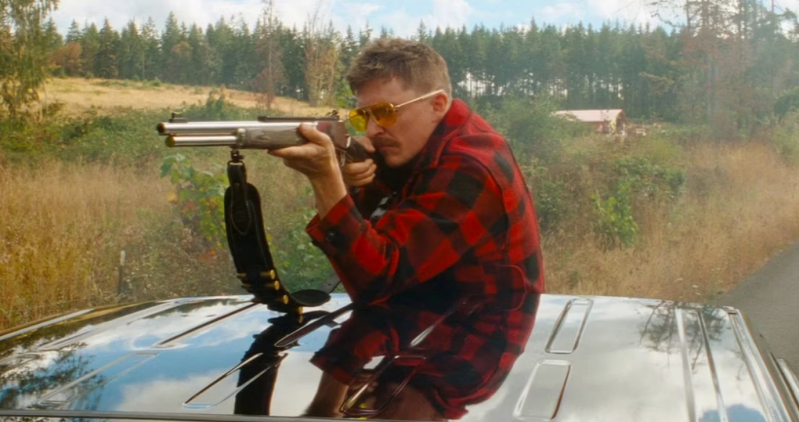
I will not go into details here for avoiding ruining any of your fun, but I can tell you instead on how the movie wants to be provocative via a series of uncomfortable moments between its two main characters. As they spend time together, the woman seems to have some naughty fun as flirting with the other main character’s interest and desire, and that eventually leads to a kinky sexual sequence where they push or pull each other as mainly driven by her unpredictable whim.
But who are this woman and her accidental sex partner? The screenplay by director/writer JT Mollner, who recently wrote the adapted screenplay for Francis Lawrence’s “The Long Walk” (2025) from the novel of the same name by Stephen King, merely presents its two main characters as broad archetypes without fleshing them out more along its convoluted narrative. Instead of becoming real characters to observe or enjoy, they come to us as thin figures more or less than superficial plot elements, and the same thing can be said about a certain old couple who get unfortunately themselves involved with these two main characters later in the story.
This is the main reason why most of the blatant dialogues in the film feel quite artificial instead of truly provoking or unnerving us. When its heroine talks about how women are often in danger of getting murdered when they just try to have some carnal fun, she feels more like dictating Mollner’s writing instead of really talking to her sex partner, and we are not so surprised at all when his screenplay subsequently attempts a bit of genre subversion.
It goes without saying that the movie also wants to be an edgy commentary on the misogynistic aspects of those countless “women in danger” flicks out there, but I am not so sure about it is as successful as intended. In its rather unpleasant genre subversion later in the story, the film ironically embodies the very misogynistic stuffs it is supposed to criticize, and this disagreeable contradiction is particularly exemplified by several minor female characters in the story, all of whom are no more than cardboard figures to be manipulated in one way or another.
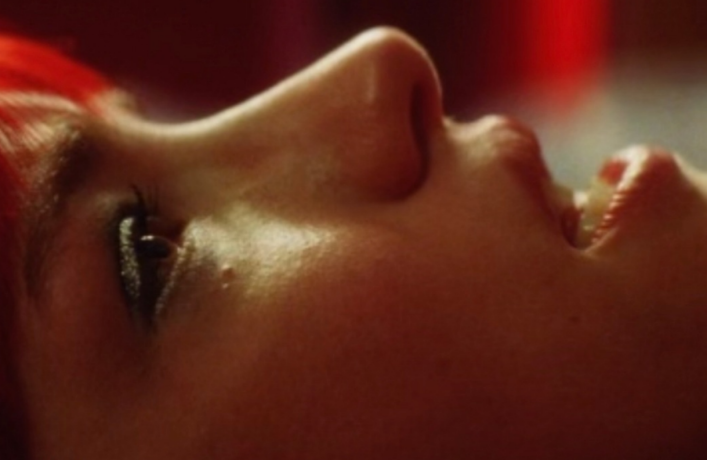
Anyway, the movie does not look cheap or crummy at all because Mollner and his crew members occasionally show considerable technical efforts to be recognized. As clearly stated at the very beginning of the movie, the movie was shot on 35mm film stock by co-producer Giovanni Ribisi, who incidentally makes a cinematographic debut here in this film. While being mainly known as a character actor who has played a number of odd and unconventional roles (Remember that hilariously deranged dude in Seth MacFarlane’s “Ted” (2012)?), Ribisi demonstrates a very unexpected side of his talent, and he and Mollner did a fairy good job of utilizing the grainy texture of 35mm film stock for establishing the distinctive mood of their movie on the screen.
The main cast members of the film try to fill their respective roles as much as possible. Willa Fitzgerald and Kyle Gallner are believable as their characters go up and down along the increasingly unreliable storyline, and it is a shame that their considerable commitment on the screen is not utilized that well on the whole. In case of several other main cast members, they are mostly wasted, and I was especially dissatisfied with watching Ed Begley Jr. and Barbara Hershey being hopelessly stuck in their totally thankless parts.
In conclusion, “Strange Darling”, which is Mollner’s second feature film after “Outlaws and Angels” (2016), is not a total waste of time thanks to its admirable technical aspects, but it still feels like a hollow and passable Tarantino wannabe. No, I am not against imitating those Tarantino movies at all, but I must point out that we have seen truly bad imitators besides some fairly good ones during last 30 years, and “Stranger Darling” belongs to a spot somewhere between these two groups.


 Seongyong's Private Place