
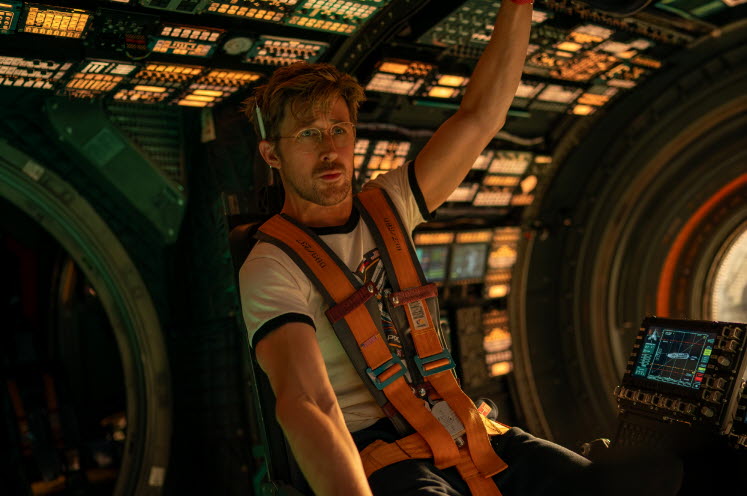
“Project Hail Mary” is an entertaining science fiction packed with enough wit, style, and drama to engage us during its rather long running time (156 minutes). While it is not as ambitious as Christopher Nolan’s “Interstellar” (2014), it still works quite well as a funny and thrilling space adventure story dexterously peppered with humor, intelligence, and some poignancy, and the result is indubitably one of the early highlights of this year.
The movie begins with its plain hero suddenly regaining his consciousness inside a big spaceship heading to somewhere in universe. He is Dr. Ryland Grace (Ryan Gosling), and he has no idea about how he ended up being inside the spaceship because he is suffering from a bit of retrograde amnesia at present. To make matters worse, the two other astronauts in the spaceship happen to be dead, so there is no one to tell him what is going on around him right now.
As getting more accustomed to this sudden situation of his, Dr. Grace gradually gathers where the spaceship is going. The spaceship is already far away from the solar system, and now it is approaching to a star called Tau Centi. Dr. Grace is naturally baffled, but, as he remembers more of what happened to him in the past, he gets to know more about this space mission of him and those two currently deceased astronauts.
Via a series of flashback parts, we see how he got himself involved with the space mission from the very beginning. Around 10 years ago, a strange incident was observed from the Sun, and that led to the discovery of a bunch of odd cosmic entities clearly sucking energy from the Sun. If this trend is continued without any interruption, it will be disastrous for the Earth and all the living organisms on it, and many experts around the world gathered for solving this catastrophic problem as soon as possible.
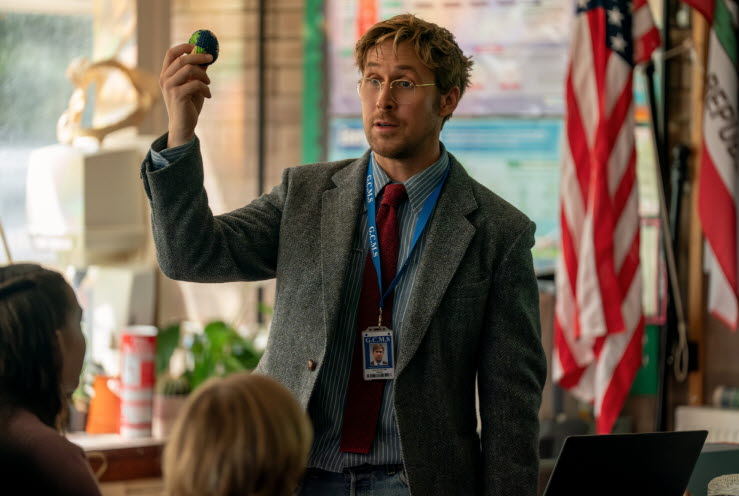
Although he was merely working as an elementary schoolteacher at that time, Dr. Grace once proposed a rather unconventional hypothesis on the lifeforms in the outer space, and that is why he was approached by the leader of that global expert groups, who is incidentally played by Sandra Hüller. He was initially skeptical about whether he could be any help at all, but, what do you know, he actually gave not only a breakthrough but also a possible solution developed from that.
When the spaceship eventually arrives in Tau Centi, there comes another big surprise for Dr. Grace. I will not go into details here for not spoiling any entertainment for you, but, because the trailer already showed that, I can tell you that Dr. Grace encounters an alien who eventually becomes his unlikely friend and colleague as they work together on the search for any possible chance to solve the common problem of their respective races.
Of course, things do not go that well for them at times, and the screenplay by Drew Goddard, which is based on the science fiction novel of the same name by Andy Weir (He also wrote “The Martian”, which was adapted into Ridley Scott’s 2015 film), engages us more as Dr. Grace and his alien friend work on their common mission in one way or another. Although there are several barriers between them including the language one, they eventually find a way to communicate fairly well with each other, and there is a little amusing moment when Dr. Grace tries to find the right human voice for the translation of what his alien friend says.
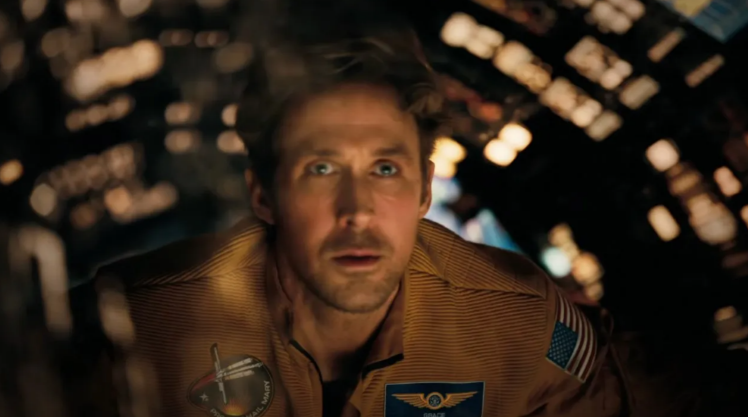
The story eventually culminates to when Dr. Grace and his alien friend come across a possible chance for getting their mission accomplished, and the movie naturally delivers a number of stunning visual moments worthwhile to watch from big movie theater screen. Thanks to a group of the first-rate crew members of the film including cinematographer Greig Fraser, who won an Oscar for Denis Villeneuve’s “Dune” (2021), the movie is quite impressive for its vast and wondrous presentation of the space, and you may also enjoy small and big details as the camera fluidly moves along with Dr. Grace here and there inside the spaceship.
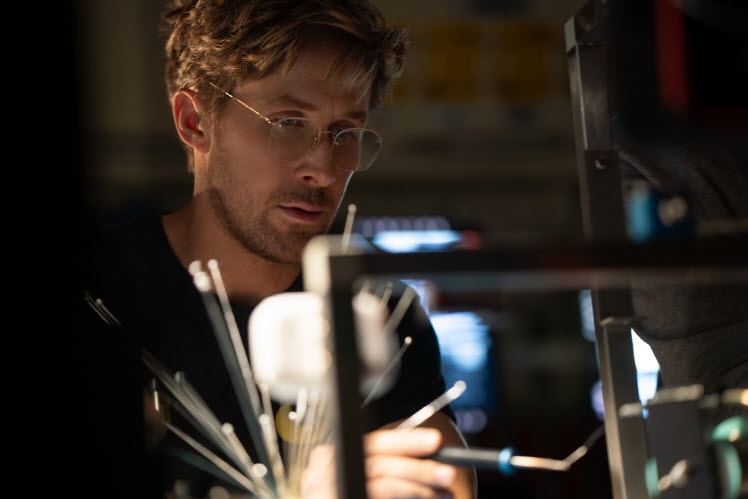
Above all, the movie also finds a surprising amount of sincerity from the relationship drama between Dr. Grace and his alien friend. Their interactions are rather strained at times due to many differences between them, but we come to sense more of how much both of them care about each other, and we certainly come to root for them more around the climactic part of the story.
I must point out that Goddard’s screenplay stumbles a bit during the finale where it tries a bit too many things for tidying up the story within around 20 minutes, but we remain engaged as before thanks to another good performance from Ryan Gosling, who also participated in the production of the film along with Weir and directors Phil Lord and Christopher Miller. Besides ably holding the center of the film as required with his likable presence, he is convincing in a number of key scenes unfolded across the space, and he and James Ortiz, who is the voice and lead puppeteer of Dr. Grace’s alien friend, flawlessly click with each other throughout the film.
On the whole, “Project Hail Mary” is definitely not something you cannot miss if you love good space movies. Since Alfonso Cuarón’s “Gravity” (2013) came out, we have had a fair share of wonderful space movies during last 13 years, and “Project Hail Mary” deserves to be placed around the top of the field. Although it is not exactly ground-breaking compared to “Gravity” or “Interstellar”, Miller and Lord, who gave us “The Lego Movie” (2014) and “Spider-Man: Into the Spider-Verse” (2018), surprise us again, and that is more than enough for recommendation in my inconsequential opinion.


 Seongyong's Private Place