
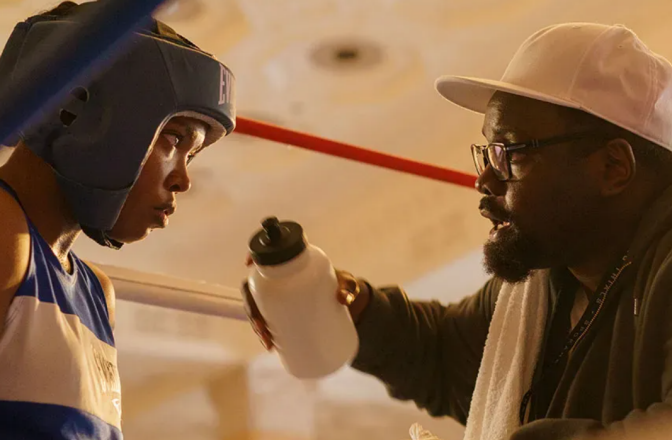
“The Fire Inside” is a solid sports drama film which turns out to be a little more thoughtful than I thought. Unlike many other sports films, it does not simply illustrate the journey toward an expected moment of triumph, and it also focuses on how its heroine struggles to move on after that triumphant moment. Mainly thanks to the strong performances from its two main performers, the movie is steadily engaging despite its few shortcomings, and you will come to root for its heroine more in the end.
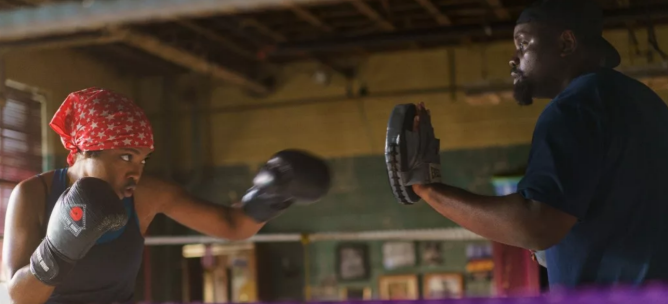
The story revolves around the early boxing career of Claressa “T-Rex” Shields (Ryan Destiny), a female professional boxer who has been known well for her notable wins at the 2012 and 2016 Summer Olympics. The opening scene shows how young Shields, who was a little girl living in one of the poor neighborhoods in Flint, Michigan, came to start learning boxing under her coach Jason Crutchfield (Brian Tyree Henry), and then we see how much she becomes more skilled and confident during next several years.
And we also observe more of how Shields depends more on her coach – and how much she wants to get out of her poor and harsh environment. Her single mother is not particularly interested in supporting Shield’s hope and ambition, and then Shield finds herself kicked out of their house due to a minor clash between her and her mother. When she calls for help, Crutchfield possibly cannot say no, and she eventually becomes a part of his little family.
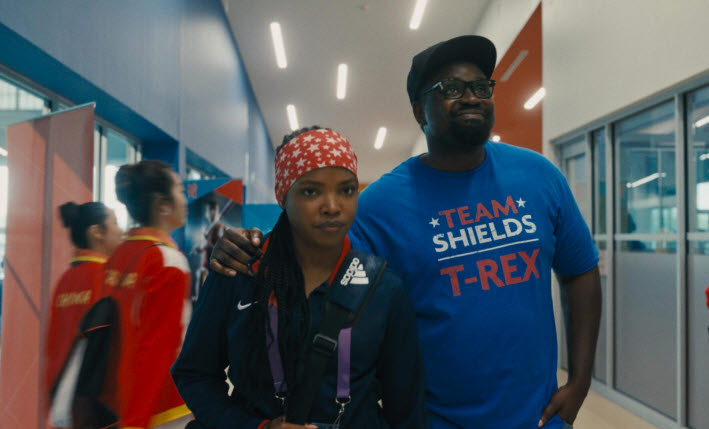
Thanks to Crutchfield’s good coaching, Shields keeps advancing in her boxing careers, and then there comes an opportunity to compete at the upcoming 2012 Summer Olympics in London. When she can finally go to the tryout competition to be held in Shanghai, China, she is naturally excited, but there comes an unexpected obstacle: Crutchfield cannot go just because 1) he is an unqualified coach and 2) he cannot afford to go there.
And that is just the first one of many obstacles Shields has to overcome with some help and assistance from her coach. When she is eventually selected for competing at the 2012 Summer Olympics, Crutchfield decides to go to London along with her, though he is still not her official coach at the competition. Nevertheless, she appreciates how much he cares about her and her boxing career, and that leads to a surprise win to distinguish herself much more than before.
After this narrative point, the screenplay by co-producer Barry Jenkins, who has been mainly known for his Oscar-winning film “Moonlight” (2016), shifts onto a more thoughtful mode. Shields and Crutchfield hope that things will get much better for her, but they soon face another big obstacle in front of them. Just because of gender bias, there are not many sponsors willing to promote her and her career out there, and Shields naturally becomes more frustrated and conflicted as she remains stuck in her poor neighborhood in Flint.
The mood eventually becomes a bit more melodramatic when Shields’ relationship with Crutchfield gets more strained later, but the movie mostly remains calm and restrained even at that point. Although a key scene between Shields and her mother later in the story feels rather contrived at first, it is handled well with low-key sensitivity at least, and that is the main reason why it turns out to be more touching than expected. While the finale is a bit too anti-climactic, it still works as staying focused on the relationship between Shields and Crutchfield, and we are reminded that her journey is not over yet even at this point.
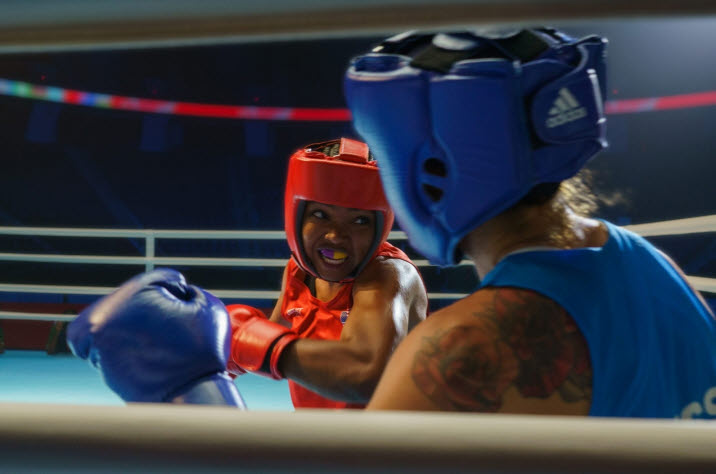
As the center of the film, Ryan Destiny demonstrates that she is a promising newcomer with a lot of potential, and she did a splendid job of imbuing her character with enough human qualities to interest and then engage us. This is only the third feature film in her burgeoning movie acting career, but she is simply compelling to watch, and I can only hope that we will see more of her considerable talent during next several years.
On the opposite, Brian Tyree Henry, who has given us a series of stellar performances during last several years, is dependable as usual. Yes, his coach character looks a bit too typical on the surface, but Henry brings real human details to his character without showing off them at all, and the result is another fine performance to be added to his steadily advancing career.
In case of several other main cast members, they are just required to fill their respective spots as much as possible, and some of them acquit themselves well despite that. As Shields’ rather uncaring mother, Oluniké Adeliyi manages to overcome her thankless role later in the film, and De’Adre Aziza has a couple of good scenes as Crutchfield’s patient wife.
In conclusion, “The Fire Inside” works thanks to not only the commendable efforts from its two main performers but also the competent direction of director Rachel Morrison, an Oscar-nominated cinematographer who incidentally made a feature film debut here. According to IMDB, she has already moved onto her next film to come, and, considering the solid overall result of her first feature film, I guess I can have some expectation on that.


 Seongyong's Private Place