
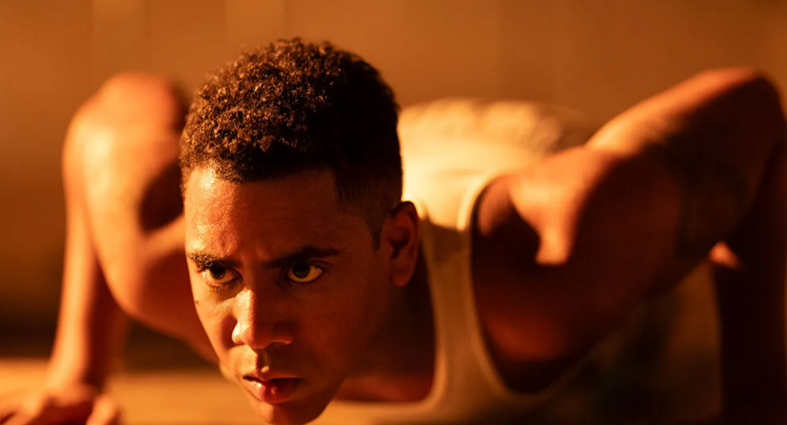
I exactly knew what I was going to get from “Unstoppable”, which is currently available on Amazon Prime Video. This is your average underdog sports drama film, and you will not be surprised that much by its predictable narrative arc if you are a seasoned moviegoer like me. Nevertheless, its earnest efforts somehow won my heart in the end, and I will not deny at all that I got really engaged in its predictable but undeniably uplifting climactic part.
Jharrel Jerome, who has been one of the most promising actors working in Hollywood since his breakthrough supporting turn in Barry Jenkins’ Oscar-winning film “Moonlight” (2016), plays Anthony Robles, who drew a lot of attention as a wrestler with considerable disability during his high school and college years. Robles was born without one leg, but he went all the way as dedicating himself a lot to wrestling, and the movie is about how he overcame one obstacle after another before eventually having a big triumphant moment for his life and career (Is this a spoiler?).
The first half of the movie focuses on when Robles is about to make an important decision for himself. After distinguishing himself a lot at the national high school championship, he expects to be approached by several major state universities including the University of Iowa, which has been famous for its renowned wrestling team. However, it turns out that the University of Iowa and many other universities are not particularly interested in recruiting him, and it looks like his only option is Drexel University in Philadelphia, Pennsylvania, which is actually quite willing to provide him a full scholarship.
In the end, Robles decides to enroll in Arizona State University (ASU) just because he wants to stay closer to his family living in Mesa, Arizona. Thanks to his caring high school coach, he has a meeting with the wrestling team coach of ASU, who gives Robles some tough advice while recognizing Robles’ talent and dedication. As he warned Robles in advance, the following tryout session is pretty grueling to say the least, but this only motivates Robles more than before, and he eventually earns some respect from not only the coach but also many of his fellow candidate players.
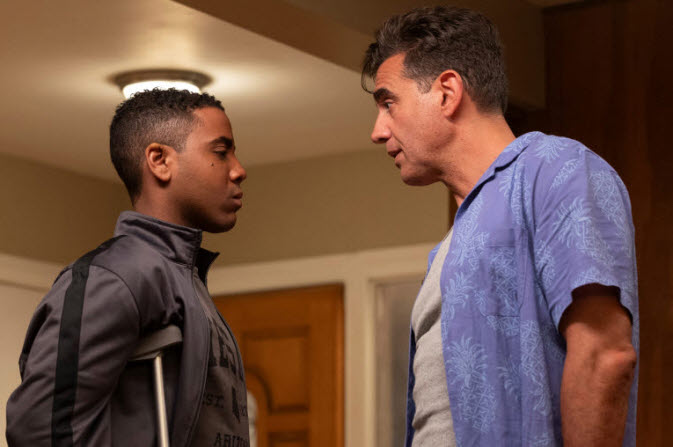
Of course, there come a series of obstacles popping up here and there around Robles. In case of his mother, her recent spouse turns out to be much less reliable than expected, and this affects her as well as her children including Robles, who surely cares a lot about his mother just like his several younger siblings. While his mother comes upon one trouble after another mainly due to her lousy spouse, he keeps trying to focus on his games as before, but then there come some other troubles including the unexpected budget cut on his wrestling team.
The movie sometimes becomes a bit too melodramatic in my humble opinion, but the screenplay by Eric Champnella, Alex Harris, and John Hindman, which is based on the memoir of the same name which Robles wrote with Austin Murphy, keeps things rolling along its many ups and downs. While it is touching to see Robles’ mother eventually shows more resilience and resourcefulness than expected, we are also moved by when Robles’ teammates show him some solidarity at one point later in the story.
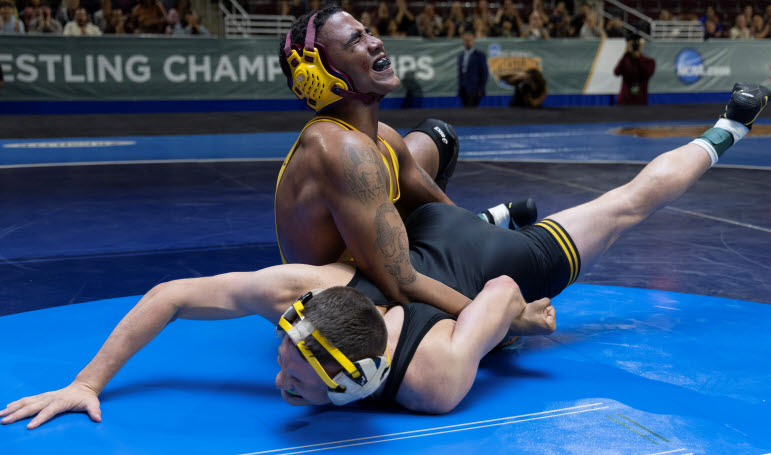
In case of all those wrestling match scenes in the film, they are competently handled under the solid direction of director William Goldenberg, an Oscar-winning editor who incidentally made a feature film debut here. He and his editor Brett M. Reed did a good job of generating enough intensity and excitement to engage us, and we come to care more about Robles’ strenuous quest for triumph even though we all know where he will arrive in the end.
The movie also depends a lot on Jerome’s admirable commitment on the screen. While his appearance on the screen is certainly assisted a lot by special effects from the beginning to the end, he ably embodies his character’s indomitable spirit and determination, and he is also quite convincing as willingly throwing himself into many intense physical moments during the wrestling match scenes in the film.
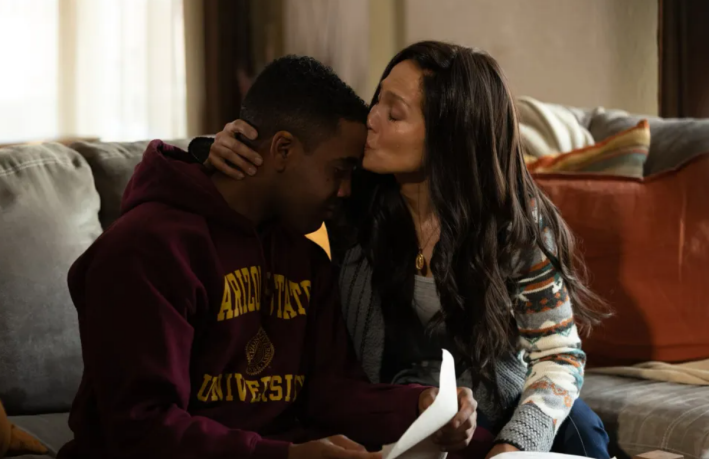
Jerome is also supported well by several notable main cast members. While Michael Peña and Don Cheadle have each own moment to shine as the two important coaches of Robles, Bobby Cannavale brings some extra intensity as the crummy spouse of Robles’ mother, and Mykelti Williamson is also effective in his small but crucial supporting part. In case of Jennifer Lopez, she may be a little too glamorous as Robles’ mother at first, but her undeniable star quality, which was already proven in Lorene Scafaria’s “Hustlers” (2019), is utilized well during one particular key scene between her and Jerome. This moment feels rather clichéd at first, but Jerome and Lopez bring real poignancy to it, and the result is more powerful than expected.
In conclusion, “Unstoppable” does not go beyond the conventions of its genre, but it still works inside its genre conventions. As I said at the beginning of this review, there is nothing particularly new or fresh here, but it follows its playbook well on the whole despite some blatant touches such as the reference to John G. Avildsen’s Oscar-winning sport film “Rocky” (1976), so I will not grumble at least for now.


 Seongyong's Private Place