
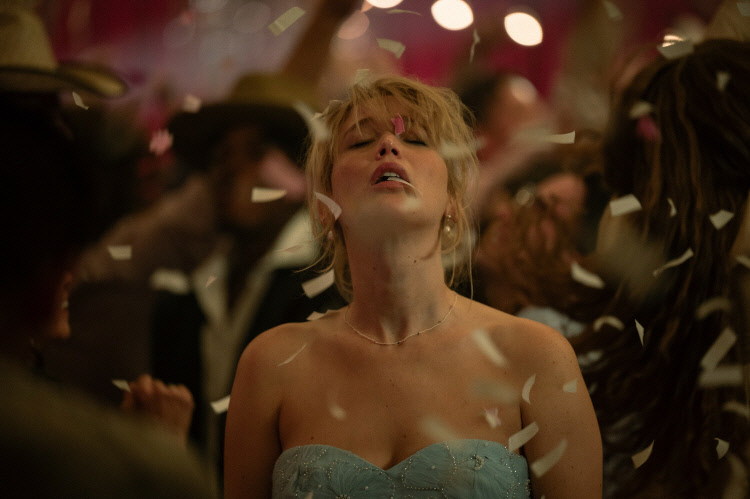
It is often uncomfortable to watch Lynne Ramsay’s latest film “Die My Love”, an edgy but engaging presentation of postpartum depression. As its heroine going up and down along her frequent mood swings, the movie vividly illustrates her increasingly unhinged state of mind, and we come to have some human understanding on her downward spiral even while horrified and baffled by her destructive behaviors along the story.
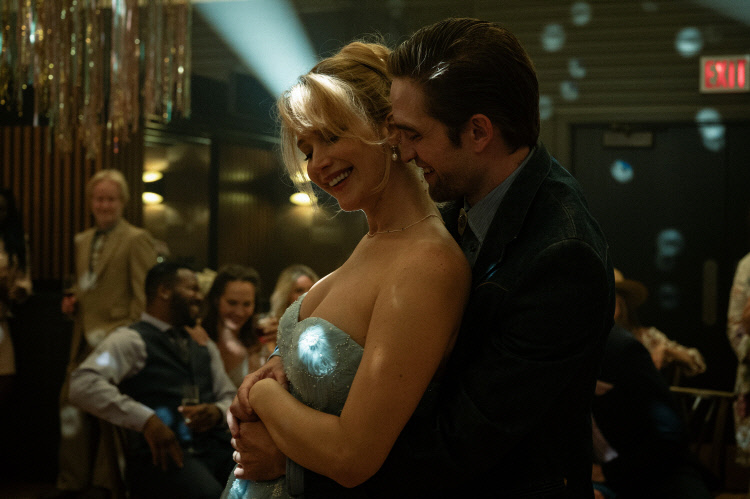
At the beginning, we get to know a bit about Grace (Jennifer Lawrence) and her boyfriend Jackson (Robert Pattinson). They recently moved to Jackson’s rural hometown in Montana, and the opening scene shows them checking out an empty house which belonged to a dead brother of Jackson’s father Harry (Nick Nolte). Although the house looks rather shabby, Grace and Jackson are happy to have their own place, and we subsequently see them throwing themselves into another passionate moment between them.
However, not long after Grace and Jackson’s baby is born, the situation becomes less optimistic. While Jackson is often absent due to working outside for earning their living, Grace tries to start her writing again whenever she is not busy with taking care of their baby, but then she begins to show the signs of postpartum depression, and we see how much she struggles to deal with her worsening mental illness. No, she does not show much negligence in case of raising her baby, but she cannot help but become quite depressed to say the least, and this leads her to some extreme behaviors.
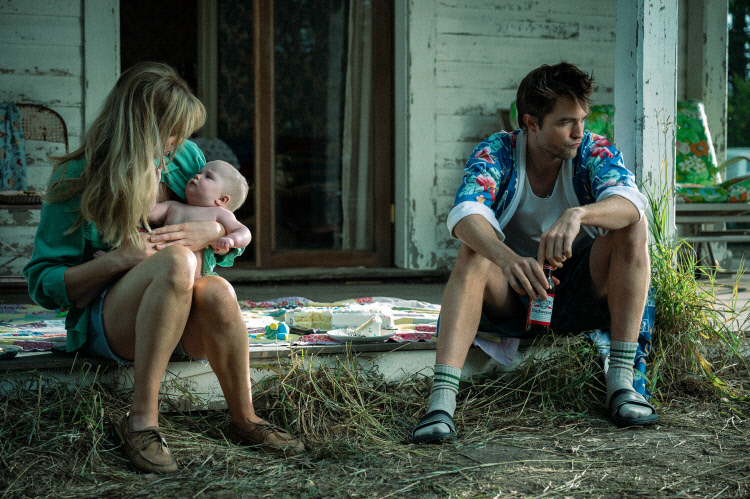
Needless to say, Jackson and his mother Pam (Sissy Spacek) begin to notice that something is going wrong in Grace’s mind, though neither of them can help Grace much despite their good intentions. While hoping that Grace’s postpartum depression is just a temporary predicament they must pass through, Jackson tries to tolerate and understand Grace as much as possible, but he often finds himself way over his head whenever Grace shows another extreme behavior from her ongoing mental illness. They come to fight more with each other, and they become more estranged from each other even though they subsequently try to be nice to each other.
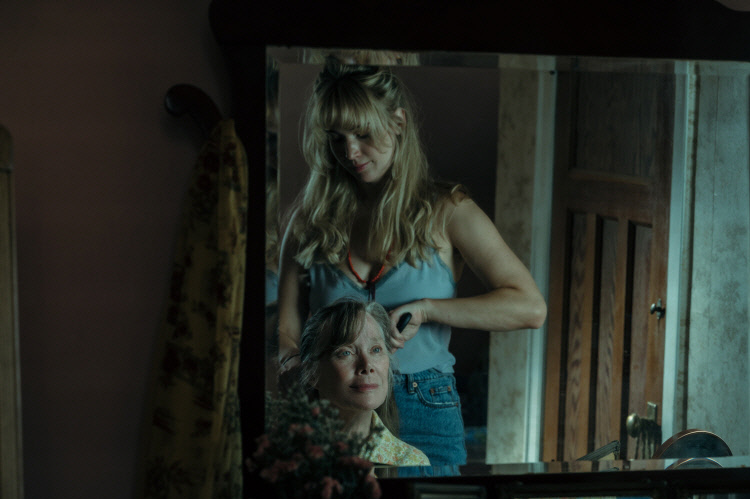
In case of Pam, she understands Grace’s mental struggle well as a woman with her own emotional issues. After all, since her husband’s recent passing, Pam often finds herself sleepwalking at night, and she is willing to provide any emotional support to Grace, though she knows well that she probably cannot help Grace a lot in the end.
Anyway, Grace insists that everything is fine for her, and that makes the situation all the worse for her along with several other negative factors including a pet dog brought into the house by Jackson. Right from its first day in their house, this dog annoys Grace a lot, and the movie emphasizes this more and more as it continues to bark on the soundtrack.
Around that point, Grace’s viewpoint becomes more unreliable to say the least. Early in the story, she notices a stranger riding a motorcycle, and she later comes to have a nocturnal encounter with that stranger in that question, who turns out to be played by LaKeith Stanfield. When this mysterious figure appears again in front of her, we come to have more doubt about her state of mind, and you will not be that sure about what subsequently occurs between them.
Despite our increasing bafflement, the movie, whch is based on the novel of the same name by Ariana Harwicz, continues to hold our attention thanks to Ramsay’s skillful handling of mood and details. The editing by Toni Froschhammer is often jarring as aptly reflecting Grace’s abrupt mood swings, and cinematographer Seamus McGarvey, who previously collaborated with Ramsay in “We Need to Talk About Kevin” (2011), did a good job of conveying to us more of the heroine’s increasing sense of frustration and suffocation in addition to bringing more attention to her deteriorating mental condition.
Needless to say, Jennifer Lawrence, who also produces the film along with Martin Scorsese (He recommended Harwicz’s book to her, by the way), is crucial for the emotional effectiveness of the film. While we never get to know that well about whatever really makes her character driven into the bottom of her postpartum depression, Lawrence steadily holds our attention even when her character feels like beyond our reach or understanding, and her strong performance demonstrates that she is still one of the best actresses working in Hollywood despite some recent downturns in her acting career.
Around Lawrence, several notable performers in the film bring some extra human elements to the story. Robert Pattinson, who can be as fearless as his co-star, does not hesitate to embody his character’s human flaws, and Sissy Spacek provides a bit of warmth to the story during her several key scenes with Lawrence. In case of Nick Nolte, he simply comes and then goes just like Standfield, but both of them leave some impression at least.
Overall, “Die My Love” is another disturbing but interesting work from Ramsay, who impressed me with “We Need to Talk About Kevin” and then “You Were Never Really Here” (2017). Although it is less impressive than these previous two films of hers, the movie still works thanks to Ramsay’s competent direction and Lawrence’s strong performance, and it will surely make you reflect more on its story subject after its strikingly self-immolating finale. Yes, things can be quite bad in any kind of clinical depression, and you will have some understanding on why self-destruction feels like the only way out in some very severe cases like Grace.


 Seongyong's Private Place