

Kleber Mendonça Filho’s latest film “The Secret Agent”, which won the Best Director Award at the Cannes Films Festival early in last year and then garnered 4 Oscar nominations including the ones for Best Picture and Best International Film, is another ambitious work from its director. While it initially seems to be a bit too sprawling, the movie gradually immerses us into that dangerous period surrounding its hero and a bunch of other characters in the story, and that is something you will not easily forget after it is over.
The opening scene succinctly establishes the overall tone of the story, which is mainly set in early 1977, when the Brazilian society was being oppressed by the military dictatorship. The mood is initially cheerful with some radio music on the soundtrack, but then we get disturbed by what is shown next on the screen. A little yellow Volkswagen arrives in a gas station located at some remote rural spot, but the owner of the gas station does not care much about what has been right in front of his gas station, and neither are the two highway police officers who subsequently arrive there. As a matter of fact, the officers are more occupied with how to get any kind of bribe from the driver of Volkswagen, who is not so pleased but tries to be tactful with them as much as possible.
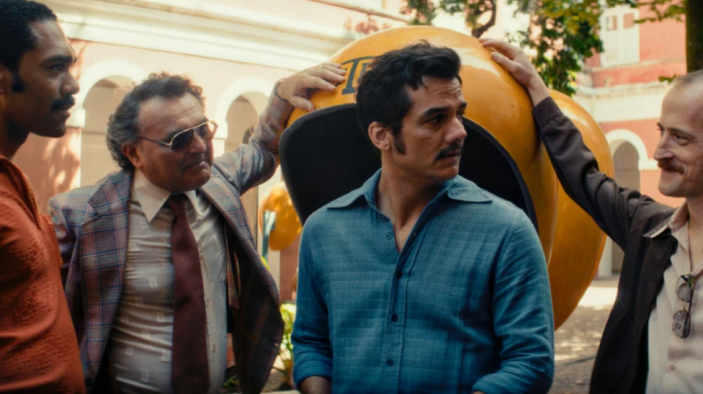
This driver in question presents himself as Marcelo Alves (Wagner Moura) when he arrives in Recife and then goes to where he is going to stay. He is wholeheartedly welcomed by the old landlady of his staying place, and he is also introduced to a number of various people staying there under his landlady’s protection.
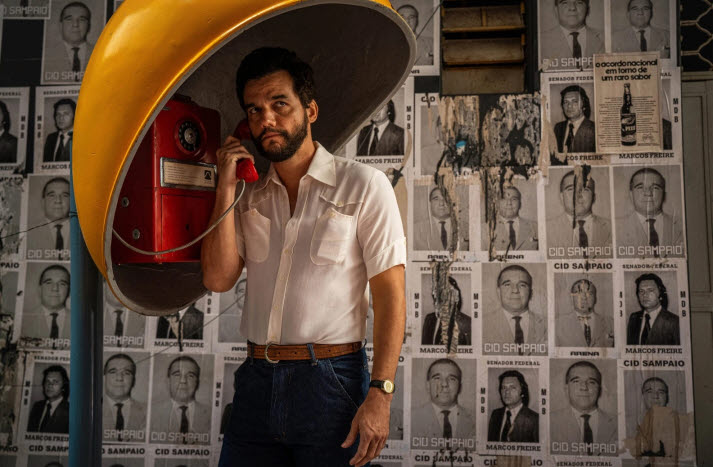
Now you sense something fishy about Marcelo and his current situation, and the movie slowly reveals who he is and why he comes to Recife along the story. He subsequently gets hired at a local identification card office, whose archival room is full of countless identification cards. He is particularly interested in finding the identification card of a certain female figure, and the supervisor of the identification card office is willing to help him as one of a few persons who knows who he actually is.
And it also turns out that Marcelo has a young son, who has been taken care of by his parents-in-law in Recife shortly after his wife’s death. When he visits his parents-in-law at one point early in the story, it is apparent that he really cares about his son’s welfare, but he must be careful about his ongoing circumstance, which turns out to be riskier than it seemed at first. Someone rich and influential is very angry at him, and this figure in question already hired two guys willing to eliminate Marcelo.
Even at this narrative point, the screenplay by Mendonça Filho takes its time for building up the story and its hero with more detail and mood. Thanks to cinematographer Evgenia Alexandrova, everything looks plain and fine under bright sunlight on the surface, but we also often observe the sleazy and dangerous sides of dictatorship and corruption mainly via a trio of local dirty cops. Ironically, these dudes show Marcelo a bit of hospitality, and that certainly makes him all the more nervous behind his back.
The movie also tries a gruesome but amusingly offbeat subplot which is clearly inspired by a certain brief but horrific moment in Steven Spielberg’s “Jaws” (1975), which Marcelo’s young son is obsessed with even though he has not watched it yet. You will be tickled by how this subplot culminates to an unexpectedly surreal moment later in the story, and you may be also often delighted by the occasional small references on several recognizable movies such as Richard Donner’s classic horror film “The Omen” (1976).

On the top of all and many other things in the story, the movie adds an extra perspective from our contemporary period. This feels rather redundant at first, but it slowly sets the ground for the eventual finale, which may surprise you for being deliberately anti-climactic but will linger on your mind for a while as reminding more of how many people like its hero struggled during that dark time in Brazil – and how their gloomy past has been fading away due to that inevitable passage of time.
As the strong human anchor of the movie, Wagner Moura, who deservedly received the Best Actor award at the Cannes Film Festival and then got recently Oscar-nominated for this film, gives a subtly multi-layered performance as steadily carrying the story to the end. At first, we often wonder about his character’s true identity and whatever he is hiding behind his back, but we come to care about Marcelo as the movie reveals more of his past and humanity along the story, and there is a poignant scene where he and his temporary neighbors open themselves a bit to each other while not revealing that much on the surface. Around Moura’s quietly powerful lead performance, Mendonça Filho assembles a bunch of colorfully diverse performers who contribute more personality to the film, and the special mention goes to Carlos Francisco, Tânia Maria, and Udo Kier, who sadly passed away not long after the movie came out.
Overall, “The Secret Agent” is another interesting work from Mendonça Filho, who previously gave us “Aquarius” (2016) and “Bacurau” (2019). I must confess that I underrated “Bacurau” just because I simply thought it could have been wilder and quirkier, but then it somehow grew on me during next several months, and the following second viewing made me realize that I was wrong in my 2.5-star review. Just like “Bacurau”, “The Secret Agent” is an equally rich cinematic experience to be savored and appreciated, and it is certainly another commendable addition to the current Brazilian cinema in my humble opinion.


 Seongyong's Private Place
Pingback: My Prediction on the 98th Academy Awards | Seongyong's Private Place