
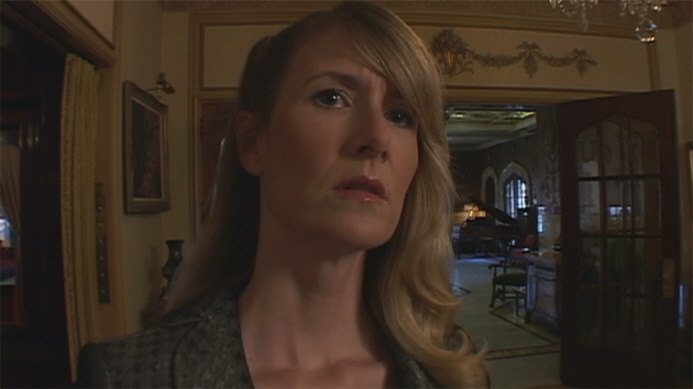
David Lynch’s 2006 film “Inland Empire”, which is being shown along with his several works at selected South Korean theaters, is still capable of alternatively baffling and dazzling me. Although I already watched it a couple of times, I am still not so sure about what it is exactly about, but my eyes and mind somehow got engaged in how it is about during my recent viewing despite its rather long running time (179 minutes).
As many of you know well, the movie was a little experimental filmmaking project from Lynch. After the considerable critical success of his Oscar-nominated film “Mulholland Drive” (2001), Lynch was ready for anything new and different, and then he became interested in shooting a film via digital camera mainly because it might allow him more creative freedom. Although he did not have a finished screenplay from the start, he began to shoot the film anyway, and most of the movie was actually developed on scene-by-scene basis during the rather long and loose shooting period during next three years.
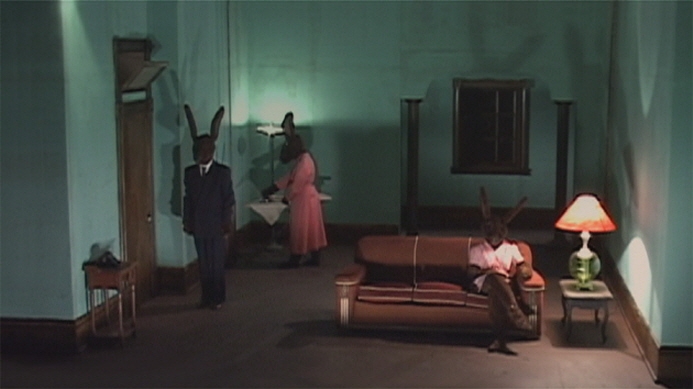
The story initially seems to be about the making of the latest movie of a Hollywood actress named Nikki Grace (Laura Dern). Not long after she is introduced to us after the elusively surreal opening part featuring a trio of talking rabbit figures, she gets cast as the lead actress of a movie titled “On High in Blue Tomorrows”, and she is quite excited for working with the prominent lead actor and director of that movie, both of whom are also eager to work along with her.
However, of course, there was already a bad sign for Grace. Early in the film, she was visited by a weird middle-aged lady, and this strange lady, who is incidentally played by Grace Zabriskie from Lynch’s iconic TV drama series “Twin Peaks”, baffled her a lot as saying a series of incomprehensible things and then eventually leaving.
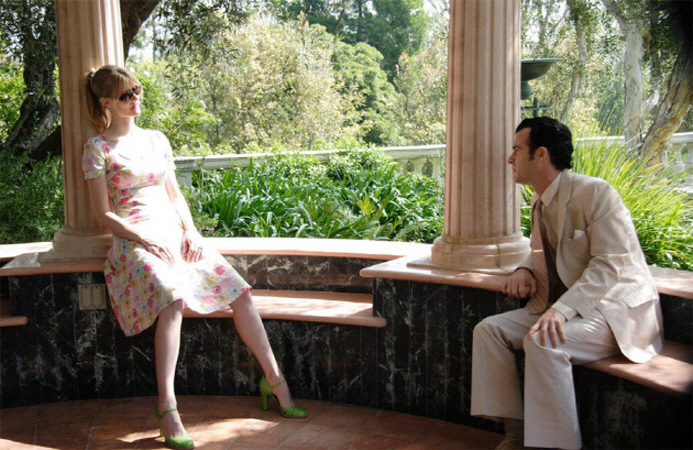
In addition, the movie gives several more ominous signs to notice along the narrative. Grace is married to a wealthy and influential man who looks rather menacing to say the least, and he does not seem that pleased about whom she is going to play with, mainly because the lead actor of “On High in Blue Tomorrows” is your average ladies’ man. Although her co-star, played by Justin Theroux from “Mulholland Drive”, assures that nothing will happen between him and Grace, but, what do you know, they soon find themselves attracted to each other as trying to channeling their respective roles as much as possible in front of the camera and their director.
On one day, something odd occurs when Grace and her co-star prepare a bit along with their director on the set, and the director, who is flatly played by Jeremy Irons, confides to them about a hidden fact behind their movie. According to him, their movie is in fact a remake of some unfinished German film based on a cursed Polish folktale, and the production of that German film was halted after its two lead performers were found murdered under a very mysterious circumstance.
After coming to learn about this disturbing background of her movie, Grace gets gradually disturbed in one way or another. While trying to keep acting as before, she somehow finds herself quite confused between reality and fiction, and her viewpoint becomes all the more unreliable when she later gets tumbled into what can be described as your typical Lynchian dreamland. As she becomes more stuck in this nightmarish labyrinth, many seemingly random moments pop up here and there, and we naturally become more and more confused just like our heroine.
While Lynch might not have any clear idea on his big picture from the very beginning, we come to sense a sort of dream logic beneath the increasingly baffling narrative flow of the film thanks to his casual but confident direction. Just like “Mulholland Drive”, the movie feels quite confusing and incoherent at times, but it keeps engaging and then intriguing us with its sheer style and mood nonetheless. Its visual quality is rather rough as Lynch, who also served as the editor and cinematographer of the movie, shot it on low-resolution digital video, but that somehow fits with its the overall dreamy atmosphere, and Lynch occasionally adds extra digital effects for more surrealistic mood, as shown from a truly frightening moment later in the movie which can be regarded as one of the scariest cinematic moments during last several decades.

Above all, the movie is steadily anchored by the strong performance from Laura Dern, who was no stranger to Lynch’s singular artistic vision considering her appearances in “Blue Velvet” (1986) and “Wild at Heart” (1990). Regardless of whether her character is real or just a mere projection of some very unhappy young woman’s state of mind, Dern always holds the emotional center of the film, and it can be said that her rather overlooked performance here in this movie led her to another chapter of her impressive acting career, which is filled with a series of equally stellar performances including her Oscar-winning supporting turn in Noah Baumbach’s “Marriage Story” (2019).
Just like Zabriskie, Irons, and Theroux, many of the main cast members in the film simply come and go as dutifully supporting Dern. Despite their brief appearances, William H. Macy, Laura Harring, Julia Ormond, Nastassja Kinski, Mary Steenburgen, Terry Crews, Harry Dean Stanton, and Diane Ladd, who is Dern’s mother and sadly passed away a few months ago, leave some impression on us, and Naomi Watts, who was the heart and soul of “Mulholland Drive” along with Harring, provides the voice for one of those recurring rabbit figures in the movie.
In conclusion, “Inland Empire” is relatively less accessible compared to what Lynch achieved so fantastically in “Mulholland Drive”, but it remains as another important work in Lynch’s long and illustrious career. Yes, this turned out to be his final feature film, but he kept entertaining us with a number of various stuffs ranging from the long-awaited third season of “Twin Peaks” to the enjoyable cameo appearance at the end of Steven Spielberg’s “The Fabelmans” (2022), before he sadly died early in last year. He will be missed more and more, but we will continue to admire and cherish many of this great American filmmaker’s interesting works at least.


 Seongyong's Private Place