

Japanese filmmaker Juzo Itami’s 1985 film “Tampopo”, whose 4k remastered version is currently being shown in South Korean theaters, is a first-rate food movie filled with a lot of wit and charm to be savored and then appreciated. While cheerfully following its main characters’ sincere and comic efforts for making a perfect bowl of ramen, the movie also presents a number of humorous vignettes as sort of side dishes to taste and enjoy for a while, and you will surely feel like having a full meal in the end.
The main story of the film revolves around a little ramen restaurant belonging to a young widow named Tampopo (Nobuko Miyamoto, who was Itami’s wife and frequent collaborator). During one rainy evening, a truck driver and his younger partner happen to drop by her ramen restaurant, and, not long after finishing his bowl of ramen, the truck driver comes to fight with one of Tampopo’s frequent customers over a petty issue. In the end, the truck driver finds himself staying at Tampopo’s house due to his resulting injury, and then he makes a rather brutal but honest comment on how sub-par her ramen is in many aspects.
While feeling quite daunted to say the least, Tampopo also discerns that her unexpected guest does know much about the qualities of ramen, so she requests him to be her teacher/advisor for improving her ramen. Once he agrees to do that, the truck driver teaches her one thing after another, and you will have some good laughs especially when they look into several other ramen restaurants in the neighborhood. Needless to say, Tampopo and the truck driver sometimes need to be a bit sneaky while they do their research on those better ramen restaurants, and there is a little funny moment later in the story when Tampopo pretends to be a dissatisfied customer to extract more information from the chef of one fairly successful ramen restaurant.
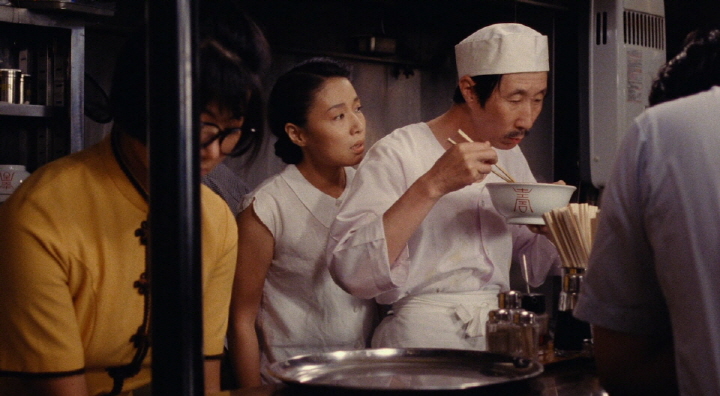
In addition, Tampopo and the truck driver get some extra help from two unlikely experts. One of them is an old homeless man who turns out to be quite knowledgeable about ramen, and we get a hilarious scene where he and his fellow homeless men show a surprising amount of culinary insights. When Tampopo and the truck driver happen to save an old rich man’s life, they are introduced to the chauffeur of that old rich man, and, what do you know, this dude turns out to be a considerable ramen expert and is very willing to help Tampopo’s ongoing project.
While steadily rolling its main story to its expected finale, the movie doles out a series of quirky comic moments around the fringe of the story. These moments are not directly connected with the main story, but all of them are connected with food and eating in one way or another, and some of them are quite wry and naughty to our little amusement. In case of a couple of sex scenes involved with a lot of different types of food, we are served with a weird but funny cross between Adrian Lyne’s “9 1/2 Week” (1986) and Dušan Makavejev’s “W.R.: Mysteries of the Organism” (1971), and this is certainly something we cannot see everyday. I also like an uproarious comic scene involved with eating spaghetti, and I must tell you that the sound effects in this scene are as hilarious as that infamous fart scene in Mel Brooks’ “Blazing Saddles” (1974).
You may roll your eyes more than once during these and other offbeat moments in the story, but the movie, which is clearly influenced by the works of Jacques Tati as well as Luis Buñuel (Itami was particularly inspired by Buñuel’ 1974 film “The Phantom of Liberty” (1974), by the way), presents them with a lot of humor and insight based on human nature. We can often be quite silly as following our basic human needs including eating right from when we are born into this world, and that is particularly exemplified well by a vignette involved with a guy who still cannot stop his food love even though he is soon going to a dental clinic for some serious treatment. You may laugh for his silliness at first, but then you will come to have a knowing smile as observing a bit of human nature from his silly behaviors.
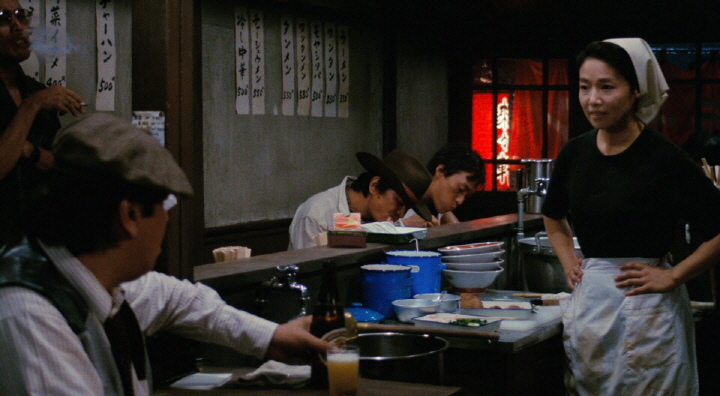
Anyway, the movie always goes back to making a good bowl of ramen, and there are surely several moments to make you hungry for ramen during your viewing. I still remember how wonderfully the movie presents a bowl of freshly cooked ramen with a lot of juicy details to observe at the beginning of the story, and I was alternatively touched and amused by that inevitable moment when Tampopo finally reaches the end of her lesson and then demonstrates her improved culinary skill (Is this a spoiler?).
The main characters in the film are more or less than broad archetypes, but they leave indelible impression thanks to the spirited efforts of the main cast members. While Nobuko Miyamato often elevates the movie with her plucky performance, Tsutomu Yamazaki is effective as a gruff but ultimately generous man, and he and Miyamato click well with each other as suggesting a low-key sense of romance between their characters. In case of several notable supporting performers in the movie, they also have each own moment to shine, and you may be delighted to see Kōji Yakusho and Ken Watanabe during their early career years.
In conclusion, “Tampopo”, which incidentally means “dandelion” in Japanese, is brimming with a lot of charm and amusement even after 40 years it came out, and I am still smiling a bit as reflecting on many of its funny or tasty moments. In my trivial opinion, that is what a good movie can do, and I am already willing to revisit this modest but undeniably charming movie sooner or later.


 Seongyong's Private Place