

Ari Aster’s latest film “Eddington” is a superficial genre exercise which did not amuse or engage me at all. Yes, I understand that the movie is supposed to function as a distorted mirror to the confusion and frustration in the American society during the COVID-19 pandemic era, but the movie only ends up being a nihilistic ideological mess, and I come to detest its ideas and attitudes more as I reflect more on its story and characters.
The main background is a small New Mexico town named Eddington during late May 2020, which was the peak period of the COVID-19 pandemic. When Ted Garcia (Pedro Pascal), the mayor of the town, not only implements a lockdown but also enforces mask mandates for preventing more infection, some people in the town are not so pleased to say the least, and Sheriff Joe Cross (Joaquine Phoenix) is one of such people. Just because the town has not had any COVID-19 patient yet, he believes that the mayor is just overacting, and, not so surprisingly, he often watches and listens to numerous conspiracy theory stuffs on the Internet, which were incidentally increased a lot more during the COVID-19 pandemic era.
And a number of people around Sheriff Cross do not help or correct him much. While his two deputy sheriffs are not so competent to say the least, his wife Louise (Emma Stone) has been stuck in her own delusion, and the same can be said about his mother-in-law Dawn (Deirdre O’Connell). Dawn often talks about how petty and inconsequential he is compared to his father who also worked as the town sheriff before his death, and this certainly prompts him to do more willful defiance against Mayor Garcia, who is rather annoyed as preparing for the upcoming mayoral election in the town.

In the end, Sheriff Cross decides to run for the election, and the movie surely generates a bit of amusement how woefully unprepared he is from the very beginning. First, he does not know much about how to register himself as an eligible candidate, and neither do his deputies, who also cannot think of any simple or effective slogan for his election campaign. Nevertheless, he manages to draw more attention and support from others in the town, and Mayor Garcia becomes more watchful about this possible competitor of his. Besides his election business, Mayor Garcia also must work on how to get a rather questionable business project approved, and Sheriff Cross is willing to make him look corrupt for that.
In addition, we come to learn later that there is a complicated history between these two opposing figures. Some years ago, Louise was Mayor Garcia’s girlfriend, but he eventually left her not long before she married Sheriff Cross. Just because of really believing that Mayor Garcia hurt his wife at that time, Sheriff Cross is willing to expose more of whatever happened between his wife and Mayor Garcia, but that is the last thing wanted by Louise.
Meanwhile, things keep getting more complicated in the town. After that tragic real-life incident involved with a black man named George Floyd, many young people become politically active to a considerable degree, and this certainly leads to more headache for Sheriff Cross. In addition, there is an anonymous vagrant who is clearly not that well in his mind, and we instantly sense a trouble right from his first appearance at the beginning of the story.
All these and many other elements including a radical cult leader who draws Louise’s attention are supposed to gel together for creating a big picture of the confusion and frustration in the American society during the COVID-19 pandemic era, but Astor’s screenplay merely juggles its clashing plot elements without generating much narrative momentum to hold them together. At one point in the middle of the story, there is a big protest sequence clearly intended to reflect and symbolize how confusingly disharmonious the American society was during that time, but you can only see Astor throwing a lot of different stuffs in the air without any clear direction at all.
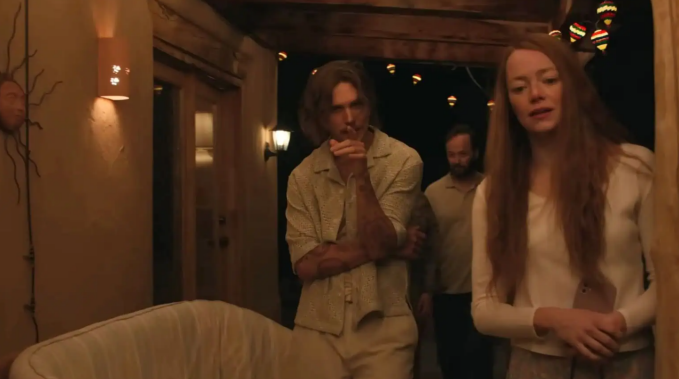
Well, you might say this is actually the point of the movie, but it still feels quite aimless and confused about what and how it is about. As making almost all of the characters in the film unlikable in one way or another, the movie seems to take that typical stance of criticizing, yes, *both sides*, and I cannot help but think of how such a mindlessly irresponsible stance has led to the rise of fascism around our world during last several years. To make matters worse, the story only exacerbates this glaring ideological flaw during its second half with more viciousness and nihilism, and that makes the film more like tolerating a very confused and disagreeable dude for more than 2.5 hours.
Joaquin Phoenix, who previously collaborated with Aster in “Beau Is Afraid” (2023), is certainly no stranger to playing a deeply troubled anti-hero, and he does his best for carrying the movie to the end, but it regrettably fails to support his efforts just like Todd Phillips’ equally hollow film “Joker” (2019). In case of many other notable performers in the film such as Pedro Pascal, Emma Stone, Deirdre O’Connell, Micheal Ward, Clifton Collins Jr., and Austen Butler, they are simply required to do no more than filling their respective spots, but Butler manages to bring some twisted humor to his few scenes in the film at least.
In conclusion, “Eddington” is another disappointment from Aster after “Beau Is Afraid”, which is interesting to some degree but ends up becoming quite self-indulgent to my growing annoyance. Nevertheless, I still admire Aster’s two feature films “Hereditary” (2018) and “Midsommar” (2019), and I can only hope that Aster will be back in his element as soon as possible.



 Seongyong's Private Place