
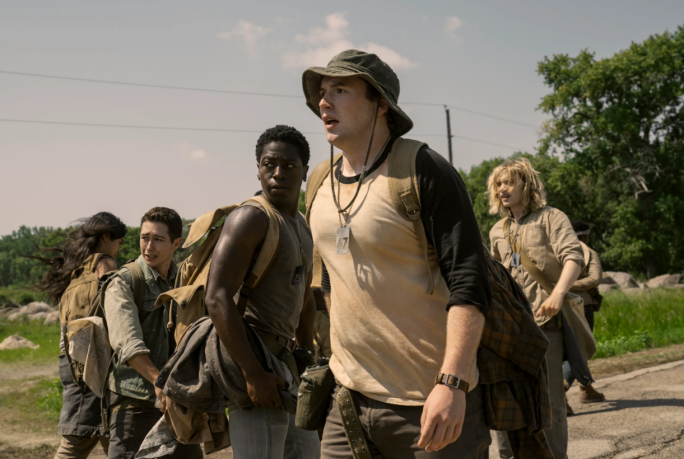
“The Long Walk” is a modest but effective dystopian survival thriller driven by one simple but compelling story premise. Although we can clearly see where it is heading from the very beginning, the movie keeps things rolling before eventually arriving at its expected finale, and it is also supported well by a bunch of good performers to notice.
The movie, which is based on the 1979 novel of the same name by Stephen King (It was originally published under his pseudonym Richard Bachman, by the way), mainly revolves around a lad named Raymond “Ray” Garraty (Cooper Hoffman), and the early part of the story quickly establishes his dystopian world, which an alternative version of the American society during the late 20th century. After some big war, the American society in the story has been ruled by a military dictatorship mainly represented by an authoritarian figure called “the Major” (Mark Hamill, who feels as hammy as demanded), who supervises an annual national competition event called “the Long Walk”. Every year, 50 young men, who are respectively selected from the 50 states of the country, participate in this competition, and the rule of this competition is pretty simple: walk in the constant pace as long as possible until you become the last man walking.
While he could quit right before the beginning of the competition, Garraty is already quite determined due to a personal goal to be revealed later in the story. After arriving at the starting spot where many other young men are already waiting for the beginning of the Long Walk, he comes to befriend some of them including Peter “Pete” McVries (David Jonsson), and the mood seems casual among these young lads even though they all know well that they will end up competing with each other in one way or another.

And things gradually gets intense for them as the competition is started right after a big speech delivered by the Major. For whoever will eventually become the winner, there will be a lot of money in addition to one wish to be granted, and many participants are quite eager to win the prize despite the amounting challenge upon them. All they have to do is continuing to walk at the speed of three miles (4.8 km) per hour, but, of course, that becomes harder and harder as they keep walking for more than 24 hours without any rest at all.
The soldiers under the command of the Major provide some water at times as accompanying and monitoring the participants of the Long Walk, but their main purpose is eliminating anyone violating the rule of the competition. If anyone stops or becomes slower than three miles per hour, there will be a warning. Although this can be nullified if he continues to walk during next three hours, he will be instantly eliminated once he gets three warnings in row.
Needless to say, many of the participants get eliminated one by one along the story for various reasons such as a strained ankle. As their number is dwindling step by step, the remaining lads become more desperate for survival, but their competition seems endless as before, and they inevitably find themselves on the verge of facing each own breaking point.
Steadily maintaining its pacing along with its main characters, the adapted screenplay by JT Mollner occasionally allows some character development to engage us more. As they show more of themselves to each other, Garraty and McVries come to bond with each other more, despite still knowing well that only one person will survive and then win in the end. Besides them, we also get to know some of the other participants, and their broad but colorful personalities bring a bit of humor and pathos to the story.
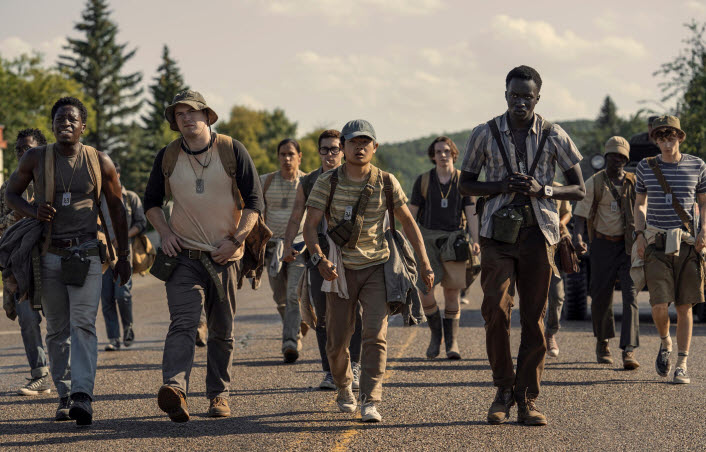
This is not alien territory at all for director/co-producer Francis Lawrence, who previously made several movies in the Hunger Games series including “The Hunger Games: The Ballad of Songbirds & Snakes” (2023). Although the movie is far more modest and simpler compared to those Hunger Games movies, Lawrence did a competent job of making the story and characters look and feel convincing on the screen. While the story itself is more or less than a social allegory, it is filled with enough mood and tension at least, and that is the main reason why we come to care more about what may happen at the end of the story.
It certainly helps that the main cast members, who will receive the Robert Altman Award along with Lawrence at the Film Independent Spirit Awards early in the next year (The movie actually costs no more than 20 million dollars, folks), carry the film well with their solid ensemble performance. While Cooper Hoffman, who is the son of late Philip Seymour Hoffman and has already shown his considerable potential in Paul Thomas Anderson’s “Licorice Pizza” (2021), holds the center as required, David Jonsson, who has been a new exciting talent to watch after “Rye Lane” (2023) and “Alien: Romulus” (2024), ably complements Hoffman, and several other main cast members including Garrett Wareing, Tut Nyuot, Charlie Plummer, Ben Wang, Jordan Gonzalez, and Joshua Odjick are well-cast in their respective supporting parts.
On the whole, “The Long Walk” walks fairly well enough for holding our attention to the end, and I appreciate how it vividly presents some of the suspense and drama I experienced while reading King’s novel around 25 years ago. Yes, this is not exactly fresh in these days due to many of other similar movies ranging from those Hunger Games movies and Japanese film “Battle Royale” (2000), but it did its job well, so I will not grumble for now.


 Seongyong's Private Place