

French film “Souleymane’s Story” follows the plight of one young immigrant from Guinea. He simply hopes to be allowed to live and work for himself as well as his dear family in Guinea, but his situation becomes quite desperate in one way or another as one important chance seems to slip away from him. Yes, this is another typical immigrant drama on the whole, but the movie is packed with considerable realism and verisimilitude to engage us, and, above all, it is firmly anchored by one of the best movie performances I saw during this year.
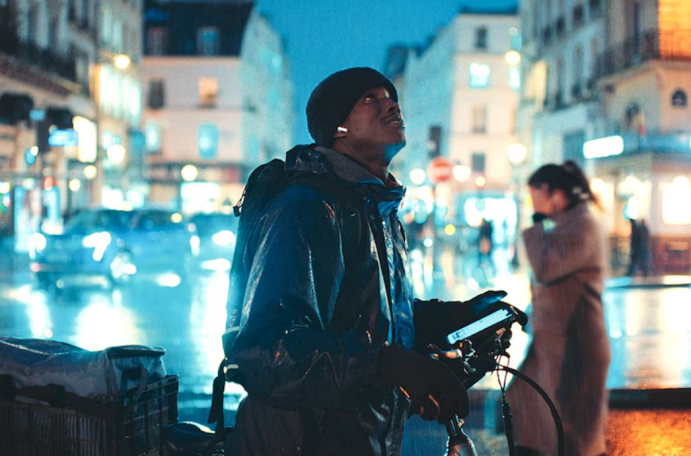
After the brief opening scene, the movie quickly establishes how things have been hard and difficult for Souleymane (Abou Sangaré). Some time ago, he left his country for working in France, but his current status is quite unstable to say the least. He has earned his meager living via working as a food delivery guy, and, mainly because he is not legally permitted to live and work there yet, he has to borrow the food delivery account of somebody else, whom he must pay a considerable part of his daily earning in exchange for that. In addition, because he is virtually homeless, he always has to depend on a local homeless shelter at every night, so he must finish his delivery job before being too late for the bus to take him and many others to that facility.
Meanwhile, as already shown from the opening scene, Souleymane has been trying to apply for political asylum, though he was just a mere mechanic in his home country. Needless to say, he must lie a lot about why he came to leave the country, and there is a little amusing scene where a fellow Guinean guy gives some advice to him and several others while also promising to give some necessary documents for political asylum application. Of course, the guy demands some money in exchange for that, but, alas, Souleymane does not have enough money to pay for those phony documents.

In the end, he has no choice but to work harder for earning more money. Because he is going to have an asylum application interview no less than two days later, Souleymane tries to memorize every detail of his fake history as much as possible, but he is not so sure about whether his lie can actually help him settling in Paris, especially when one of his colleagues tells a bit about how he miserably failed in the same attempt.
And he continues to work as usual. We often see him riding his bike here and there in city for one delivery job after another, and this takes my mind to Sean Beaker and Shih-Ching Tsou’s little but memorable movie “Take Out” (2004), which is about a young Chinese immigrant lad working as a delivery guy in New York City. Like the hero of “Take Out”, Souleymane must cope with various difficulties during his working time day by day, and we cannot help but observe how often he is callously disregarded by his clients.
Later in the story, something unexpected happens, and this makes Souleymane’s situation all the more frustrating. As he tries to handle this increasingly despairing circumstance of his, the camera of cinematographer Tristan Galand stays closer to our unfortunate hero for generating more verisimilitude on the screen, and I was not so surprised to learn later that the camera and the boom operator actually had to ride a bike for shooting all those bike-riding scenes in the film.
And the screenplay by director Boris Lojkine and his co-writer Delphine Agut gradually reveals some personal details on its hero. We come to learn later that he came to Paris mainly for earning enough money for taking care of his mentally ill mother more, and there is a sad moment when he talks with his mother in Guinea on the phone for a while. It is clear that her medical condition is getting worse, but he cannot possibly do anything about that. Furthermore, his girlfriend, who is also in Guinea, notifies to him that she is seriously considering marrying someone else now, and this naturally makes him wonder more about whether he made the right decision when he left his country.
In the end, everything expectedly culminates to the asylum application interview between Souleymane and a female government official who is going to listen to his story and will decide whether he can stay in France as a political refugee. At first, things seem to be going fairly well for him, but we come to sense that the government official have seen a lot of guys not so different from him, and the mood accordingly becomes more tense later.
Before the production of his film, Lojkine, who received the Jury Prize when the movie was shown at the Un Certain Regard section of Cannes Film Festival early in last year, went through an extensive search for his leading actor, and he did find the right one from Abou Sangaré, a non-professional Guinean actor who had no previous acting experience before this film. While there is indeed a considerable overlap between his real life and his character, Sangaré, who received the Best Performance award at the Cannes Film festival and then recently received the Breakthrough Performance award at the Gotham Independent Film Awards, is totally compelling is his strong natural performance, and his excellent acting brings enough sincerity and honesty to prevent the movie from becoming another usual immigrant drama film.
In conclusion, “Souleymane’s Story” is another powerful immigrant drama film to notice thanks to Lojkine’s skillful direction and Sangaré’s unforgettable performance at its center. It may not surprise you that much in terms of its main subject, but it will engage you much more than expected, and you will never forget its hero after it is over.



 Seongyong's Private Place
Pingback: 10 movies of 2025 – and more: Part 2 | Seongyong's Private Place