
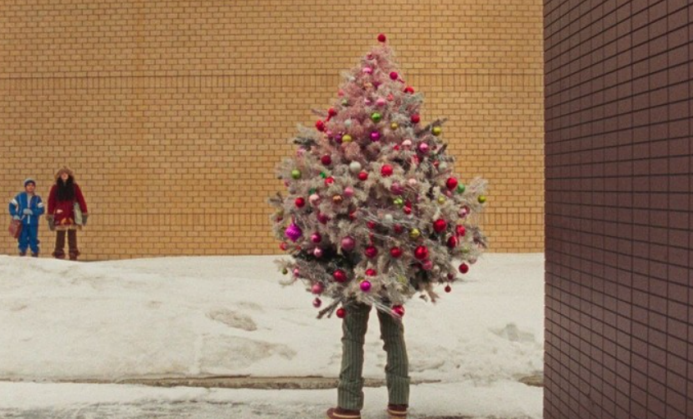
Matthew Rankin’s “Universal Language”, which was selected as the Canadian submission to Best International Film Oscar in last year, is a singular cinematic mix to behold. While clearly influenced by the works of Guy Maddin, Wes Anderson, and Roy Andersson, the movie also distinguishes itself a lot with its own unconventional cultural concoction, and it also shows a bit of surprising human poignancy behind its many moments of deadpan comedy.
The movie, mainly set in Winnipeg of Canada, begins with the dryly absurd opening scene which clearly evoke the deliberately and humorously drab texture of many funny moments in Anderson’s several films such as “You the Living” (2007). On another very snowy day, a teacher comes to his classroom, but he somehow becomes quite annoyed by his perky students, and he comes to say some really bitter things to them, though none of them seems so dispirited by that.
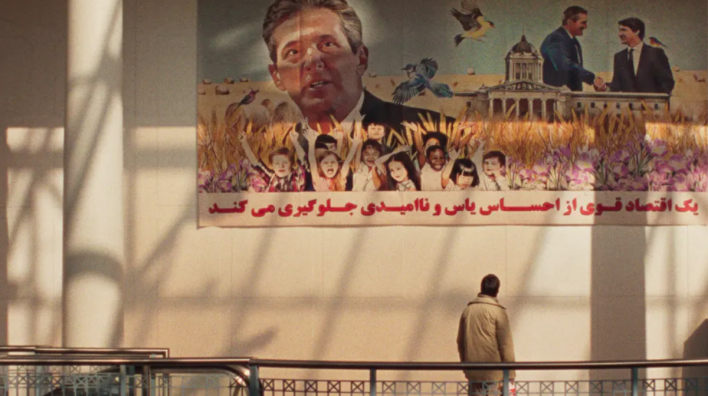
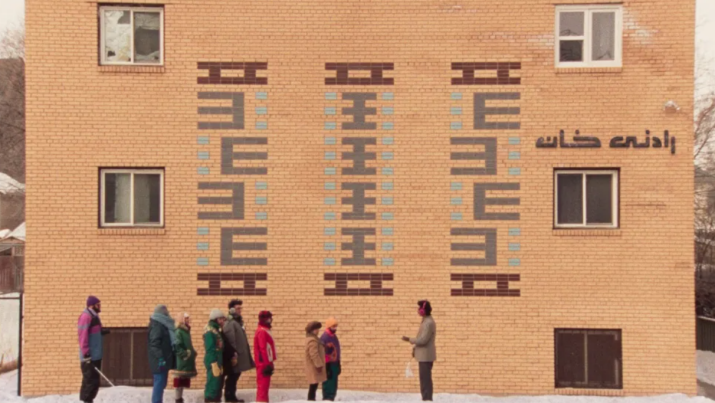
Meanwhile, we notice more of the odd background setting of the film. The city and its citizens look like belonging to an alternative world where Iranian is a common language instead of English, though they still have to learn French for working in Quebec. Although many buildings in the city surely look Western, we observe a number of Iranian elements here and there on the screen, and this alternatively baffles and amuses us.
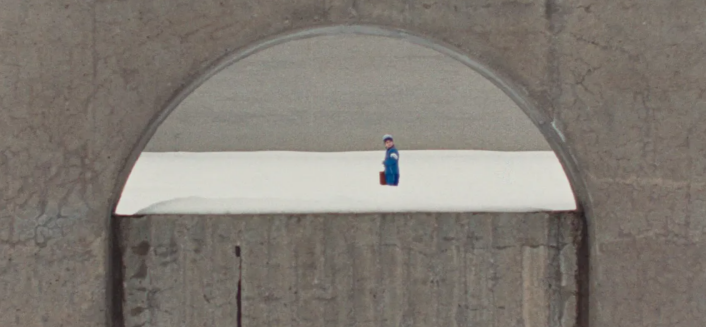
Anyway, we are later introduced to two young sisters Negin (Rojina Esmaeili) and Nazgol (Saba Vahedyousefi), whose innocent story may remind you a bit of Iranian children’s films such as Abbas Kiarostami’s “Where Is the Friend’s House?” (1987), Because one of her classmates lost his glasses due to a rather unbelievable incident which occurred when he was going to their school, Negin wants to help him as much as possible. At first, she and Nazgol simply try to find his glasses, and then they come across money frozen in ice, and they subsequently look for any possible way for retrieving it and then using it for buying the new glasses for Negin’s unfortunate friend.
Meanwhile, we get to know a bit about Matthew, who is a plain ordinary guy returning from Quebec after his many years of absence and is incidentally played by Rankin himself. He just wants to see his aging mother again, but, alas, he is only notified that his mother died some years ago, and his old family house is now resided by some other family. When he later goes to that house, the current owner of the house treats him with sincere hospitality, and there is a little sad moment when the camera lingers on something from his childhood past for a while.
Because somebody answered when Matthew tried to contact his mother on the phone, he cannot help but become curious about who this person is, and we are soon introduced to this person in question. Massoud (Pirouz Nemati) has worked as a tourist guide, and there are several absurdly amusing scenes where he guides a small group of tourists around a number of rather banal spots which are supposed to be, uh, historically important.
While several different narrative lines in the story eventually get intertwined with each other, the movie takes time for getting us more absorbed in its strange but somehow very realistic background. Rankin and his cinematographer Isabelle Stachtchenko frequently fill the screen with palpable wintry atmosphere, and that makes a good contrast with several unexpectedly colorful comic moments as stylized as the works of Wes Anderson. I particularly enjoyed the part involved with a local turkey shop and its eccentric owner, and the movie adds extra surreal touch via a bunch of living turkeys frequently roaming across snowy streets.
These and many other offbeat moments eventually function as the ground for what can be regarded as the emotional highpoint of the movie. When Matthew finally meets Massoud later in the story, Massoud tells Matthew more about the last years of Matthew’s mother, and Matthew comes to feel more guilt and sadness, especially when he goes inside a certain room and then experiences something quite surreal. I will not go into detail here, but the movie stays straight along with its performers, and that is the main reason why this strange moment works with genuine dramatic impact.
Even at that point, the movie does not lose any of its quirky sense of humor, and this often reminds me of Guy Maddin’s extraordinary film “My Winnipeg” (2007). Although these two films are quite different from each other in many aspects, they also share a lot of common things between them besides their main background, and that is quite evident whenever Rankin cheerfully goes back and forth between deadpan humor and surreal absurdity just like Maddin did in “My Winnipeg”.
Overall, “Universal Language” shines with a lot of offbeat style and humor to be savored, and I am willing to revisit its odd but interesting world just for cherishing more of its distinctive mood and details. Although I have not seen his first feature film “The Twentieth Century” (2019) yet, I can tell you instead that Rankin shows considerable talent in his very next feature film, and I will certainly look forward to watching what may come next from this promising filmmaker. In short, this is one of the best films I saw during this year, and I wholeheartedly recommend you to check it out as soon as possible.


 Seongyong's Private Place
Pingback: 10 movies of 2025 – and more: Part 2 | Seongyong's Private Place