
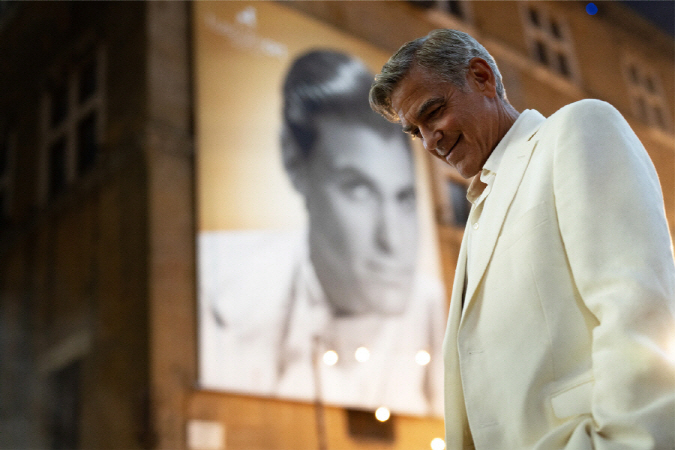
Noah Baumbach’s latest film “Jay Kelly”, which was briefly shown in theaters before it is released on Netflix in this week, is a humorous story about the middle-life crisis of one big movie star. While it is quite typical in many aspects, the movie is packed with enough wit and insight as following its celebrity hero’s emotional journey, and it is also anchored well by the solid lead performance at its center.
George Clooney, who gives one of his best performances here in this film, plays Jay Kelly, a famous Hollywood actor who has just finished shooting another movie at the beginning of the story. While he will soon move onto the next movie to shoot, Kelly wants to spend some little private time with his adolescent younger daughter Daisy (Grace Edwards) before that, but she is soon going to travel around Europe before beginning to study in John Hopkins University, and that reminds him again of how distant they are to each other at times.
Meanwhile, his longtime manager Ron Sukenick (Adam Sandler) brings him a sudden sad news. Peter Schneider (Jim Broadbent), an old filmmaker who gave Kelly a big career breakthrough many years ago, died, and Kelly cannot help but feel guilty for a good reason. When Schneider requested a bit of help from him not so long ago, Kelly flatly rejected Schneider’s request without much thought. As watching Schneider’s son remembering his father at the following funeral, Kelly feels all the more regretful, and then there comes another figure who knew him during those early years of his career.

Of course, Kelly comes to reflect more on where his life has been going, and then he makes a rather impulsive decision to the surprise of everyone around him including Sukenick. He decides to accept the life achievement award given by some prestigious film festival to be held somewhere in Italy, just because that will make a good excuse for meeting and then spending some time with Daisy, who has already gone to Europe along with several friends of hers.
Needless to say, things do not go that well for Kelly and his several close associates right from when they arrive in France via a private jet plane, and they end up being stuck with many passengers on a train going to Italy. Not so surprisingly, Kelly is instantly recognized by the passengers, and he certainly charms them a lot with his own presence and charisma. After all, he is played by Clooney, and we cannot possibly expect anything less than that, right?
And we also get to know more about Kelly’s many human shortcomings. As he sometimes looks back on his past, he comes to see more of how he has often ruined his relationships with a number of people close to him including Daisy and her older sister Jessica (Riley Keough), who has distanced herself from her father a lot for years. During one flashback scene, he sincerely tries to fix his damaged relationship with Jessica, and then he only ends up running away from facing her longtime pain and resentment caused by him.
In case of Daisy, she is not so amused to see her father again, and Kelly miserably fails to persuade her to join him in that film festival in Italy. In the end, only his aging father attends a little celebration party with Kelly, and Kelly’s father surely reminds Kelly of how Kelly is not so different from his father as becoming a lousy father just like him.
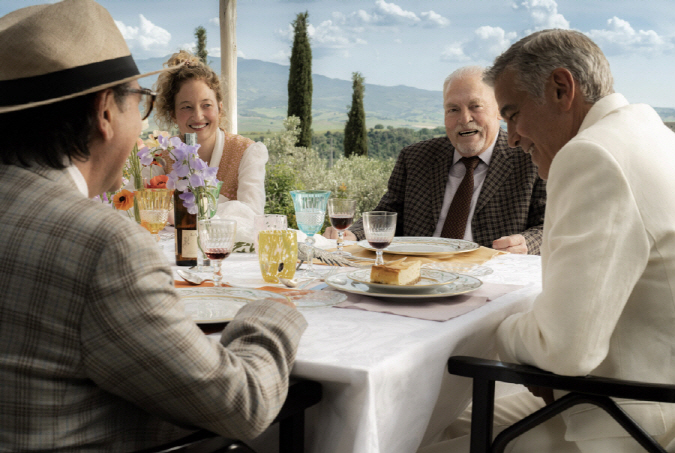
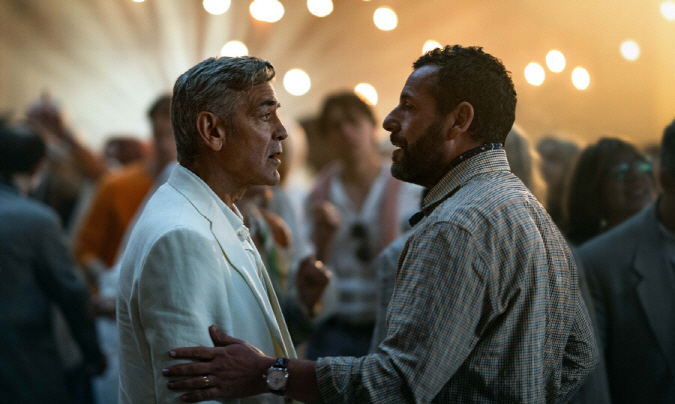
The screenplay by Baumbach and his co-writer Emily Mortimer, who also served as one of the executive producers of the film besides briefly appearing in the opening scene, feels a bit too leisurely at times, but it still engages us with several well-written moments to observe. Besides sharply observing how messy its hero’s private life, the movie also pays some attention to several main characters revolving around him, and it is poignant to observe how much Sukenick has devoted himself to Kelly’s career. Sukenick frequently disappoints his wife and kids a lot along the story due to being always busy with handling all those matters involved with Kelly, but they accept that simply because they understand and love him, and his loving relationship with his family surely makes a contrast with Kelly’s problematic relationship with his kids.
During the last act, the movie becomes more predictable, but it remains buoyed by its overall lightweight mood. Besides deftly handling the wonderful extended shot of the opening scene, cinematographer Linus Sandgren, who previously won an Oscar for Damian Chazelle’s charming musical film “La La Land” (2016), did a splendid job of filling the screen with warm and intimate atmosphere, and that is often accentuated by Nicholas Britell’s witty score.
As Clooney, who has surely been aged enough to play his character, effortlessly holds the center, a number of various performers have each own moment to shine. While Riley Keough and Grace Edwards are terrific as Kelly’s two different daughters, Laura Dern, Billy Crudup, Stacy Keach, Jim Broadbent, Patrick Wilson, Greta Gerwig, Isla Fisher, and Alba Rohrwacher are effectively cast in their small supporting parts, and Adam Sandler, who previously collaborated with Baumbach in “The Meyerowitz Stories (New and Selected)” (2017), demonstrates again that he can ably dial down his rather abrasive comic persona for the more serious sides of his acting talent.
Overall, “Jay Kelly” is less impressive compared to Baumbach’s previous Oscar-winning Netflix film “Marriage Story” (2019), but it is at least two or three steps up from the disappointment of “White Noise” (2022), another recent Netflix film from Baumbach. I must point out that the movies about affluent white man’s middle-life crisis have been dime a dozen for years, but the movie is a fairly good one at least thanks to its competent handling of story and characters, so I will not grumble for now.


 Seongyong's Private Place
Pingback: 10 movies of 2025 – and more: Part 2 | Seongyong's Private Place