
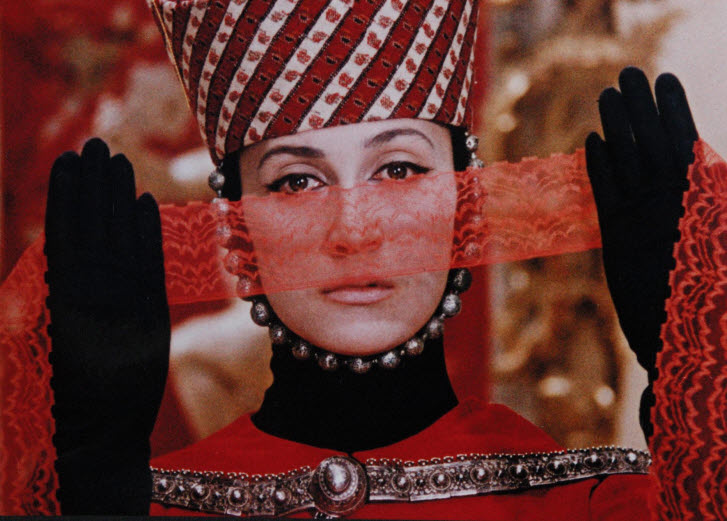
In my humble opinion, a good movie can reach to your heart and mind, no matter how vague and elusive it is in what and how it is about. In case of Sergei Parajanov’s 1969 film “The Color of Pomegranates”, which was incidentally released in South Korean theaters in last week, you will likely be left with a lot of bafflement on what it is really about, especially if you do not know anything about its main subject in advance. To be frank with you, my mind became befuddled again when I watched it yesterday, but my heart was also reminded again that its rough but mesmerizing cinematic beauty is definitely something singular to behold.
Although he has been regarded as one of the greatest filmmakers in the 20th century, the works of Parajanov, who died in 1990, have been sort of an acquired taste to me. Before watching “The Color of Pomegranates”, I watched his another acclaimed work “Shadows of Forgotten Ancestors” (1965), but that film also baffled me a lot although it may be a bit more accessible in comparison. Right after watching it, I moved onto “The Color of Pomegranates”, but I was not wholly enthusiastic, unlike many other critics and filmmakers who cherished the film a lot as it slowly emerged from obscurity during last 46 years.
The movie is supposed be about the life and career of a 17th century Armenian poet named Saya-Nova (1712 ~ 1795), but, folks, this is not a conventional biography film at all. Here in this film, Parajanov tries a very unorthodox artistic approach on his main subject without any apparent narrative line to hold our attention, and the movie mainly consists of a series of seemingly random individual scenes which are supposedly derived by the life and works of Saya-Nova.

You will surely get quite confused and confounded during its first 10 minutes as I did again, but you may also admire what Parajanov, who also edited the film along with M. Ponomarenko and Sergei Yutkevich, and his crew members including cinematographer Suren Shakhbazyan and composer Tigran Mansuryan are trying to achieve on the screen. Many of the key scenes in the film evoke the statically ordered composition of tableaux vivants for vividly conveying to us the artistry of the works of Sayat-Nova and their cultural/religious backgrounds, and I paid attention especially to how often Parajanov often adds some slight physical movements to the mise-en-scène of many of the key scenes in the movie. For example, he frequently adds an object moving back and forth like an pendulum in the background, and now I wonder whether this little artistic touch symbolizes the passage of time, though what my late mentor/friend Roger Ebert once said comes to my mind: “If you have to ask what it symbolizes, it didn’t.”
In case of those various images in the film, some of them will surely remain in your mind for a while for their striking visual quality. The opening scene is quite impressive as a number of various objects including a knife and, yes, three pomegranates are presented one by one on a piece of white sheet, and we later get the hunting image of the knife covered with the juicy fluid from the crushed pomegranates. In case of a part involved with a youthful romance in Sayat-Nova’s life, this part is unfolded inside a confined space which supposedly stands for a local palace, and Sofiko Chiaureli, who played various roles in the film including “Poet as a Youth”, provides several beguiling moments as a young beautiful woman who seems to be the object of desire for Saya-Nova.
Meanwhile, I came to notice more of several other interesting things in the film during my second viewing. The early part of the movie presents “Poet as a child”, played by Melkon Aleksanyan, and there is a brief but fascinatingly voyeuristic moment when this young boy has some sneaky peek on a local bathing place. Along with him, the movie lovingly looks at the full body of a man, and then there comes a shot showing a naked female torso whose one of the two breasts is covered by a shell. This somehow reminded me of that infamous line from Stanely Kubrick’s Roman period film “Spartacus” (1960): “My taste includes both snails and oysters”.
According to Wikipeida, Parajanov was actually a closeted bisexual who has some serious trouble with the Soviet government, which persecuted him a lot for his bisexuality and several other reasons such as his political involvement surrounding Ukrainian nationalism. Not long after “The Color of Pomegranates” was made, he got arrested and then sentenced to five years in a hard labor camp for homosexuality, and that was just one of many troubles he had with the Soviet government throughout his life and career.
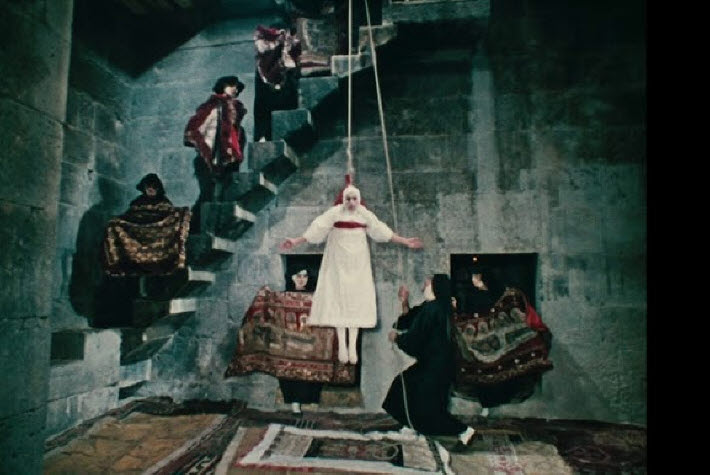
And the movie also went through a pretty hard and difficult time during the same period. Mainly due to its avant-garde style defying against the social realism style of many other contemporary Soviet films during that period, the movie was quickly rejected by the Soviet censors and officials, and the movie subsequently went through a considerable modification process just for making it a bit more accessible to the public. In fact, the very title of the movie was actually not the original one (The original title was simply “Sayat-Nova”).
Fortunately, the movie later went through the 2014 restoration by Martin Scorsese’s Film Foundation in conjunction with Cineteca di Bologna, and the result has been wholeheartedly embraced by many critics and movie fans around the world. In addition, it becomes all the more accessible now thanks to the release of the Criterion blu-ray edition in 2018 (Needless to say, Criterion did not disappoint us at all).
On the whole, “The Color of Pomegranates” is quite an admirable arthouse film even though I still do not understand and like it that much even at this point. I only give it three stars now mainly because of this reason as well as its adamantly befuddling nature, but I am also willing to revisit and learn more from this remarkable artwork which has surely occupied a very important place in the cinema history. Anyway, I am glad that I watched it at a local movie theater along with several other equally baffled audiences yesterday, and I will remember this interesting movie experience at least for a while.


 Seongyong's Private Place