
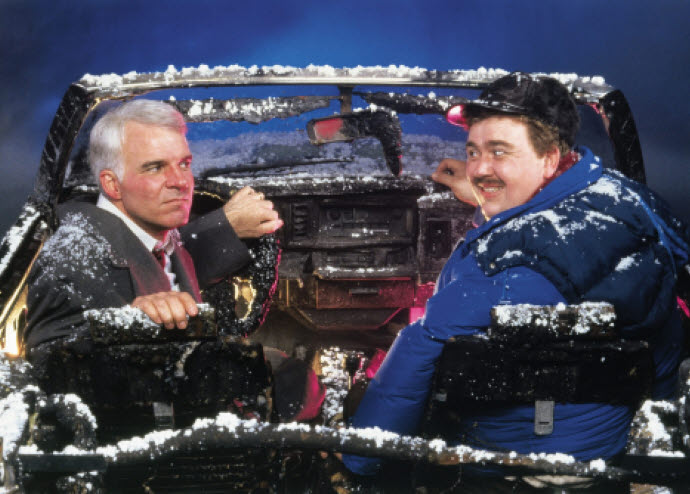
As a South Korean who has seldom left his country during last 42 years, I have never experienced Thanksgiving Day for my whole life, but I could not help but amused and touched by John Hughes’ 1987 film “Planes, Trains and Automobiles”. While it looks like your average Thanksgiving Day season movie on the surface, the movie works as a surprisingly moving comedy of human nature and understanding, and I found myself again freshly learning its invaluable life lessons.
The biggest reason for that is how I soon found myself wincing and cringing again thanks to one of its two lead characters. Yes, Del Griffith (John Candy), who is merely a traveling shower curtain ring salesman, is certainly a certain type of person who will make your eyes roll for good reasons, and I was annoyed again by his many flaws during the first 30 minutes of the film, but, surprise, I came to accept, tolerate, and understand him a lot just like I did when I watched the film for the first time around 20 years ago.
The secret of the success of the film is having someone who can function as an effective counterpoint to Del in addition to being changed a lot by his presence and influence. He is a New York City advertisement company executive named Neal Page (Steven Martin), and the first half of the movie has a lot of naughty fun with his amounting frustration from how he keeps struggling to get back in his family home in Chicago before Thanksgiving Day. First, he has to endure his boss’ exasperating indecisiveness on their latest project. Second, he must hurry to get a cab to take him to the airport, and, of course, he spectacularly fails to his annoyance, Third, he manages to arrive at the airport in time, but, what do you know, his airplane to Chicago gets not only delayed during next several hours but also has to land in somewhere else due to an unexpected snow storm in Chicago.

In the midst of this unbelievable series of bad luck, Neal finds himself stuck with Del, who looks like the cherry on the top of the amounting layers of troubles for Neal. Right from their first formal introduction to each other, Del annoys Neal a lot to say the least, so Neal tries to distance himself away from Del’s friendly approach as much as possible, but, of course, he only gets more stuck with Del, especially when they come to stay in a motel after their airplane landed somewhere in Kansas instead. During the next several hours, Neal comes to learn more of how annoying Del can be in one way or another, and we are not so surprised when he eventually reaches to the breaking point and then becomes very, very, very brutally honest about Del’s many shortcomings.
And that is when the Huges’ screenplay comes to show much more heart than we expected. As cinematographer Donald Peterman’s camera focuses on Del’s face, we come to gather how much Del feels hurt by Neal’s brutal honesty, and it is also implied that this is not the first time when Del unintentionally rubs out others in wrong ways. Once Neal’s rather harsh assessment on his personality is over, Del makes a defiant and poignant argument on how he is not ashamed at all of who he is, and we are not so surprised when Neals soon regrets about what he just said to Del.
Once its two lead characters are established enongh for more development, the movie doles out a series of uproarious comic moments as they go through a series of ups and downs on their road to Chicago. In case of one particular scene which is probably the sole reason for the movie getting rated R, it has one of the most hilarious utilizations of a certain F-word, and the simple but undeniably priceless punchline for this very funny moment still tickles me a lot. I also enjoy that loony highway scene which virtually goes all the way for more laughs, and its coming timing is simply exquisite from the beginning to the end.

Just like many other American comedy films in the 1980s, the movie has some dated aspects to notice. The score for Ira Newborn, who has been mainly known for his contribution to the Naked Gun Trilogy, is mostly effective, but it feels rather old whenever it becomes dominated by those old-fashioned synthesizers, and that reminds me of why I personally believe that those supposedly cool contemporary electronic scores by Trent Reznor and Atticus Ross will quickly be old-fashioned just like that within 20 years. In case of that famous “Those arent’s pillows!” scenes, it only seems to exist for removing the possibility of any homosexual subtext between Neal and Del, while also unintentionally showing some homophobia.
Nevertheless, Huges’ deft handling of his main characters still shines a lot with a lot of caring and affection, and Steve Martin and John Candy are an impeccable comic duo ably complementing each other from the beginning to the end. Martin brings genuine humanity to his role while never stepping away from his character’s neurotic side, and he is also believable as his character comes to accept and then care about Del a lot more than expected around the end of the story. On the opposite, John Candy imbues his character with a lot of good-natured jolliness and sincerity, and he also did a splendid job of adding subtle moments of pathos to his character.
In conclusion, “Planes, Trains and Automobiles” has a lot of wonderful things to make into an enduring holiday season to be cherished, and it can be said that it sets a precedent for many different subsequent movies including Oscar-winning film “Rain Man” (1988). Like that classic film, “Planes, Trains and Automobiles” makes an indelible point on the importance of accepting and understanding others in our life, and I think the movie will keep giving that invaluable lesson to me as before.


 Seongyong's Private Place