
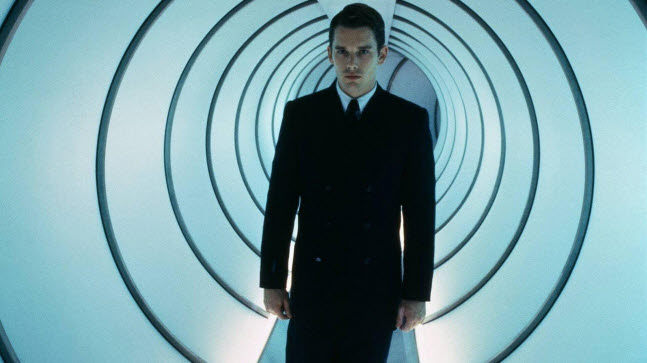
Andrew Niccol’s 1997 film “Gattaca”, which happens to be re-released in selected theaters in South Korea a few days ago, still throws interesting questions for us. Even after more than 25 years after it came out, the movie remains to be a thought-provoking science fiction drama packed with fascinating ideas and details to observe, and it also touches us a lot as making some powerful points on how human spirit cannot be limited by technology.
During its opening part, the movie succinctly establishes a dystopian society where eugenical discrimination becomes quite common thanks to advanced genetic technologies. Many people come to prefer having their babies genetically modified for removing any inferior traits in advance, and many of those naturally conceived persons are socially discriminated in one way or another just because of being genetically inferior, while all those genetically modified individuals come to have much more chance and privilege in contrast.
Vincent Freeman (Ethan Hawke) is one of those naturally conceived persons, and he has been well aware of how he is different even during his childhood years. Regretting the result of their good-willed choice on Vincent, his parents decided to have their second son Anton (Loren Dean) genetically modified in advance, and Vincent could not help but become more and more conscious of the genetic difference between him and his younger brother.
Nevertheless, this did not prevent Vincent from dreaming of becoming an astronaut someday. Although that seemed impossible due to the social discrimination on his genetic condition, Vincent later came to have a bit of conviction when he happened to surpass his younger brother for the first time in their little swimming competition, and that eventually propelled him to try much more for his dream than before.
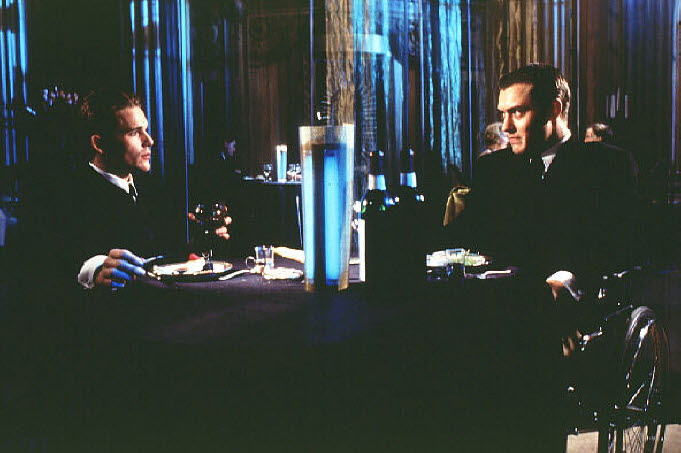
Several years after he left his family and then tried to find any possible way for getting employed in a spaceflight conglomerate named Gattaca Aerospace Corporation (As some of you know, its name consists of the four letters which respectively represent those four nucleobases of DNA: guanine (G), adenine (A), thymine (T), and cytosine(C)), Vincent comes across a good chance via an illegal broker, who introduces to him to a lad named Jerome Morrow (Jude Law). While he was once a promising professional swimmer with an almost flawlessly modified genetic background, Jerome is now wheelchair-bound due to his permanent spinal injury, and he is willing to rent his superior genetic identity to Vincent as living with Vincent for a while.
Thanks to what Jerome provides to him day by day, Vincent manages to get employed in Gattaca, and, thanks to his longtime preparations and efforts, it does not take much time for him to become one of the most promising figures in the company, though he must always be extremely careful about any possibility of getting exposed. As shown from the opening scene, he must clean and shave himself a lot early in the morning, and that is just a mere small part of his daily disguise in the company.
And then things become very problematic for Vincent. One week before the beginning of another space mission which he may eventually join, one of the supervisors is violently murdered. Unfortunately, a tiny debris from his body is subsequently collected during the following police search, and he must be all the more careful in maintaining his genetic disguise – even when he comes to open his heart a bit to Irene Cassini (Uma Thurman), one of the fellow employees in his department who becomes quite attracted to him.
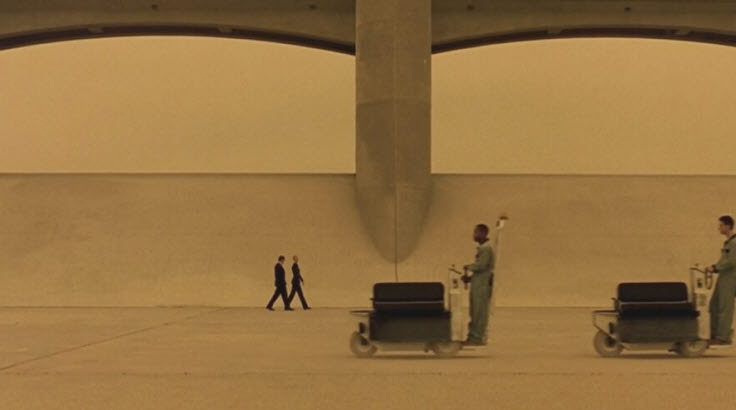
While closely following its hero’s increasingly desperate plight, the movie also takes some time in bringing more details to its distinctive futuristic world. The production design by Jan Roelf and Nancy Nye, which deservedly received an Oscar nomination, often impresses us with its slick and austere retro-futuristic style, and the resulting clinical mood surrounding the main characters is often accentuated by their similar attires and hairstyles. As watching Vincent and other Gattaca employees coming into the company one by one, my mind could not help but reminded of the lyrics from Malvina Reynolds’ 1962 song “Little Boxes”: “And they’re all made out of ticky tacky / And they all look just the same”.
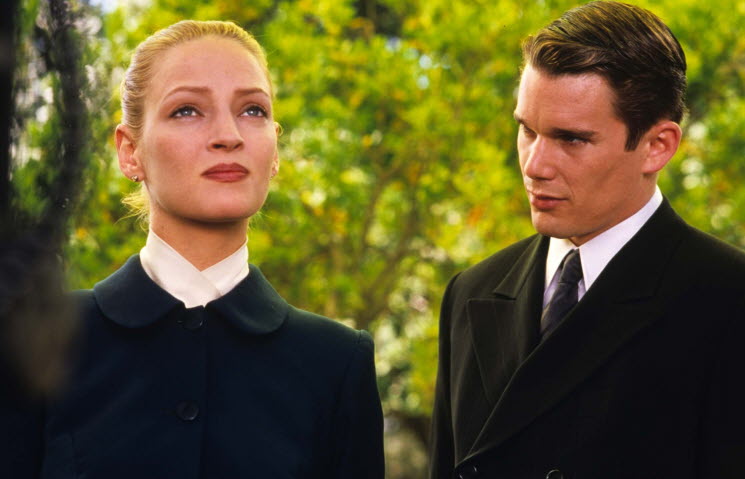
Within this dry and detached world, the movie finds some precious heart to engage us more. Around the last act, Vincent and Jerome come to stick together a lot more than expected, and Jerome’s own little drama along the story gives extra poignancy to the movie. In addition, Vincent’s passion and determination moves not only Irene but also a few others around him, and I particularly like a brief but crucial scene where Vincent receives some unexpected support from one of these figures. No matter how rigid a system is in classification and discrimination, humans always reach for any loophole and can actually succeed as driven by sheer belief and determination, and so now I wonder – is it possible that Vincent’s society has actually allowed and tolerated Vincent and many others strong-willed enough to cross the line, mainly for getting the brightest and strongest ones from their “genetically inferior” class?
While his diligent performance steadily carries the movie to the end, Ethan Hawke, who has been one of the most interesting actors working in Hollywood for many years, is surrounded by a bunch of various performers to notice. Uma Thurman brings some little warmth to her several key scenes with Hawke, and she is especially good when her character makes an important choice later in the story without revealing anything. Alan Arkin, Ernest Borgnine, Gore Vidal, Loren Dean, Xander Berkeley, Elias Koteas, Blair Underwood, and Tony Shalhoub are well-cast in their respective supporting roles, and the special mention goes to Jude Law, who gives the best performance in the film as an arrogantly bitter man who comes to appreciate and care about the sincere aspiration of his accomplice.
On the whole, “Gattaca” is a superlative genre film whose ideas are quite relevant even at present. During last several decades, our society has had a lot of advance and development in biological science, and the world of “Gattaca” surely feels much closer to us than before. Will that brave new world eventually come to us? I have no idea for now, but I can only hope that human spirit will ultimately prevail as the movie hopes.


 Seongyong's Private Place