
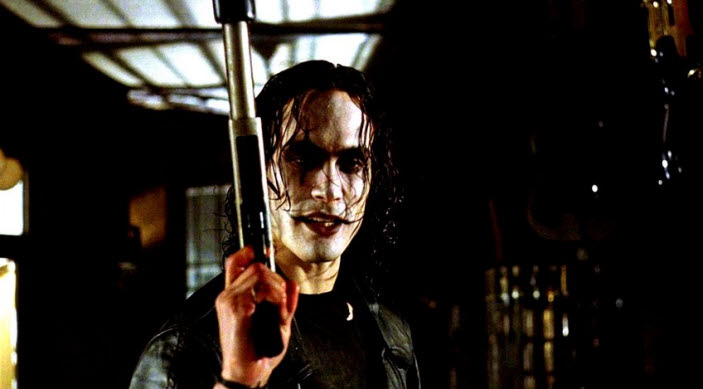
Alex Proyas’ 1994 film “The Crow” is a darkly compelling comic book movie full of style, mood, and details to be appreciated. While it has been mainly remembered as the last film of its ill-fated lead actor, the movie exudes its palpably moody visual power across the screen even after more than 30 years, and this is an exemplary example of how a comic book movie can be both dark and interesting.
The story is set in Detroit, Michigan, but I must say that the city in the movie looks more like a lovechild between Tim Burton’s “Batman” (1989) and David Fincher’s “Seven” (1995). Under the stark night sky, those shabby buildings in the city often look and feel quite seedy and ominous in their dark appearance, and the gloomy atmosphere surrounding them is further accentuated by the frequent rain poured from the sky.
In this rather hellish urban environment riddled with a lot of crime and poverty, there was a young couple who tragically died on the day before their wedding day, which was incidentally Halloween. Just because his fiancée stood against some unfair treatment against them and several other tenants in their apartment building, Eric Draven (Brandon Lee), who was a promising young rock band leader, was brutally murdered along with his fiancée, and their unjust death certainly shocked many of their neighbors including a young girl who was very close to them.
One year later, something unbelievable happens. Via some supernatural power associated with a mysterious crow, Draven returns from death, and we see how he gradually remembers not only who he was but also how he died along with his fiancée. Needless to say, he soon becomes quite vengeful to say the least, and then we soon see him trying a bit of white clownish makeup on his face, which surely makes him look a bit like Batman’s infamous arch-nemesis.
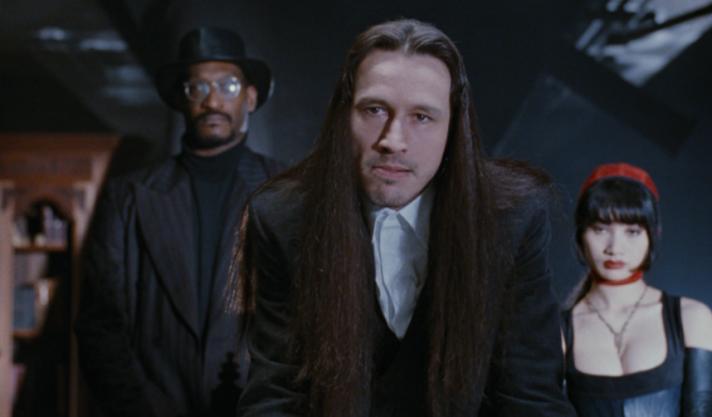
His main targets are those four thugs directly responsible for his and his fiancée’s death. As he eliminates these deplorable criminals one by one thanks to his considerable superpower, Draven comes to draw the attention of Top Dollar (Michael Wincott), a powerful and ruthless crime lord who has virtually had Draven’s neighborhood under his control. It goes without saying that Top Dollar is not very amused by the trouble caused by Draven, and he is certainly quite determined to take care of the latest problem in his area.
Meanwhile, the movie provides a bit of warmth as also focusing on that young girl and Sergeant Albrecht (Ernie Hudson), a veteran police officer who also knew well Draven and his fiancée before their death. After respectively coming to learn about Draven’s miraculous return, both of them get themselves involved more with Draven’s quest for vengeance later in the story, and we come to brace for ourselves when the girl is held as a hostage later in the story (Is this a spoiler?).
As its main characters roll toward the expected climax, the movie, which is based on the comic book series of the same name by James O’Barr, gets itself more drenched in its strikingly noirish ambiance coupled with some Gothic touches, and cinematographer Dariusz Wolski, who would move onto a series of notable works including Proyas’ very next film “Dark City” (1998), provides a number of impressive moments to linger on your mind for their strong visual qualities. We get thrilled whenever that crow, which often serves as another pair of eyes for Draven along the story, sweeps around many dark buildings in the city, and the movie also provides a fair share of well-executed action scenes to excite us more (Chad Stahelski, who would be more prominent as the director of “John Wick” (2014), works as one of the stunt performers in the film, by the way). In addition, a number of rock songs are effectively utilized during several key scenes in the movie, and these songs are flawlessly mingled with Graeme Revell’s tense electronic score on the soundtrack.
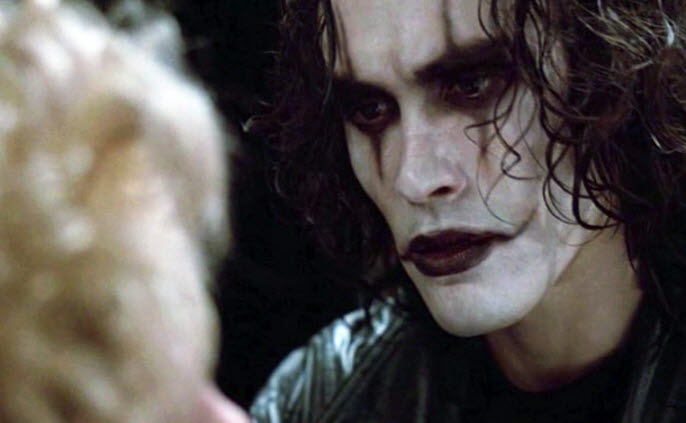
Because of Bradon Lee’s very unfortunate death on the set which occurred not long before the end of its shooting period, the movie drew a lot of attention even before it was completed. Although Proyas and his crew had to depend on stunt double and digital special effects to a considerable degree, the result still does not look that awkward on the whole, though you may sense some few gaps and holes in the overall narrative flow.
Anyway, Lee, who is incidentally the son of Bruce Lee, demonstrates here that he had enough presence and potential, and he could actually have become a solid action movie actor after this movie. He also did a good job of bringing harrowing poignancy to his character as well as the story, and his charismatic acting comes to function as the darkly pulsating heart of the story.
Just like any other stylish comic book movies, the movie depends a lot on broad but colorful archetypes for generating some humor and fun, and a number of good performers surrounding Lee ably fill their respective spots. Michael Wincott, Jon Polito, Tony Todd, Bai Ling, and Ernie Hudson are certainly dependable as expected, and Wincott, who recently delighted us in Jordan Peele’s “Nope” (2022), has some understated fun with his insidious villain character.
In conclusion, “The Crow” is one of the better comic book movies of the 1990s in addition to being one of a few highlights in Proyas’ filmmaking career. Sadly, he has never surpassed what he achieved so brilliantly in “The Crow” and “Dark City”, but both of them have endured the test of time as wonderful cult films to be savored at least. Although I think is “Dark City” is better as a great film, “The Crow” also deserves some attention, and I am glad to report to you that it becomes timeless enough instead of becoming old and dated.


 Seongyong's Private Place