
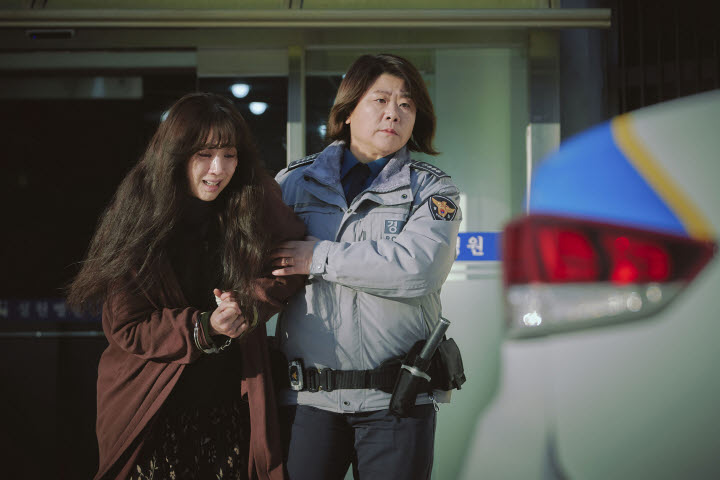
South Korean film “The Woman in the White Car” is a little female mystery thriller with chilly sensitivity to be savored. While you may easily guess what it is about right from the very beginning, the movie will gradually engage and then surprise you as slowly delving into its main characters’ emotional struggles along the story, and you will eventually find yourself alternatively chilled and touched by how it is about.
The movie, which is set in some rural mountain region in the middle of one snowy winter, opens with a sudden disturbing incident. A car quickly arrives at a local hospital, and one of the two figures inside the car hurriedly comes out and then desperately cries for help. It turns out that the other figure in the car is in the serious need of medical treatment due to a severe physical injury, and we soon see this figure quickly taken into the hospital for emergency surgery.
The two local police officers, Hyeon-joo (Lee Jung-eun) and her rookie partner Yong-jae (Lee Hwi-jong), subsequently arrive at the hospital for the following investigation, but then they are quite baffled about what exactly happened. On the surface, it seems that those two figures in question are Do-kyeong (Jung Ryeo-won) and her older sister, but then it is revealed that the injured woman brought by Do-kyeong is clearly not his older sister. After all, her older sister once worked as a nurse at the hospital, and her older sister’s former colleagues do not know at all who the hell that injured woman is.
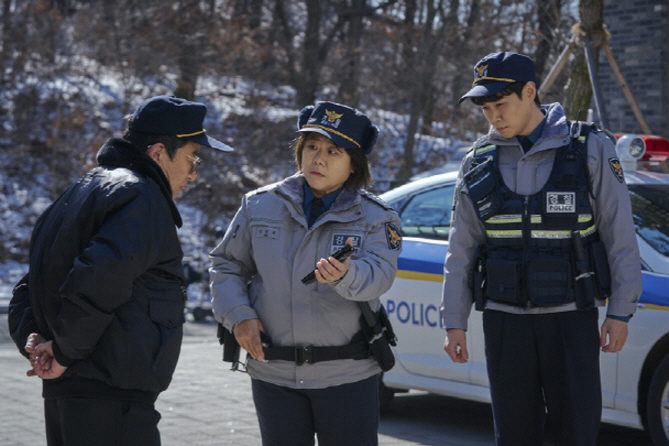
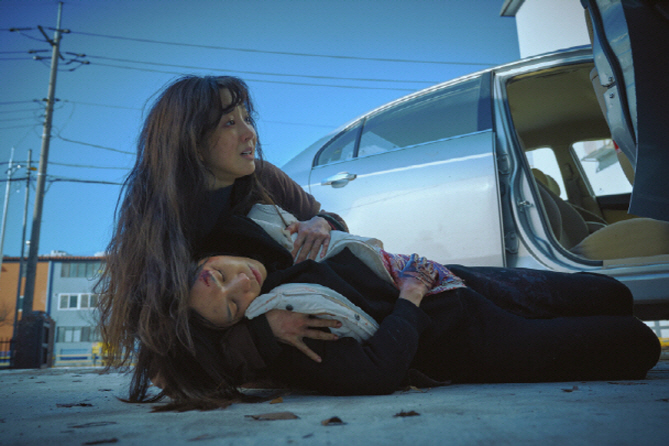
Do-kyeong claims that her “older sister” was actually stabbed by her husband, and the movie gives us a flashback scene showing how that occurred. According to Do-kyeong, her older sister’s husband was pretty nasty and abusive to say the least, and she testifies to the police officers that her older sister happened to be injured in the middle of a violent physical clash between them and that loathsome dude.
However, Hyeon-joo is skeptical about Do-kyeong’s testimony for good reasons. Although she was once a promising young novelist who was also quite successful, Do-kyeong was put under her older sister’s care due to a serious mental problem not long after losing their parents, and this certainly makes her testimony rather unreliable. In addition, her “older sister” has been unconscious after her emergency surgery while her husband is currently gone missing, so there is no one to confirm whether Do-kyeong told the truth or not.
As a woman still haunted by those painful memories of abuse in her past, Hyeon-joo instinctively senses how damaged and traumatized Do-kyeong really is. Her instant sympathy toward Do-kyeong makes Hyeon-joo all the more determined about finding what really happened to Do-kyeong, but then she only encounters more baffling questions about the case. For example, it later turns out that Do-kyeong’s real older sister was not actually living with Do-kyeong, and she was somehow disappeared not long before Do-kyeong came to the hospital along with that mysterious woman.
While she comes to sense more of how fishy her case is in many aspects, Hyeon-joo also begins to reflect more on her dark past from which she is still reeling. She was frequently abused by her alcoholic father who often exerts some toxic influence on her even at present, and there is an unnerving moment showing how she tries to calm herself in a way not so far from what her father often did to her during that time.
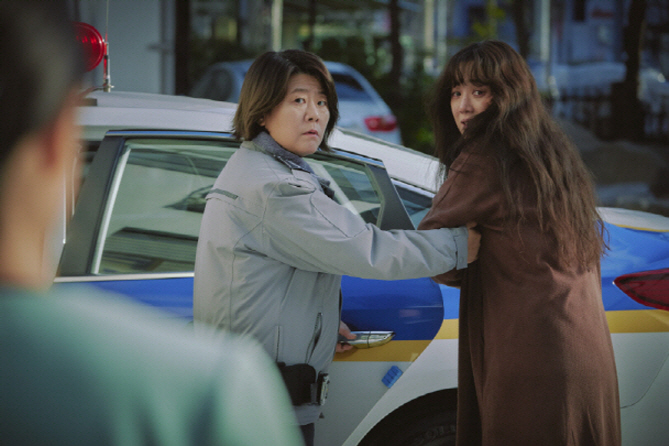
What is eventually revealed during the last act is a bit too contrived in my humble opinion, but the screenplay by Seo Ja-yeon keeps holding our attention via focusing on the subtle emotional drama unfolded between Hyeon-joo and Do-kyeong. Although she often looks rather elusive, it is apparent that Do-kyeong is struggling with whatever she is hiding behind her back, and there is a little poignant moment when she chooses to open herself a bit more to Hyeon-joo later in the story.
The movie is carried well by the solid performances from its two wonderful main cast members. While often looking as distant and baffling as required, Jung Ryeo-won skillfully handles her several key scenes in the film, and her ambiguous presence is contrasted well with the more straightforward acting of Lee Jung-eun, who has been one of the most dependable character actresses in South Korean cinema since her breakthrough supporting turn in Bong Joon-ho’s Oscar-winning film “Parasite” (2019). Even when the movie stumbles a bit with some preposterous plot turns, Jung and Lee hold it together to the end, and they are also supported well by several other main cast members including Jang Jin-hee, Kang Jun-woo, Lee Hwi-jong and Kim Jung-min.
In conclusion, “The Woman in the White Car”, which received considerable attention when it was shown at the Bucheon International Fantastic Film Festival in 2022 (Jung received the Korean Fantastic Best Actress Award, for instance) but then was belatedly released in South Korean theaters on last Wednesday, is a competent genre film, and I enjoyed how it distinguishes itself via its good mood, storytelling, and performance. Although she has been mainly directing a number of local TV drama series episodes, director Christine Ko shows here that she is a promising filmmaker with some potential, and it will be interesting to see what may come next after this commendable feature film debut of hers.


 Seongyong's Private Place