
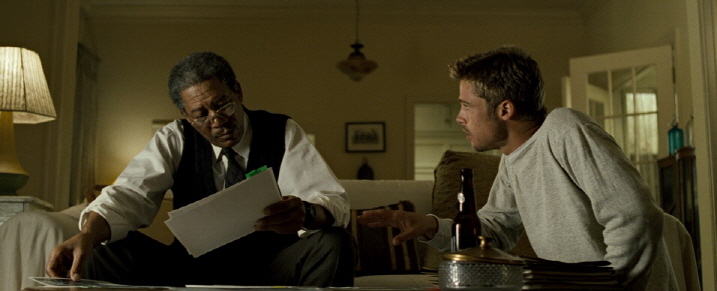
David Fincher’s 1995 film “Seven”, whose 4K remastered version is currently shown in selected theaters in South Korea, is a gruesome but undeniably compelling thriller to admire and appreciate. While it is surely as grim, unpleasant, and disturbing as your average serial killer flick can possibly be, the movie engages us with a considerable amount of style and mood first, and then it haunts our mind much more than expected with its weary human attitude to the sheer evil and nihilism presented in the story.
At first, the movie, which is set in some anonymous city, briefly establishes the nascent partnership between two very different cops: Detective Lieutenant William Somerset (Morgan Freeman) and Detective David Mills (Brad Pitt). Having been quite tired of what he has faced for many years, Somerset is planning to retire within a week, and that is why he does not welcome much being partnered with Mills, your typical rookie detective who is rather indiscreet and impulsive besides being too cocky and confident.
On the next day, these two cops are assigned to a case which baffles and shocks both of them a lot. An extremely obese dude was found dead inside his house, and it is clear that somebody forced him to eat a lot of food for hours right before his eventual death. As a seasoned investigator, Somerset instinctively senses that this is not a simple case at all, and, of course, another equally grotesque murder happens on the very next day.
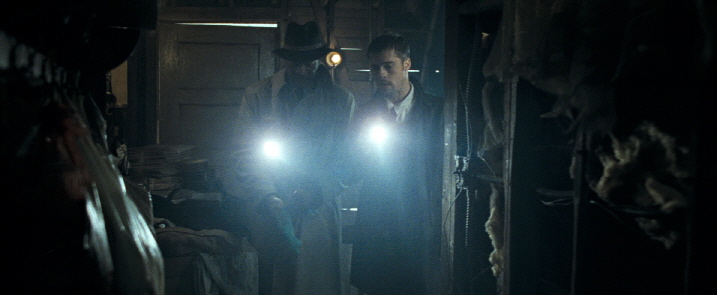
It does not take much time for Somerset to realize that these two murders are just the beginning for several next killings to happen. The killer in question is executing his murderous plan according to the Seven Deadly Sins mentioned in the Bible and several works of literature including Dante Alighieri’s “The Divine Comedy”, and Somerset and his partner come to see more of how deviously patient and methodical the killer is. In case of the third killing, it is apparent that the killer has been carefully preparing for this for at least one year, and there is some twisted sense of humor from how the killer leads the police from the second murder to the third one later in the story.
While the identity of the killer functions as sort of MacGuffin to hold our attention, the screenplay by Andrew Kevin Walker gradually develops its two main characters via several small but crucial personal moments. While we get to know more about Mills and his pretty wife Tracy (Gwyneth Paltrow in one of her early roles), we also come to learn more of how weary Somerset has been about his work and the despairing enviornment surrounding him and many others in the city. As a wise and well-experienced old man, he certainly knows a lot about how evil man can be – and how apathic and uncaring one can be as living in the city for years.
Nevertheless, though he usually sticks to his reserved appearance, Somerset is also capable of compassion and empathy, and there is a little poignant moment between him and Tracy, who later comes to him for getting some advice on a certain personal conflict behind her warm and bright appearance. He quietly listens to her, and then he tells her a bit about a certain personal choice of his in the past. Although he does not signify much on the whole, we sense some bitter feelings behind his phlegmatic attitude, and so does Tracy.
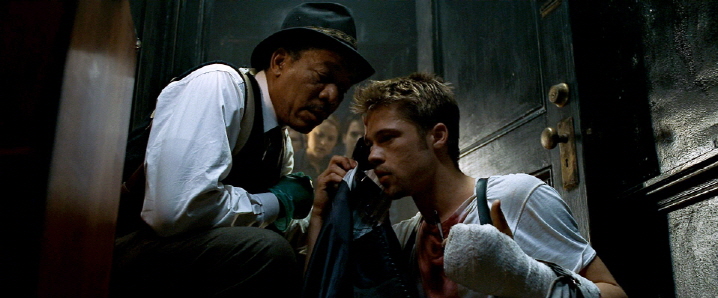
While never flinching from the gruesome details of the murders in the story, the movie constantly fills the screen with a lot of dark but palpable ambiance. Fincher and his cinematographer Darius Khondji frequently utilize the high contrast between light and shadow in many of the interior scenes in the film, and this accentuates the sense of dread and horror as Somerset and Mills delve more into their increasingly fiendish case. The city in the movie looks as rainy and moody as that futuristic city in Ridley Scott’s “Blade Runner” (1982), and we are often overwhelmed by the depravity and despair felt from the streets and alleys of the city.
In the end, the movie eventually culminates to the confrontation between our two detectives and the killer, but it takes time for arriving at its starkly nihilistic finale, and that depends a lot on what is precisely exchanged among the three main performers during this part. Morgan Freeman and Brad Pitt complement each other well besides imbuing their archetype roles with enough sense of life; Freeman is absolutely terrific as eventually becoming as the main voice of reason and morality in the story, and Pitt holds his own place fairly well even though his character is rather flat compared to Freeman’s. In case of the actor who plays the killer in the film, I will not talk a lot about him because 1) he is still a surprise for anyone watching the film for the first time and 2) he has been quite infamous for the reason many of you know well, but I can tell you instead that he is quite effective as subtly conveying to us his character’s unfathomable depravity and confident intelligence behind his understated appearance.
In conclusion, “Seven” is one of the best works in Fincher’s interesting filmmaking career. Although I do not like some of his works such as “The Curious Case of Benjamin Button” (2008), he has never made any lousy movie yet, and it is interesting to observe how he has often focused on the dark and unpleasant sides of humanity as shown from “Zodiac” (2007), “The Girl with the Dragon Tattoo” (2011), and recent Netflix drama series “Mindhunter”. I may not totally embrace “Seven”, but its grim but vivid presentation of the dark sides of the humanity remains fresh and compelling as before thanks to his skillful direction, and I am glad to revisit at a big local theater.


 Seongyong's Private Place