
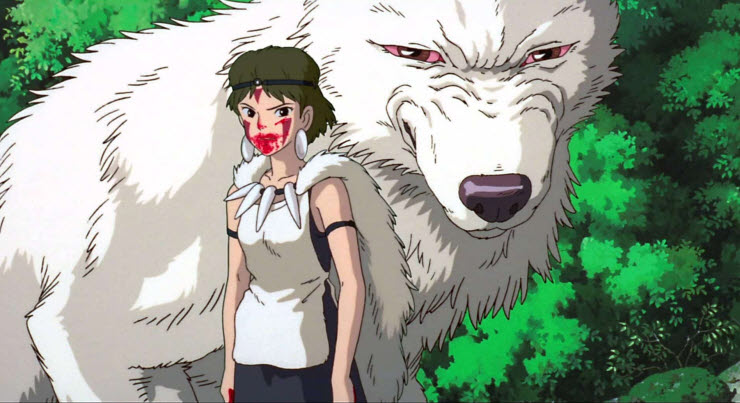
Hayao Miyazaki’s 1997 animation feature film “Princess Mononoke”, which happens to be re-released in South Korean theaters today, is an epic fantasy historical drama to behold and admire. While its story engages us as a complex drama of ideas, intrigues, and beliefs, the film is visually enchanting for its beautifully wondrous details to observe and appreciate, and it has not lost any of its immense artistic power even though almost 30 years have passed since it came out.
The story, which is set around the Muromachi-era Japan (1336 ~ 1571), begins with the stunning opening scene. A giant demonic entity suddenly appears near an isolated mountain tribe village located somewhere in the eastern region of Japan, and then it is stopped and then killed by Ashitaka at the last minute (voiced by Yōji Matsuda), a young prince of the tribe who is incidentally the sole male descendant of his royal family. Unfortunately, he gets wounded and cursed in his right arm by the destructive power of that demonic entity, and he is told that he will die soon if he does not find any possible way to remove that curse from him.
Eventually, Ashitaka leaves the village along with his faithful red elk. As looking for the origin of his curse in the western region, he is alarmed to discover that his cursed arm is pulsating with that destructive power of that demonic entity, and we get a brief but rather gory moment of action when he happens to be attacked by several soldiers at one point early in the story.

After the encounter with a silly but shady monk named Jigo (voiced by Kaoru Kobayashi), Ashitaka arrives in the region surrounding an industrial town ruled by Lady Eboshi (voiced by Yūko Tanaka), a strong-willed noblewoman who has been clashing with the mythic animal creatures of a big nearby forest for getting more iron and power for her and her people. As a matter of fact, her new weapons caused the creation of that demonic figure which cursed Ashitaka, and Ashitaka certainly feels the hate and rage inside his cursed power when he has a private meeting with Lady Eboshi later.
And he also gets to know about San (voiced by Yuriko Ishida), a mysterious young woman who is incidentally the titular figure of the story. She has been tried to protect the forest from Lady Eboshi and her people along with a trio of big wolves including the one who raised her since she was an abandoned baby girl, and Ashitaka soon finds himself in the middle of the ongoing conflict between San and Lady Eboshi.
Now this sounds like a simple conflict between good and evil, but Miyazaki’s screenplay brings some unexpected complexity to the story and characters. While she hates humans as much as her wolf family, San is also a human, and then she finds herself touched by Ashitaka’s courageous act of good will and compassion. In case of Laby Eboshi, she is not a mere antagonist at all, and she is also driven by her will and belief as much as San. In addition, she is actually a fairly good leader for her people, and some of the most poignant moments in the film come from how much her people including a bunch of lepers and ex-prostitutes appreciate her generosity as well as her leadership.
And the story becomes all the more complicated with more conflicts and intrigues circling around its main narrative. Besides battling against those mythical animal creatures including a certain elusive magical entity who is the main life force of the forest, Lady Eboshi must deal with some other lord who has coveted her iron and wealth, and she later gets allied with Jigo, who turns out to have his own sneaky plan involved with that elusive magical entity in question.

While taking its time for letting us process and understand the motives and plans of many different figures in the story, the film dazzles us with the sheer mastery of mood, style, and detail from Miyazaki and his crew. As many of you know, Miyazaki and his crew drew every shot of the film from the beginning, and the result is often strikingly impressive to say the least. Thanks to their painstaking efforts, many details in the film ranging from those wormy tentacles of those demonic figures to the ethereal appearance of that elusive magical entity look quite vivid and distinctive, and that will remind you again of why cell animation usually shows more artistic human touches than digital animation – and why that recent AI imitation program based on the works of Studio Ghibli is quite an unspeakable abomination.
In the end, the story culminates to the climax where a lot of things happen across the screen, but it stays focused on the dynamic dramas among its main figures while never overlooking what is being at stake for them, respectively. According to recent documentary film “Miyazaki: Spirit of Nature” (2024), Miyazaki struggled a lot for getting the right ending for the story even during the production, and all I can tell you is that he did a commendable job of leading the story and characters to a satisfying resolution.
Overall, “Princess Mononoke” is one of many highlights in Miyazaki’s legendary career, which gave us numerous top-notch animation films such as “My Neighbor Totoro” (1988) and “Spirited Away” (2001). When I watched it for the first time in 2003, it instantly became one of my favorite animation films, and I felt my mind recharged again as revisiting it after more than 20 years since that. This is indeed a great work, and I am glad that I and many other South Korean audiences can watch it on big screen right now.


 Seongyong's Private Place