

I wonder how I would have responded to the 1999 South Korean film “Shiri” if I had watched it 26 years ago. I did not feel any particular need to watch it mainly because I was unfortunately exposed to its main spoiler at that time, and then the movie somehow evaded me during the next 26 years. After its 4K remastered version was released briefly in local theaters early in this year and then recently went to Netflix in South Korea, I belatedly watched the movie, and it only reminded me of how much South Korean cinema has advanced since it came out.
In 1999, the movie drew a lot of attention for being one of the rare blockbuster South Korean films in the 1990s. Believe or not, it broke the local box office record of James Cameron’s “Titanic” (1997), and I still remember how much many others around me talked about the movie in that year. As a matter of fact, I even participated in a silly school play based on it (I incidentally played the chief, and, as the audiences will attest, I gave the least clumsy acting in the bunch because I instinctively knew that I had to play as straight as possible for selling my part).
However, “Shiri” sadly fails to endure the passage of time, and it is not even a good movie in my humble opinion. While it looks hopelessly dated in terms of technique aspects, the movie also suffers a lot from its mediocre plot and weak characterization, and now we can clearly see that this is more or less than a cheap imitation of many Hollywood action movies during its time.
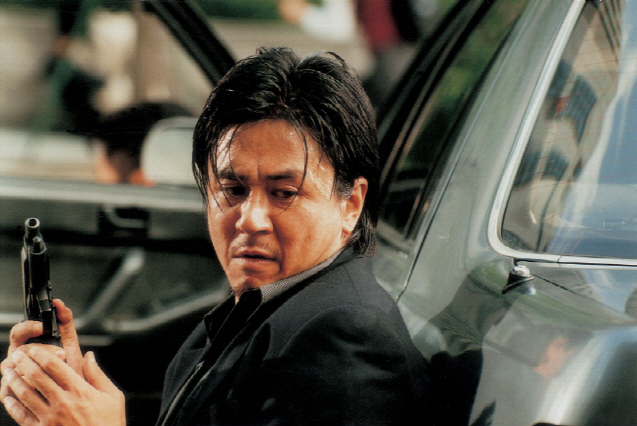
The plot is inspired by how the political situation between South and North Korea became less hostile than before around the late 1990s. While the political leaders of these two countries become quite willing to do more cooperation for the eventual peace and, possibly, the unification, there are a certain faction of the North Korean army which does not welcome this change at all, and a small group of North Korean special forces soldiers soon infiltrate into South Korea for their secret terror plan.
Fortunately, this plan happens to be detected by Yoo Joong-won (Han Suk-kyu), a South Korean secret agent who is incidentally about to marry his longtime girlfriend. Along with his close partner Lee Jang-gil (Song Kang-ho), Yoo tries to find any possible way to track down and stop their dangerous opponents, but their efforts are always thwarted by a mysterious female assassin from North Korea at the last minute, and both Yoo and Lee come to wonder more about the possibility of a mole somewhere inside their agency.
In the meantime, things become more urgent for Yoo and Lee and their agency when their opponents later steal a considerable amount of special liquid bomb which is highly explosive to say the least. In addition, the leader of these North Korean soldiers turns out to be an old foe of Yoo in the past, and that makes Yoo all the more determined to catch him and the other North Korean soldiers as soon as possible.
As the match between Yoo and his main opponent is continued, the movie gives us several action scenes, which might have looked cool at that time but feels now rather corny and dated. In case of a sequence involved with the bombing of a big building in the middle Seoul, you will clearly see that director/writer Kang Je-gyu and his crew used some cheap models for the expected moment of explosion, and you may also be a bit amused by the totally unnecessary red-colored digital timer of the bomb, which has surely been a time-honored cliché in many action thriller movies out there. The shootout sequence later in the film is apparently influenced by the similar one in Michael Mann’s “Heat” (1995) to some degree, but, though this moment is fairly competent on the whole, the movie only knows how to play the notes but not the music itself, and the same thing can be said about the eventual climax part unfolded inside a big sports stadium.
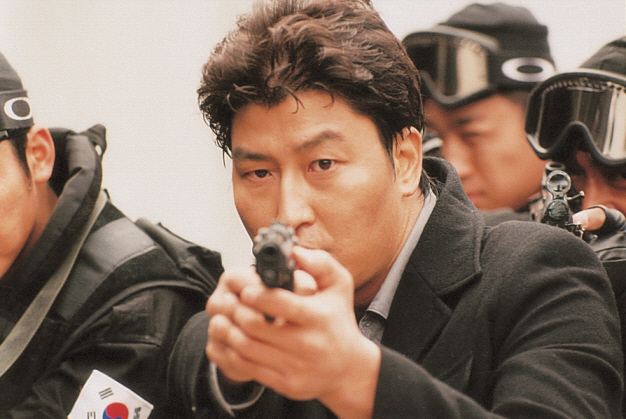
Above all, Kang’s screenplay is very clumsy to say the least. Probably because he was afraid that the audiences might not follow the plot and characters easily, his screenplay is riddled with a lot of exposition and speech from the beginning to the end, and, to make matters worse, it does not bring much inner life or personality to many of its archetype characters. While Yoo is an average clean-cut agent hero, his partner is just a bit more colorful compared to many other characters around them, who are mostly flat or wooden in one way or another. In case of a subplot involved with Yoo’s relationship with his girlfriend, it is so rote and bland that it frequently makes the story lag or stumble to our distraction, and you may also easily guess in advance about how melodramatic it will become later in the film.
Anyway, the movie was a breakthrough for the respective careers of its four principal main cast members. Although this is not exactly one of his best moments, Han Suk-kyu dutifully carries the film as required. Song Kang-ho, Choi Min-sik, and Yunjin Kim manage to fill their supporting roles to some degree, and, as many of you know, all of them moved onto better things shortly after the movie came out. While Han solidified his status as a star actor, Song soon became one of the best actors working in South Korea as appearing in many notable South Korean films including Bong Joon-ho’s “Memories of Murder” (2003) and, yes, “Parasite” (2019), and the same thing can be said about Choi, who has always been remembered for his fearless performance in Park Chan-wook’s “Oldboy” (2003). In case of Kim, her career was less stellar in comparison, but you may remember her supporting turn in American TV drama series “Lost”.
In conclusion, “Shiri” is more like a relic at present, but it did contribute to the rise of South Korean cinema during the next two decades to some degree. Thanks to its big commercial success, the South Korean movie industry became more willing to go further and take more chance during next several years, and that eventually led to numerous wonderful South Korean films besides the ones mentioned above. Yes, it is regrettably old and tacky now, but I guess we can show a bit of respect for its substantial contribution.


 Seongyong's Private Place