
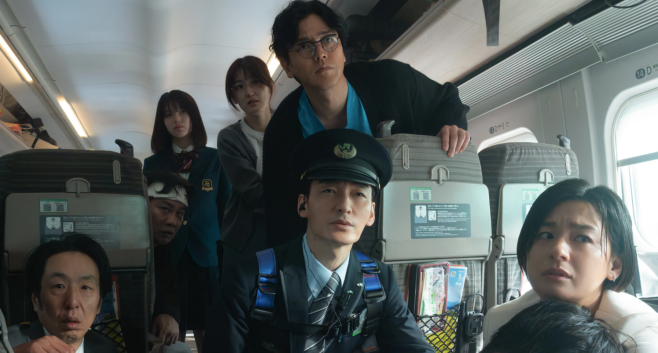
Japanese Netflix film “Bullet Train Explosion”, which was released on this Wednesday, provides enough fun and thrill along as your typical disaster film. While its course is predictably bumpy to say the least, the movie diligently and excitingly rolls its conventional story and characters from one expected moment to another, and that is more than enough to compensate for its several weak aspects.
The movie does not waste any time at all as quickly establishing its story premise. Not long after a Shinkansen, which is also colloquially known as Bullet Train in English, bound from Shin-Aomori to Tokyo departs, somebody calls the train company in Tokyo. It turns out that there is at least one bomb on that train, and the bomb will be exploded if the train is slowed down under 100 km per hour. Once it becomes quite evident that the train is indeed in serious danger, everyone at the control center quickly responds to this emergency, and they are soon joined by several other figures including a detective assigned to the case and a haughty government official.
Now you may be reminded of “Speed” (1994) and some other similar action thriller films, but the movie is actually a sequel to the 1975 film “The Bullet Train”. Although I have not seen that movie yet, the movie thankfully shows several clips from that movie as the detective and his men compares their ongoing case to what happened in that movie, and you may be amused a bit as observing how that movie looks rather dated compared to its slick junior.
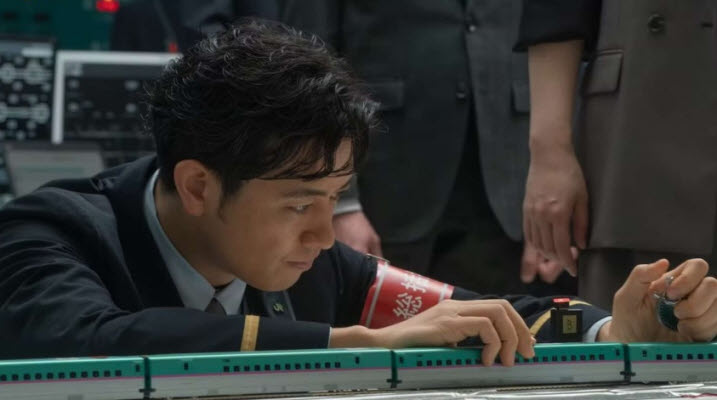
Anyway, the figure who planted the bomb on the train later demands the ransom, but the demand baffles the people at the control center a lot. While the ransom is no less than one hundred billion yen, it should be collected from the individual donation from every person in Japan, and that certainly feels preposterous, considering that there is not much time for the train and its passengers from the beginning.
For buying more time, the people at the control center, led by its confident general manager, clear the course for the train, and its driver slows down the train as much as possible, but, of course, there comes one obstacle after another for generating more suspense along the story. There is a nail-biting scene where the train must change its track while maintaining its high speed as before, and everyone at the control center naturally becomes quite nervous as bracing for what may happen in the worst case.
In the meantime, the movie also focuses on what is happening inside the train. Its unflappably dedicated train manager tries as much as possible for preventing any unnecessary incident of panic among his passengers, but, of course, it turns out to be quite difficult for him to get more than 300 passengers under control, and the passengers get more anxious as the time keeps running out for them minute by minute.
And we get to know a bit more about some of the passengers as expected. They are 1) a prominent politician who wants to leave behind her recent scandal as soon as possible; 2) a popular online influencer who becomes quite active for gathering the ransom money from all the people in Japan as quickly as possible; 3) a rather suspicious dude who does not want to be recognized by others; and 4) a quiet and introverted high school girl who got on the train along with her teacher and a bunch of schoolmates.
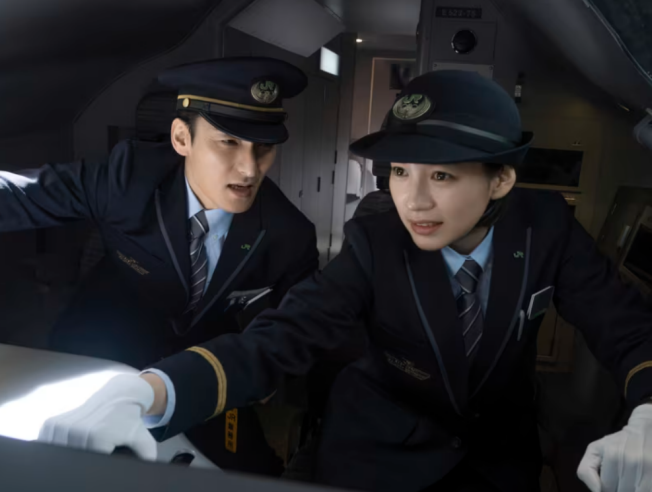
Occasionally giving some attention to these and several other characters in the story, the movie keeps rolling during its first half, which eventually culminates to a very risky rescue attempt which surely demands a lot of precision from everyone participating in that. I will not go into details here for not spoiling your fun, but I can tell you instead that director Shinji Higuchi and his crew members including cinematographers Yusuke Ichitsubo and Keizō Suzuki did a good job of making this moment look as vivid and realistic as possible. As a result, we are more engaged in what is happening across the screen, and that leads to more excitement and suspense for us.
However, I must point out that the second half of the movie is relatively less gripping than the first half. After the identity of the bomber is finally revealed (You can easily guess that in advance, by the way), the movie slows down itself to some degree for some extra melodrama, and that is where my level of interest began to decrease. The mood becomes tense again as required when several main characters are thrown into an impossible circumstance, but that is not compelling enough mainly because its main characters are mostly broad archetypes without much human depth. Fortunately, the movie eventually regains its speed along with the train later, and the following climactic sequence will certainly not disappoint you.
In conclusion, “Bullet Train Explosion” is not entirely without flaws, but it is still one of the more entertaining products from Netflix during this year. I would like it more if its second half were shorter and tighter, but its overall result is fairly good enough for recommendation, and, above all, it touches my soft spot a bit. Yes, I love fun train movies such as, say, “Train to Busan” (2016), and I must admit that, despite some distracting bumps on its course, the movie is a little better ride than I expected.


 Seongyong's Private Place