
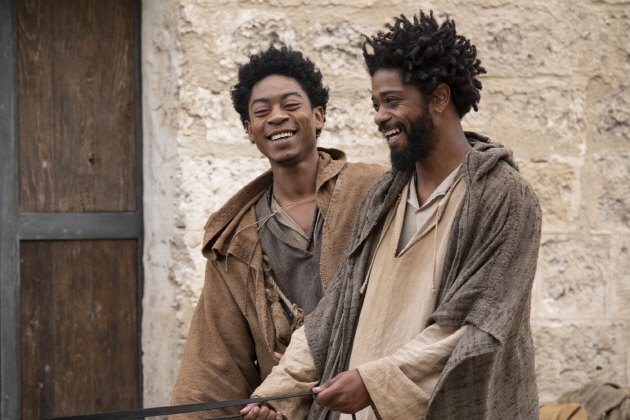
Jeymes Samuel’s latest film “The Book of Clarence”, which is currently available on Netflix in South Korea, is a middling biblical satire disappointing us in more than one aspect. While its story setup and premise are fairly amusing on the surface, the movie is unfortunately too shallow and deficient to work as a satire or a drama, and it is pretty much like a one-joke comedy feeling too long after quickly running out of its comic momentum.
Set in Jerusalem in AD 33, the story is about a young small-time Jewish hustler named Clarence (LaKeith Stanfield). He and his friend Elijah (RJ Cyler) are currently in a big trouble due to owing a lot of money to a local gangster boss, and they must find any possible way to pay their debt within 30 days for not getting killed by their ruthless creditor.
After several attempts and failures, Clarence comes upon a seemingly good idea. Watching how a certain well-known figure and his 12 apostles including his own twin brother exert considerable influence on the people of Jerusalem, Clarence decides to be another apostle of his, and we get a little amusing moment when he approaches to those 12 apostles for proving himself. After seeing that they do not regard him that seriously, he chooses to do his own religion business instead, and Elijah willingly joins his business scheme along with Barabbas (Omar Sy), a hulking gladiator Clarence managed to liberate at one point.
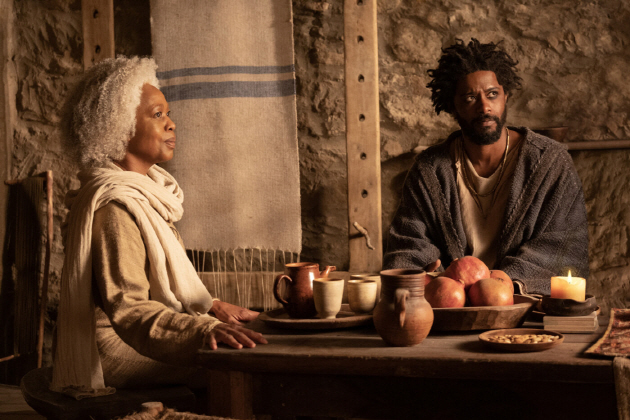
Clarence’s first attempts of speaking out in front of the crowd are not exactly successful to say the least, but, what do you know, he soon gets to learn more of how to engage and motivate the crowd more. As a result, besides quickly getting a lot of money within a short time, he finds himself as widely regarded as another possible Messiah in the town, and those 12 apostles are certainly not amused to say the least.
Of course, things soon become all the more serious as Clarence comes to draw more attention from those Roman soldiers and rulers, who are already ordered to eliminate any possible Messiah in Jerusalem. In addition, as observing his growing power and influence on those people believing in him, Clarence naturally feels conflicted about his religion business, and that ironically makes him quite serious about faith and religion later in the story.
However, the screenplay by Samuel, who also serves as the composer of his movie, does not provide much wit or substance to the story. Yes, it is sort of refreshing to see a biblical film filled with black cast members, but the movie does not go that far from this interesting setup, and we only get a small laugh from the unexpected cameo appearance from a certain prominent white British actor, who incidentally looks quite unrecognizable under his heavy makeup at first.
Above all, the movie often seems confused about how to present and regard its hero. On one hand, it just wants to laugh for a number of absurd moments around him, but it does not reach to the level of sheer absurdity and hilarity in “Monty Python’s Life of Brian” (1979). On the other hand, it also wants to be quite serious about its hero’s growing inner conflict along the story, but his bumpy quest for recognition and redemption is frequently marred by plot contrivance and superficial characterization.
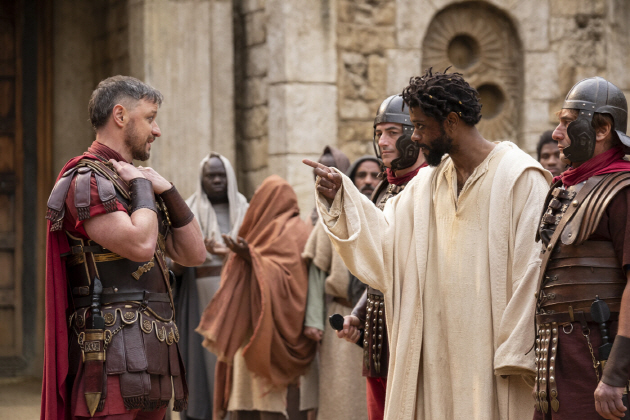
LaKeith Stanfield, a wonderful actor who has steadily advanced during last 10 years since his breakout supporting turn in “Short Term 12” (2013), surely tries as much as possible, but his dual performance in here in this film surprisingly lacks spirit and interest compared to his recent better works including that Oscar-nominated performance in “Judas and the Black Messiah” (2021). Although he is effective to some degree as having some goofy fun early in the film, he is somehow not that convincing in Clarence’s spiritual transformation later in the story, and, above all, his two characters somehow do not click that well with each other during several scenes of theirs in the movie.
Furthermore, the movie also criminally wastes the talent of its various cast members. While RJ Cyler, Omar Sy, Micheal Ward, Babs Olusanmokun, David Oyelowo are hopelessly stuck in their thankless supporting parts, Alfre Woodard, Teyana Taylor, Anna Diop, and Marianne Jean-Baptiste manage to come and go with their dignity remaining intact, and James McAvoy gladly chews every comic moment of his while looking totally serious as Pontius Pilate. As a matter of fact, considering how effortlessly McAvoy can be both funny and loony, it is really a shame that the movie does not give him something as hilarious as that outrageously uproarious scene with Michael Palin as Pilate in “Monty Python’s Life of Brian”.
In conclusion, “The Book of Clarence” is two or three steps down from the considerable potential Samuel demonstrated in his previous film “The Harder They Fall” (2021). Although I did not like that film enough for recommendation, I admired its bold variation on many familiar genre elements, and that is the main reason why it is really disappointing to observe numerous failures in “The Book of Clarence” As reflected by its boldly anachronistic soundtrack, it certainly wants to do something really different, but it does not work well enough to hold our interest in addition to not surpassing anything in “Monty Python’s Life of Brian” at all, and I think you should watch that classic biblical comedy film instead – especially if you really want to be tickled a lot while also having some stuffs to reflect on.


 Seongyong's Private Place