
Steven Soderbergh’s new film “Black Bag” is a slick and efficient genre piece to be savored for many good reasons. Although it may feel a bit too murky for you as you try to discern its rather twisty plot, the movie effortlessly bounces from one narrative point to another without any misstep, and the result is another small gem to be added to Soderbergh’s long and illustrious career.
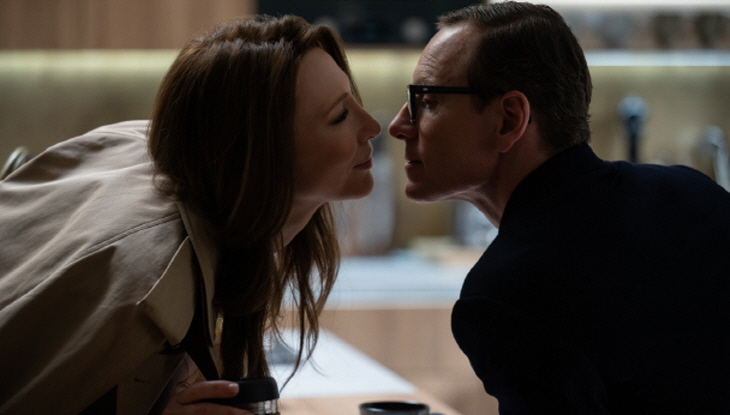
The story opens with its spy hero receiving an important tip from one of his colleagues. George Woodhouse (Michael Fassbender) is a British intelligence agent, and his agency has been in a big trouble because somebody in the agency stole and then leaked something quite dangerous from the agency. It seems that there are five suspects, and Woodhouse is not so amused when he comes to learn that his wife Kathryn (Cate Blanchett), who incidentally also works in the agency, is one of these suspects.
Anyway, along with his wife, George subsequently invites the other four suspects to a little private dinner to be held at his house. They are 1) Freddie Smalls (Tom Burke), a close friend/colleague of George who has some messy private issues behind his back; 2) Clarissa Dubose (Marisa Abela), a young junior agent who has recently had an affair with Freddie; 3) Colonel James Stokes (Regé-Jean Page), a dashing and ambitious dude recently promoted to a rather unspecified position which seems very important nonetheless; and 4) Dr. Zoe Vaughan (Naomie Harris), a psychiatrist monitoring the mental status of many agents inside the agency.
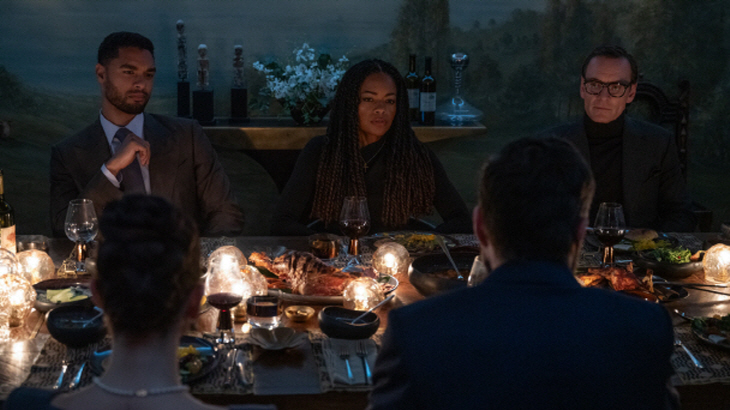
Not so surprisingly, these four people already know George’s hidden motive behind his dinner invitation, and both George and Kathryn also know this too well. As a consequence, the mood gradually becomes tense as everyone gathers at the dinner table, and then Michael makes his intention quite clear to the others around him.
However, in contrast to those four other suspects, Kathryn does not look particularly nervous about whatever her husband is planning to do, because she and George have steadily maintained their married life via being quite honest to each other about who they are despite also being often elusive about whatever they respectively do outside. They supposedly trust and love each other on the surface, but they also do not ask or tell each other too much even inside their little domestic environment. According to George, that is the main reason how he and his wife have so successfully balanced themselves between work and marriage for many years.
In the end, this increasingly uncomfortable dinnertime eventually culminates to a striking act to be committed by one of these six persons at the table, and the movie follows how George embarks on his little secret investigation after shaking up the tree via his rather disastrous dinner party. As he delves more into the case, every suspect on the list seems more untrustworthy, but then he finds himself focusing more on whatever his wife is doing behind her back. As usual, he does not ask too much, and neither does she, but she looks more like a prime suspect as he continues his investigation.
Playfully toying with this possible crisis in the professional/private relationship between Geroge and Kathryn, the screenplay by David Koepp, who previously collaborated with Soderbergh in “Kimi” (2022) and “Presence” (2024), deftly doles out a number of small and big plot turns along the story, and Soderbergh, who also served as the unofficial editor and cinematographer under pseudonyms again, ably rolls the story and characters via his own distinctive filmmaking touches. His cinematography feels dry but slick as providing enough atmosphere and suspense to the screen, and this solid visual result is further enhanced by not only his judicious editing but also the effective score by his usual collaborator David Holmes.
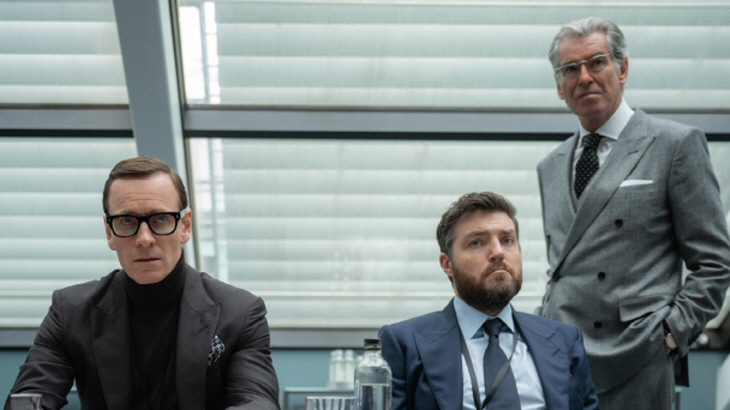
Above all, Soderbergh draws enjoyable performances from his main cast members. As the center of the film, Michael Fassbender and Cate Blanchett always click well with each other as much as, say, William Powell and Myrna Loy in W.S. Dyke’s classic comedy mystery film “The Thin Man” (1934), and their effortless chemistry on the screen is the constant source of tension and humor throughout the film. Fassbender, who has been always good at playing cold and detached characters as recently shown from David Fincher’s recent Netflix film “The Killer” (2023), steadily and stoically carries the ground as required, and his unflappable appearance is complemented well by the frequently wily attitude of Blanchett, who surely has a ball with her character’s many elusive aspects.
Around Fassbender and Blanchett, several other main cast members hold each own place well as having each own moment to shine along the story. While Tom Burke, Naomie Harris, and Regé-Jean Page are dependable as usual in each own way, Marisa Abela also deserves some praise as another crucial supporting character in the story, and Pierce Brosnan has a brief but juicy fun as the suave head of the agency.
In conclusion, “Black Bag” is one of the better works from Soderbergh, and I admire more of how consistently productive he has been during last several years since he announced his retirement and then changed his mind not long after that. Around the time of his retirement announcement, he did not seem to feel no particular need for achieving more, but then he has impressed us more and more since that, and I am sure that he will continue to do that for another decade at least. In short, this is one of more interesting films of this year, and you certainly should check it out if you have admired many of his good works as I have.


 Seongyong's Private Place
Pingback: 10 movies of 2025 – and more: Part 2 | Seongyong's Private Place