
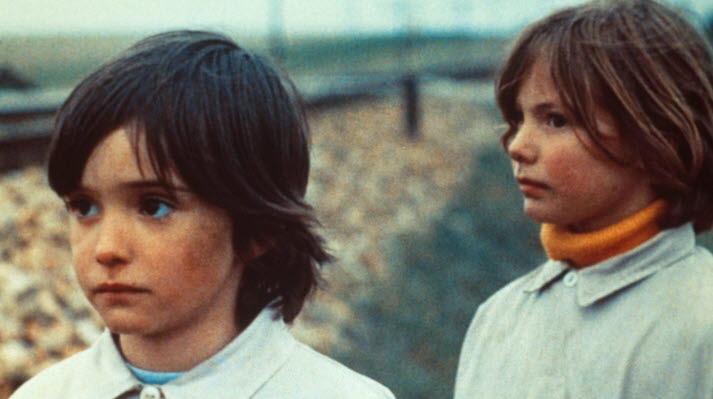
Víctor Erice’s 1973 film “The Spirit of the Beehive”, which is currently being shown in South Korean theaters after his recent comeback work “Close Your Eyes” (2023) came in last year, has delicately sublime qualities to be admired and appreciated. Masterfully balancing itself between the simplicity of childhood fantasy and the ambiguity of allegorical drama, the movie has a series of mesmerizing moments to intrigue or enchant you, which will linger on your mind for a long time after it is over.
The main background of the movie is a small, isolated village located in the middle of the Castilian plateau of Spain during its post-Civil War period. At the beginning of the story, the whole town is getting quite excited by the upcoming screening of classic American horror film “Frankenstein” (1931) by a mobile cinema, and we soon see many adult and child audiences watching that film at their little town hall.
One of the audiences is a 6-year-old girl named Ana (Ana Torrent), who comes along with her older sister Isabel (Isabel Tellería). She is quite baffled when the movie, which is incidentally the censored version, does not show why and how the Monster kills that unfortunate little girl. She immediately asks Isabel, who later “explains” to her younger sister that 1) the monster actually does not kill that little girl (“Everything in the movies is fake.”) and 2) he is actually alive somewhere out there as a spirit.
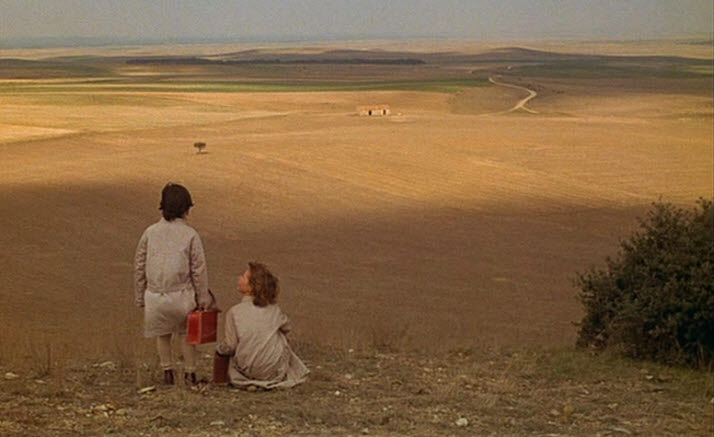
Like any young innocent girl around her age, Ana believes her older sister’s harmless lie without any doubt, and we observe how this little white lie leads to Ana’s own little fantasy. After their school time is over on the very next day, they go to an abandoned barn located in the middle of the plateau outside the village, and Isabel elaborates a bit more on her lie. As a result, Ana comes to believe more in the spiritual presence of the Monster around that abandoned barn.
Meanwhile, we gradually sense a faint sense of uneasiness in their family house while noticing how distant their parents often look to each other. Their middle-aged father is mostly occupied with his beekeeping work unless he writes about honeybees inside his library. In case of their mother, she frequently writes letters to somebody, but the movie does not give much detail on the receiver of these letters, except that the receiver is probably someone to whom she was quite close before the Civil War.
These two adult figures’ frequent silence throughout the film has been interpreted as the indirect reflection of how things were grim and oppressive for many people in Spain after the end of the Civil War, which was the beginning of Francisco Franco’s dictatorship which lasted more than 30 years. As a matter of fact, the movie was made not long before the end of that gloomy period, but it was actually allowed to be released in Spain just because, besides the critical success outside Spain, those local censors thought the movie would be too “arty” to draw the public attention.
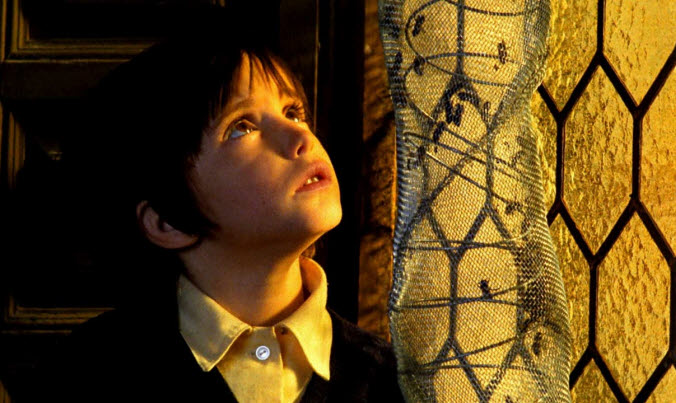
Yes, it is certainly slow and opaque as your average arthouse movie, but the movie decorates its ambiguous allegory with indelible mood and details to intrigue and then engage us more. Although he was losing his eyesight due to his terminal illness during that time, cinematographer Luis Cuadrado vividly captures the earthy beauty of the Castilian plateau on the screen, and he also imbues considerable poetic qualities to many of interior scenes inside the girls’ house. These interior scenes are visually striking as shrouded in warm and bright yellow lighting, whose honey-like hue is clearly connected with those beehives taken care of by the girls’ father.

Some of you may wonder whether the mechanical aspects of the daily life inside beehives, which is mentioned via the father’s writing more than once in the film, is a symbolic metaphor of the Spanish society oppressed under the Franco regime. Again, the movie does not specify anything at all, and it continues to stick to its restrained attitude – even when its young heroine encounters a mysterious figure who fuels her imagination more. The situation subsequently becomes a bit tense when her little fantasy inevitably clashes with the reality of the adult figures around her, and everything in the story culminates to an eerily poignant moment, not long after she inadvertently causes a big trouble for others.
Ana Torrent, who has been steadily active during last 50 years since her acting debut here in this film (It is certainly nice to see her again in “Close Your Eyes”, by the way), is simply astonishing in what can be regarded as one of the best child performances in the movie history. Often direct and expressive in her unadorned acting, she effortlessly conveys her character’s silent emotional journey along the story, and she also clicks well with her co-star Isabel Tellería, who also has a few memorable moments of hers around Torrent.
On the whole, “The Spirit of the Beehive”, which has been regarded as one of the greatest Spanish films during the late 20th century, is superlative even when it is simply viewed as a childhood fantasy tale. It is quite a shame that Erice only made three feature films since “The Spirit of the Beehive”, but “Close Your Eyes” demonstrated that he has not lost any of his talent yet, and it is really fortunate for me and other South Korean audiences to get a chance to see both of these two masterworks in movie theater.


 Seongyong's Private Place
I saw it in Seoul last week, just 50 years after seeing it on its UK release in 1974. In between, I’ve seen it a few more times, most recently at the Jeonju Festival a few years ago. One comment that stuck in my mind was by the critic Dilys Powell, who noted how quiet it was, and (silent films apart) it must be among the quietest films ever made. Up until Close Your Eyes, I’d only seem Anna Torent in two more films, Carlos Saura’s Cria Cuervos and The Other Boleyn Girl, where she played a dignified Catherine of Aragon. I’d like to have seen more of her. A friend’s daughter has just invited me to see it together next week, and I think I’ll take her up.
SC: I am considering watching it again…