
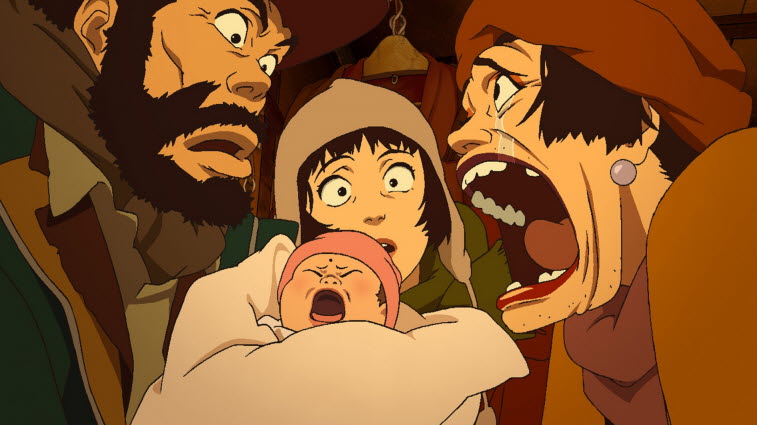
It did not take much time for me to get engaged and then entertained more in Satoshi Kon’s animation feature film “Tokyo Godfathers”, which is still a charmingly quirky holiday genre mix even after more than 20 years. Mainly revolving around the three differently colorful homeless figures, the film freely and cheerfully swings back and forth between comedy and melodrama, and the result is alternatively funny and poignant from the beginning to the end.
As reflected by the very title of the movie, the story premise is clearly influenced by John Ford’s classic western film “3 Godfathers” (1948). On one cold Christmas Day in Tokyo, the three different homeless figures, who have lived together as a sort of alternative family in their little makeshift place, come upon an abandoned baby while rummaging a pile of trash. They decide to take care of this little baby for themselves for a while, but they eventually try to search for whoever abandoned the baby, though this task turns out to be more difficult than expected despite several discovered items which may lead them to the mother of the baby.
As these three main figures go through their little bumpy journey along with the baby, the screenplay by Kon and his co-writer Keiko Nobumoto deftly balances itself between comedy and melodrama. While the unpleasant odor of its three homeless characters often functions as a sort or running gag, the story gradually brings some depth and pathos to each of them as they come to reveal more of their past and humanity, and we come to care about them as well as the baby, who fortunately does not seem to be aware that much of what is going on even in the end.
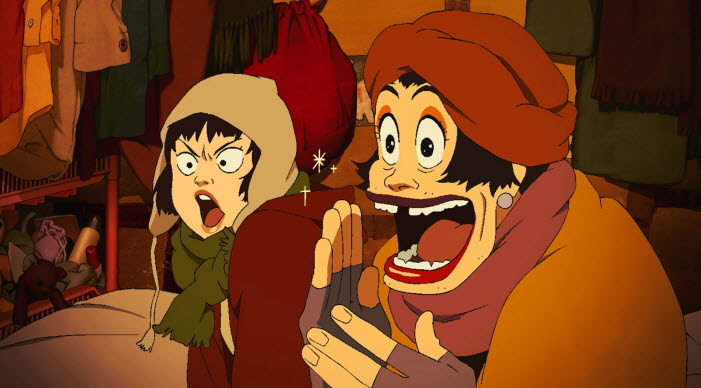
Of these three homeless characters, Hana (voiced by Yoshiaki Umegaki) is certainly the most memorable as your average aging gay drag queen. While she surely cannot help but neurotic and self-pitying at times, she is also a proud lady not ashamed at all of who she is, and there is an uproarious flashback scene where she becomes very, very, very angry due to a certain rude dude at a drag queen bar where she once worked.
In case of Gin (voiced by Tooru Emori), this gruff middle-aged guy turns out to have a shameful past he is still not totally honest about even in front of the two people who have been pretty much like a family to him for years. As taking care of the baby, he is reminded more of what a crummy man he was to both of his wife and daughter, and his anger and guilt are more intensified when he and his two fellow homeless figures happen to encounter someone responsible for his downfall in the past at one point early in the story.
As the third member of the group, Miyuki (voiced by Aya Okamoto) does not tell much about her background, but this young woman also has been running away from a painful past as shown from the brief but violent flashback scene involved with her father. During one scene where she happens to receive the unexpected kindness of a stranger, she comes to miss her home more than ever, but it looks like there is no possible way of going back for her to her bitter sadness.
While never overlooking the respective sadness and despair of its three main characters, the film, which was incidentally introduced to South Korean audiences as “The Chance of Encountering a Miracle on Christmas”, is often filled with a cold but lovely holiday atmosphere while occasionally throwing unbelievable moments of luck and coincidence along the story. There are actually more than one chance encounters in the story, and there is a particularly poignant moment when Gin makes some peace with the past via one of these chance encounters.

In case of the mystery surrounding the baby, the film keeps us more intrigued as our three homeless figures get to know more about a certain person who abandoned the baby. This person in question later turns out to be quite unhappy and desperate just like our three homeless figures, and that eventually leads to a wild chase sequence which culminates to what can be regarded as a Christmas season miracle.
The film was the third animation feature films of Kon, who made a feature film debut with “Perfect Blue” (1997) and then made “Millennium Actress” (2001). Although I merely admire “Millennium Actress” because I still think it is no more than an exercise in style, that animation film and “Perfect Blue” successfully established Gon as another prominent Japanese animation film director to come after Hayao Miyazaki and Isao Takahata, and he could have been known more to us just like Makoto Shinkai or Mamoru Hosoda, if he had not died too early not long after his fourth animation feature film “Paprika” (2006).
In conclusion, “Tokyo Godfathers”, whose recent 4k remastered version happens to be released in selected South Korean theaters on this Wednesday, is still a lovely piece of work to be admired and appreciated for its mood, style, and storytelling, and I must tell you that its deft and stylish mix of 2D and 3D animation feels much more vivid and striking than whatever I saw from many of recent Hollywood blockbuster animation films. While digital animation surely has its own advantages, they still cannot surpass cell animation much in my inconsequential opinion, and you will see that I am right, once you watch “Tokyo Godfathers”.


 Seongyong's Private Place